
Cost of Long Term Care by State Calculator

Jason Stolz CLTC, CRPC
The cost of long term care by state varies dramatically across the country, and understanding those differences is one of the most important steps in retirement risk planning. Nursing home care, assisted living, and extended facility care can cost anywhere from moderate five-figure amounts annually in lower-cost regions to well into six figures per year in higher-cost states. Those numbers are not static — they rise over time, often faster than general inflation. That means a care event 15 or 20 years from now may look very different from today’s pricing. This page is designed to help you estimate current facility care costs by state and understand how those expenses could impact your retirement income plan, asset preservation strategy, and legacy goals.
Many retirees are surprised to learn that Medicare does not pay for long-term custodial nursing home care beyond limited short-term rehabilitation under specific medical conditions. Health insurance generally does not cover ongoing assistance with daily living activities. Medicaid may provide coverage once assets are spent down to qualifying levels, but that can require significant depletion of savings. For households that have spent decades building retirement accounts, investment portfolios, real estate equity, and guaranteed income streams, the possibility of extended care expenses creates a serious financial exposure. This is why long term care planning is often coordinated alongside fixed annuity income strategies, annuity income calculations, and Social Security optimization. Long term care is not a standalone issue — it interacts directly with your retirement cash flow.
State-by-state variation in long term care costs is significant. For example, private room nursing home care in certain Northeastern or West Coast states may exceed double the cost of comparable care in parts of the Midwest or South. Assisted living facilities show similar geographic spread. Even within a single state, urban metro areas may carry materially higher monthly costs than rural regions. When planning for potential extended care needs, you must evaluate local pricing, projected duration of care, and inflation growth assumptions. Underestimating even one of those factors can lead to shortfalls that strain savings and disrupt carefully structured retirement income plans.
Use the Long Term Care Cost by State Calculator
Estimate nursing home and facility care costs in your state and see how expenses compare nationwide. This tool provides a practical starting point for retirement planning discussions.
Once you have reviewed your state’s estimated facility care cost, the next step is understanding duration risk. The average stay in a nursing facility varies, but averages do not tell the full story. Some individuals may require only months of care following a health event, while others may require multiple years due to chronic illness, mobility limitations, or cognitive impairment. A multi-year stay at six figures annually can rapidly deplete retirement accounts that were originally designed to produce steady income through systematic withdrawals or annuitized income streams. If your retirement plan includes structured payouts — such as those described in our current fixed annuity rate overview — the erosion of principal can permanently reduce lifetime income sustainability.
Inflation magnifies this exposure. Long term care inflation historically outpaces general consumer price inflation because it is driven by labor costs, regulatory requirements, healthcare staffing, and facility overhead. A nursing home room costing $110,000 per year today could cost substantially more 15 years from now. Retirement plans that do not account for this growth risk may unintentionally underestimate future liabilities. This is why some long term care insurance policies include inflation riders designed to increase benefit pools over time. Coordinating those features with broader income modeling ensures realistic projections.
Self-funding long term care is an option for some households with substantial liquid assets and strong guaranteed income floors. However, self-funding still requires analysis. Drawing large sums from retirement accounts during market downturns can accelerate sequence-of-returns risk. Liquidating appreciated assets may trigger tax consequences. Using home equity may disrupt estate intentions. When evaluating whether to self-insure or transfer risk to an insurer, many clients also review broader protection planning such as life insurance strategies or work with an independent insurance broker to compare multiple carriers and policy designs. The objective is not simply to buy insurance — it is to design a coordinated protection strategy.
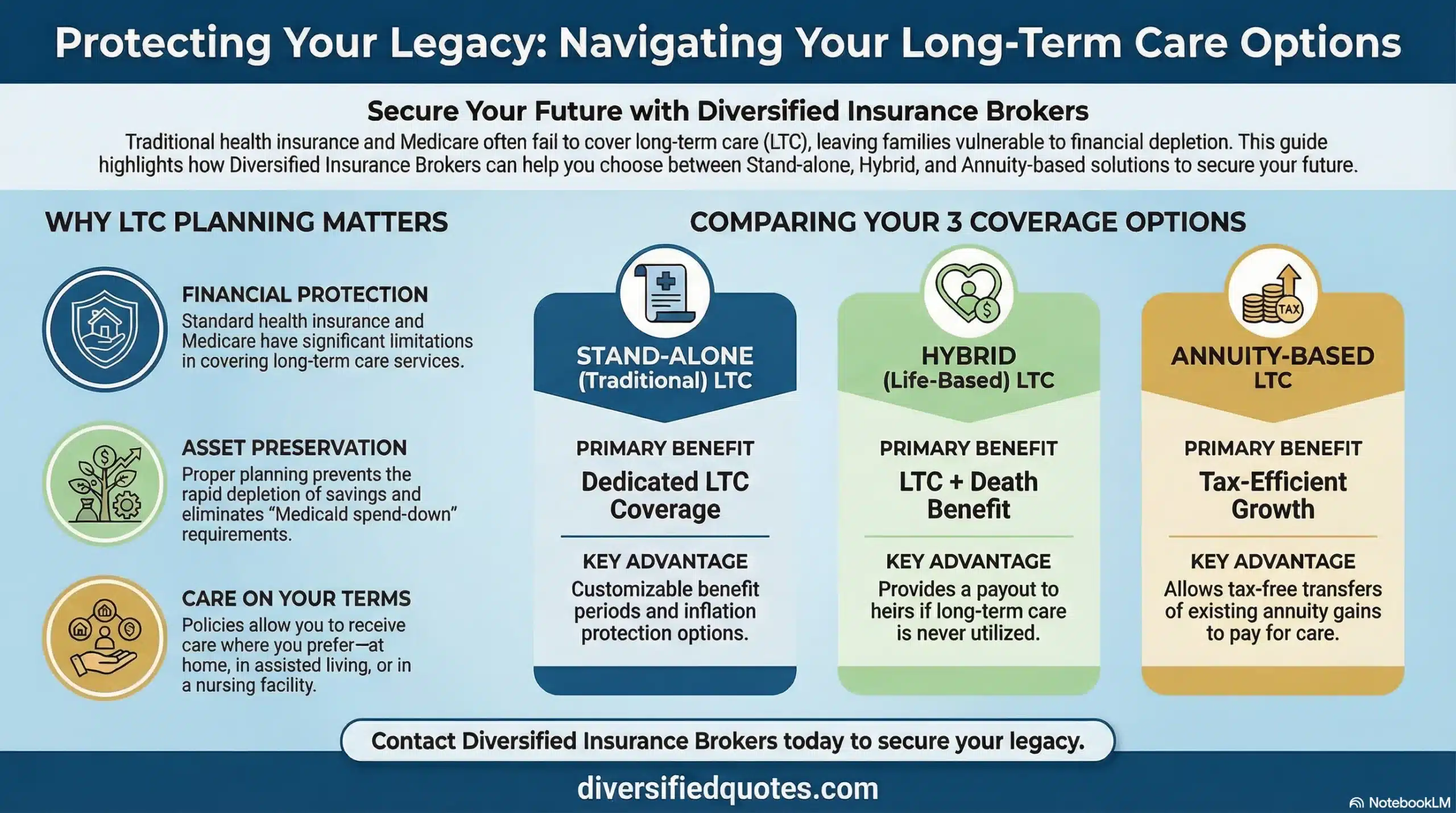
Traditional long term care insurance policies are structured around a defined daily or monthly benefit, a benefit period, and an elimination period. Hybrid or asset-based policies may combine life insurance or annuity components with long term care riders. The correct structure depends on age, health, asset levels, and personal preferences. Some individuals prefer pure cost-efficiency; others prefer knowing that if care is never needed, a death benefit will pass to heirs. Understanding state-level cost estimates allows you to select benefit amounts aligned with realistic facility pricing rather than arbitrary figures.
Couples face additional planning considerations. Shared-care riders may allow spouses to access unused benefits from one another’s policy. Planning must also account for the financial strain of one spouse requiring care while the other remains at home. Household income may drop if pension options were structured as single-life rather than joint-life payouts. Social Security timing decisions — discussed in our retirement benefits guide — may also influence available income during care periods. Every moving part interacts.
Estate preservation is another dimension. Without planning, extended care expenses can reduce inheritances or charitable intentions. For families who value legacy planning, transferring some risk through insurance can protect accumulated wealth. For others, a blended approach using moderate insurance coverage plus earmarked investment reserves may be appropriate. There is no universal answer — only individualized modeling.
Using the cost calculator above provides a concrete starting point. It moves the discussion from abstract risk to tangible numbers specific to your state. Once you see the projected annual cost of nursing home or assisted living care in your region, you can evaluate how those figures align with your retirement income, assets, and long-term goals. This clarity supports informed decisions rather than reactive choices made during health crises.
Review Your Long Term Care Plan
After reviewing state-specific costs, schedule a personalized evaluation of traditional and hybrid long term care insurance options tailored to your retirement income strategy.
Planning for long term care is ultimately about control. When costs are unknown, fear drives decisions. When costs are quantified and integrated into a broader financial strategy, you regain control. Whether you ultimately decide to self-fund, partially insure, or fully insure against extended care risk, the key is acting proactively while options are widest and underwriting approval is most likely. Reviewing state-specific facility care costs today gives you a measurable foundation for that decision.
Related Pages
Financial Protection Essentials
High-risk life insurance solutions, disability income education, and international travel protection strategies for financial security.
Talk With an Advisor Today
Choose how you’d like to connect—call or message us, then book a time that works for you.
Schedule here:
calendly.com/jason-dibcompanies/diversified-quotes
Licensed in all 50 states • Fiduciary, family-owned since 1980
Cost of Long Term Care by State – FAQ
Nursing home costs vary by state and facility type, but private rooms commonly exceed $8,000 to $12,000 per month in many states. Higher-cost regions may exceed $15,000 monthly. Use our Long Term Care Cost Calculator to estimate current pricing in your state and compare it to your retirement income plan.
Medicare only covers short-term skilled nursing care following a qualifying hospital stay. It does not pay for ongoing custodial long term care. That is why many retirees explore planning options such as life insurance strategies or long term care insurance to protect retirement assets.
Costs differ based on labor expenses, state regulations, facility demand, and regional cost of living. Urban areas often have higher facility pricing than rural regions. Reviewing state-specific data helps ensure your retirement income modeling — including tools like annuity income calculations — reflects realistic care expenses.
Length of stay varies widely. Some individuals require only months of rehabilitation, while others may need multiple years of extended care. Because duration risk is unpredictable, many households coordinate cost estimates with broader retirement strategies like Social Security optimization and guaranteed income planning.
The decision depends on your assets, income structure, and risk tolerance. Some retirees self-insure using investment reserves, while others transfer risk through traditional or hybrid long term care policies. Reviewing options with an independent insurance broker allows you to compare carriers and benefit designs objectively.
About the Author:
Jason Stolz, CLTC, CRPC and Chief Underwriter at Diversified Insurance Brokers, is a senior insurance and retirement professional with more than two decades of real-world experience helping individuals, families, and business owners protect their income, assets, and long-term financial stability. As a long-time partner of the nationally licensed independent agency Diversified Insurance Brokers, Jason provides trusted guidance across multiple specialties—including fixed and indexed annuities, long-term care planning, personal and business disability insurance, life insurance solutions, and short-term health coverage. Diversified Insurance Brokers maintains active contracts with over 100 highly rated insurance carriers, ensuring clients have access to a broad and competitive marketplace.
His practical, education-first approach has earned recognition in publications such as VoyageATL, highlighting his commitment to financial clarity and client-focused planning. Drawing on deep product knowledge and years of hands-on field experience, Jason helps clients evaluate carriers, compare strategies, and build retirement and protection plans that are both secure and cost-efficient.
