
Fixed Indexed Annuity Myths Debunked

Jason Stolz CLTC, CRPC
Fixed Indexed Annuity Myths Debunked: There’s a lot of misinformation online about fixed indexed annuities (FIAs). Some articles claim they’re “too complex,” “lock up your money,” or “don’t perform well.” In reality, a properly selected fixed indexed annuity can protect your principal from market losses, provide tax-deferred growth, and even create dependable income you can’t outlive. At Diversified Insurance Brokers, our advisors help clients separate fact from fiction by comparing real contract features (caps, participation rates, spreads, liquidity, and income options) to find the right fit for retirement—not just the most popular headline.
One reason these myths keep circulating is because FIAs sit in the middle of two worlds: the safety of fixed insurance products and the growth potential of market-linked strategies. That “middle ground” is exactly why fixed indexed annuities can be so valuable, but it’s also why confusion happens. Once you understand what FIAs do (and what they don’t do), it becomes much easier to decide whether an FIA belongs in your plan—or whether a different annuity type is a better match for your goals.
Compare Today’s Best Fixed & Bonus Annuities
See current fixed indexed annuity rates and request a side-by-side illustration for your state and age.
Fixed Indexed Annuity Myths — The Truth Behind the Headlines
Most people searching for “fixed indexed annuity myths” aren’t looking for a sales pitch. They’re looking for clarity. They want to know whether they’re being pitched something that is genuinely useful—or something that sounds good but behaves differently than expected.
To keep this guide practical, we’ll walk through the most common myths about FIAs one-by-one and explain what’s actually true, what’s partially true, and what you should ask before moving forward. The goal isn’t to convince everyone to buy an FIA. The goal is to help you understand the product well enough that you can confidently accept or reject it based on your situation.
Along the way, we’ll also show where FIAs typically fit within a broader income strategy, how to compare them against other annuity types, and why two contracts that both “sound the same” can produce very different long-term outcomes.
First, What Is a Fixed Indexed Annuity (FIA)?
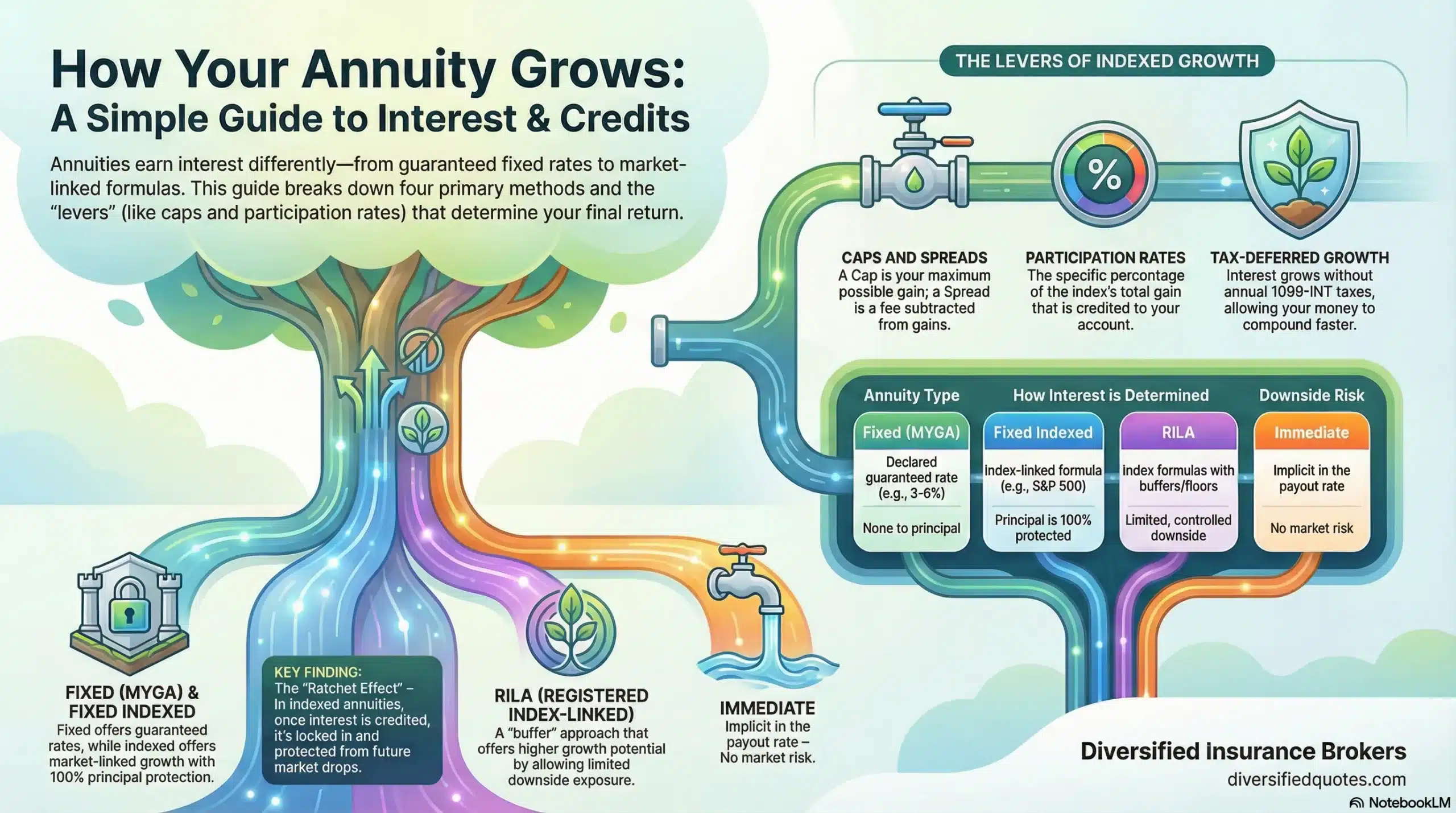
A fixed indexed annuity is an insurance contract designed to provide principal protection while offering interest credits based on the performance of a market index (like the S&P 500, Nasdaq, or other benchmark). Unlike buying stocks or index funds directly, you’re not investing in the market inside the annuity. Instead, the insurance carrier uses a crediting formula that can include items like a cap, participation rate, or spread.
The simplest way to think about an FIA is this: your account value doesn’t go down because of market declines, but your gains are generally limited in exchange for that protection. That tradeoff is a feature, not a flaw, for many retirees. If your priority is avoiding losses as you transition into retirement, FIAs can provide a “stay invested without getting hurt” type of structure—especially compared to an all-or-nothing stock strategy.
If you want a deeper breakdown of the basics, you can also read our full guide here: How Does an Annuity Work?.
Myth #1: “Fixed indexed annuities can lose money in a bad market.”
Reality: In most FIA designs, market losses do not reduce your credited account value due to index performance. That’s the core reason people choose them. When the index is negative for a crediting period, the credited rate is typically 0% for that period (not negative). In other words, you don’t participate in downside the way you would in a brokerage account.
This is one of the most important advantages fixed indexed annuities offer pre-retirees and retirees. In retirement, avoiding large drawdowns can matter just as much as earning returns, because big losses early on can permanently reduce the money available to generate income later. That’s why many people exploring FIAs also want to understand how to protect your funds in retirement without giving up growth completely.
However, it’s also true that some annuities may include fees, optional riders, or withdrawal charges that can reduce your cash value if you take money out incorrectly or too soon. So the “FIAs can lose money” statement is usually a misunderstanding. The more accurate statement is: you can lose money if you choose the wrong features for your timeline or withdraw funds the wrong way. That’s why product selection and strategy matter.
Myth #2: “FIAs lock up your money with harsh penalties.”
Reality: Most fixed indexed annuities include structured liquidity. The main tradeoff for principal protection and market-linked growth is that FIAs are designed as longer-term contracts, not short-term parking accounts. But that does not mean “no access.”
A common structure is the ability to take up to 10% penalty-free withdrawals each year after the first contract year. Some contracts also offer additional waivers for specific situations such as terminal illness, confinement in a nursing facility, or qualifying home health care. That said, surrender schedules matter, and the details vary by contract—so it’s essential that your timeline matches the surrender period you select.
If you want a full breakdown of how penalty-free access commonly works, this guide is extremely helpful: Annuity Free Withdrawal Rules.
The misconception here usually comes from people assuming FIAs work like checking accounts. They don’t. They’re built to be long-term retirement vehicles, similar to how a 401(k) is long-term by design. But when structured properly, FIAs can still provide meaningful flexibility—especially if your plan includes maintaining other liquid savings separately.
Myth #3: “Fixed indexed annuities are too complicated.”
Reality: FIAs can look complicated because there are multiple crediting options, and the terminology feels foreign at first. But the fundamentals are straightforward once you break them down into plain language.
At the core, an FIA is built around three primary ideas: principal protection, index-linked interest crediting, and tax-deferred growth. The “complexity” mostly comes from how interest is calculated. That’s where caps, spreads, and participation rates come in. The contract uses one or more of these levers to determine how much interest gets credited when the index is positive.
Here’s the truth many people never hear: you do not need to memorize every crediting formula to make a smart decision. You need to understand how the annuity is designed to behave in three types of markets—up, flat, and down—and how the income features work if you plan to turn it into retirement cash flow.
At Diversified Insurance Brokers, we often compare FIAs against other conservative solutions so the differences are crystal clear. For example, some people ultimately choose a MYGA instead because they prefer a simple declared rate. If you’re in that camp, you can compare current fixed rates here: Current Fixed Annuity Rates. Others want higher upside potential, and they focus on bonus structures or long-term crediting history, which you can explore here: Current Bonus Annuity Rates.
Myth #4: “FIAs don’t perform well.”
Reality: FIAs are not designed to “beat the market” in the short term. They are designed to help you compound safely over time without experiencing market losses. The correct way to judge a fixed indexed annuity isn’t comparing it to the best year of the S&P 500. The better comparison is: how does it perform across full market cycles when you include down years?
A common retirement risk is earning strong returns for a while and then getting hit with a major drawdown right before—or right after—retirement begins. Many investors discover too late that volatility hurts more when you’re taking distributions. That’s why FIAs can be valuable in “retirement red-zone” planning, where protecting the income engine matters more than chasing maximum upside.
Another reason this myth exists is because people confuse “performance” with “statement growth.” Some FIAs are purchased primarily for income rider benefits, where the main goal is not to maximize account value, but to create a reliable withdrawal stream. That’s a completely different purpose than trying to maximize a brokerage balance, and it requires a different measurement system.
Myth #5: “You’ll miss all the market upside.”
Reality: With fixed indexed annuities, you typically capture a portion of market gains during positive years, and you avoid market losses in negative years. That means, yes, in strong bull runs, an FIA may lag a pure equity strategy. But in down years, an FIA avoids the damage that can take years to recover from.
For many retirees, this tradeoff is exactly the point. Missing a portion of upside can feel frustrating in the moment, but avoiding a devastating drawdown may preserve long-term income sustainability. This is especially important if your goal is not just “growth,” but income you can depend on.
Some people choose to blend strategies—keeping one bucket for growth in the market and another bucket for safety and income in annuities. In those cases, FIAs may be used alongside other retirement income tools depending on the timeline and goals. You can learn more about these retirement income structures here: Lifetime Income Strategies.
Myth #6: “FIAs are only for people close to retirement.”
Reality: FIAs are popular with people in their late 50s and 60s because that’s when retirement decisions get urgent. But they can also benefit people in their 40s and early 50s—especially those who are conservative, experienced market volatility, or simply want a portion of savings insulated from future downturns.
Starting earlier can create advantages, such as a longer compounding runway, more time for index interest credits to accumulate, and potentially better flexibility in how you plan future income. Some individuals use FIAs as a “stable growth bucket” that can later be converted into a predictable income stream. This is the same mindset behind building a personal pension alternative—where you design an income source you control, rather than relying only on employer pensions or Social Security timing.
Myth #7: “Fixed indexed annuities are ‘hidden fee’ products.”
Reality: Some FIAs have explicit fees, and some do not. This myth is not entirely made up—it’s just oversimplified. Many fixed indexed annuities have no annual management fee built into the base contract. However, optional riders (such as guaranteed lifetime income riders) can include fees that are clearly disclosed in the contract.
The important takeaway is not “FIAs have fees” or “FIAs have no fees.” The real takeaway is: you should understand what you are paying for. If a rider fee exists, you want to confirm what benefit you’re receiving in exchange (higher guaranteed withdrawal percentage, enhanced income base, higher roll-up, additional payout options, etc.).
In some cases, paying a fee for guaranteed income can be very reasonable—if it replaces the need to take more market risk, reduces sequence-of-returns risk, or increases retirement stability. But if you don’t need income features and you’re purely seeking accumulation, you may choose a lower-cost structure that aligns better with your objective.
Myth #8: “FIAs aren’t safe.”
Reality: FIAs are insurance products, not securities. Their guarantees are backed by the claims-paying ability of the issuing insurance company. The safety profile is fundamentally different than owning market assets directly. In many cases, people who are uncomfortable with market volatility feel more confident with the insurance-based structure of an annuity—especially when their goal is retirement income rather than pure growth.
That said, safety doesn’t mean “ignore due diligence.” The right way to evaluate an annuity is to look at the product features, the contract structure, and whether it matches your objectives. You also want to ensure the annuity you’re considering is appropriate in terms of liquidity, timeline, and use case.
Another piece many people overlook is that some annuities include optional features that can increase protection for heirs. If leaving a legacy matters to you, this resource may help you understand how those benefits function: Annuity Beneficiary Death Benefits.
Understanding Fixed Indexed Annuities (In Plain English)
If the myths are making FIAs feel confusing, here’s a simple way to “ground” the conversation. A fixed indexed annuity is usually built to solve one of two retirement problems (and sometimes both): safe accumulation and stable income.
On the accumulation side, FIAs can protect principal while still offering a growth engine that’s stronger than what many people expect from conservative accounts. The ability to earn interest in up years while taking zero in down years can lead to steady compounding over time—especially during volatile decades where markets fluctuate repeatedly.
On the income side, many FIAs can be paired with an optional income feature designed to convert savings into retirement cash flow later. People often misunderstand this point. FIAs do not magically turn into pensions by default. But they can be structured to support long-term withdrawals, and for many retirees, that structure is what provides confidence during retirement spending years.
And because FIAs grow tax-deferred (in non-qualified accounts), they can be useful for individuals who are already maxing out other tax-advantaged options and want an additional long-term vehicle. If you want to understand how annuity taxation behaves once you begin withdrawals, our guide here can help: Annuity Exclusion Ratio Guide.
When Fixed Indexed Annuities Truly Shine
Fixed indexed annuities tend to shine in specific retirement scenarios. The first is when you want to reduce the risk of losing money at the wrong time. This is especially common in the years leading up to retirement and the first decade after retirement—when the consequences of a major market decline can be amplified.
Another scenario is when you want to create a stable income foundation. Some retirees want to cover “must-pay” expenses like housing, food, insurance, and utilities using predictable income sources. The idea is that discretionary spending can come from growth assets, but necessities are covered by a more stable engine.
FIAs can also be a fit when you are rolling over funds from an employer retirement plan and want a safer structure. Many people explore this after leaving a job or retiring and asking what to do with old plan balances. If that’s your situation, understanding rollover mechanics can prevent expensive mistakes. This page breaks down a common safe method: What Is a Direct Rollover?.
Some individuals also consider FIAs for Roth strategies depending on goals. While Roth-specific annuity decisions can be nuanced, this page provides background on one common rollover concept: How to Transfer a Roth IRA to an Annuity.
Get a Personalized FIA vs. MYGA Comparison
We’ll show side-by-side results for caps, spreads, renewal history, liquidity, and income riders.
FIA Myths Debunked: What You Should Ask Before You Buy
One of the best ways to protect yourself from bad annuity decisions isn’t memorizing product details—it’s asking the right questions. When a fixed indexed annuity is explained properly, the answers should be easy to understand, and the illustration should match the explanation.
Here are the most important questions we recommend asking before purchasing any FIA. These questions prevent confusion, reduce surprises, and help you avoid selecting a contract that doesn’t match your timeline.
1) What is the surrender schedule and what is my real timeline? Many people get in trouble with FIAs because they choose a longer surrender schedule than they truly want. If you may need access to principal soon, you want a contract designed for that reality—not a “best case scenario” plan.
2) What are the penalty-free withdrawal rules? This is where the “locked up forever” myth often disappears. If your contract allows 10% penalty-free access annually, the product can be much more flexible than people assume—especially when paired with other liquid savings.
3) What index crediting strategy is being used? Some people want simpler crediting. Others want more diversification. What matters is understanding how your interest is credited and how renewals may change. This is also why we encourage clients to view a full side-by-side comparison rather than focusing on only one current cap or one current strategy.
4) Is an income rider included, and if so, why? If you want income later, a rider may support that strategy. If you don’t need income, paying for a rider could be unnecessary. This is one of the biggest “make or break” areas when designing an FIA-based retirement plan.
5) How does this annuity fit into my broader plan? A fixed indexed annuity should not be purchased in isolation. It should be part of a clear strategy that explains what assets are for growth, what assets are for stability, and how income will be produced over time.
Fixed Indexed Annuities vs. “Traditional” Fixed Annuities
Fixed indexed annuities are often compared to fixed annuities (like MYGAs). Both are insurance-based products, and both can offer principal protection and tax deferral. The difference is that fixed annuities usually provide a declared interest rate for a set term, while FIAs provide interest credits based on index-linked formulas.
Fixed annuities may be better for clients who want maximum simplicity and a straightforward guaranteed rate. FIAs may be better for clients who want a chance at higher interest credits in strong markets while still avoiding market losses. Neither one is “always better.” The best option depends on your timeline, income goals, liquidity needs, and overall risk tolerance.
If you want to compare these options in real time, you can start by reviewing current market opportunities here: Current Annuity Rates.
Fixed Indexed Annuities and Retirement Income: The Real Conversation
When people research FIAs, they often focus on whether the annuity can “perform.” But for many retirees, the bigger issue is whether their income plan will hold up for life. Performance matters, but income stability matters more once retirement begins.
This is where fixed indexed annuities can play a unique role. When structured properly, an FIA can provide a stable base that supports income withdrawals later, potentially reduce the need to take aggressive stock risk, and help stabilize a portfolio during volatile periods.
Some families also prefer FIAs because they want a solution that behaves predictably. They may not want to guess whether the market will be up or down over the next decade. Instead, they want a strategy that can continue moving forward even during challenging years. This is the same mindset behind why many people ask whether annuities are worth it for retirement planning. If that’s your question, this page adds helpful context: Are Annuities Worth It?.
Another related question is whether annuities make sense as a retirement investment in general. Some people want income, some want safety, some want tax deferral, and some want all three. If you want a broader “big picture” framework, start here: Are Annuities a Good Investment in Retirement?.
Why “Bad” FIA Experiences Happen (And How to Avoid Them)
Many of the worst stories people hear about fixed indexed annuities are not about the concept of an FIA itself—they’re about poor matching between product design and client needs. A good product used in a bad situation will still feel like a bad product.
One common issue is when someone ties up too much of their liquid net worth into a long surrender schedule without keeping a proper emergency fund. Another issue occurs when someone believes they are buying a “high return” product, when the actual intention of the FIA was safety and income planning. Misaligned expectations create disappointment even when the product performs exactly as designed.
Finally, some people are placed into annuity structures that don’t match their tax situation. Tax deferral can be valuable, but the withdrawal strategy matters. Proper planning includes understanding when withdrawals might begin, how they will be taxed, and whether the annuity will be used primarily for accumulation, income, or legacy planning.
FIA Myths Debunked: The Real Benefits of a Well-Designed Contract
When we strip away marketing noise and focus on real-world outcomes, FIAs provide a handful of benefits that stand out for retirement planning. They can provide principal protection that many people simply cannot tolerate losing as retirement approaches. They can offer tax-deferred growth that compounds without annual taxation in non-qualified accounts. They can provide structured liquidity through penalty-free withdrawal provisions. And in many cases, they can serve as part of a reliable income strategy.
Some FIAs can also be paired with additional features depending on what a client is trying to solve. While we never recommend stacking features unnecessarily, the ability to tailor an annuity to a specific purpose is part of why they remain popular—especially for conservative investors.
And if your focus is guaranteed income, it’s often helpful to understand how annuity payouts can be structured in different ways. FIAs are one tool, but they can also be compared to other income-focused designs depending on your goals and timing. Our advisors help you evaluate these options in plain English.
Next Steps: How to Make a Smart FIA Decision
If you’ve read through these fixed indexed annuity myths and you’re still interested, the next step is simple: you want a side-by-side comparison that shows what the annuity is actually built to do for your age, your state, your premium, and your timeline. FIAs can look very different depending on how they’re designed.
At Diversified Insurance Brokers, we help clients evaluate fixed indexed annuities the right way—by matching the contract to the goal. That includes comparing liquidity, surrender schedules, index strategies, income options, renewal history patterns, and how each option aligns with your retirement income plan.
Start Your Fixed Indexed Annuity Plan
Protect your retirement, eliminate risk, and grow safely with a fixed indexed annuity built around your needs.
See Bonus Annuity Rates Get Personalized Quotes
Our advisors specialize in debunking fixed indexed annuity myths and showing clients how to create guaranteed income with confidence.
Related Pages
Keep learning how annuities work, compare strategies, and explore more retirement income tools.
Financial Protection Essentials
Retirement bonus annuities, international travel protection, transplant underwriting, and critical illness coverage education.
Talk With an Advisor Today
Choose how you’d like to connect—call or message us, then book a time that works for you.
Schedule here:
calendly.com/jason-dibcompanies/diversified-quotes
Licensed in all 50 states • Fiduciary, family-owned since 1980
FAQs: Fixed Indexed Annuities
Can a fixed indexed annuity lose value?
No. Crediting can be 0% in down years, but the account value won’t decrease due to market losses (fees/riders still apply).
How much can I withdraw without penalties?
Many FIAs allow up to 10% of account value per year penalty-free after the first year. See contract for specifics and any health-event waivers.
What’s the difference between a cap, participation rate, and spread?
They’re simply ways to calculate your credited interest from the index: caps limit upside to a maximum, participation rates give you a percentage of the index gain, and spreads subtract a stated amount from the index return.
Do I need an income rider now?
Not always. If income is several years away, we can compare accumulation-focused FIAs now and price the rider later. If income is near-term, a rider can lock in payout factors today.
How are FIA withdrawals taxed?
Tax-deferred growth; distributions are generally taxed as ordinary income. Non-qualified contracts often follow the exclusion ratio when annuitized.
About the Author:
Jason Stolz, CLTC, CRPC and Chief Underwriter at Diversified Insurance Brokers (NPN 20471358), is a senior insurance and retirement professional with more than two decades of real-world experience helping individuals, families, and business owners protect their income, assets, and long-term financial stability. As a long-time partner of the nationally licensed independent agency Diversified Insurance Brokers, Jason provides trusted guidance across multiple specialties—including fixed and indexed annuities, long-term care planning, personal and business disability insurance, life insurance solutions, Group Health, and short-term health coverage. Diversified Insurance Brokers maintains active contracts with over 100 highly rated insurance carriers, ensuring clients have access to a broad and competitive marketplace.
His practical, education-first approach has earned recognition in publications such as VoyageATL, highlighting his commitment to financial clarity and client-focused planning. Drawing on deep product knowledge and years of hands-on field experience, Jason helps clients evaluate carriers, compare strategies, and build retirement and protection plans that are both secure and cost-efficient. Visitors who want to explore current annuity rates and compare options across multiple insurers can also use this annuity quote and comparison tool.
