
How Does a Fixed Annuity Work

Jason Stolz CLTC, CRPC
How does a fixed annuity work? A fixed annuity is a contract between you and an insurance company that guarantees a stated interest rate for a defined period of time while protecting your principal from market loss. You deposit funds — either from personal savings or by rolling over assets from an IRA, 401k, 403b, TSP, or pension — and the insurer credits a fixed rate that does not fluctuate during the guarantee period. Your account value cannot decline due to stock market volatility, and interest grows tax-deferred until withdrawn.
In today’s retirement environment, predictability has become increasingly valuable. Markets rise and fall. Bond prices move when interest rates shift. Inflation pressures purchasing power. A fixed annuity introduces stability into that equation. It creates a contractual rate of return, eliminates downside exposure tied to equities, and allows retirees to plan income with greater confidence. For many individuals approaching or already in retirement, that certainty becomes the foundation of a broader income strategy.
At Diversified Insurance Brokers, we help retirees nationwide compare rates from more than 75 insurance carriers, evaluate surrender schedules, and determine whether a multi-year guaranteed annuity or shorter-term fixed strategy aligns with long-term goals. Understanding how a fixed annuity works is not simply about knowing the rate — it is about understanding how interest is credited, how flexibility works, how income options function, and how the contract fits into your overall retirement plan.
The Structure Behind the Guarantee
A fixed annuity begins with a premium deposit. Most commonly, this is a single lump sum, though some contracts allow flexible contributions. Once funded, the insurer declares and contractually guarantees an interest rate for a specified term. These guarantee periods often range from two to ten years, with five- and seven-year contracts among the most popular.
During that guarantee window, the rate cannot decline. If you lock in 5.25% for five years, you receive 5.25% each year regardless of what happens in the broader economy. Even if interest rates drop nationwide or financial markets experience volatility, your annuity continues compounding at the guaranteed rate. That stability is the core reason fixed annuities are frequently used as conservative anchors within diversified portfolios.
Unlike variable investments, there are no daily price swings. The insurance company assumes investment management responsibility internally, primarily investing in high-quality bonds and conservative fixed-income instruments. Your role is not to manage allocation shifts. Your benefit is contractual certainty.
Compare Today’s Fixed & Bonus Annuity Rates
See which carriers are offering the highest multi-year guarantees and explore bonus annuity opportunities that may increase your starting value.
View Current Fixed Annuity Rates View Current Bonus Annuity Rates Request My Personalized Comparison
How Interest Is Credited and Compounded
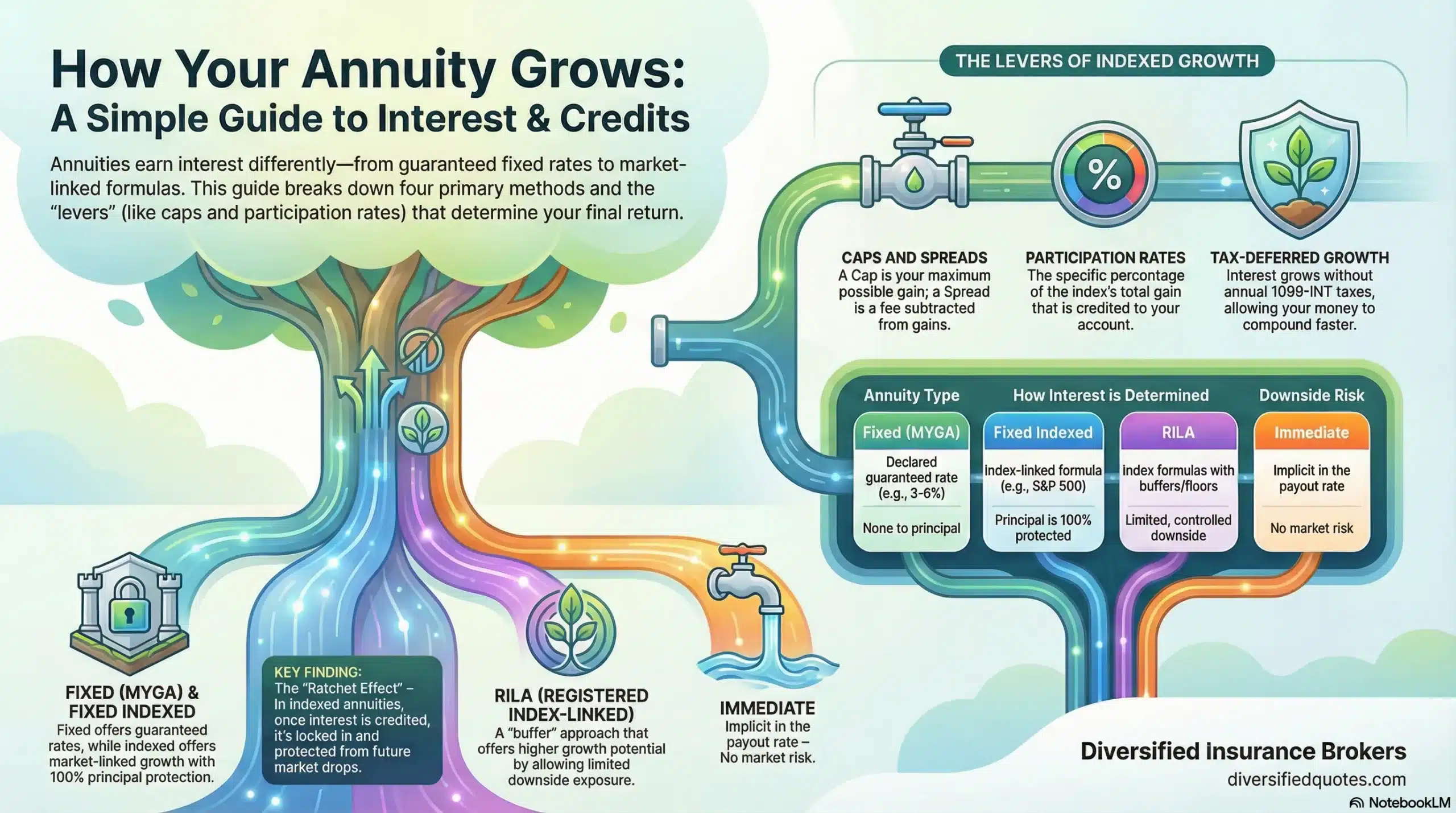
Interest in a fixed annuity is typically credited annually and compounds over time. Because the rate is locked in, your earnings accumulate predictably. Each year’s credited interest becomes part of your principal for the following year’s calculation, creating compound growth inside the contract.
This compounding occurs on a tax-deferred basis. Unlike bank CDs held in taxable accounts, you do not receive a 1099 for annual interest unless withdrawals occur. This allows the full account value to continue growing without annual tax drag. Over multi-year periods, that tax deferral can meaningfully enhance net accumulation.
For those interested in the mechanics behind how insurers generate returns, you may also review how annuities earn interest to better understand the underlying structure.
Principal Protection and Risk Management
One of the most attractive features of a fixed annuity is principal protection. Your contract value cannot decline due to stock market corrections or bond price fluctuations. While surrender charges apply during the early years if funds are withdrawn beyond permitted limits, the underlying accumulation value remains protected from market loss.
This makes fixed annuities particularly appealing to retirees who are transitioning from accumulation to preservation. Many individuals five to ten years from retirement begin reallocating portions of market-exposed portfolios into guaranteed products. By reducing volatility exposure during this pre-retirement window, they protect against sequence-of-returns risk — the danger of experiencing major losses just before beginning income withdrawals.
Those exploring broader risk-reduction strategies often review how to protect your funds in retirement to determine appropriate allocation balance between market assets and guaranteed vehicles.
MYGA vs. Traditional Fixed Annuities
Most fixed annuities fall into two categories. A Multi-Year Guaranteed Annuity, commonly referred to as a MYGA, locks in a specific rate for a defined term such as three, five, seven, or ten years. These contracts closely resemble bank CDs but typically offer higher yields and tax deferral.
Traditional fixed annuities may offer shorter guarantee periods, sometimes one year at a time, with renewal rates declared annually. While this can provide flexibility, it also introduces renewal-rate uncertainty after the first term.
Retirees comparing these structures often evaluate rate environments by reviewing how annuity rates change to understand how interest cycles affect renewal periods.
Income Conversion Options
Although many investors use fixed annuities purely for accumulation, they can also serve as income foundations. At the end of the guarantee period, you may convert the account into lifetime income through annuitization or structured withdrawals. Income options can include payments for a single life, joint lifetime coverage for spouses, or period-certain guarantees that ensure payments for a specified number of years.
This conversion feature transforms a conservative growth vehicle into a predictable retirement paycheck. Instead of worrying about market withdrawals, retirees can create contractually guaranteed income streams that supplement Social Security or pensions.
Estimate Your Guaranteed Lifetime Income
See how your fixed annuity balance could convert into dependable lifetime payments based on your age and premium amount.
End-of-Term Flexibility and 1035 Exchanges
When your guarantee period ends, you typically enter a renewal window. During this timeframe, you may renew at the new declared rate, withdraw funds without surrender charges, convert to income, or execute a tax-free Section 1035 exchange into a new annuity offering more competitive terms. This rollover flexibility allows retirees to adapt to changing interest rate environments without triggering immediate taxation.
Many conservative investors use laddering strategies, staggering contract maturities across multiple years. This approach maintains periodic liquidity while capturing varying rate environments over time.
How Fixed Annuities Compare to Other Conservative Options
Bank CDs provide FDIC insurance but often lower yields and no lifetime income features. Bonds offer income potential but fluctuate in value when rates rise. Fixed indexed annuities introduce index-linked growth potential with downside protection, offering a different balance between safety and opportunity. Those evaluating indexed strategies can review how a fixed indexed annuity works to compare structures more thoroughly.
Ultimately, the choice depends on your objective. If your priority is guaranteed accumulation with no market risk, a fixed annuity remains one of the most straightforward tools available.
Personalized Comparison Matters
Rates vary by carrier, state, and term length. Surrender schedules differ. Renewal policies change. Because these factors directly affect long-term results, independent comparison is critical. We analyze financial strength ratings, historical renewal behavior, liquidity provisions, and income features before recommending any contract.
Whether you are repositioning maturing CDs, rolling over retirement accounts, or preparing to generate predictable income, a fixed annuity can serve as a stabilizing element within your retirement strategy.
Request Your Fixed Annuity Comparison
See side-by-side quotes from top-rated insurers and lock in competitive guaranteed rates today.
Related Pages
Financial Protection Essentials
Carrier reviews, senior burial planning, high-risk underwriting guidance, and final expense planning tools.
Talk With an Advisor Today
Choose how you’d like to connect—call or message us, then book a time that works for you.
Schedule here:
calendly.com/jason-dibcompanies/diversified-quotes
Licensed in all 50 states • Fiduciary, family-owned since 1980
FAQs: How Does a Fixed Annuity Work?
What does a fixed annuity guarantee?
A fixed annuity guarantees principal protection, a locked-in interest rate, and predictable growth for the entire term.
Are fixed annuity rates locked in?
Yes. Fixed rates remain guaranteed for the entire term, regardless of market performance.
Can I lose money in a fixed annuity?
No. Fixed annuities protect your principal and interest from market losses.
How is interest taxed?
Growth is tax-deferred. Withdrawals are taxed as income on interest for non-qualified funds, and fully taxable for IRA or 401k funds.
What happens when the term ends?
You can renew, withdraw funds, convert to lifetime income, or transfer to another annuity without penalty.
About the Author:
Jason Stolz, CLTC, CRPC and Chief Underwriter at Diversified Insurance Brokers (NPN 20471358), is a senior insurance and retirement professional with more than two decades of real-world experience helping individuals, families, and business owners protect their income, assets, and long-term financial stability. As a long-time partner of the nationally licensed independent agency Diversified Insurance Brokers, Jason provides trusted guidance across multiple specialties—including fixed and indexed annuities, long-term care planning, personal and business disability insurance, life insurance solutions, Group Health, and short-term health coverage. Diversified Insurance Brokers maintains active contracts with over 100 highly rated insurance carriers, ensuring clients have access to a broad and competitive marketplace.
His practical, education-first approach has earned recognition in publications such as VoyageATL, highlighting his commitment to financial clarity and client-focused planning. Drawing on deep product knowledge and years of hands-on field experience, Jason helps clients evaluate carriers, compare strategies, and build retirement and protection plans that are both secure and cost-efficient. Visitors who want to explore current annuity rates and compare options across multiple insurers can also use this annuity quote and comparison tool.
