
Long Term Care Insurance for Diabetics

Jason Stolz CLTC, CRPC
Long-term care insurance for diabetics is attainable, but the outcome depends on underwriting details that most people never see until it’s too late. Diabetes is not automatically disqualifying. Instead, long-term care insurers focus on functional risk—whether your health profile suggests a higher likelihood of needing help with everyday activities (bathing, dressing, transferring, continence, toileting, eating) earlier than average. The goal of this page is to help you understand what carriers actually look for, how to position your case correctly, and which planning paths may be realistic based on the type of diabetes and your overall health.
The biggest mistake diabetic applicants make is assuming all long-term care insurance carriers treat diabetes the same. They don’t. Underwriting is not uniform, and carrier appetites change over time. One carrier may accept a stable diabetic profile with reasonable terms, while another might offer coverage only with heavier pricing or restrictions—or decline entirely. That difference is why strategy matters. The “right” long-term care policy for a diabetic applicant is rarely found by applying blindly. It’s typically found by matching your medical profile to the carriers that underwrite it most reasonably and presenting the case in a way that underwriters can approve with confidence.
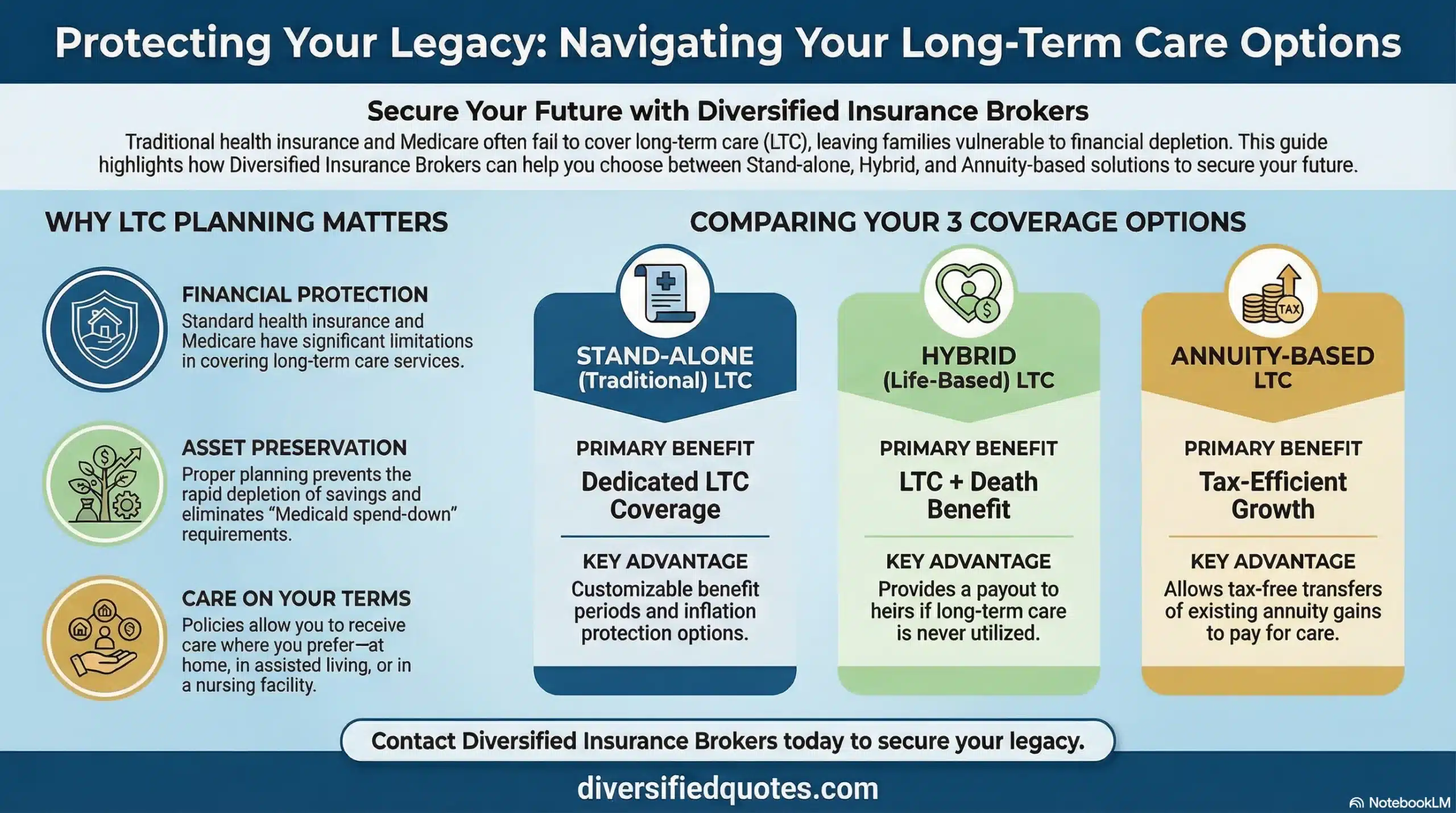
At Diversified Insurance Brokers, we approach long-term care insurance for diabetics with an underwriting-first mindset. That means we start by identifying which carriers are most appropriate for your specific medical profile before an application is ever submitted. We also focus on timing—because diabetes that is stable today may look different to an underwriter if complications develop later. With the right approach, many diabetic clients can still secure meaningful long-term care coverage, and in many cases, the “best” option isn’t one-size-fits-all. It could be traditional long-term care insurance, a hybrid life insurance policy with long-term care benefits, or an annuity that offers long-term care features, depending on goals, budget, and medical history.
Check Your Eligibility and Options
We’ll compare carriers and explain your best path—traditional LTC vs. hybrid life/LTC vs. annuity with LTC benefits.
Why long-term care planning matters for diabetics
Diabetes is associated with medical issues that can increase the likelihood of needing long-term care later in life, including neuropathy that affects balance and walking, circulation issues that limit mobility, vision changes that impact safety and independence, kidney disease that can lead to fatigue and functional decline, and cardiovascular events that may require ongoing assistance. Not every person with diabetes will experience these outcomes, and many diabetics remain active and independent for decades. However, long-term care insurers evaluate probability rather than certainty. They underwrite based on the likelihood that a condition might lead to functional limitations over time.
Long-term care insurance is designed to pay for care that traditional health insurance and Medicare generally do not cover in a meaningful way. It can help pay for extended in-home care, assisted living, memory care, and nursing facility care. For many families, the most expensive care scenario is not a short hospital stay—it’s months or years of ongoing assistance. Without coverage, those costs are typically paid out of pocket, which can erode retirement assets quickly and change a spouse’s lifestyle, housing choices, and long-term financial security.
Because long-term care insurance is medically underwritten, applying while diabetes is stable—before complications develop—often results in better approval odds and more affordable premiums. This is also why many clients ask us to evaluate eligibility early, even if they don’t plan to use benefits for years. The best time to get coverage is usually when you still qualify on favorable terms and can design a policy that keeps premiums manageable long-term.
If you want a broader overview of eligibility rules across multiple health conditions, review how to qualify for long-term care insurance and how carriers evaluate medical stability, functional independence, and the likelihood of future claims.
How long-term care underwriting evaluates diabetes
Long-term care insurance underwriting is primarily focused on functional risk. Underwriters want to understand whether a medical condition increases the likelihood of needing help with activities of daily living, and whether there are warning signs that independence is already declining. For diabetic applicants, underwriting is less about the label “diabetes” and more about what the diabetes is doing (or not doing) to the body over time.
When reviewing diabetic applicants, underwriters typically evaluate time since diagnosis, stability of A1C levels, medication history, physician follow-up, and whether complications are present. They also consider overall build, blood pressure, cholesterol levels, and cardiovascular history because diabetes often interacts with these risk factors. Underwriters commonly look for patterns: stable medical management, consistent follow-up, and a record of compliance with treatment. One isolated lab value rarely tells the whole story. Consistency matters more than a single perfect number.
This functional focus is also why it helps to understand benefit triggers. Most long-term care policies pay benefits when you can’t perform a set number of activities of daily living or when cognitive impairment requires supervision. If you haven’t looked at this yet, start with what are activities of daily living to understand what insurers are trying to predict when they underwrite diabetic applicants.
Type 2 diabetes and long-term care insurance
Type 2 diabetes is often easier to insure than many people expect, especially when it is managed with oral medications and lifestyle measures and there are no meaningful complications. Applicants with stable labs, consistent medical care, and no functional impairments often qualify for coverage. The underwriter’s core question is whether the condition appears controlled and whether the applicant shows signs of complications that might lead to near-term claims.
Insulin use does not automatically result in a decline. Many carriers will consider insulin-managed Type 2 diabetes if control is stable, follow-up is consistent, and complications are absent or minimal. Underwriters commonly review whether insulin usage has been steady, whether it improved control, and whether there has been any progression in diabetic complications. The presence of multiple additional risk factors—significant cardiovascular history, uncontrolled blood pressure, severe obesity, or mobility limitations—can change underwriting outcomes, but many insulin-treated applicants are still insurable with the right carrier selection.
Carrier selection remains critical because some insurers treat insulin use as a stronger negative factor than others. Our process is built around identifying which carriers are most aligned with your profile before you apply, so you don’t accumulate unnecessary declines that complicate future options.
Type 1 diabetes: more conservative, not impossible
Type 1 diabetes is often underwritten more conservatively because it is lifelong and typically involves insulin therapy. That said, approval is still possible, and many Type 1 diabetics are healthy, active, and stable for decades. For Type 1 applicants, carriers are usually focused on long-term stability, consistent endocrinology care, and the absence of functional limitations. They also look closely at evidence of complications—especially neuropathy, kidney disease, and vision issues—because those are more predictive of long-term care need than the diagnosis itself.
In Type 1 cases, strategy becomes even more important. Some carriers are significantly more conservative than others, and even small differences in underwriting philosophy can change whether an application is approved or postponed. This is where an underwriting-first approach can help because it allows us to target the carriers most likely to evaluate a well-managed Type 1 profile fairly, rather than wasting time and creating avoidable declines.
Complications that matter most to underwriters
Long-term care insurers are most concerned with complications that affect independence. Neuropathy that impacts balance or walking, kidney disease that progresses or requires intensive management, vision impairment that affects daily safety, cardiovascular disease, history of stroke or TIA, and amputations tend to carry the greatest weight. Underwriters also pay attention to hospitalizations and emergency events, especially if those events suggest fragile health or repeated episodes that might lead to functional decline.
However, complications are not always treated equally. Early-stage or well-managed findings without functional impact may still be insurable, depending on severity and stability. Underwriters assess progression, treatment response, and real-world limitations rather than diagnosis names alone. Two applicants might share the same diagnosis on paper but have very different underwriting outcomes depending on stability and function.
This functional focus is also why some households consider asset-protection strategies alongside coverage design. If you’re looking to protect assets in a way that coordinates with state Medicaid rules, you may want to review partnership-qualified long-term care insurance and how certain LTC policies can help preserve assets if long-term care is needed later.
Timing and policy design considerations
Applying earlier generally results in better options. If diabetes is stable and complications are minimal, you may have access to stronger benefit options, better inflation protection choices, and more flexible policy designs. Once approved, building the right policy becomes just as important as eligibility. Benefit amounts, elimination periods, benefit durations, and inflation protection determine how useful the policy will be when care is needed. A policy that looks affordable today but doesn’t keep pace with future costs can leave a gap later. Conversely, a policy that is overly rich can create long-term premium strain and lead to lapse risk.
Many diabetic applicants prioritize affordability and simplicity, especially if they’re balancing other costs in retirement. Others prioritize stronger inflation protection because long-term care costs typically rise over time. The “right” design depends on your age, assets, household income, and how much risk you want to self-insure. If you want a design that preserves premium value if you never use care, review long-term care insurance with return of premium and how those structures may fit certain planning goals.
Some clients also want to understand whether a hybrid strategy makes sense. Hybrid options can be attractive if you want long-term care leverage with a life insurance death benefit, or if you want an annuity-based LTC option that creates a pool of benefits. The right fit depends on medical eligibility, premium budget, and whether you prefer ongoing premiums or a single premium design.
Traditional LTC vs. hybrid options for diabetics
Traditional long-term care insurance is typically designed for maximum leverage: you pay premiums and, if you need care, the policy can pay a multiple of what you paid in—sometimes for years—depending on benefit levels. For diabetics who can qualify on reasonable terms, traditional LTC can be a highly efficient way to protect assets. The downside is that if you never use benefits, premiums may not create a residual value unless the policy includes specific return-of-premium provisions.
Hybrid life/LTC policies combine long-term care benefits with life insurance. If you never need care, there is generally a death benefit. If you do need care, the policy can accelerate the death benefit for long-term care and often provide an extended pool of benefits. Hybrid designs can be appealing to diabetic clients who want the psychological comfort of “value either way,” but they may have different underwriting requirements and funding structures.
Annuities with long-term care benefits can also be considered in some cases. These designs vary, but the general concept is that the annuity can provide a pool of LTC benefits that may increase the value available for care if qualifying events occur. This can be a fit for certain clients who want principal protection and a predictable base while gaining enhanced long-term care benefits.
The point is not that one path is always better. The right strategy is the one you can qualify for, afford long-term, and comfortably keep in force. That’s exactly what an underwriting-first review is designed to clarify.
Medicare and the long-term care gap
Medicare does not cover long-term custodial care in the way most people expect. It typically provides limited short-term skilled care under specific conditions and does not cover extended help with bathing, dressing, meal preparation, supervision, or other daily needs over the long term. This gap is why long-term care insurance often becomes a cornerstone of retirement planning. For diabetics, who may face a higher probability of needing assistance later in life, understanding this gap is essential so you can plan proactively instead of relying on assumptions.
If you want a deeper breakdown of what Medicare does and does not cover, review does Medicare cover long-term care and how families typically fund care when Medicare is not designed to pay for ongoing custodial needs.
Not sure if you’ll qualify with diabetes?
A diabetes-focused review can clarify eligibility, carrier fit, and realistic coverage paths before you apply.
How Diversified Insurance Brokers helps diabetics navigate long-term care insurance
Our role is to help diabetic applicants avoid unnecessary declines and identify the most realistic underwriting paths first. We focus on carrier fit, documentation, and policy design so coverage aligns with real-world needs. In practical terms, that means we start with the underwriting questions carriers will ask, we help you understand what’s most important in your profile, and we guide you toward applications that have the highest probability of a clean approval outcome.
We also help you think through the “why” behind the policy design. A long-term care policy should be built around how you expect to use it. Some families want robust in-home care coverage because they want to stay at home as long as possible. Others prioritize assisted living or facility benefits. Some want shorter elimination periods to reduce out-of-pocket exposure. Others accept longer elimination periods to reduce premiums and self-insure the first part of a claim. The best design is the one that fits your retirement plan, not a generic template.
Long-term care insurance for diabetics is rarely about perfection. It’s about applying at the right time, with the right carrier, using the right strategy, and building a policy that remains affordable and meaningful for the long haul. If you want us to review your situation, we’ll walk you through realistic options and help you choose a path that aligns with your health profile and your goals. As a side note, if you plan to use Long Term Care Benefits overseas, read more and learn what options are available.
Talk With an Advisor Today
Choose how you’d like to connect—call or message us, then book a time that works for you.
Schedule here:
calendly.com/jason-dibcompanies/diversified-quotes
Licensed in all 50 states • Fiduciary, family-owned since 1980
Can you get long-term care insurance if you have diabetes?
Yes. Many people with diabetes qualify for long-term care insurance, especially when the condition is well controlled and free from serious complications.
Does Type 2 diabetes affect long-term care insurance rates?
Type 2 diabetes may result in higher premiums depending on control and duration, but many applicants are still approved at reasonable rates.
Is insulin use an automatic decline?
No. Insulin use does not automatically disqualify you, but insurers will closely evaluate stability, A1C trends, and complication history.
What A1C level do long-term care insurers prefer?
Most insurers prefer consistent A1C readings within a controlled range, but trends and overall health matter more than a single number.
What diabetes complications are most concerning to insurers?
Complications affecting mobility, cognition, vision, kidneys, or cardiovascular health have the greatest impact on underwriting decisions.
When should diabetics apply for long-term care insurance?
Applying earlier, before complications develop, typically results in better approval odds and more affordable premiums.
About the Author:
Jason Stolz, CLTC, CRPC and Chief Underwriter at Diversified Insurance Brokers (NPN 20471358), is a senior insurance and retirement professional with more than two decades of real-world experience helping individuals, families, and business owners protect their income, assets, and long-term financial stability. As a long-time partner of the nationally licensed independent agency Diversified Insurance Brokers, Jason provides trusted guidance across multiple specialties—including fixed and indexed annuities, long-term care planning, personal and business disability insurance, life insurance solutions, Group Health, and short-term health coverage. Diversified Insurance Brokers maintains active contracts with over 100 highly rated insurance carriers, ensuring clients have access to a broad and competitive marketplace.
His practical, education-first approach has earned recognition in publications such as VoyageATL, highlighting his commitment to financial clarity and client-focused planning. Drawing on deep product knowledge and years of hands-on field experience, Jason helps clients evaluate carriers, compare strategies, and build retirement and protection plans that are both secure and cost-efficient. Visitors who want to explore current annuity rates and compare options across multiple insurers can also use this annuity quote and comparison tool.
