
Short-Term vs. Long-Term Disability Insurance

Jason Stolz CLTC, CRPC
Short-Term vs. Long-Term Disability Insurance: What’s the Difference — and Which Do You Actually Need?
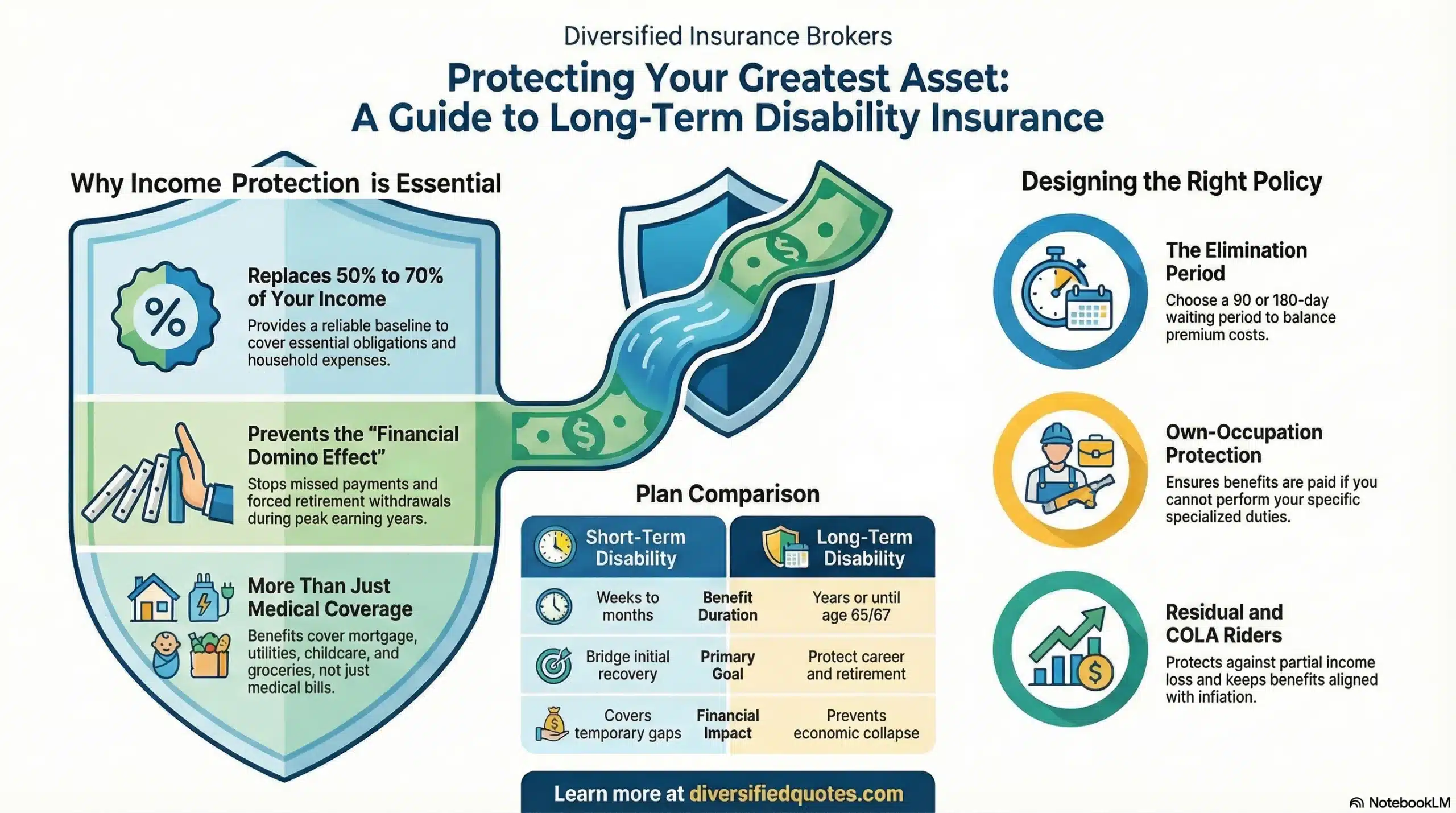
Disability insurance exists for one simple reason: your income is your most valuable asset. If an illness or injury prevents you from working, your paycheck stops — but your mortgage, utilities, insurance premiums, retirement contributions, and daily living expenses do not. The difference between short-term and long-term disability insurance isn’t just duration — it’s strategy. Short-term disability (STD) is designed to cover temporary interruptions, typically lasting a few weeks to several months. Long-term disability (LTD) is built to protect your earning power for years — sometimes until retirement age. Understanding how these two forms of coverage work together can determine whether a temporary setback becomes a financial inconvenience… or a permanent financial crisis.
Short-term disability insurance typically begins paying benefits quickly — often after a 0 to 14 day elimination period — and continues for three to six months, sometimes up to one year. It is commonly offered through employers, but individual policies are available. Long-term disability insurance, on the other hand, usually begins after a longer elimination period (90, 180, or even 365 days) and can pay benefits for 2, 5, 10 years, or to age 65 or 67. The longer the benefit period and the shorter the waiting period, the higher the premium. But here’s what many people misunderstand: short-term coverage without long-term coverage leaves you exposed to catastrophic financial risk. Conversely, long-term coverage without short-term coverage may leave you responsible for months of expenses before benefits begin. Coordinating both is often the most comprehensive strategy — especially for professionals, business owners, and individuals in physically demanding or high-risk occupations.
For high-risk professionals — including construction workers, pilots, medical specialists, law enforcement, industrial contractors, and those in hazardous environments — disability planning becomes even more critical. Occupational class heavily influences eligibility, benefit structure, and premium cost. Certain roles may be declined by traditional carriers or offered modified contracts with exclusions. If you’re self-employed or own a business, the stakes are even higher. Unlike employees, you may not have access to employer-sponsored group benefits. In these cases, reviewing related protection strategies like Group vs Individual Life Insurance can help you structure layered protection across multiple financial risks.
Another factor often overlooked is how disability coverage integrates with long-term retirement income planning. If you become disabled and cannot contribute to your IRA, 401(k), or deferred compensation plan, your future retirement income could be permanently reduced. Understanding how income vehicles function — such as Annuity vs 401k retirement planning — helps clarify why protecting earning ability during working years is essential. Disability insurance is not just income replacement; it is retirement protection in disguise.
Request Disability Income Protection
Submit our disability income form for personalized protection options.
High-risk occupations face additional underwriting scrutiny. For example, aviation professionals may need coverage structured differently than office-based professionals. Those in international roles should coordinate protection alongside solutions like Life Insurance for Foreign Travel and Residency to ensure global exposure does not create policy limitations. Similarly, pilots may review specialty coverage options such as Disability Insurance for Pilots when evaluating occupation-specific underwriting guidelines.
Short-term disability works best for predictable, temporary setbacks — surgery recovery, pregnancy leave, or short medical events. Long-term disability protects against the events you cannot financially recover from on your own: neurological conditions, chronic illnesses, spinal injuries, cancer, and degenerative diseases. Statistics consistently show that a significant percentage of disabilities stem from illness rather than accidents. This is why relying solely on workers’ compensation is insufficient. Workers’ compensation only covers work-related injuries, while individual disability policies typically cover both on-the-job and off-the-job incidents.
High-risk professionals must also evaluate policy definitions. “Own occupation” coverage pays benefits if you cannot perform the duties of your specific occupation — even if you can work elsewhere. “Any occupation” definitions require inability to work in any gainful employment. The difference is enormous. For example, a surgeon unable to operate may still be able to teach or consult. With true own-occupation coverage, benefits may continue. Without it, they may not. Structuring these details correctly is critical — especially for income earners whose careers require specialized skill sets.
Ensure You Are Receiving the Absolute Top Rates
Current Fixed Annuity Rates
Compare today’s best fixed annuity rates from top carriers.
Current Bonus Annuity Rates
See which annuities offer competitive bonus structures.
Request Disability Income Protection
Submit our disability income form for personalized protection options.
Lifetime Income Calculator
Estimate how protected retirement income fits into your overall financial plan.
For individuals transitioning assets, disability planning may intersect with retirement rollovers. For example, understanding How to Transfer an IRA to an Annuity may become relevant if a disability forces early retirement. Similarly, individuals evaluating tax-efficient retirement income strategies often explore tools like What Is a QLAC when coordinating income protection and longevity planning.
High-risk professionals face unique exposure not only from injury but from liability, litigation, and income disruption. In certain legal scenarios, individuals may need to understand options such as Advance on a Pending Lawsuit or broader Legal Cash Advances to maintain financial stability during extended disputes. While not substitutes for disability insurance, these tools demonstrate how layered financial planning can prevent a temporary setback from escalating.
The bottom line: short-term disability protects your immediate cash flow. Long-term disability protects your lifetime earning power. High-risk occupations demand specialized underwriting and careful policy design. When structured properly, disability insurance safeguards your income, your retirement contributions, your family’s stability, and your long-term financial independence. Without it, a single medical event can undo decades of disciplined saving. Coordinated correctly, it becomes one of the most powerful financial protection tools available.
Related Pages to Explore
Talk With an Advisor Today
Choose how you’d like to connect—call or message us, then book a time that works for you.
Schedule here:
calendly.com/jason-dibcompanies/diversified-quotes
Licensed in all 50 states • Fiduciary, family-owned since 1980
Frequently Asked Questions
Short-term disability coverage only protects income for a few months. Without long-term disability insurance, a serious illness or injury could leave you without income for years. Many professionals layer both forms of coverage to protect immediate cash flow and long-term earning power.
Common elimination periods include 90, 180, or 365 days. Choosing a longer elimination period typically lowers premiums but requires more emergency savings. If you are building retirement reserves, reviewing strategies like Deferred Compensation Planning After Retirement may help coordinate cash reserves with disability planning.
Not necessarily. While some high-risk roles face stricter underwriting, many professionals can still qualify for modified or occupation-specific policies. For example, those in aviation or technical fields may explore coverage similar to Disability Insurance for New Professionals structures depending on job classification.
Indirectly, yes. Disability benefits replace lost income, allowing you to continue covering expenses and potentially maintain retirement contributions. Some individuals also coordinate retirement income vehicles such as Annuity Exclusion Ratio strategies to plan future tax-efficient income streams.
No. Workers’ compensation only covers job-related injuries. Individual disability insurance typically covers both work-related and non-work-related illnesses or injuries. Business owners may also review broader protection needs, including Contract Indemnity Life Insurance for liability exposure planning.
About the Author:
Jason Stolz, CLTC, CRPC and Chief Underwriter at Diversified Insurance Brokers, is a senior insurance and retirement professional with more than two decades of real-world experience helping individuals, families, and business owners protect their income, assets, and long-term financial stability. As a long-time partner of the nationally licensed independent agency Diversified Insurance Brokers, Jason provides trusted guidance across multiple specialties—including fixed and indexed annuities, long-term care planning, personal and business disability insurance, life insurance solutions, and short-term health coverage. Diversified Insurance Brokers maintains active contracts with over 100 highly rated insurance carriers, ensuring clients have access to a broad and competitive marketplace.
His practical, education-first approach has earned recognition in publications such as VoyageATL, highlighting his commitment to financial clarity and client-focused planning. Drawing on deep product knowledge and years of hands-on field experience, Jason helps clients evaluate carriers, compare strategies, and build retirement and protection plans that are both secure and cost-efficient.
