
Small Business Group Health Insurance Agent Near Me

Jason Stolz CLTC, CRPC
Small business group health insurance agent near me is a search phrase employers type when they’re overwhelmed by confusing plan language, unpredictable renewals, and the pressure to “get it right” without a full-time HR department. Small employers face unique challenges that larger companies rarely feel in the same way: tight margins, seasonal cash flow, owner eligibility rules, small-group participation requirements, and the real-world stress of employees asking questions that you don’t have time to answer. A strong agent simplifies that complexity, protects compliance, and helps you choose a plan structure you can actually sustain at renewal—not just a plan that looks good in a first-year quote.
At Diversified Insurance Brokers, we work with employers nationwide to compare fully insured, level-funded, and self-funded options in a clean, apples-to-apples way. Even though you may be searching locally, the biggest factor is not whether your agent is ten minutes away—it’s whether your agent understands small group underwriting mechanics, contribution and participation rules, and how to build a plan that employees can use without constant HR headaches. If you’re just getting started and want the foundational model explained, begin with what is self-funded group health insurance and then come back to this page for the “how to choose and implement” roadmap.
This guide explains who we help, how we build quotes, what small employers should compare, and how to avoid the most common mistakes that create delays, repricing, or renewal spikes. You’ll also see how level-funded structures work for small groups, why stop-loss is central to those designs, and how a “local-minded” approach can still serve teams with remote employees across multiple states.
Get Side-by-Side Small Group Quotes
We compare traditional, level-funded, and self-funded options and design the plan around your budget, networks, and employee needs.
Who We Help and the Problems We Solve
Small employers come in all shapes and sizes, but the most common challenge is the same: offering competitive benefits without overspending or creating an administrative mess. The “right” group health strategy is rarely just a carrier decision. It’s a combination of eligibility structure, plan design, network alignment, contribution strategy, and the funding model that best matches your risk tolerance.
Two-person start-ups often need help proving eligibility, structuring payroll documentation, and understanding which carriers are realistic for micro-groups. If you’re in this category, our guide on best group health options for 2-person businesses is a useful starting point, and it pairs well with 2-person group health insurance if you want the eligibility and underwriting lane explained in more detail.
Growing small employers typically care about renewal stability, plan usability, and employee satisfaction. These employers often discover that the best plan is not the plan with the lowest premium, but the plan that reduces turnover, minimizes employee complaints, and stays sustainable at renewal. If you want a comprehensive overview built for businesses under 50 employees, review small employer group health insurance.
Multi-state or hybrid workforces have a different pain point: networks. A plan that works perfectly in the headquarters ZIP code can be a disaster if remote employees live in different regions. We map networks where employees actually live and build the plan around those realities to reduce out-of-network surprises that cause frustration and claim disputes.
Groups facing sharp renewal increases often need a different approach rather than a different carrier. Renewal spikes are sometimes driven by plan design mismatches, network issues, or poor participation stability. In those cases, we restructure funding method, adjust plan design, review contribution strategy, and compare level-funded alternatives when appropriate—so you’re not repeating the same renewal cycle every year.
If you’re unsure whether you qualify as a group, eligibility is usually driven by W-2 employees and carrier participation rules. Many employers start by verifying the minimum group definition and common exceptions. See minimum employees for group health insurance for a clearer view of how qualification typically works.
What “Near Me” Should Really Mean for a Group Health Insurance Agent
Most employers assume “near me” means someone local who can meet in person. That can be helpful, but it’s not the primary value. For small business group health insurance, “near me” should mean a partner who is accessible, responsive, and experienced with small group underwriting—so you’re not wasting weeks on delays, missing documentation, or confusing plan comparisons. The right agent makes the process feel calm and organized, even when carriers and underwriting rules are not.
It also means you get a structured decision process. Many employers get stuck because they compare too many variables at once—different networks, different plan designs, different funding models, and different contribution strategies—without a clean method. We keep the process simple: define goals and constraints first, then compare a few high-quality options in the same lane, and only then decide whether you should shift lanes (for example, from fully insured to level-funded).
If you want a quick reference for the most common employer questions that come up during quoting, see top questions employers ask about group health insurance. It’s a good complement to this page because it mirrors the real questions owners ask as they move from “shopping” to “choosing.”
How We Work With Small Businesses
Step 1: Discovery and census build. We start by collecting the information that drives accurate quoting: employee ages, ZIP codes, dependent considerations if applicable, and any must-have doctors or hospitals. We also clarify your budget and employer contribution approach because those decisions influence participation and plan stability. A clean census and clear eligibility story reduce underwriting friction and produce better pricing options.
Step 2: Market scan and plan design. We compare plan structures that fit your workforce profile—PPO, EPO, HMO, and HDHP/HSA designs—based on what employees are likely to use. For small groups, plan design matters as much as premium because it determines how the plan feels in real life. If you’re considering level-funded designs, it’s also useful to understand how employer costs are structured and why the net cost can differ from a fully insured renewal. Our guide on level-funded health insurance tax benefits explained is often a helpful reference point for that comparison.
Step 3: Funding strategy selection. Fully insured plans can be a great fit for employers who prioritize simplicity and do not want exposure to claim volatility. Level-funded plans are popular for employers who want a predictable monthly number with the possibility of surplus return in favorable claim years. Self-funded strategies offer the most flexibility when paired with strong stop-loss coverage, but they require more active governance. If you want to understand the self-funded lane clearly, start with what is self-funded group health insurance.
Step 4: Onboarding, notices, and compliance. Small employers usually do not have time to become compliance experts. We help you set up clean onboarding, maintain required notices, and keep employee communication clear. If you want a “FAQ-style” resource for the employer-side questions that drive compliance and quoting, revisit top employer questions about group health.
Step 5: Renewal and cost containment. Renewals improve when employers treat benefits like a multi-year strategy rather than a once-a-year shopping event. We review plan performance, identify what’s driving cost, and adjust plan design and funding approach when it makes sense. Employers who need more transparency often explore level-funded options at renewal because they want a clearer “why” behind pricing changes.
Small Group Funding Options at a Glance
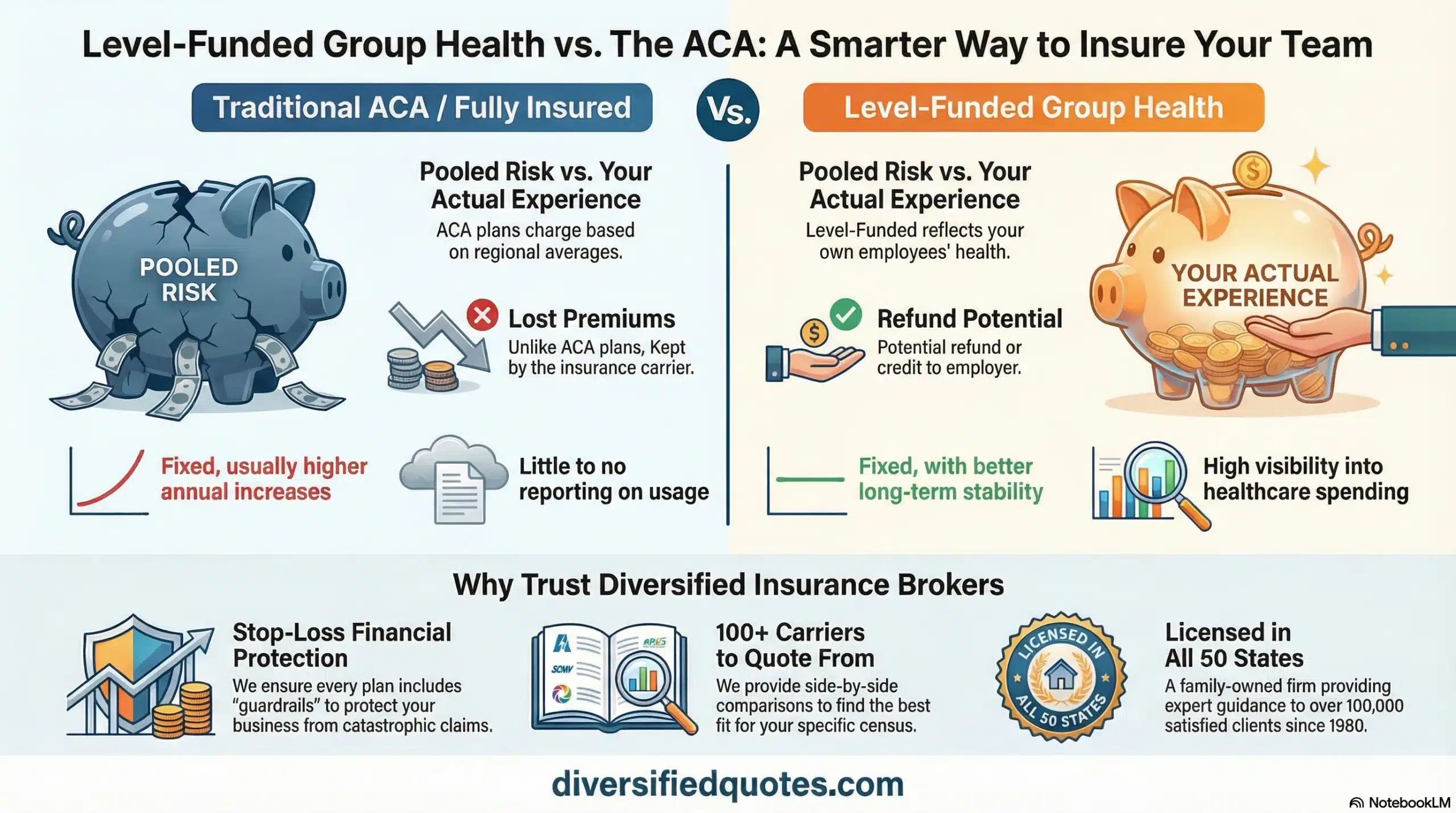
Understanding the differences between funding models helps you choose an approach that matches your risk tolerance, budget, and long-term goals. Here is a quick comparison to guide your evaluation, especially if you are considering whether level-funded is a better fit than a traditional fully insured plan.
| Feature | Fully-Insured | Level-Funded | Self-Funded |
|---|---|---|---|
| Premium predictability | High (fixed premiums) | High (set monthly, reconcile at year-end) | Medium (requires reserves and strong stop-loss) |
| Potential to recoup surplus | None | Yes (unused claims dollars may return) | Yes (claims savings stay with employer) |
| Administrative complexity | Low | Medium (TPA reporting and settlement) | Higher (active oversight) |
| Best fit scenarios | Very small teams; prefer simplicity | 2–50 employees; want savings with stability | Employers seeking customization and data control |
If you are evaluating coverage for a micro-group, it can help to review eligibility and documentation expectations specific to the smallest market segment. Start with 2-person group health insurance, and then review best group health insurance options for 2-person businesses for plan-structure considerations.
Why Level-Funded Plans Are Popular With Small Employers
Level-funded plans are popular because they solve two common small employer problems at the same time: they preserve budgeting stability while giving employers a clearer pathway to long-term cost control. The employer pays a steady monthly amount that typically includes expected claims funding, fixed administrative expenses, and stop-loss premium. In favorable claim years, many level-funded designs can return a portion of unused claims funding based on contract terms.
Stop-loss insurance is the safety net that makes this realistic for small groups. It protects against the kind of single large claim that could otherwise blow up the plan’s economics. If you want a plain-English walkthrough of how stop-loss is structured and what quote terms mean, start with understanding stop-loss insurance in level-funded plans.
Tax treatment, administrative fees, and how carriers structure their level-funded components can meaningfully change the net cost of coverage, so it helps to compare proposals using the same assumptions. A practical resource for understanding the “why” behind cost differences is level-funded health insurance tax benefits explained.
Compliance, Contributions, and Employee Communications
Small employers do not need more paperwork. They need the right paperwork, handled at the right time, with clear employee communication so the plan does not become a constant source of confusion. We help employers structure eligibility rules that match hiring pace, set contributions that support participation and affordability, and keep communications simple so employees understand how to use their benefits.
Contractors are a common friction point. If you are trying to support contractors while keeping the group plan compliant and underwritable, your strategy matters. It is usually better to keep the group plan clean for eligible W-2 employees and create separate pathways for contractors rather than forcing contractors into a structure carriers will not underwrite. If that scenario fits your business, revisit can 1099s get group level funding.
Employer eligibility rules are another common issue. Businesses often assume they qualify as a group, then discover documentation or employee classification issues late in the process. If you want to confirm the basics early, see minimum employees for group health insurance.
Three Fast Frameworks That Improve Small Group Plans Without Wrecking the Budget
Framework 1: Network and plan design alignment. Many small employers can improve employee satisfaction without increasing employer cost simply by choosing a network and plan design that matches where employees actually live and how they typically access care. That includes avoiding out-of-network surprises and choosing a design that employees can realistically afford to use.
Framework 2: Contribution strategy clarity. Some employers protect their budget and improve plan stability by shifting from a percentage-based contribution to a tiered flat-dollar approach. The point is not to pay less. The point is to make costs predictable and to keep employee contributions within a range that supports participation.
Framework 3: Level-funded pilot at renewal. For groups that are tired of fully insured renewal spikes, moving to a level-funded structure at renewal can be a practical middle step. It preserves a predictable monthly number, adds better transparency, and creates a potential pathway to savings when claims are favorable. The best pilots start with clean documentation and realistic expectations, then use the renewal cycle to measure whether the model fits long-term.
Want a Cleaner Renewal Strategy?
We’ll compare your current approach with level-funded options and show how eligibility, participation, and stop-loss affect real cost.
Request a Renewal ComparisonHow to Choose the Right Agent and the Right Plan
If you are searching for a small business group health insurance agent near you, you are probably looking for three things: you want the plan to be affordable, you want it to be compliant, and you want it to be easy to manage. Those goals are achievable when the quoting process starts with clean eligibility rules, accurate census information, and a clear decision lane. The biggest mistakes happen when employers try to compare too many unrelated variables at once or submit incomplete information that forces underwriting to reprice late in the process.
A good agent helps you decide in the right order. First, confirm eligibility and participation strategy. Second, choose the funding lane that matches risk tolerance (fully insured, level-funded, or self-funded). Third, compare plan designs and networks within that lane. Finally, implement with a communication plan that prevents confusion and reduces HR burden. If you want the employer questions that typically come up during this process summarized in one place, revisit top questions employers ask about group health insurance.
Request Small Business Group Health Quotes
Send your basic details and we’ll return side-by-side options with clear explanations and clean comparisons.
Request QuotesRelated Group Health Pages for Small Employers
Explore eligibility rules, funding models, level funding details, and employer-focused comparisons.
Talk With an Advisor Today
Choose how you’d like to connect—call or message us, then book a time that works for you.
Schedule here:
calendly.com/jason-dibcompanies/diversified-quotes
Licensed in all 50 states • Fiduciary, family-owned since 1980
FAQs: Small Business Group Health Insurance
How many employees do I need to qualify as a group?
In most states, you need at least two employees who are not married to each other. For details and documentation tips, see minimum employees for group health insurance.
Are level-funded plans available for very small groups?
Yes. Many carriers offer level-funded programs starting at two or three enrolled employees, with stop-loss to cap exposure and potential surplus refunds if claims run low.
What information is required to get quotes?
A simple census: employee ZIP codes, ages, dependent status, and desired effective date. A recent renewal packet helps us benchmark your current plan.
Can contractors be covered on our plan?
Contractor participation is limited. Review rules and alternatives in can 1099s get group level funding.
How do you keep costs manageable year over year?
Quarterly utilization reviews, smart network selection, Rx strategies, contribution design, and—when appropriate—moving to level-funded structures with stop-loss.
What’s the fastest way to start?
Submit your census through our secure form and we’ll build a side-by-side comparison. Start here: request small group quotes.
About the Author:
Jason Stolz, CLTC, CRPC and Chief Underwriter at Diversified Insurance Brokers (NPN 20471358), is a senior insurance and retirement professional with more than two decades of real-world experience helping individuals, families, and business owners protect their income, assets, and long-term financial stability. As a long-time partner of the nationally licensed independent agency Diversified Insurance Brokers, Jason provides trusted guidance across multiple specialties—including fixed and indexed annuities, long-term care planning, personal and business disability insurance, life insurance solutions, Group Health, and short-term health coverage. Diversified Insurance Brokers maintains active contracts with over 100 highly rated insurance carriers, ensuring clients have access to a broad and competitive marketplace.
His practical, education-first approach has earned recognition in publications such as VoyageATL, highlighting his commitment to financial clarity and client-focused planning. Drawing on deep product knowledge and years of hands-on field experience, Jason helps clients evaluate carriers, compare strategies, and build retirement and protection plans that are both secure and cost-efficient. Visitors who want to explore current annuity rates and compare options across multiple insurers can also use this annuity quote and comparison tool.
