
Social Security Spousal Benefits after Divorce

Social Security spousal benefits after divorce can be one of the most valuable “hidden” opportunities in retirement—especially if you spent years in a marriage where your ex-spouse earned more. In the right scenario, a divorced spouse can receive up to 50% of an ex-spouse’s Primary Insurance Amount (PIA) at Full Retirement Age (FRA). The challenge is that the rules are precise, the timing decisions are hard to undo, and filing the wrong way can permanently reduce lifetime income.
At Diversified Insurance Brokers, we help clients turn the rules into a clear plan: what you qualify for, the best month to claim, and how to coordinate divorced spousal, survivor planning, work income, and taxes. If you want the big-picture framework before diving into divorce-specific rules, start here: Maximize Social Security benefits.
Below you’ll learn what divorced spousal benefits really are, who qualifies, how the amount is calculated, how remarriage changes eligibility, and how to avoid the most common mistakes—especially deemed filing traps that can quietly lock you into a lower outcome.
Get Your Divorced Spousal Strategy
We’ll verify eligibility, estimate your benefit on both records, and map optimal timing—including restricted application and survivor coordination.
What “Divorced Spousal Benefits” Actually Mean
Divorced spousal benefits are Social Security benefits you may be able to claim on an ex-spouse’s work record while your ex is still living. This is different from divorced survivor benefits, which apply after an ex-spouse passes away and can be as high as the ex’s full benefit amount (depending on timing). Many people hear “spousal benefits” and assume it only applies to current marriages. Social Security has a separate path for divorced spouses—but you must meet eligibility rules and file correctly.
It’s also important to know what divorced spousal benefits are not. They do not reduce your ex-spouse’s benefit. They do not impact your ex’s current spouse. And they do not require your ex-spouse’s permission. If you qualify, Social Security can pay a divorced spouse benefit based on a prior marriage history and an ex-spouse’s earnings record.
Who Qualifies for Social Security Spousal Benefits After Divorce?
In most situations, you may qualify to claim on an ex-spouse’s record if the marriage lasted 10 years or longer, you are age 62 or older, and you are currently unmarried. Social Security also generally pays the benefit only when it provides you a higher amount than what you would receive on your own record at that time. If your own retirement benefit is higher, you typically receive your own benefit instead.
One rule that surprises many people is that your ex doesn’t always have to be collecting yet. If you’ve been divorced for at least two years, you can often claim a divorced spouse benefit as long as your ex is eligible to claim—even if they haven’t started benefits. That “independently entitled divorced spouse” concept can create opportunities when one person wants income earlier and the ex plans to delay.
Timing drives outcomes, so before choosing a filing month, it helps to understand how filing age changes the numbers. If you want a clear explanation of how waiting can increase your own retirement benefit, start here: Delayed Retirement Credits. And if you want to understand how applying for one benefit can “pull in” others, this is essential: Deemed filing rules.
How Much Can You Receive as a Divorced Spouse?
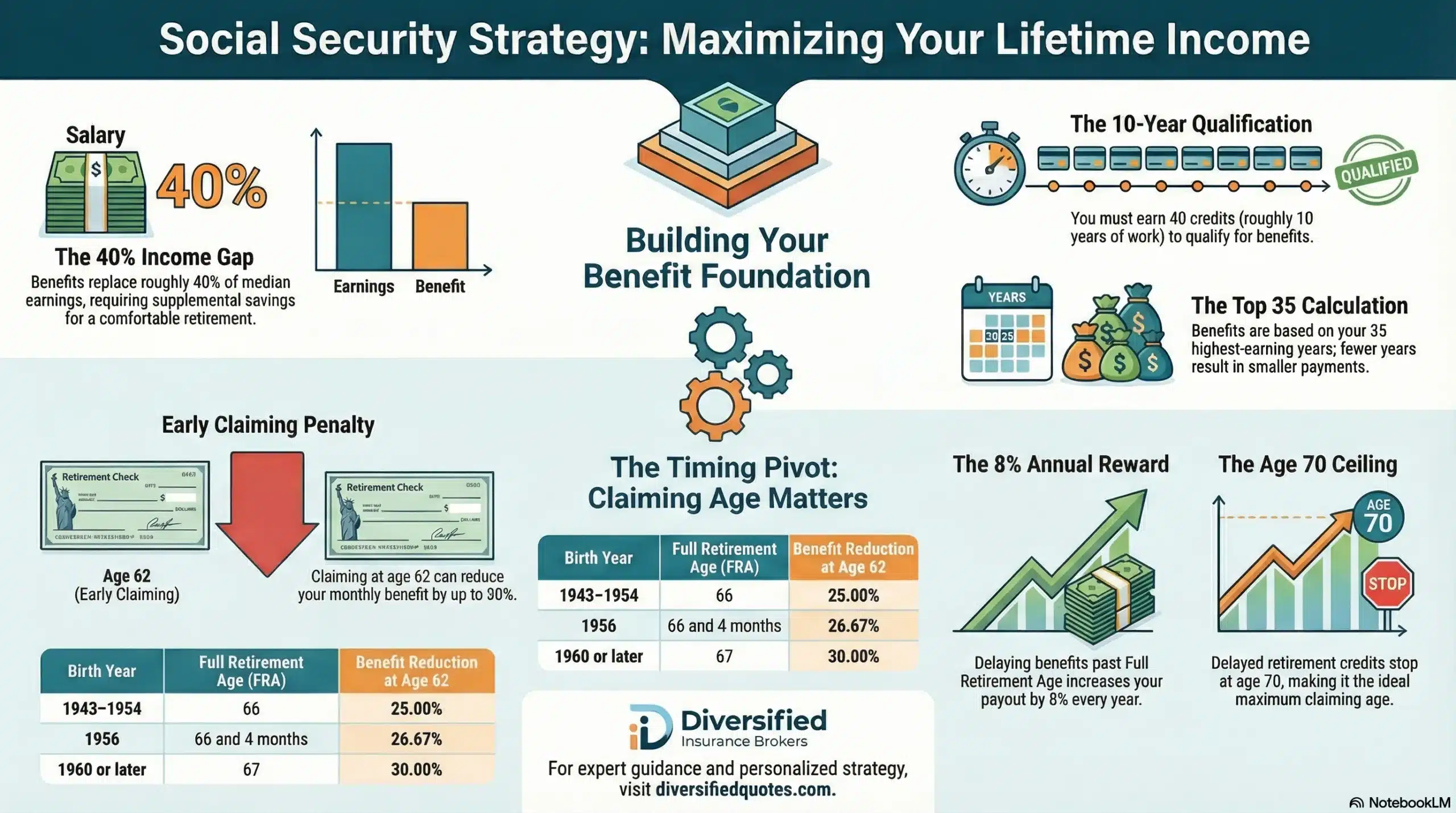
At Full Retirement Age (FRA), a divorced spousal benefit can be up to 50% of your ex-spouse’s PIA. The PIA is the ex-spouse’s benefit at their own FRA (not necessarily what they’re receiving if they claimed early or delayed). If you claim a divorced spousal benefit before your FRA, the spousal portion is reduced—sometimes significantly.
Here’s a key planning point: unlike your own retirement benefit, divorced spousal benefits do not earn delayed retirement credits after FRA. Waiting beyond FRA increases your own benefit (up to age 70), but it does not increase the spousal portion above the 50% level. That’s why the “best” plan often comes down to which benefit will be the long-term winner: your own record or the ex-spouse spousal amount.
Many divorced filers also have a work record of their own. Social Security often pays your own retirement benefit first, then adds a “top-off” spousal amount if you qualify for more. That is exactly why deemed filing matters—because once you apply, the system may treat you as applying for all benefits you’re eligible for at the time. If your payments change over time due to new earnings replacing lower years, this is the page that explains the mechanism: Social Security annual recomputation.
Timing Strategies After Divorce (How to Avoid Permanent Reductions)
Most divorced-spouse strategy comes down to one question: Should you claim at 62, at FRA, or later? Claiming at 62 can create income sooner, but it permanently reduces your retirement benefit—and it can reduce the divorced spousal portion as well. Claiming at FRA preserves the maximum divorced spousal benefit (up to 50% of the ex’s PIA). Delaying beyond FRA can be valuable when your own retirement benefit will ultimately be larger, because your own amount can increase up to age 70 through delayed retirement credits.
Some people may benefit from a “collect one benefit earlier, switch later” approach. Whether that is available depends heavily on birth year and eligibility rules that changed years ago. If you think you might qualify for the older spousal-only filing approach (in narrow situations), check: Restricted application eligibility. For a broader “how to pick the right age” guide that helps you compare 62, FRA, and 70 with real tradeoffs, use: When to start Social Security benefits.
Work income can also change the best plan. If you claim before FRA and continue working, the earnings test can temporarily withhold benefits and alter the “best” filing month. If you expect to work while collecting, review: Social Security income limits.
Remarriage Rules: Spousal vs Survivor (Not the Same)
Remarriage is one of the most important “forks in the road” after divorce. In general, remarriage ends eligibility for divorced spousal benefits on an ex-spouse’s record while the later marriage is in effect. If that later marriage ends (death, divorce, annulment), eligibility on the prior record may be restored if the other requirements are still met.
Survivor benefits are different. If your ex-spouse has passed away, divorced survivor benefits can be available, and remarriage rules are more flexible. Remarriage after age 60 typically does not disqualify divorced survivor benefits (and age 50 if disabled). This distinction matters because survivor benefits can be much larger than divorced spousal benefits, and a plan that ignores survivor rules can leave real money on the table.
Government Offsets That Can Reduce Divorced Spousal Benefits
If you have a pension from work where you did not pay into Social Security (certain teacher systems, some police/fire systems, and other non-covered government employment), you may be affected by the Windfall Elimination Provision (WEP) or the Government Pension Offset (GPO). WEP can reduce your own retirement benefit. GPO can reduce spousal or survivor benefits. These rules create some of the biggest “surprise reductions” we see, so it’s best to review them before you pick a filing date: Windfall Elimination Provision (WEP) and Government Pension Offset (GPO).
Even if you are unsure whether your pension is “covered” or “non-covered,” it is worth verifying before you file. When offsets apply, the best claiming sequence can change dramatically, and planning early helps you avoid a surprise reduction after benefits begin.
Step-by-Step: How to Claim as a Divorced Spouse
Social Security decisions are often difficult to undo, so the cleanest approach is to treat your claim like a checklist and confirm the key facts before submitting anything. If you want the filing walk-through itself, start here: How to apply for Social Security. Then use the divorce-specific steps below to confirm you’re taking the correct entitlement path.
Step 1: Confirm the 10-year rule and your exact divorce date. Have your marriage certificate and divorce decree accessible. If you don’t have your ex’s Social Security number, you can still file, but having identifying info can reduce delays.
Step 2: Confirm your Full Retirement Age and list your best “start month” options. FRA anchors the maximum spousal amount and determines how work income interacts with benefits. If you may work while collecting, review: Social Security income limits.
Step 3: Compare your own benefit vs the divorced spousal “top-off.” Many people assume the spousal benefit is separate. Often, it’s a combination: your own benefit plus an added amount if the spousal benefit is higher. This is where deemed filing can restrict future options, so understand it before filing: Deemed filing rules.
Step 4: Model taxes before you lock in a filing date. Social Security can become taxable depending on other income sources. Timing can influence which years are the most tax-expensive, especially when you’re coordinating retirement account withdrawals or part-time income. Start here: Reduce taxes on Social Security.
Step 5: File with the correct entitlement path and keep your confirmation details. Your application should clearly reflect divorced spouse eligibility. Save confirmation numbers, screenshots, and the selected start month so you can verify the final award.
Step 6: Re-check switching opportunities later. As your own benefit grows (or if your earnings record changes), switching can become attractive. If your ex-spouse passes away, divorced survivor benefits may become available and can change the best strategy.
Case Example: How the “Best Choice” Can Change
Maria is 62 and divorced after a 15-year marriage. Her FRA is 67. Her ex’s PIA is $3,200, so her maximum divorced spousal benefit at FRA could be up to $1,600. If she claims at 62, she locks in a reduced amount. If she waits to FRA, she preserves the maximum divorced spousal amount.
But Maria also has her own earnings record. If she delays her own retirement benefit, it can grow through delayed retirement credits up to age 70. If her age-70 benefit would exceed $1,600, then the long-term “winner” may be her own record, and the best plan might involve bridging income early while preserving the biggest lifetime check later. The “best” answer depends on cash flow needs, work plans, tax impact, and whether survivor planning is a factor. We run the scenarios side-by-side and map a filing month that fits the real-world timeline.
If you want a clean decision framework for choosing a filing age, this guide helps you evaluate longevity assumptions and breakeven points: When to start Social Security benefits.
Schedule a Free Consultation
We’ll review your filing age, work income, and start month—then help you avoid earnings-test surprises and coordinate taxes and Medicare.
Prefer to talk first? Call 800-533-5969
FAQs: Social Security Spousal Benefits after Divorce
Do I qualify for divorced spousal benefits?
Usually yes if your marriage lasted 10+ years, you’re 62+, you’re currently unmarried, and your own benefit is lower than the divorced spousal amount. If divorced 2+ years and your ex is eligible (even if not filed), you can often claim.
How much will I receive?
At FRA you can receive up to 50% of your ex’s PIA. Filing before FRA reduces the amount; filing after FRA won’t increase a spousal benefit (no delayed credits on spousal).
What if I remarry?
Remarriage generally ends eligibility for a divorced spousal benefit. For survivor benefits, remarriage after age 60 typically doesn’t disqualify you.
Can I file a restricted application?
If you were born on or before January 1, 1954, you may still have access to a restricted application at FRA (spousal only, switch later). See our eligibility guide.
What documents do I need to apply?
Proof of age/identity, marriage certificate, divorce decree, and your ex’s identifying details (name, DOB—SSN if available). We’ll help you prepare a clean submission.
About the Author:
Jason Stolz, CLTC, CRPC and Chief Underwriter at Diversified Insurance Brokers, is a senior insurance and retirement professional with more than two decades of real-world experience helping individuals, families, and business owners protect their income, assets, and long-term financial stability. As a long-time partner of the nationally licensed independent agency Diversified Insurance Brokers, Jason provides trusted guidance across multiple specialties—including fixed and indexed annuities, long-term care planning, personal and business disability insurance, life insurance solutions, and short-term health coverage. Diversified Insurance Brokers maintains active contracts with over 100 highly rated insurance carriers, ensuring clients have access to a broad and competitive marketplace.
His practical, education-first approach has earned recognition in publications such as VoyageATL, highlighting his commitment to financial clarity and client-focused planning. Drawing on deep product knowledge and years of hands-on field experience, Jason helps clients evaluate carriers, compare strategies, and build retirement and protection plans that are both secure and cost-efficient.
