
Travel Medical and Evacuation from Ireland

Jason Stolz CLTC, CRPC
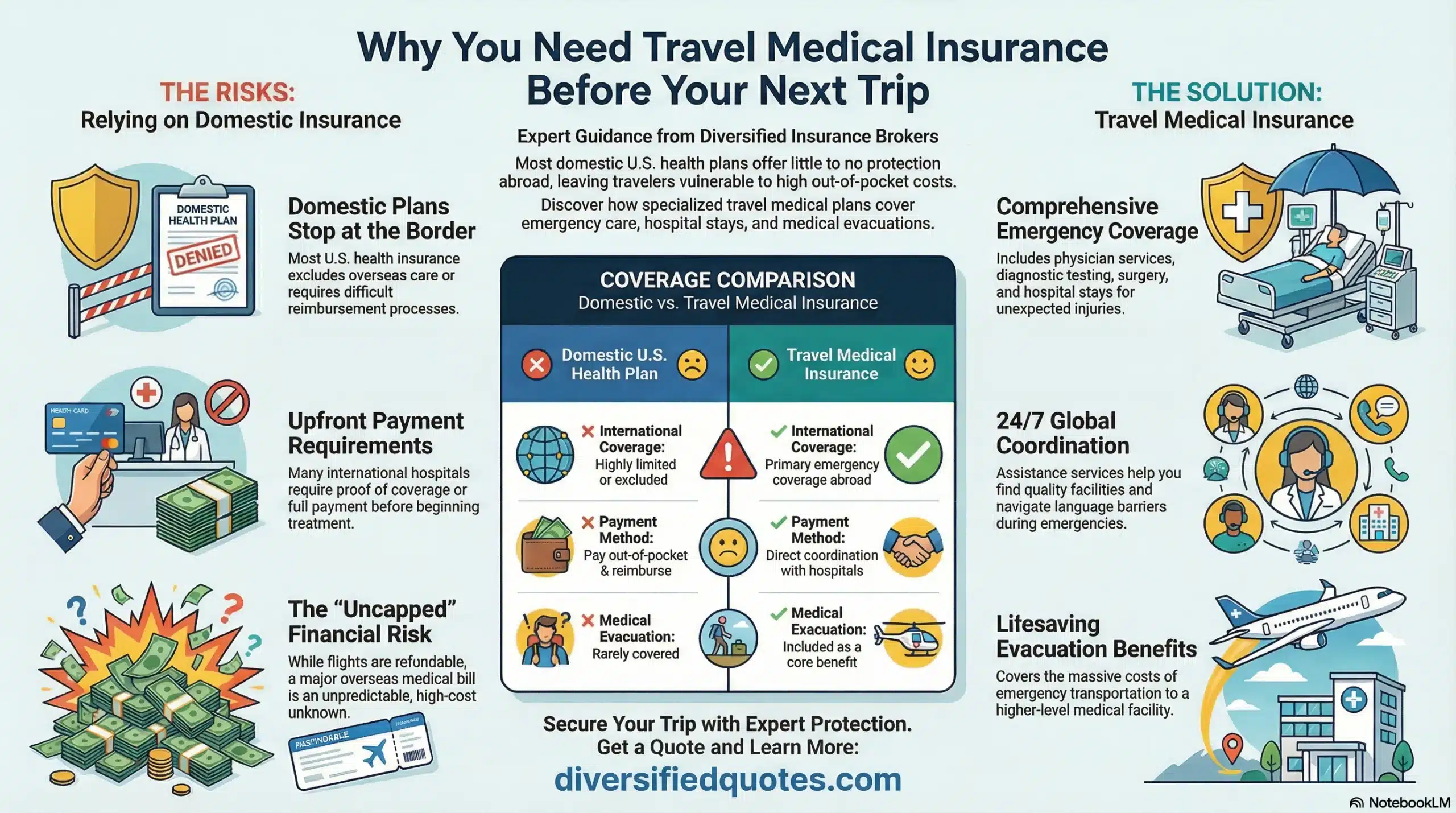
Travel Medical and Evacuation from Ireland is one of the simplest ways to protect your trip when you want real medical access, fast support, and the ability to get home safely if something goes wrong. Ireland is a popular destination for U.S. travelers, study abroad programs, business trips, and multi-country European itineraries. But even in a country with excellent medical infrastructure, the most expensive part of a travel disruption is rarely the flight change—it’s the medical bill, the logistics, and the uncertainty of “what happens next” when you’re sick or injured far from home.
At Diversified Insurance Brokers, we help travelers protect themselves with plans that focus on the two most important categories: medical treatment coverage and emergency evacuation support. The goal is not to overcomplicate travel insurance. The goal is to make sure a traveler has a clear plan for urgent care, emergency hospitalization, prescriptions, and—if needed—a medically coordinated trip to the right facility or back to the United States.
Most travelers don’t realize how often a “small” issue becomes a costly one overseas. A severe stomach infection, an asthma flare-up, a broken ankle, an unexpected ER visit, a short hospital admission, or even a simple urgent care visit can create a chain reaction: translation needs, unfamiliar payment policies, documentation requirements, and the stress of coordinating care in a different system. A strong travel medical plan can cut through that chaos by giving you both financial protection and 24/7 assistance coordination.
Some travelers assume their domestic insurance will handle everything. Others assume their credit card travel benefit will cover serious situations. The reality is that international medical billing often works differently than what U.S. families expect. Travel medical coverage is designed for emergencies during a defined trip window and can be the missing piece that keeps a medical situation from becoming a financial one.
Get Protected Before You Travel to Ireland
Compare travel medical coverage and emergency evacuation benefits in minutes.
If you’re building a travel protection plan, it helps to understand the difference between “travel insurance” and true travel medical coverage. Some policies lean heavily on trip cancellation and baggage delay. Those can be useful, but they do not replace strong medical coverage. If your priority is medical protection, you want a plan that clearly defines eligible treatment, emergency transportation rules, and how the assistance center helps coordinate care. You can also compare broader strategies in our guide to travel medical insurance.
Why travelers still buy travel medical coverage for Ireland
Ireland is one of the most traveled-to countries in Europe for U.S. visitors. It’s also a country where travelers frequently rent cars, explore rural areas, take long day trips, and move between regions quickly. While major cities have strong medical options, many trips involve driving routes where immediate access to the right facility depends on travel distance and timing. The risk is not that Ireland lacks good care—the risk is that travelers can find themselves needing care unexpectedly, with limited clarity on costs and paperwork.
A travel medical plan can help pay for eligible emergency treatment and provide an organized pathway to care. That includes things like evaluation, imaging, prescriptions, outpatient procedures, or hospital stays. Even when a traveler is treated quickly, the process of being billed as an international visitor can be surprising. A plan helps reduce out-of-pocket exposure and helps you avoid making decisions while stressed, sick, or injured.
Another reason travel medical matters is that many travelers are not traveling to Ireland alone. A spouse, parent, or adult child may be on the trip too. If one person becomes ill, the entire travel plan can shift overnight. Travel medical benefits can stabilize the situation financially while assistance services help coordinate next steps.
What travel medical insurance for Ireland typically covers
Travel medical coverage is designed for unexpected medical situations during your trip. This isn’t routine wellness care or elective treatment. It’s protection for emergencies and urgent situations that occur while you’re away from home. Depending on the plan design you choose, it may help cover doctor visits, urgent care, emergency room treatment, diagnostic testing, and hospital services.
Many travelers also want to know whether prescriptions are covered. Some plans include prescription benefits as part of eligible treatment, while others treat it as a separate limit or reimbursement structure. This is important because a short medical visit can easily turn into multiple expenses when medication is required for recovery.
A strong plan should also provide access to a support team you can contact when you’re overseas. If you’ve ever tried to arrange care while traveling, you already know how much time can be lost figuring out where to go, who can treat you, and how to document the situation properly. That coordination element is often the “hidden value” of travel medical coverage.
If you want to compare travel medical designs for common traveler needs, our overview of international travel health coverage can help you understand the major moving pieces.
What emergency evacuation coverage is really for
Emergency evacuation is one of the most misunderstood benefits in travel coverage. Many people assume “evacuation” means a helicopter ride from anywhere to anywhere at any time. In reality, emergency evacuation benefits are built around medical necessity and appropriate facility access. If a traveler needs to be transported to the nearest suitable medical facility, or needs medically supervised relocation due to the severity of the situation, evacuation coverage is designed to address those costs and logistics.
Evacuation is not just about distance. It’s about the complexity of the situation. A serious injury may require stabilized transport, medical staffing, equipment, and structured coordination—especially if the traveler needs to move from one facility to another. The cost of medically supervised transport can become substantial quickly, which is why evacuation benefits are often one of the most valuable pieces of the coverage even though it’s rarely used.
For travelers who want a deeper breakdown of what evacuation coverage can do, compare it to standard travel medical using our guide to emergency medical evacuation insurance.
Common real-life scenarios for Ireland trips
Travel medical and evacuation coverage becomes most valuable when the situation isn’t theoretical. It’s not always a dramatic emergency. It’s often a normal accident or illness that happens at the worst possible time—like the day before a flight home, on a weekend, or in the middle of a multi-city itinerary.
A traveler in Ireland might slip on wet pavement, twist a knee on uneven stone steps, get a respiratory infection that escalates quickly, experience dehydration that requires IV fluids, or have a pre-existing condition flare up due to fatigue and travel stress. Plans vary widely in how they treat pre-existing conditions, so if you know you’re traveling with a medical history, your plan selection matters more than your destination.
Travel coverage can also be essential for travelers over age 60 who want predictable access to care and help coordinating services abroad. If that fits your situation, you may also want to review travel medical insurance for seniors before choosing limits and plan design.
Compare Travel Medical & Evacuation Options
Pick coverage limits that match your itinerary, traveler age, and risk tolerance.
Choosing limits for Ireland travel medical coverage
One of the most important choices in a travel medical plan is selecting benefit limits that match your real situation. Many travelers default to the cheapest option, but the better approach is to choose limits that reflect the kind of trip you’re taking. A weekend city visit is different from a two-week road trip. A solo traveler is different from a family group. A healthy 25-year-old is different from a 72-year-old with a medication list.
In general, higher medical maximums can provide more comfort, especially when travelers are concerned about hospital-level events. Travelers should also look carefully at deductibles, because the deductible can change the feel of the plan. Some travelers prefer a higher deductible to lower cost. Others prefer a lower deductible so they can access care without second-guessing whether the visit is “worth it.”
Evacuation limits also matter. Evacuation is the category most travelers least want to “test” out-of-pocket. Even when evacuation is not used, choosing a plan with a strong evacuation structure can reduce stress because it creates a clear plan if the situation escalates.
Pre-existing conditions and Ireland travel coverage
Pre-existing conditions can be the biggest difference-maker in how travel medical plans perform in real life. Every carrier defines “pre-existing” differently. Some plans focus on lookback windows. Others use stability language. Some rely on “acute onset” wording. The details matter because the goal is not to argue about coverage after something happens—the goal is to pick the right plan before departure.
If you’re traveling with a known medical history, the smartest approach is to treat plan selection as part of your travel planning checklist. That includes confirming how the plan defines a pre-existing condition, what exceptions exist, and what documentation is required if you need care abroad.
If you want a broader planning view (especially if your trip includes multiple countries), our guide to international travel health coverage can help you evaluate how territory rules and trip structures interact with coverage eligibility.
How claims and reimbursement usually work
Claims processes vary by plan, but travelers generally do best when they treat documentation as part of the emergency response. That means keeping itemized bills, collecting proof of payment, saving discharge summaries when available, and writing down dates and provider details. The easier it is to show what happened and what was charged, the smoother reimbursement typically becomes.
Some travelers assume they can “figure it out later,” but overseas documentation can be difficult to track down after the fact. The best practice is to ask for paperwork before leaving the facility, even if you’re tired or stressed. It’s also useful to keep digital photos of documents in case paper copies are lost during travel.
In many cases, travelers will also use assistance services while they’re abroad to help locate appropriate providers and confirm what to do next. That can be helpful not only for treatment access, but also for documenting the claim correctly from the beginning.
When a travel medical plan is the best fit
Travel medical coverage is a strong fit when your goal is to reduce financial uncertainty and protect your travel experience. It’s especially valuable when your domestic coverage is limited overseas, when you’re traveling with family members, when you’re planning rural exploration, or when you want the ability to respond quickly without worrying about immediate costs.
It can also be useful if your itinerary includes multiple European countries and the trip is more complex than a single-city visit. Travel coverage doesn’t replace good planning, but it creates a safety net that makes the “unexpected” more manageable.
For travelers who want additional emergency-focused coverage options, you can compare designs in our guide to emergency travel health insurance.
Why travelers use Diversified Insurance Brokers
Travel medical coverage can look simple on the surface, but the details determine whether the plan is actually useful when you need it. Our job is to help travelers choose coverage that matches their trip and their risk profile. We also focus on clarity: what is covered, what isn’t, how evacuation works, and what steps you take if you need help overseas.
If your trip includes additional destinations beyond Ireland, or if you’re comparing broader travel medical options, you can also explore our main hub page for short-term and travel medical resources.
Ready to Lock In Ireland Travel Coverage?
Choose your dates, compare benefits, and enroll online.
Related Travel Medical Pages
Continue exploring travel medical coverage and evacuation topics that may apply to your trip planning.
Related Destination Pages
Destination-specific travel medical pages for different travel profiles and safety needs.
Talk With an Advisor Today
Choose how you’d like to connect—call or message us, then book a time that works for you.
Schedule here:
calendly.com/jason-dibcompanies/diversified-quotes
Licensed in all 50 states • Fiduciary, family-owned since 1980
FAQs: Travel Medical and Evacuation from Ireland
Do I need travel medical insurance for Ireland if it’s considered a safe destination?
Many travelers still choose coverage because medical issues can happen anywhere. The goal is to avoid unexpected out-of-pocket costs and to have support coordinating care if you need treatment while abroad.
What does a travel medical plan usually cover in Ireland?
Travel medical coverage typically focuses on emergency treatment during the trip, such as urgent care visits, ER treatment, testing, and hospitalization when medically necessary.
What’s the difference between emergency evacuation and repatriation?
Emergency evacuation generally refers to medically necessary transport to an appropriate facility, while repatriation can refer to medically supervised return travel home when required.
Will I be covered if I travel outside Dublin into rural areas?
Most plans cover you throughout Ireland, but assistance services become more important when you’re farther from major medical centers because they help coordinate care and transport decisions.
How do pre-existing conditions work for Ireland travel medical plans?
Plan rules vary widely. The best approach is to review how the plan defines a pre-existing condition and whether any timing or eligibility rules apply before you purchase coverage.
Can I buy coverage if Ireland is only one stop in a multi-country trip?
Many travel medical plans cover multiple countries during the same trip dates, but it’s important to confirm territory rules and make sure your coverage dates match your full itinerary.
What should I do if I need medical care while I’m in Ireland?
If it’s an emergency, seek immediate treatment first. For non-emergency situations, using the plan’s assistance services can help you find appropriate care and understand documentation needs.
Do I have to pay out of pocket and get reimbursed?
It depends on the plan and provider. If you do pay out of pocket, keep itemized bills, proof of payment, and clinical notes so your claim is easier to process.
Is travel medical insurance worth it for a short Ireland trip?
For many travelers, yes. Even short trips can produce unexpected medical needs, and the value often comes from both the coverage and the assistance coordination support.
Does travel medical coverage replace my U.S. health insurance?
No. Travel medical coverage is designed for emergencies while traveling. It does not replace domestic health insurance and typically does not cover routine care outside the trip’s purpose.
About the Author:
Jason Stolz, CLTC, CRPC and Chief Underwriter at Diversified Insurance Brokers (NPN 20471358), is a senior insurance and retirement professional with more than two decades of real-world experience helping individuals, families, and business owners protect their income, assets, and long-term financial stability. As a long-time partner of the nationally licensed independent agency Diversified Insurance Brokers, Jason provides trusted guidance across multiple specialties—including fixed and indexed annuities, long-term care planning, personal and business disability insurance, life insurance solutions, Group Health, and short-term health coverage. Diversified Insurance Brokers maintains active contracts with over 100 highly rated insurance carriers, ensuring clients have access to a broad and competitive marketplace.
His practical, education-first approach has earned recognition in publications such as VoyageATL, highlighting his commitment to financial clarity and client-focused planning. Drawing on deep product knowledge and years of hands-on field experience, Jason helps clients evaluate carriers, compare strategies, and build retirement and protection plans that are both secure and cost-efficient. Visitors who want to explore current annuity rates and compare options across multiple insurers can also use this annuity quote and comparison tool.
