
Travel Medical and Evacuation from Spain

Jason Stolz CLTC, CRPC
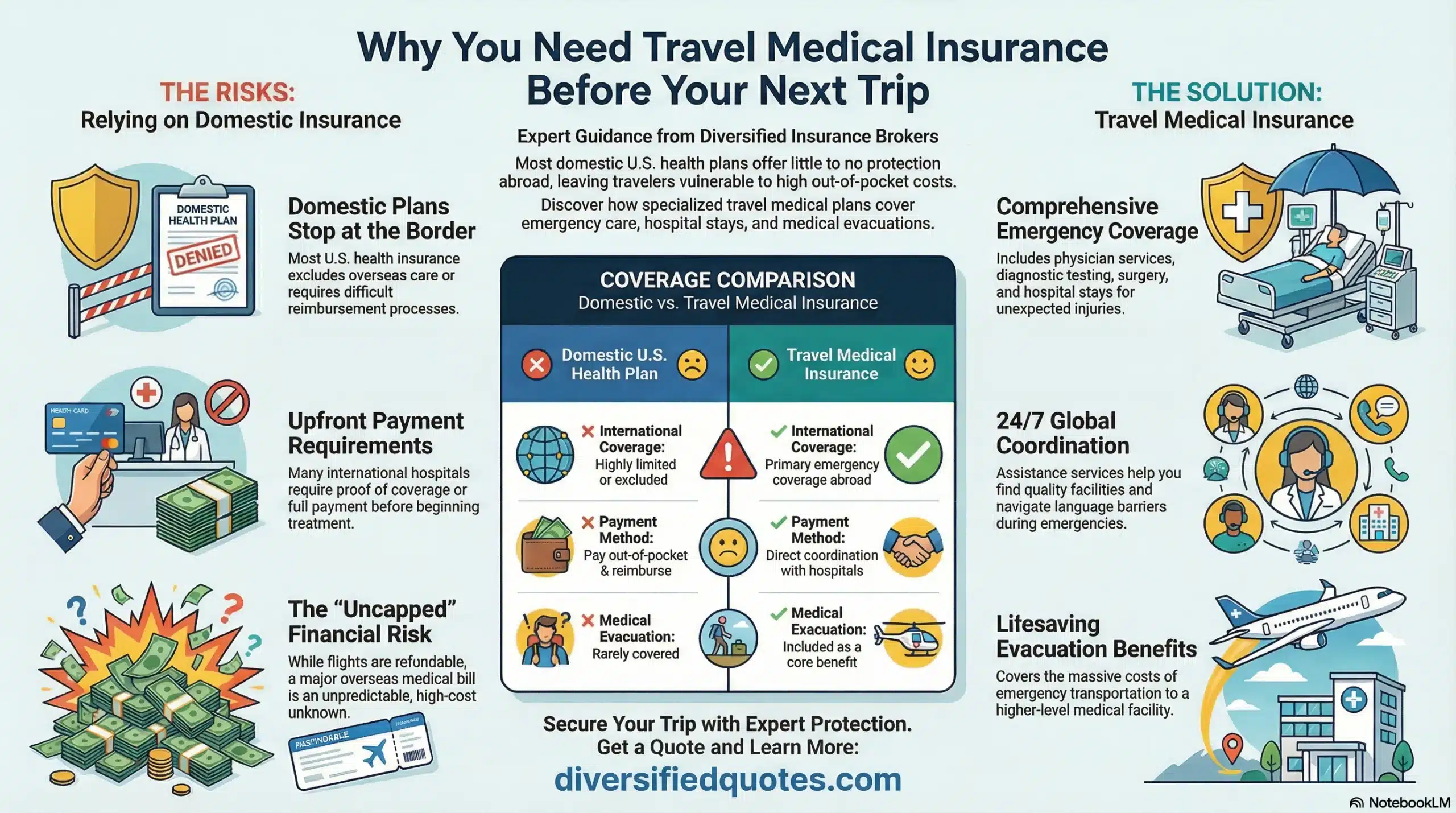
Traveling to Spain is usually straightforward, but medical surprises rarely happen on a schedule. A stomach bug that turns into dehydration, a slip on wet stone steps, a scooter accident, or a sudden flare-up of a chronic condition can create a situation where you need care quickly—often in a city you’ve never visited, in a language you don’t speak fluently, while your credit card company starts pinging you about large charges. Travel medical and evacuation coverage from Spain is built for those “what if” moments. It’s designed to help protect your savings, reduce friction when you need care, and make it easier to get the right level of treatment without turning the trip into a financial crisis.
At Diversified Insurance Brokers, we help travelers compare plans that cover emergency medical treatment in Spain and plans that also include medical evacuation—because those are two different problems. A plan can pay for an ER visit in Madrid and still leave you exposed if you need to be transported to a higher level of care, moved to another facility, or returned home with medical supervision. The goal is to choose coverage that matches how you travel: your length of stay, the activities you’ll be doing, your age, and whether you have a health history that changes the risk profile.
Spain has an excellent healthcare reputation, especially in major metro areas, but travelers should not confuse “good healthcare” with “free healthcare.” Tourists often pay out-of-pocket unless they have coverage. Even when charges are reasonable compared to some U.S. pricing, it only takes one emergency, hospitalization, or specialized transfer to make the trip unexpectedly expensive. If you want to understand how travel plans are structured at a high level before you pick a specific option, start with our overview of travel medical insurance.
Get a Travel Medical Plan for Spain
Choose coverage for emergency medical care, evacuation, and trip length—then enroll online.
What “travel medical and evacuation” actually covers from Spain
Most travelers think of coverage as a single thing: “insurance for my trip.” In reality, the protections you care about fall into a few separate buckets. The first bucket is emergency medical treatment—doctor visits, urgent care, diagnostic testing, ER treatment, hospital stays, and prescriptions that result from a covered illness or injury. The second bucket is medical evacuation and transport, which is about moving you to the right facility when the local option isn’t appropriate, or moving you home when you’re medically stable enough to travel but still need support. The third bucket is assistance services—the operational side that helps you find care, coordinate bills, translate where needed, and organize logistics. Many travelers don’t realize that the assistance component is often what makes a stressful situation manageable.
It also helps to be clear about what travel medical coverage is not. It’s not long-term international health insurance for living abroad indefinitely, and it’s not designed to cover routine checkups or elective procedures. It’s built for unexpected problems that happen during a defined trip. If you’re comparing different styles of coverage (for example, a plan meant for a short vacation vs. a longer stay), our guide on international travel health coverage can help clarify how plan types differ in structure and intent.
Why Spain trips create a different risk profile than “ordinary” domestic travel
Even if Spain feels familiar, the risk profile changes as soon as you leave your home system. You’re navigating unfamiliar transportation, unfamiliar street layouts, different pharmacy processes, and a healthcare environment where billing may be handled differently than what you’re used to. Add a time-zone shift, jet lag, more walking than usual, and local foods that your system isn’t accustomed to, and you’re already increasing your odds of needing some kind of care—even if it’s minor.
Travel also tends to compress decision-making. At home, you might call your doctor, wait for an appointment, or drive to your preferred urgent care. Abroad, you’re choosing between facilities with limited context, trying to decide whether you need immediate help, and sometimes deciding how to pay. A travel medical plan is partly about dollars, but it’s also about removing friction so you can focus on getting better instead of negotiating logistics.
Emergency medical care in Spain: what travelers should know
Spain’s system includes both public and private care, and travelers often use private clinics or hospitals for speed and convenience. In major cities and tourist regions, you can usually access competent care quickly. But the real issue isn’t whether good care exists—it’s whether you can get into the right place smoothly and whether you’ll be comfortable with the financial side of it if you don’t have coverage. Travelers who assume “my credit card will handle it” often discover that some costs have to be paid up front and reimbursed later, and reimbursements can become complicated if documentation is incomplete.
A good travel medical plan can help by paying eligible costs directly or reimbursing you based on covered expenses, depending on how the plan is structured. It can also provide assistance that helps you locate an appropriate facility and confirm what paperwork you need to keep. That’s especially important when your care escalates beyond a simple clinic visit into imaging, a hospital observation stay, or a specialized referral.
Medical evacuation: the part that creates the biggest financial exposure
Most travelers think of evacuation as a dramatic helicopter scenario. In real life, evacuation decisions are often more ordinary but still financially meaningful. Evacuation might mean a medically supervised transport from a smaller facility to a better-equipped hospital in a major city. It might mean arranging a commercial flight home with medical clearance and support. In more serious situations, it could involve air ambulance coordination. The key point is that transport is not the same as treatment, and many people mistakenly assume that if medical bills are covered, transport is automatically covered too.
If you want a deeper breakdown of how evacuation coverage is typically defined, what “medically necessary” means in plan language, and why assistance coordination matters as much as the benefit limit, review emergency medical evacuation insurance.
For a trip to Spain, evacuation is less about a lack of hospitals and more about matching the level of care to your situation. If you have a complicated injury, a neurological event, a cardiac emergency, or a situation where a specialist team is needed, the “right facility” may not be the nearest facility. Evacuation coverage exists to remove the financial barrier to getting you where you can receive appropriate care.
Pre-existing conditions: how to think about coverage the right way
Many travelers have some form of health history—blood pressure medication, cholesterol management, a past surgery, asthma, diabetes, or ongoing monitoring for a condition that’s stable. That doesn’t mean you can’t get travel coverage. It does mean you should pay attention to how plans treat pre-existing conditions, because definitions and eligibility windows can vary. The important thing is not just whether a plan says “pre-existing conditions covered,” but how it defines them, what “acute onset” means, and whether you must meet specific enrollment timing requirements relative to your trip.
If you want to compare the way plans tend to handle stable conditions versus more recent changes in treatment, start with travel medical insurance for pre-existing conditions. This helps set expectations before you assume you have (or don’t have) protection.
A practical approach is to be honest about what you’re trying to protect. If your main worry is an entirely new event—injury, infection, food poisoning, a fall—most plans address that risk well. If your main worry is a flare-up of a known condition, you’ll want to evaluate plan language more closely and choose coverage that matches your situation, not just the cheapest monthly premium.
Older travelers: why the plan design matters more than the destination
Spain is a great destination for retirees—walkable cities, accessible transit, beautiful coastlines, and an easy rhythm of travel. But for older travelers, the plan design matters because the probability of needing care rises with age, and the cost of a complicated event can rise quickly. That doesn’t mean you should buy the biggest plan available by default. It means you should be intentional about deductibles, maximums, and evacuation limits, and you should avoid plan designs that leave you with large gaps if you need hospitalization.
For an age-specific lens on how coverage is commonly structured, see travel medical insurance for seniors. The goal is to align benefits and assistance services with the realities of how medical events tend to unfold for older travelers—not just the marketing headline of the plan.
Students, longer stays, and study abroad travel patterns
Spain is one of the most popular study-abroad destinations in Europe, and student travel risk looks different than a two-week vacation. Students are often abroad longer, have more day-to-day exposure to routine health needs, and may travel around Europe while they’re there. A plan that works for a ten-day trip can be the wrong fit for a semester-long stay. The same is true for internships, language programs, and multi-country itineraries that include Spain as one stop.
If you’re planning around a student schedule, compare plans using a study-abroad lens and review travel medical insurance for studying abroad. Even when the destination is “low drama,” the time horizon changes the odds of something happening, and it changes what you want from your coverage.
Volunteer trips and group travel: what changes in the risk picture
Volunteer travel and group travel often create more moving parts: multiple travelers, coordinated schedules, and activities that are more physically demanding than typical sightseeing. Even in Spain, group itineraries can include hiking, cycling, coastal excursions, or travel between rural villages. Group leaders also care about operational simplicity—how quickly someone can access care, what documentation is needed, and what support is available when a participant is injured or ill.
If you’re planning a service trip or you’re coordinating coverage for a group that includes Spain, compare options with a volunteer framework using travel medical insurance for volunteer groups. The objective is to reduce the chance that a single medical event derails the entire trip.
Compare Coverage for Spain in Minutes
If you want the plan that fits your trip length, age, and activity level, start with a side-by-side view of options.
What to look for in a Spain travel medical plan
Most plan comparisons start with the premium, but the premium is only meaningful when you understand what it buys. A better approach is to start with the trip scenario. Are you doing major walking each day? Are you renting a car or using trains? Are you doing adventure activities? Are you traveling with children or older parents? Are you visiting multiple countries, or staying primarily in Spain? Then you match coverage to that scenario.
From there, focus on a few core elements. First, the medical maximum should be realistic for the downside risk you’re trying to protect. Second, the deductible should be an amount you’re comfortable paying without stress if something happens early in the trip. Third, the evacuation benefit should match your risk tolerance for transport exposure. Fourth, the plan should include assistance services that you’d actually want to use—especially if a situation escalates beyond routine care.
If you want to understand how plans earn interest or behave like annuities, that’s a different category of protection entirely. Travel medical is not an investment tool. It’s a risk transfer tool. The goal is to prevent a medical event from turning into a financial event, and to make it easier to get care without hesitation.
How claims and reimbursement tend to work in real life
Travel medical claims can feel intimidating if you’ve never dealt with one. The practical reality is that the process usually comes down to documentation. You want itemized bills, clinical notes if available, and proof of payment if you paid out of pocket. Many travelers struggle because they leave Spain without collecting complete paperwork, then they try to reconstruct details later. The easiest way to avoid that problem is to assume you’ll need documents and ask for them at the point of service.
Another important point is timing. Some services can be coordinated by the assistance team, and that coordination can simplify billing. In more urgent situations, you may pay and then file a claim afterward. Either way, good documentation is what protects you. That’s also why we prefer travelers to choose a plan before departure—because last-minute decisions tend to produce the wrong coverage and messy paperwork later.
Common situations that trigger medical care in Spain
Most Spain travel medical claims are not dramatic. They’re typical travel issues that are inconvenient, uncomfortable, and costly enough to matter. Gastrointestinal illness is common because your routine changes, your diet changes, and your schedule changes. Falls happen because Spain’s older neighborhoods have uneven stone paths, slick surfaces in rainy weather, and stairs that aren’t designed like modern U.S. buildings. Respiratory issues happen because travelers underestimate how tiring the first few days can be, especially after long flights and poor sleep. And basic infections happen because travel compresses personal space—planes, trains, crowded venues, and close quarters.
These issues are exactly what travel medical plans are intended to handle. The coverage is not about predicting the exact event. It’s about recognizing that travel increases variance, and being prepared for outcomes that are unlikely at home but more plausible abroad.
Why evacuation coverage is still relevant in a “safe” destination
It’s reasonable to think that Spain doesn’t require evacuation planning because it has strong hospitals. The catch is that evacuation isn’t just about the destination; it’s about the mismatch between your needs and the local resources at the moment you need them. If you’re on an island, in a rural region, or far from a major hospital, your local option may be limited. If you need a particular specialist team, your nearest facility might not be the right facility. And if your family preference is to recover at home, medically supervised return travel can be complex.
Evacuation is also a “tail risk” cost. Most people won’t use it, but the people who do can face large bills without it. The goal is to decide whether you want to self-insure that tail risk or transfer it to a plan that includes the benefit.
How Diversified Insurance Brokers approaches travel medical planning for Spain
We keep this simple. We start with your trip details: ages, dates, destinations, activities, and any health history that changes the risk picture. Then we match your scenario to plans that fit the time horizon and your risk tolerance. We also help you avoid a common mistake: buying a plan that looks good on a summary page but creates gaps in the specific scenario you’re worried about.
For Spain travel, we typically focus on clean plan design, clear evacuation benefits, realistic medical maximums, and good assistance services. The outcome we want is the same outcome you want: you travel confidently knowing that if a problem shows up, you can handle it without hesitation.
Related Travel Medical Pages
Explore plan types, trip scenarios, and coverage structures that commonly apply to Spain travel.
Related Destination Pages
If you’re building a multi-country itinerary, these destination guides can help you compare requirements and plan design.
Ready to Lock In Spain Coverage?
Enroll online and travel with a plan that can handle emergencies and evacuation needs.
Talk With an Advisor Today
Choose how you’d like to connect—call or message us, then book a time that works for you.
Schedule here:
calendly.com/jason-dibcompanies/diversified-quotes
Licensed in all 50 states • Fiduciary, family-owned since 1980
FAQs: Travel Medical and Evacuation from Spain
Do I need travel medical insurance for Spain if the healthcare system is good?
Spain has strong medical care, but travelers are usually responsible for costs unless they have coverage. A travel medical plan helps pay eligible emergency treatment and can also provide assistance services that make it easier to locate care and handle documentation.
What’s the difference between travel medical coverage and medical evacuation coverage?
Travel medical coverage focuses on treatment costs like doctor visits, ER care, testing, and hospitalization. Medical evacuation coverage addresses transport to an appropriate facility or medically supervised return travel when it’s necessary.
Does a plan cover me anywhere in Spain, including islands and rural areas?
Coverage typically applies throughout Spain, but assistance coordination and transport options can matter more in remote areas. If you’re traveling to islands or planning rural excursions, look closely at how the plan defines evacuation and how assistance services coordinate care.
How do pre-existing conditions work with Spain travel medical plans?
Plans define pre-existing conditions differently and may include specific eligibility windows or requirements. If you’re traveling with a known health history, focus on how the plan defines a pre-existing condition, what “acute onset” language means, and whether any timing rules apply.
Will I have a waiting period before coverage starts?
Many travel medical plans are effective based on the dates you select and payment/issuance rules. The “waiting period” concept is more common in guaranteed issue life insurance than travel medical, but some travel plans have specific provisions for certain benefits. Always rely on the plan’s certificate for exact timing.
What should I do if I need care while I’m in Spain?
If it’s an emergency, seek immediate care first. For non-emergency situations, use the plan’s assistance resources when possible so you can be directed to an appropriate facility and understand what documentation to collect for claims.
How do claims usually work if I pay out of pocket?
Keep itemized bills, proof of payment, and any clinical notes you can obtain. Reimbursement often depends on documentation. If you can, collect paperwork before you leave the facility so you aren’t trying to reconstruct details later.
Is travel medical insurance worth it for a short Spain trip?
For many travelers, yes—because even short trips can produce unpredictable medical needs. The value is strongest when you want to avoid out-of-pocket exposure and you want access to assistance services if something happens.
Does travel medical coverage replace my U.S. health insurance?
No. Travel medical is designed for emergencies during the trip. It’s not a replacement for domestic coverage, and it typically doesn’t cover routine care or ongoing treatment outside the trip’s scope.
Can I buy coverage if my trip includes multiple European countries, not just Spain?
Many plans cover travel across multiple countries, but you should confirm the territory rules and the dates of coverage. If your itinerary changes frequently, pick a plan built for flexible multi-country travel rather than a narrow design.
About the Author:
Jason Stolz, CLTC, CRPC and Chief Underwriter at Diversified Insurance Brokers (NPN 20471358), is a senior insurance and retirement professional with more than two decades of real-world experience helping individuals, families, and business owners protect their income, assets, and long-term financial stability. As a long-time partner of the nationally licensed independent agency Diversified Insurance Brokers, Jason provides trusted guidance across multiple specialties—including fixed and indexed annuities, long-term care planning, personal and business disability insurance, life insurance solutions, Group Health, and short-term health coverage. Diversified Insurance Brokers maintains active contracts with over 100 highly rated insurance carriers, ensuring clients have access to a broad and competitive marketplace.
His practical, education-first approach has earned recognition in publications such as VoyageATL, highlighting his commitment to financial clarity and client-focused planning. Drawing on deep product knowledge and years of hands-on field experience, Jason helps clients evaluate carriers, compare strategies, and build retirement and protection plans that are both secure and cost-efficient. Visitors who want to explore current annuity rates and compare options across multiple insurers can also use this annuity quote and comparison tool.
