
When Should You Start Taking Social Security Benefits?
One of the most important retirement decisions you will ever make is when to begin drawing your Social Security benefits. While you can claim as early as age 62, your monthly payment will be permanently reduced if you do. On the other hand, waiting until full retirement age—or even age 70—can significantly increase your lifetime income. The key question is not simply “When can I file?” but rather, “How does this decision fit into my complete retirement income strategy?” Social Security is not an isolated choice. It interacts with taxes, Medicare timing, spousal and survivor planning, retirement account withdrawals, annuities, continued employment, and your long-term income security. Getting this decision right can mean the difference between running tight later in retirement and creating a durable, inflation-adjusted income foundation that supports you and your spouse for decades.

Many retirees underestimate how permanent this choice is. Once you claim, your benefit level is largely locked in for life, subject only to cost-of-living adjustments. That filing age also affects spousal benefits and survivor income. For married couples, this is not one decision—it is a coordinated strategy involving two lifetimes. For single individuals, it can determine whether later-life income feels stable or strained. For self-employed individuals, filing timing can be even more nuanced due to income patterns and tax coordination, which we outline in more detail here: Social Security benefits for self-employed individuals. The “right” claiming age depends on your health, longevity expectations, income needs, tax environment, work status, and the structure of your overall retirement plan.
If you claim at 62, your benefit may be reduced by as much as 25–30% compared to your full retirement age (FRA) benefit. FRA varies depending on birth year, generally between 66 and 67 for most current retirees. If you delay beyond FRA, you earn delayed retirement credits—approximately 8% per year until age 70. That increase is permanent. For someone with strong longevity expectations or a spouse who may outlive them, those delayed credits can substantially improve lifetime household income. The increase is not just theoretical—it directly boosts the surviving spouse’s income if you are the higher earner. That’s why coordinating filing decisions is critical for married couples and widows, and why we provide additional strategy guidance here: Strategies for claiming Social Security for widows and survivor benefits.
However, delaying is not automatically “better.” If you need income immediately to reduce withdrawals from retirement accounts, claiming earlier may preserve investment assets. If your health is uncertain or longevity expectations are lower, claiming sooner may provide greater lifetime value. If you continue working before FRA, the earnings test may temporarily reduce benefits, adding complexity to the timing decision. And if you delay Social Security while drawing from IRAs or 401(k)s, you may be able to strategically manage taxes in lower-income years before required minimum distributions begin. Every decision has tradeoffs.
One of the most overlooked elements of Social Security planning is tax coordination. Social Security benefits can be taxable depending on your combined income. Filing earlier or later changes how benefits interact with IRA withdrawals, Roth conversions, pensions, and annuity income. Sometimes delaying Social Security while strategically withdrawing from retirement accounts can smooth your long-term tax burden. Other times, claiming earlier reduces pressure on investment portfolios during volatile markets. Social Security planning is not just about maximizing the check—it’s about optimizing your entire income structure.
Another key consideration is Medicare timing. Most Americans become eligible for Medicare at 65, regardless of when they claim Social Security. Filing for Social Security does not automatically mean you should file for Medicare at the same time, and vice versa. Coordinating Medicare enrollment with your Social Security strategy is essential to avoid penalties and gaps in coverage. For a deeper look at how Medicare timing integrates with retirement income planning, review What to Know Before You Enroll in Medicare and our comparison guide: Medicare Advantage vs. Medicare Supplement.
For married couples, strategy matters even more. The higher earner’s decision often determines the survivor’s long-term protection. If the higher earner delays benefits to age 70, the surviving spouse inherits that larger inflation-adjusted income. If the higher earner claims early, the reduced benefit may permanently lower survivor income. In households where one spouse earned significantly more, this becomes a cornerstone planning decision. Even the sequencing of who claims first can impact total household income. Couples who treat Social Security as a joint lifetime income strategy—rather than two separate filing decisions—often create significantly stronger long-term outcomes.
Single retirees face a different dynamic. Without survivor considerations, the decision becomes more directly tied to longevity and income needs. If you expect to live well into your 80s or 90s, delaying may increase lifetime benefits substantially. If you need income immediately or have shorter longevity expectations, claiming earlier may be reasonable. But even then, the decision should integrate with retirement account withdrawals, annuity income, pensions, and investment strategy.
Many retirees also overlook the role of guaranteed income layering. Social Security forms the inflation-adjusted base of retirement income. Some retirees supplement that base with pensions or annuity income strategies to create stable monthly cash flow. When structured correctly, layering guaranteed income sources can reduce market stress and provide clarity around spending. In those cases, delaying Social Security may strengthen the long-term income foundation. In other cases, early filing reduces pressure on investment accounts during early retirement years. Coordination—not guesswork—is what produces confidence.
Another major mistake is filing based on a single rule of thumb. “Always wait until 70.” “Always claim at 62.” “Take it as soon as you can.” These simplified answers ignore personal variables. Health, marital status, employment, taxes, asset mix, pensions, required minimum distributions, and survivor planning all matter. Even psychological comfort with risk plays a role. Some retirees value receiving benefits earlier for peace of mind. Others prefer locking in the highest possible future income. Both approaches can be valid—if they fit the broader strategy.
At Diversified Insurance Brokers, we approach Social Security filing decisions as part of a coordinated retirement income strategy. We look at your expected expenses, other income sources, tax exposure, spousal coordination, Medicare timing, and longevity assumptions. We stress-test different claiming ages and illustrate how each affects lifetime income. We do not rely on a generic age-based answer. Instead, we build a strategy around your specific household.
👉 Visit our Social Security Services page here
For those who want to go deeper into benefit optimization strategies, including advanced coordination and income sequencing techniques, we recommend reviewing How to Maximize Social Security Benefits. Understanding the tradeoffs clearly can add tens or even hundreds of thousands of dollars in lifetime value—especially for married couples where survivor benefits are part of the equation.
Ultimately, the decision of when to claim Social Security is not about choosing an age—it is about choosing a lifetime income structure. Claiming early provides income sooner but permanently reduces the monthly amount. Waiting increases monthly income but requires other resources in the meantime. The right answer depends on your health, longevity expectations, marital status, tax position, employment plans, and income sources. Social Security is one of the few inflation-adjusted, government-backed income streams available. Treating it strategically rather than emotionally can significantly strengthen retirement security.
Get a Personalized Social Security Assessment
We’ll analyze your claiming options, spousal and survivor strategy, tax exposure, Medicare timing, and how Social Security fits into your broader retirement income plan. Make this decision with clarity—not guesswork.
Whether you are single, married, widowed, divorced, self-employed, or transitioning from employment into retirement, filing for Social Security is too important to handle casually. Coordinating it properly with Medicare, taxes, annuities, retirement accounts, and survivor planning can create measurable long-term benefits. If you are within five years of filing—or already eligible—it is the right time to run the analysis and build a structured claiming plan.
Related Pages
Financial Protection Essentials
Understand annuity guarantees, interest rate examples by investment size, and how retirement income strategies work in practice.
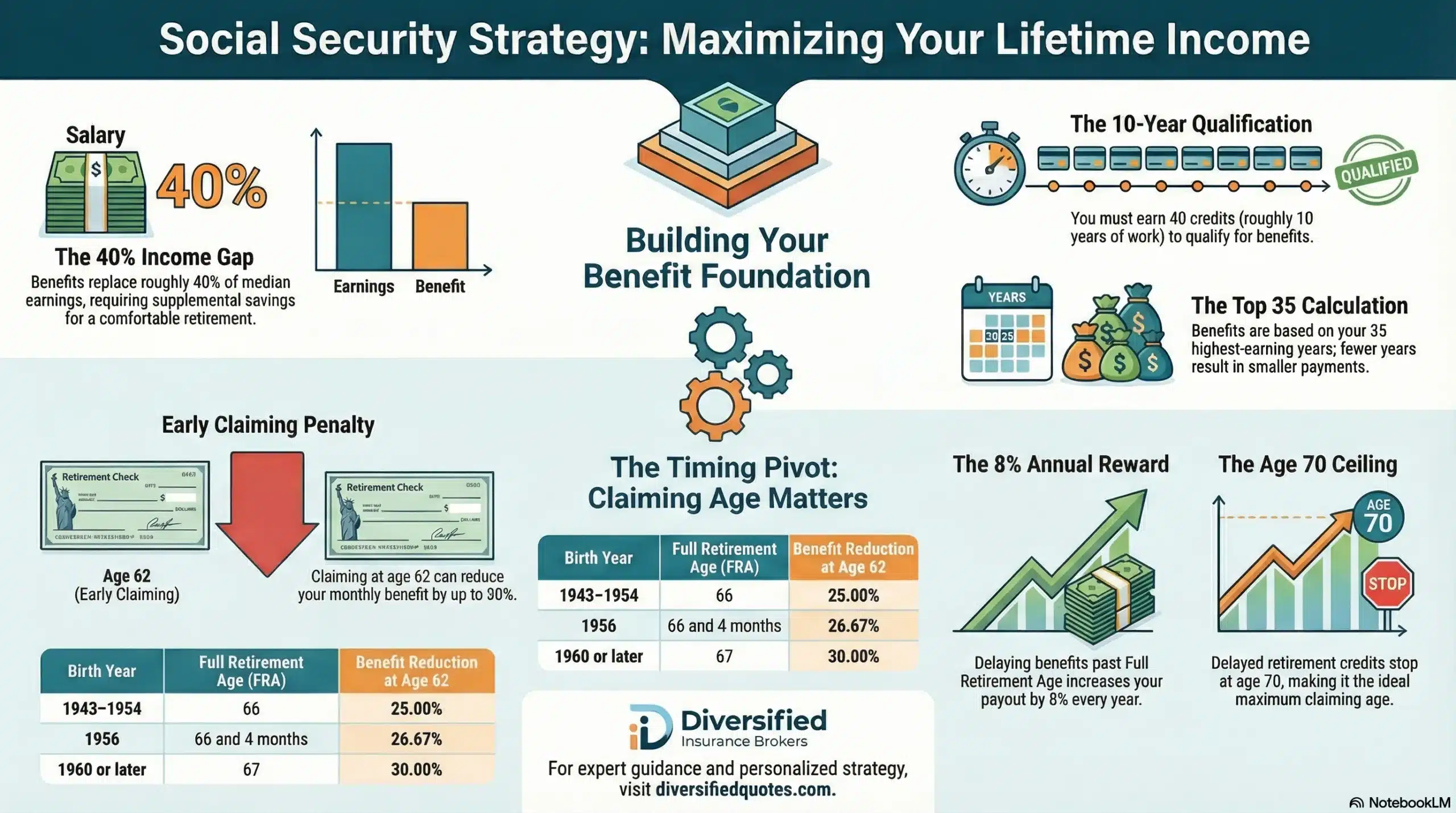
Deciding when to start taking Social Security benefits isn’t just about choosing an age—it’s about building the right retirement income timeline. Your income needs, health and longevity expectations, marital status, work plans, and tax picture all affect whether claiming early, at full retirement age, or delaying makes the most sense. The “best” choice is the one that fits your overall strategy—not a one-size-fits-all rule.
For some retirees, claiming sooner is practical. If you retire early and need dependable income right away—or you don’t have other reliable income sources—starting benefits earlier can reduce pressure on savings. But if you have other income to rely on first (continued work, pension income, withdrawals from retirement accounts, or a guaranteed annuity income strategy), delaying may allow you to lock in a permanently higher benefit and create more inflation-adjusted income later in life.
Why Claiming Age Matters More Than Most People Think
Your filing age sets your benefit level for life, and that decision also affects spousal and survivor planning. Social Security is one of the few income sources that provides a government-backed, inflation-adjusted baseline. Getting the claiming sequence right can strengthen your retirement plan—especially if you want predictable income in your later years.
Many people claim early because it feels “safe,” or because they assume there’s one correct age. In reality, tradeoffs are everywhere: higher benefits later versus more checks sooner, higher survivor protection versus greater flexibility now, and lower taxes today versus better long-term income stability.
The Power of Delaying Benefits
Delaying can be especially valuable for retirees who expect a longer retirement, want stronger inflation-adjusted income in their later years, or want to protect a surviving spouse with the higher earner’s benefit.
In general, waiting from full retirement age to age 70 earns delayed retirement credits that increase your benefit by about 8% per year. Depending on your filing age, delaying can increase your monthly benefit by 24% or more versus claiming at full retirement age. That can translate into meaningfully higher lifetime income—especially for the spouse who is likely to live longer.
When Claiming Early Can Make Sense
Claiming early is not automatically “wrong.” It can be a smart move when it matches real needs and real risks. Some common situations where early filing may be appropriate include:
- You need income now to cover essential expenses and reduce withdrawals from retirement accounts.
- You’re retiring early and want a stable baseline while you transition into retirement.
- You have health concerns or a shortened planning horizon and prefer receiving benefits sooner.
- You expect to keep working only a little (or not at all), reducing complications with the earnings test.
Even when claiming early is the right move, it’s still important to coordinate the decision with your spouse’s benefits (if applicable), your tax bracket, and your Medicare timing.
Full Retirement Age: The “Neutral” Filing Point
Full retirement age (FRA) is the point where you can claim your primary insurance amount without early-claim reductions, and without the additional delayed credits you can earn by waiting longer. For many retirees, FRA is a reasonable “middle path” when they want to start income but still avoid the permanent haircut that comes with early filing.
FRA can also be a useful coordination point if you are transitioning from work income, managing withdrawals from retirement accounts, or balancing income across multiple sources.
Married Couples: One Decision Can Affect Two Lifetimes of Income
Married couples have more planning opportunity because Social Security decisions can affect two lifetimes of income. In many cases, the higher earner’s claiming age influences not only their own benefit, but also the long-term protection available to the surviving spouse.
This is why coordinating spousal benefits—and planning around survivor timing—is so important. If you want to explore the survivor side more deeply, this guide is helpful: Strategies for claiming Social Security for widows and survivor benefits.
How Social Security Fits With Your Other Retirement Income Sources
Social Security works best when it’s integrated into a broader income plan. Filing decisions often change depending on what you’re using for income before Social Security starts.
For example, some retirees delay Social Security while drawing from:
- Pensions or other guaranteed income sources
- 401(k)/IRA withdrawals during lower-tax years
- Annuity income strategies designed to create stable income and reduce market timing risk
Coordinating these income sources can help manage taxes, reduce sequence-of-returns risk, and preserve flexibility. It can also influence Medicare-related budgeting and your overall retirement cash flow structure.
Common Mistakes to Avoid
- Claiming based on a single rule of thumb instead of your household’s full picture.
- Ignoring the spouse/survivor impact—especially when one spouse earned much more than the other.
- Forgetting the earnings test if you claim before FRA and continue working.
- Not stress-testing taxes across your expected retirement timeline.
- Failing to coordinate with Medicare timing when approaching 65 or retiring later.
Get a Personalized Social Security Strategy
At Diversified Insurance Brokers, we offer personalized Social Security Assessments to help you choose a filing strategy based on your complete financial picture—not a generic age-based answer. We look at retirement income needs, other assets and income streams, spousal and survivor planning, the earnings test, and long-term tax implications so you can make a confident, data-driven decision.
👉 Visit our Social Security page here
Schedule an Appointment with a Social Security Expert
Get personalized guidance on your claiming age, spousal and survivor benefits, the earnings test, taxes, and how Medicare timing fits in. We’ll help you avoid costly missteps and build a strategy focused on maximizing lifetime value.
🔗 Explore: Social Security Services · Maximize Benefits · Benefits for Self-Employed
FAQs: Are Annuities Guaranteed?
Are annuities guaranteed?
Annuities offer guarantees backed by the issuing insurance company. These guarantees may include principal protection, interest credits, or lifetime income, depending on the annuity type.
What parts of an annuity are guaranteed?
Guarantees can include protected principal, minimum interest rates, guaranteed income payments, and death benefits. The exact guarantees depend on whether the annuity is fixed, indexed, or variable.
Are annuities backed by the government?
No. Annuities are not FDIC-insured. Guarantees are supported by the financial strength of the insurance company, with limited protection from state guaranty associations.
Do fixed indexed annuities guarantee returns?
They guarantee protection from market losses, but credited interest depends on index performance. Returns are not guaranteed every year.
Is lifetime income guaranteed?
If you choose annuitization or an income rider, lifetime income payments are contractually guaranteed regardless of market conditions.
About the Author:
Jason Stolz, CLTC, CRPC and Chief Underwriter at Diversified Insurance Brokers (NPN 20471358), is a senior insurance and retirement professional with more than two decades of real-world experience helping individuals, families, and business owners protect their income, assets, and long-term financial stability. As a long-time partner of the nationally licensed independent agency Diversified Insurance Brokers, Jason provides trusted guidance across multiple specialties—including fixed and indexed annuities, long-term care planning, personal and business disability insurance, life insurance solutions, and short-term health coverage. Diversified Insurance Brokers maintains active contracts with over 100 highly rated insurance carriers, ensuring clients have access to a broad and competitive marketplace.
His practical, education-first approach has earned recognition in publications such as VoyageATL, highlighting his commitment to financial clarity and client-focused planning. Drawing on deep product knowledge and years of hands-on field experience, Jason helps clients evaluate carriers, compare strategies, and build retirement and protection plans that are both secure and cost-efficient. Visitors who want to explore current annuity rates and compare options across multiple insurers can also use this annuity quote and comparison tool.
