
Burial Insurance After a Heart Attack

Jason Stolz CLTC, CRPC
Burial insurance after a heart attack is often easier to qualify for than traditional term or larger permanent life insurance—because final expense policies are designed to be simple, affordable, and accessible. If you’ve had a heart attack (also called an MI), you may assume coverage is off the table. In reality, many people can still get approved, sometimes with day-one benefits, and other times with a short graded period depending on how recent the event was and how stable your follow-up care has been.
At Diversified Insurance Brokers, we help families compare burial insurance across many carriers—because underwriting rules are not the same from one company to the next. One insurer may treat a heart attack as a major red flag for years, while another may focus on stability, medications, and the amount of time since the event. The goal is to match your exact situation to the carrier most likely to offer the best blend of approval odds, pricing, and benefit structure.
Burial insurance (final expense life insurance) is typically permanent whole life coverage designed to handle funeral costs, unpaid medical bills, and small debts. If your bigger goal is income replacement or mortgage payoff coverage, you may also want to compare broader options like life insurance for heart disease alongside final expense—especially when your heart attack was many years ago and your health is stable.
Get Burial Insurance Quotes After a Heart Attack
We’ll compare carriers that are more lenient with cardiac history and target immediate coverage when your profile qualifies.
What “Burial Insurance” Covers After a Heart Attack
Burial insurance is a smaller, simpler type of permanent life insurance built for final expenses. Most families use it to cover funeral and burial costs, cremation services, outstanding medical bills, small credit balances, and the immediate “week one” expenses that hit loved ones at a difficult time. Because benefit amounts are usually modest, the underwriting process is often simpler than larger policies—and that’s why burial insurance can be a practical solution after a heart attack.
If you’re comparing final expense coverage to other options, our guide on final expense life insurance vs. term life insurance can help you understand what each policy type is designed to do. Many households use burial insurance as the “foundation,” then add other coverage only if it’s needed and affordable.
Burial Insurance Calculator
Compare rates in minutes. Then we’ll help you interpret results and identify carriers most favorable to heart attack history.
How Underwriting Works After a Heart Attack
When you apply for burial insurance after a heart attack, the carrier is usually trying to answer one question: How stable is your condition today? Carriers know that many people recover well and live full lives after a cardiac event—especially when follow-up care is consistent. The challenge is that each company uses slightly different “knockout rules” and time windows, which is why shopping matters so much.
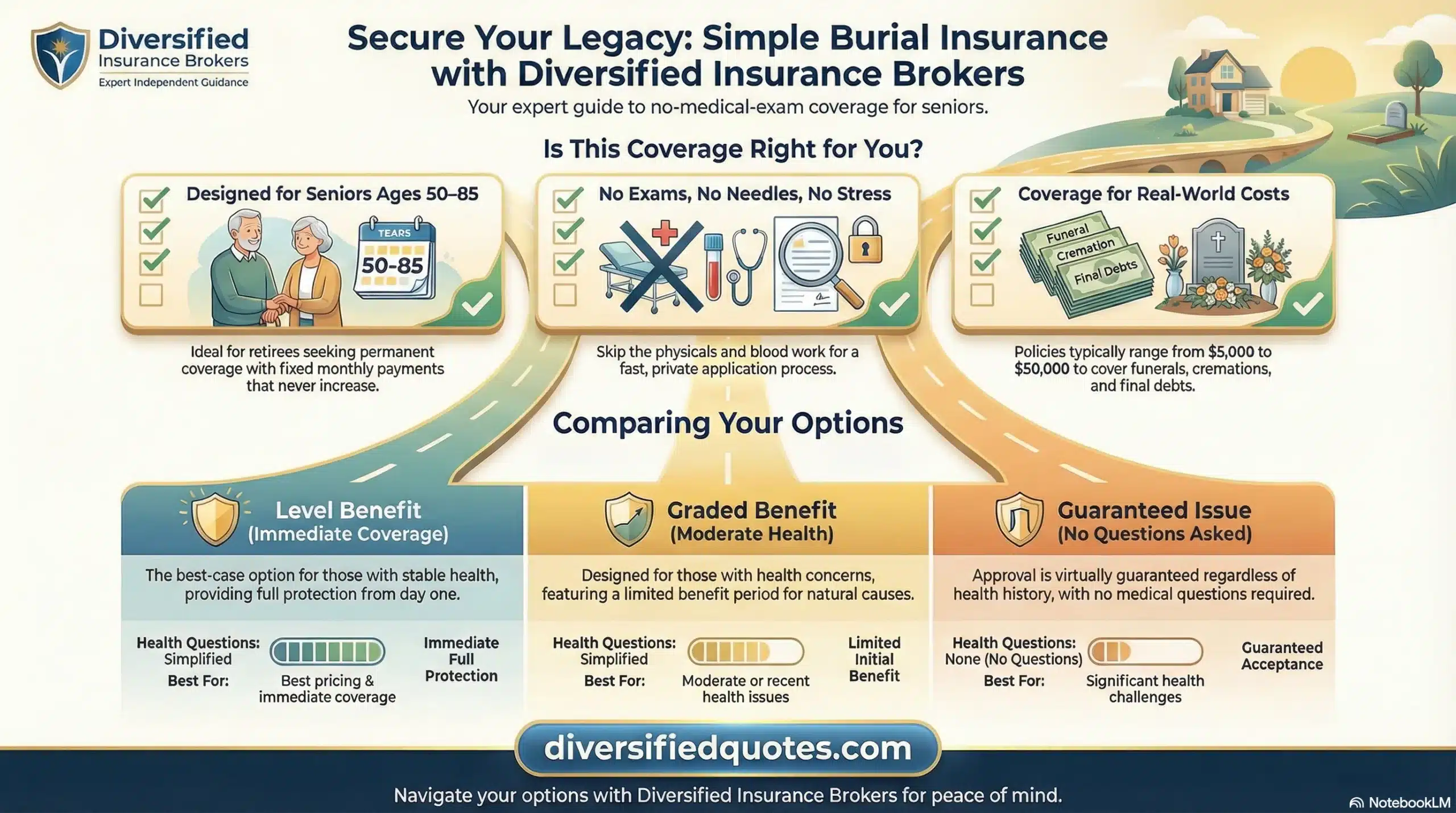
Most burial insurance applications fall into one of three paths:
1) Simplified issue (health questions, no exam). This is the most common path for final expense coverage. You’ll answer a short set of health questions, and the carrier may check prescription history and other databases. If you qualify, you can often get level premiums and level benefits with day-one coverage.
2) Graded/modified benefit (partial early period for natural causes). If your heart attack was more recent or your history is more complex, some carriers will still offer coverage, but they may limit natural-cause benefits during an initial window (commonly two years). Accidental death is typically covered immediately. This isn’t “bad”—it’s simply a trade-off that keeps coverage available when underwriting is tighter.
3) Guaranteed issue (no health questions). If you don’t want health questions or your medical history makes simplified issue difficult, guaranteed issue can still put coverage in place. These policies usually have a graded period, and the cost per dollar of benefit is higher. But for many families, the most important win is getting coverage started now rather than staying uninsured.
If you’re worried you’ll be forced into guaranteed issue, don’t assume that’s the case. We often find that a careful carrier match (and the right benefit amount) can open simplified options even with heart history—especially if your event was not extremely recent and your follow-up has been stable.
What Carriers Look At After a Heart Attack
While every carrier has its own rules, the same themes show up repeatedly in cardiac underwriting. The more clearly you can show stability, the more likely you are to qualify for immediate coverage and better pricing.
Time since the heart attack. This is often the biggest driver. A heart attack from many years ago with strong follow-up typically looks very different than one that occurred recently. Carriers often use time windows (measured in months/years) when deciding whether to offer immediate benefits versus graded.
Follow-up care and testing. Consistent cardiology follow-ups and routine testing can help. Even if you’re not required to provide full medical records for burial insurance, carriers may infer stability through prescriptions, diagnoses, and treatment patterns.
Procedures and recovery. Stents, angioplasty, and bypass surgery don’t automatically disqualify you, but carriers usually care about timing and stability. In many cases, procedures are viewed as part of successful recovery—especially when there have been no recent admissions.
Medications. Common heart medications are typically acceptable. The carrier’s bigger concern is usually active symptoms, oxygen use, recent hospitalizations, or signs that the condition is unstable.
Other risk factors. Blood pressure, cholesterol, diabetes, smoking status, and build (height/weight) can all affect pricing. The same heart history can price differently depending on the full health picture. When applicants want to avoid a full medical exam, we also compare options like burial insurance with no health exam because simplified underwriting is often the best path for speed and simplicity.
How Much Coverage Makes Sense for Final Expenses?
Most burial insurance policies are designed for modest benefit amounts, commonly in the $5,000 to $25,000 range, though some carriers go higher. The right amount depends on your local funeral costs, whether you prefer burial or cremation, whether you want to include travel for family, and whether you have lingering medical bills or small debts you’d like to wipe out.
One of the easiest ways to keep premiums affordable after a heart attack is to right-size the benefit. Instead of buying “as much as possible,” most families choose a number that covers the likely final expenses and protects loved ones from immediate cash pressure. If budget is a concern, you may also want to compare our guide on affordable burial insurance for low-income seniors, because strategy matters as much as pricing.
Immediate Coverage vs. Graded Coverage After a Heart Attack
Families often ask, “Will the policy pay right away?” The answer depends on the benefit type. With immediate (level) coverage, the full death benefit is available from day one once the policy is active and the first premium is paid. With graded coverage, natural-cause death during an initial period may return premiums plus interest (or a limited percentage), and then after the period ends, the full benefit pays.
When your heart attack was years ago and your condition is stable, immediate coverage is often achievable. When the event is more recent, a graded policy may be the most realistic “bridge” solution. In many cases, it’s better to have graded coverage now than to wait and hope—because you can always re-shop later when more time has passed and stability is well established.
If your priority is day-one benefits, you’ll also want to compare our dedicated guide on best burial insurance with immediate coverage, since that page breaks down how carriers commonly structure no-waiting-period options.
Real-World Example: Burial Insurance Approval After a Heart Attack
Profile: A 70-year-old applicant with a heart attack history, consistent cardiology follow-up, stable medications, and no recent hospitalizations. The family wanted enough coverage to handle funeral costs and final bills without putting pressure on adult children.
Approach: Instead of applying randomly with a single company, we compared several carriers that are historically more flexible with cardiac history. We targeted simplified issue options first because that path is usually the best mix of price, speed, and benefit structure.
Outcome: The applicant qualified for a level-benefit final expense policy with a straightforward application and no medical exam. The family got peace of mind knowing that coverage was in place—and that the policy was built for the exact job they wanted it to do.
Your results can vary based on recency of the event and overall health, but the point is simple: strategy and carrier match often matter more than the diagnosis label itself.
Who Should Consider Burial Insurance After a Heart Attack?
Burial insurance is a strong fit when you want coverage that’s specifically designed for final expenses and you prefer a simple approval process. It may be especially relevant if you were quoted high premiums for larger policies, declined elsewhere, or you simply want a smaller, permanent policy that stays in force for life.
It also fits well when your primary goal is to protect family from immediate expenses rather than to replace decades of income. If you’re helping an older parent navigate coverage decisions, you may also find value in reviewing age-based guides like best burial insurance for parents over 70 and best burial insurance for parents over 80.
Why Work With Diversified Insurance Brokers?
After a heart attack, it’s easy to waste time applying with the wrong carrier. Each submission can create friction if it results in a decline or an outcome that doesn’t fit your goals. Our job is to reduce that risk by matching your health profile to the carriers that are most likely to offer a good outcome—whether that’s immediate coverage, a reasonable premium, or simply a clear pathway to coverage when health history is complicated.
We help you compare options, choose a benefit amount that makes sense, and understand the difference between immediate and graded benefits so there are no surprises. If you’d like to start with a simple quote request, use the form below and we’ll take it from there.
Request Burial Insurance Quotes After a Heart Attack
We’ll compare carriers, explain your best-fit benefit type, and help you lock in coverage that protects your family.
Financial Protection Essentials
Legal funding solutions, benefit riders, annuity concepts, and carrier evaluations to support stronger financial decisions.
Talk With an Advisor Today
Choose how you’d like to connect—call or message us, then book a time that works for you.
Schedule here:
calendly.com/jason-dibcompanies/diversified-quotes
Licensed in all 50 states • Fiduciary, family-owned since 1980
FAQs: Burial Insurance After a Heart Attack
Can I qualify for burial insurance after a heart attack?
Yes. Many carriers will consider applicants with heart attack history. Approval and pricing usually depend on how long it has been since the event, whether your condition is stable, and whether there have been recent hospitalizations or complications.
Do I need to wait a certain amount of time after a heart attack to apply?
Not always. Some applicants can qualify sooner than expected, but if the heart attack was recent, you may be steered toward a policy with a graded benefit period. As more time passes with stable follow-up care, more immediate-coverage options typically open up.
Can I get day-one (immediate) coverage after a heart attack?
Often yes—especially when the event was several years ago, follow-up care is consistent, and there have been no recent cardiac admissions. If immediate coverage isn’t available, we’ll compare graded options so you can still get protection in place.
Do stents, angioplasty, or bypass surgery automatically disqualify me?
No. Those procedures are common parts of cardiac treatment and recovery. Carriers usually focus on how long it has been since the procedure, your current stability, medication adherence, and whether you have ongoing symptoms.
What if I’ve had more than one heart attack?
Multiple events can reduce immediate-coverage options, but it doesn’t necessarily eliminate coverage. In many cases, a guaranteed-issue path is still available, and we can re-shop later as your timeline improves.
Do heart medications affect burial insurance eligibility?
Common heart medications usually do not block approval by themselves. Carriers generally care more about stability, recent events, hospitalizations, and whether your follow-up care is consistent.
How much burial insurance can I get after a heart attack?
Many final expense policies offer benefits from about $5,000 up to $50,000 (sometimes more depending on age and carrier). The best amount is typically the one that covers funeral costs and final bills without stretching the monthly premium.
How fast can burial insurance be approved?
Many simplified-issue final expense applications are approved quickly—often within minutes to a few days—because most policies do not require a medical exam. Some approvals are electronic, depending on the carrier and your profile.
What if I get declined by one company?
A decline with one company doesn’t mean you’re uninsurable. Different carriers have different underwriting rules, and a guaranteed-issue policy may still be available. We can also time your next application strategically as your recovery timeline improves.
Does having a heart attack make burial insurance unaffordable?
Not necessarily. While premiums can be higher depending on the recency and complexity of your heart history, many clients still find affordable coverage by choosing the right face amount and matching their profile to the most favorable carriers.
About the Author:
Jason Stolz, CLTC, CRPC and Chief Underwriter at Diversified Insurance Brokers, is a senior insurance and retirement professional with more than two decades of real-world experience helping individuals, families, and business owners protect their income, assets, and long-term financial stability. As a long-time partner of the nationally licensed independent agency Diversified Insurance Brokers, Jason provides trusted guidance across multiple specialties—including fixed and indexed annuities, long-term care planning, personal and business disability insurance, life insurance solutions, and short-term health coverage. Diversified Insurance Brokers maintains active contracts with over 100 highly rated insurance carriers, ensuring clients have access to a broad and competitive marketplace.
His practical, education-first approach has earned recognition in publications such as VoyageATL, highlighting his commitment to financial clarity and client-focused planning. Drawing on deep product knowledge and years of hands-on field experience, Jason helps clients evaluate carriers, compare strategies, and build retirement and protection plans that are both secure and cost-efficient.
