
Disability Income Insurance for Attorneys

Jason Stolz CLTC, CRPC
Disability Income Insurance for Attorneys is designed to protect the asset that funds everything else in your financial life: your ability to earn an income. For most attorneys, income is the result of years of education, bar admission, specialization, client relationships, and a reputation that takes time to build. A health event that limits your ability to work—even temporarily—can hit harder than most people expect because legal income is often tied to billable hours, client deadlines, court schedules, contingency outcomes, and performance-based compensation structures that don’t pause just because you’re recovering.
At Diversified Insurance Brokers, we help attorneys secure disability income policies that are built around how law is actually practiced. That means focusing on definitions that protect your specialty, designing benefit amounts that align with your real obligations, and selecting elimination and benefit periods that make sense for the way a legal career grows over time. Whether you are an associate, partner, solo practitioner, in-house counsel, or running a firm, the goal is simple: if illness or injury prevents you from practicing, you still have predictable monthly income coming in.
Compare Disability Coverage for Attorneys
We’ll compare policy definitions, benefit periods, and pricing across multiple top-rated carriers based on your practice and income.
Request Attorney Disability Quotes
Prefer to talk things through? Call 800-533-5969.
Why Attorneys Need Disability Income Coverage
Attorney income is different than many other white-collar careers because the work is deadline-driven, performance-driven, and often physically demanding in ways people underestimate. Long hours at a desk can create chronic back and neck issues. Repetitive motion and keyboard work can trigger wrist and hand conditions. Court appearances and travel can be physically taxing. High stress can contribute to health events that disrupt concentration, memory, and stamina. Even when a condition is not “catastrophic,” it can still make it impossible to perform the substantial and material duties of law practice at the level your clients and firm require.
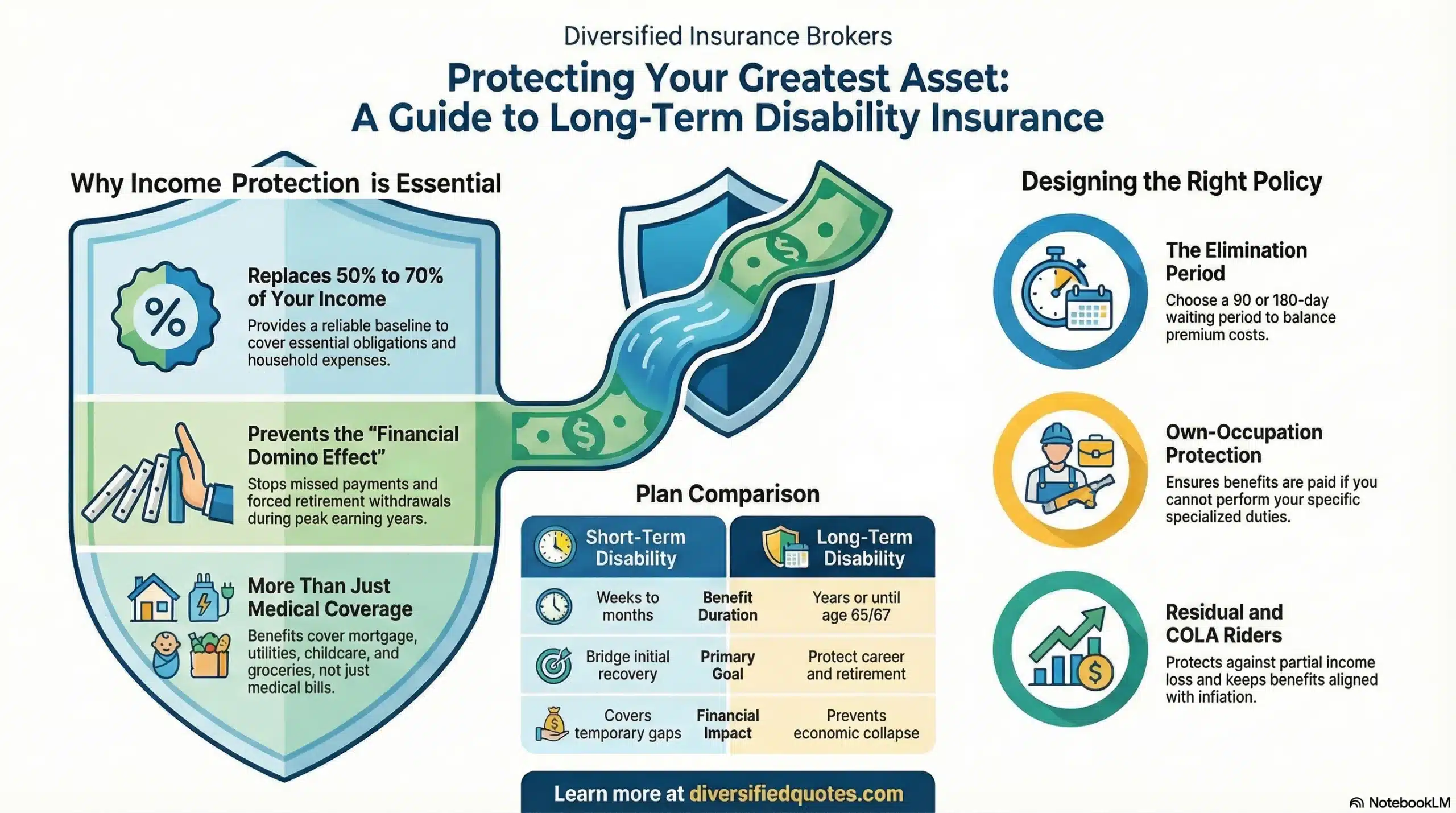
Disability insurance creates monthly income benefits when you cannot work due to a covered illness or injury. That benefit can help you keep up with core financial obligations—housing, payroll deductions, insurance premiums, childcare, taxes, debt service, and ongoing savings—without being forced to drain retirement accounts or liquidate investments at the wrong time. For many attorneys, the real value is not just paying bills; it is preserving professional options. If you can recover fully without rushing back prematurely, you protect both your health and your long-term career value.
Why “Own-Occupation” Definitions Matter in Law
When attorneys hear the term “own-occupation,” many assume it is marketing language. In reality, it is one of the most important contract features for legal professionals because it determines what counts as being disabled. A strong own-occupation definition is designed to pay benefits if you cannot perform the duties of your specific occupation—or in some cases, your specialty—rather than requiring that you be unable to work in any job at all.
That distinction is crucial for trial attorneys, litigators, and attorneys whose income depends on high-level performance. You might technically be capable of doing some work, such as consulting, teaching, or administrative tasks, while still being unable to perform core legal duties like trial work, depositions, client representation, negotiation under pressure, or complex drafting at a sustained pace. A policy that evaluates disability based on “any occupation” can create a gap where your legal earnings fall dramatically, but benefits are limited because you could hypothetically work elsewhere. Own-occupation coverage is designed to avoid that trap.
Even within law, duties vary by specialty. A disability that prevents a surgeon from operating is conceptually similar to a disability that prevents a litigator from trying cases or an M&A attorney from sustaining the intense hours required for transactions. Strong contract language aims to protect the work you actually do, not a vague idea of being employable.
How Disability Insurance Is Priced for Attorneys
Most attorneys are considered favorable occupational classes relative to many other professions because the work environment is typically controlled and non-hazardous. That often translates into better pricing and better policy features. However, rates are still shaped by age, health history, income, state of residence, and policy design choices. Two attorney policies can have the same monthly benefit amount and still price differently because of elimination period length, benefit duration, riders, and definition strength.
One of the best ways to improve long-term value is to get coverage in place while you are healthy. Disability underwriting is designed to evaluate risk based on medical history, and once an issue appears—back problems, anxiety treatment, sleep disorders, elevated labs, recent surgeries—your options can narrow or exclusions can be applied. Locking in a high-quality policy earlier can preserve broader coverage and lower costs over the life of the contract.
Common Design Choices That Affect Cost and Protection
Attorney disability coverage is often about choosing the best trade-offs rather than buying “the biggest policy.” The elimination period (waiting period) is one of the biggest levers. Many attorneys choose 90 days because it balances affordability with a realistic time window for short-term cash reserves. Some choose 180 days to reduce premium, especially if they keep stronger savings. Others choose shorter waiting periods if cash flow is tight or overhead is high.
The benefit period also matters. Some policies pay for a set number of years, while others pay to a target age such as 65 or 67. A longer benefit period costs more, but it also protects the career-long risk: the possibility that a disability persists or becomes permanent. For attorneys who are primary earners, protecting the long-duration risk is often the reason the policy exists in the first place.
Finally, riders can add meaningful value when selected intentionally. Residual or partial disability coverage is one of the most practical for attorneys because many conditions do not completely stop work; they reduce capacity. If you can only work part-time, or your billables drop significantly due to restrictions, residual benefits can help replace that lost income while you transition back. Other riders, like future increase options, can be useful early in a career as income grows, allowing you to increase coverage later without repeating full medical underwriting.
Attorney Income Structures: Associates, Partners, and Solo Practice
Attorneys often have very different income profiles depending on career stage and firm structure, and disability coverage should reflect that reality. Associates may rely on salary with bonus potential, while partners may have profit distributions, origination-based income, or draws that vary with firm performance. Solo practitioners often have income that is highly dependent on their personal production and client relationships.
This is why “benefit amount” is not always as simple as a percentage of gross income. The best design is one that targets your actual financial obligations and the income you need to keep your household stable while you recover. If your income has a variable component, it becomes especially important to document income properly and structure coverage so it aligns with what carriers will recognize as insurable earnings.
For attorneys who own a firm, disability planning often includes business-level needs in addition to household protection. If you are responsible for overhead and staff payroll, it is common to pair personal coverage with Business Overhead Expense (BOE) insurance so the business can keep operating while you are out of the office. Personal coverage keeps your household stable; BOE coverage helps keep the practice stable.
Student Loans and Long-Term Obligations
For many attorneys, student loan obligations remain a meaningful monthly expense even after income rises. Disability coverage is often viewed as “income replacement,” but the real-life objective is protecting the entire financial structure you’ve built: debt service, housing, family planning, savings goals, and career investments. When disability interrupts income, loans do not automatically stop. A well-sized disability benefit can help prevent a disability from turning into missed payments, damaged credit, or forced liquidation of savings.
Because disability insurance is designed around insurable income, the most practical approach is to select a benefit amount that keeps your monthly budget intact rather than trying to “cover everything.” When coverage is properly designed, you reduce the likelihood of needing to restructure finances under stress.
Tax Treatment and Who Pays the Premium
The tax treatment of disability benefits is often tied to who pays the premium. When premiums are paid personally, benefits are typically received in a more favorable way than when premiums are paid by an employer or firm and deducted. Attorneys in different firm structures—W-2 employees, equity partners, PLLCs, PC structures—may have different planning options around ownership and premium payment.
The key is choosing a structure intentionally rather than accidentally. The objective is clarity: if a claim happens, you want to know what the benefit looks like after taxes and how it integrates with other firm compensation arrangements. When needed, we coordinate with your tax professional to make sure coverage is structured in a way that matches your goals and your entity setup.
High-Income and Specialty Coverage for Top-Earning Attorneys
Many attorneys eventually outgrow basic coverage limits. If a significant portion of your compensation comes from bonuses, profit-sharing, or high-income partner distributions, a standard plan may not replace enough of your income to preserve your lifestyle. That is where High-Income Disability Insurance can be used to supplement coverage and protect a larger portion of earnings.
This is especially common in corporate law, complex litigation, contingency-based practices, and partner-driven firms where income can be very high relative to standard caps. The purpose of high-income coverage is not simply “bigger numbers.” It is maintaining financial continuity when a disability event threatens a high-earning career with long-term earning power.
Firm Continuity: Key Personnel, Partner Risk, and Succession Planning
In multi-partner firms, disability risk does not just affect the disabled attorney. It affects the entire partnership. If a rainmaker, managing partner, or specialized attorney is out long-term, revenue can decline, leadership can become strained, and firm value can be impacted. In these situations, Key Person Disability planning may be used to help cover replacement costs, stabilize operations, or create funding that reduces financial stress while the firm adapts.
Some firms also explore guaranteed issue arrangements for groups or executives. If your firm is considering coverage for multiple attorneys at once, Guaranteed Issue Disability Insurance can sometimes reduce underwriting friction and create more consistent access to coverage. The availability of these programs depends on firm size, structure, and underwriting guidelines.
How Diversified Insurance Brokers Helps Attorneys Get Better Coverage
Disability insurance is not a commodity purchase when your income is specialized. Our process is designed to make coverage understandable and practical. We start by looking at how you earn income, what obligations you carry, what coverage (if any) you already have through a firm, and how your work is actually performed day-to-day. Then we compare carriers and designs to find the best balance between definition strength, benefit amount, benefit duration, and premium stability.
We also help you avoid common “cheap policy” traps that show up later: weak disability definitions, limited residual benefits, designs that do not match your specialty, or benefit structures that look fine on paper but fall short in a real claim. The goal is not just a quote. The goal is coverage that performs when a career-changing event happens.
Get a Customized Quote
Every attorney’s income and practice structure is different. An associate with a predictable salary needs a different design than a partner whose income is tied to origination and firm profit. A trial attorney often needs stronger specialty protection than an attorney whose role is primarily advisory. A solo practitioner may need to coordinate disability protection with business continuity needs so the practice can survive a long recovery.
If you want a personalized comparison, we can quote multiple carriers and show you how policy definitions, elimination periods, residual benefits, and benefit periods change both the price and the real-world protection you receive.
Get a Disability Insurance Quote for Attorneys
Compare policies from leading carriers and protect your income with legal-specific coverage options.
Related Topics to Explore
These pages cover other disability strategies attorneys commonly consider.
Financial Protection Essentials
Education-sector group health planning, ACA transition strategies, and disability coverage customization resources.
Talk With an Advisor Today
Choose how you’d like to connect—call or message us, then book a time that works for you.
Schedule here:
calendly.com/jason-dibcompanies/diversified-quotes
Licensed in all 50 states • Fiduciary, family-owned since 1980
Frequently Asked Questions
- Do attorneys need own-occupation disability coverage?
Yes. It ensures benefits are paid even if you can work in another capacity but can’t perform legal duties. - Are disability benefits taxable for attorneys?
Benefits are tax-free if you pay the premium personally. Employer-paid premiums usually make benefits taxable. - Can partners buy coverage through the firm?
Yes. Partners can secure coverage individually or via firm-sponsored plans, often with premium discounts. - What’s the difference between BOE and personal disability insurance?
BOE covers firm expenses; personal disability coverage replaces your income. - How do I get a quote?
Complete our disability quote form to compare options from top-rated carriers.
About the Author:
Jason Stolz, CLTC, CRPC and Chief Underwriter at Diversified Insurance Brokers (NPN 20471358), is a senior insurance and retirement professional with more than two decades of real-world experience helping individuals, families, and business owners protect their income, assets, and long-term financial stability. As a long-time partner of the nationally licensed independent agency Diversified Insurance Brokers, Jason provides trusted guidance across multiple specialties—including fixed and indexed annuities, long-term care planning, personal and business disability insurance, life insurance solutions, Group Health, and short-term health coverage. Diversified Insurance Brokers maintains active contracts with over 100 highly rated insurance carriers, ensuring clients have access to a broad and competitive marketplace.
His practical, education-first approach has earned recognition in publications such as VoyageATL, highlighting his commitment to financial clarity and client-focused planning. Drawing on deep product knowledge and years of hands-on field experience, Jason helps clients evaluate carriers, compare strategies, and build retirement and protection plans that are both secure and cost-efficient. Visitors who want to explore current annuity rates and compare options across multiple insurers can also use this annuity quote and comparison tool.
