
How Annuities Are Divided in Divorce?

Jason Stolz CLTC, CRPC
Divorce can raise difficult questions about how to divide assets—and annuities are often one of the most misunderstood. People tend to think of annuities as “just another account,” but annuities are contracts, and contracts come with rules. How your annuity is treated in a divorce depends on when it was funded, whether it was funded with marital money, whether it sits inside a retirement account, what benefits and guarantees are attached to it, and what your state requires under its property division laws. At Diversified Insurance Brokers, we help clients nationwide understand how annuities fit into their overall financial picture before, during, and after divorce—so decisions are based on clarity instead of assumptions.
One of the biggest risks in a divorce settlement is not the court order itself—it’s the unintended consequences of how that order gets implemented. Annuities can involve surrender schedules, market value adjustments, living benefit bases, contract riders, beneficiary structures, and tax rules that behave differently than traditional brokerage accounts. If you divide an annuity the wrong way, you can accidentally trigger taxes, lose guarantees, or reduce future income in a way that doesn’t show up until years later. A better approach is to understand exactly what you own, what it’s worth, and which methods of division preserve the most value.
This guide explains how annuities are typically divided in divorce, what courts and mediators often look at, and what practical steps can help you protect long-term income potential. We’ll also cover how some people rebuild post-divorce stability using annuities—especially when they want principal protection and predictable retirement income—and how strategies like bonus annuities can sometimes help offset losses created by surrender charges or market value adjustments.
Understanding Annuities in Divorce
An annuity is a contract with an insurance company. Depending on the type, it can be designed for accumulation, guaranteed income, or both. Some annuities are funded with retirement dollars inside an IRA or employer plan rollover. Others are funded with after-tax money (non-qualified). Some include riders that create a lifetime income stream. Some are designed to grow for a period of time and then be annuitized later. Because of that variety, there is no single “divorce rule” that applies to every annuity. The right answer starts with how the annuity was funded and what benefits it contains.
Most states divide property using one of two frameworks. Community property states generally treat most assets acquired during the marriage as jointly owned, with division often leaning toward equal. Equitable distribution states focus on fairness, which may or may not be 50/50 depending on the facts of the case. In either framework, a key concept is identifying what is “marital” and what is “separate.”
In many divorces, the annuity falls into one of these buckets:
Marital annuity. The contract was purchased and funded during the marriage using income or assets considered marital. In that case, some or all of the annuity is usually considered divisible property.
Separate-property annuity. The contract was purchased before marriage, or funded with an inheritance, a gift, or other separate funds. Separate assets are often kept by the original owner—unless commingling occurred, the contract was retitled, or marital funds materially changed the value.
The complicating factor is that many annuities are partially marital and partially separate. A spouse may have purchased an annuity before marriage, then continued contributions during marriage. Or a contract might have been funded with separate funds but later increased using marital funds. In those cases, it’s common to “trace” funding sources to determine what portion is marital and what portion remains separate.
For people who want to learn more about how annuities work in general—especially when comparing fixed and indexed structures—resources like how a fixed indexed annuity works can help clarify the basics, because understanding the contract is step one in understanding divorce implications.
Why Annuities Can Be Tricky to Divide
Annuities combine insurance-based guarantees with investment-like accumulation features. That hybrid nature is exactly why they can be misunderstood in divorce. With a brokerage account, valuation is often straightforward: the market value on a given date. With an annuity, the “value” might depend on which number you’re looking at. Many contracts have multiple values, and those values can serve different purposes.
Common value concepts include:
Account value (cash value). The amount you could potentially access (subject to surrender charges, MVA, and taxes). This is often the number people see on statements.
Surrender value (net value). The actual amount available if the annuity is surrendered today after applying any surrender charges and, when applicable, a market value adjustment. This number can be meaningfully lower than the account value in the surrender period.
Benefit base (income base). Some contracts include an income rider with a “benefit base” used to calculate future guaranteed income. The benefit base is not usually a cash value; it’s a calculation value. It can be higher than the account value, and it can be extremely important if the goal is lifetime income.
Annuitized value (payment stream value). If the annuity has been annuitized (converted into payments), its value may be considered in terms of the remaining payment stream and present value calculations rather than a single account number.
In a divorce setting, problems often happen when one spouse assumes the income base is the “divisible value,” or when both spouses focus on the account value but ignore surrender penalties that will actually apply if the contract must be divided. Another common mistake is treating an annuity like a cash account and dividing it through surrender when a split contract or transfer mechanism could preserve more value.
It’s also common for people to overlook riders. Annuity riders can add value, change liquidity, or provide enhanced death benefits. If the annuity was designed to provide retirement income through an income rider, dividing it incorrectly can permanently change the income outcome—especially if the rider is not transferable or if splitting triggers rider termination.
For additional perspective on common pitfalls, many people find it helpful to understand contract liquidity rules before making any decisions. A good reference point is annuity free withdrawal rules, because it explains how withdrawals, surrender schedules, and free withdrawal provisions generally work.
Key Factors Courts and Settlements Typically Consider
Courts and mediators tend to focus on a few consistent questions when dealing with annuities. The exact legal standards vary by state, but the practical evaluation often includes the following factors.
When the annuity was purchased and funded. Timing matters. Contributions made during the marriage are usually treated differently from pre-marriage contributions. Funding source and tracing documentation are often critical.
Whether the annuity is qualified or non-qualified. Qualified annuities (those held inside retirement accounts like IRAs) often follow retirement division rules. Non-qualified annuities are funded with after-tax money and behave differently for tax purposes when divided.
Ownership and titling. Some annuities are owned individually, while others may have joint elements or spousal beneficiaries. Ownership drives who controls the contract and what administrative options exist for division.
Contract features and riders. Income riders, death benefits, enhanced payouts, and liquidity riders can affect both valuation and the “best” division method.
Surrender schedule and MVA exposure. If the annuity is in its surrender period, dividing it through surrender can create real value loss. If interest rates have moved since purchase, a market value adjustment can add another layer of change—positive or negative—depending on the contract and rate environment. If you’re not familiar with MVAs, this reference can help: what is a market value adjustment.
Intent of the annuity. Was it bought as a retirement income anchor? Was it a safe accumulation vehicle? Was it part of a broader plan? Intent doesn’t override law, but it can influence how spouses negotiate offsetting assets to preserve income or stability.
The best outcomes often happen when the settlement explicitly addresses which value is being used, how division will be implemented, and what happens to riders. Vagueness can be expensive.
Qualified vs. Non-Qualified Annuities
The tax structure of your annuity often dictates what “clean” division looks like. A qualified annuity is an annuity held inside a retirement account such as an IRA, 401(k) rollover IRA, or similar qualified plan. The money is typically pre-tax. Withdrawals are taxable as ordinary income, and early withdrawals can trigger penalties depending on age and circumstances.
In divorce, qualified assets are often divided using a court-recognized mechanism that allows a transfer without triggering immediate tax consequences. Many people have heard of QDROs, which are commonly used for employer plans. In IRA-related divorce transfers, similar court orders and trustee-to-trustee transfers are typically used to avoid creating taxable distributions. The goal is to divide the retirement asset without turning the division itself into an unexpected tax bill.
Non-qualified annuities are funded with after-tax dollars. Taxation generally applies to gains upon withdrawal, and rules around transfers and divisions can be sensitive to how the transfer is executed. That’s why the “how” matters as much as the “what.” In a non-qualified annuity division, a transfer that seems simple on paper can become complicated if it triggers a taxable distribution, resets contract benefits, or requires surrender of a rider.
If you want a deeper baseline on how annuities fit into retirement structures, what is an IRA annuity is a helpful explainer because it clarifies what it means when an annuity sits inside an IRA and how that affects planning decisions.
Common Ways Annuities Are Divided in Divorce
Most divorce outcomes divide an annuity in one of a few standard ways. Each approach has trade-offs, and the “best” choice depends on the annuity type, surrender period, riders, and the settlement’s broader asset division goals.
1) Full surrender and split of proceeds. This approach converts the contract into cash, pays any surrender charges and MVAs, then divides the net proceeds between spouses. It can be straightforward, but it can also be the most expensive approach if the annuity is in a surrender period or if the contract is unfavorable for surrender at that time. It may also create tax consequences depending on whether the annuity is qualified or non-qualified and how the surrender is processed.
2) Offset with other assets. One spouse keeps the annuity intact while the other spouse receives other assets of equivalent value, such as a larger share of a 401(k), brokerage account, or home equity. This method can preserve annuity guarantees and avoid surrender charges, but it requires accurate valuation and careful negotiation to ensure fairness. Offset strategies are common when the annuity is intended to provide lifetime income and splitting would reduce the income benefit.
3) Split contract (when available). Some insurers can divide a single annuity into two separate contracts, one for each spouse, without surrendering the annuity. This approach can preserve tax deferral and reduce surrender damage, but it is not universally available and may be limited by contract type, state rules, and the insurer’s administrative policies. Rider treatment can also vary.
4) Transfer of ownership (where allowed). In some situations, ownership can be transferred to one spouse or contracts can be reissued. Transfer rules differ by insurer and contract type. In non-qualified annuities, transfers must be handled carefully to avoid tax surprises.
5) Income sharing on an immediate annuity. If the annuity has already been annuitized and is paying income, a court order may direct how payments are allocated. The spouse receiving income may have obligations to share payments, or the settlement may assign rights depending on the contract and legal framework. Payment-stream division can be complex, which is why clarity at the settlement stage is important.
In real life, a divorce settlement may combine multiple approaches. For example, one spouse may keep an income-focused annuity intact while another accumulation annuity is split, and other assets are rebalanced to make the overall settlement fair.
Valuation: What Number Should You Use?
Valuation sounds simple until you realize there may be multiple legitimate valuation methods depending on the goal. In divorce, the “right” value is often the one explicitly agreed upon in the settlement or required by state guidelines. But from a planning standpoint, the right value is the one that reflects the economic reality of what the annuity can do for you.
If you are negotiating an offset, you may need to look at the annuity’s net surrender value, not just the account value, because that reflects what you could actually access today. If you are keeping the annuity for lifetime income and it includes an income rider, the benefit base and the expected income stream may matter more than the surrender value. If the annuity is in a retirement plan, the pre-tax nature means a dollar-for-dollar comparison to after-tax assets can be misleading without accounting for future taxes.
This is one reason annuity division should rarely be decided by “the statement number alone.” A clear understanding of surrender schedules, free withdrawal provisions, and any MVA exposure can be the difference between a fair settlement and one that unintentionally favors one spouse.
If you’re rebuilding after divorce and exploring what annuity options look like today, it can help to see a snapshot of the broader market. A useful resource is current annuity rates, which provides a starting point for comparing what’s available when you’re considering a new contract or replacing an older one.
How Surrender Charges and MVAs Can Affect Divorce Outcomes
Many annuities have surrender charge schedules that last several years. During that period, withdrawing more than the free withdrawal amount can trigger charges that reduce the amount you receive. In divorce, if the settlement requires a split that cannot be done as a contract split or transfer, surrender charges may become a real cost.
Market value adjustments can also be important. MVAs typically apply to some fixed annuities when money is withdrawn beyond free withdrawal limits during the surrender period. The adjustment reflects changes in interest rates relative to when the annuity was purchased. Depending on the direction of rate changes and the terms of the contract, an MVA can either reduce or increase the amount you receive. The point is not to fear MVAs—it is to recognize that they change the economics of surrender and should be considered before making division decisions.
Even when an annuity can be split, surrender and MVA features can still matter because a split might be treated as a partial withdrawal in some cases, depending on insurer rules. This is why divorce planning with annuities works best when the settlement includes a clear method for division and when the implementation aligns with insurer requirements.
Using a Bonus Annuity to Offset Surrender or MVA Losses
Sometimes divorce creates a forced timeline. A spouse may need to liquidate part of an annuity, or a settlement may require moving money quickly. If that process creates surrender losses or MVA-related reductions, one strategy some clients explore is reinvesting the “kept” portion of assets into a product that provides an upfront boost to help rebuild value. This is where bonus annuities can sometimes be useful.
A bonus annuity may provide an upfront credit added to the contract value. While the bonus doesn’t erase surrender charges directly, it can help strengthen the starting position of the reinvested funds. In practical terms, if you had to take a hit during divorce division, adding a bonus at the start of a new annuity can help rebuild your base more quickly—especially if you plan to hold the new contract long enough to benefit from its structure.
Bonus annuities are not a universal solution. They come with their own surrender schedules, product rules, and rider designs. The point isn’t “bonus is always best.” The point is to consider whether a bonus structure helps you recover lost ground while still aligning with your goals for liquidity, growth, and income planning. If you’re exploring how bonuses differ by term and carrier, you may also find current bonus annuity rates helpful as a comparative reference.
Divorce Settlement Strategies That Can Preserve Income
Many divorces focus on “equalizing” assets without considering what those assets do. An annuity designed for lifetime income is not the same as a brokerage account designed for growth. If one spouse keeps an income annuity, that spouse may preserve future stability but may give up other assets to make the settlement fair. In other cases, splitting the annuity might look fair on paper but could reduce the income benefit for both spouses. The best strategy depends on what each spouse needs after divorce.
Some couples decide that one spouse keeps the income-oriented annuity, while the other receives a larger share of liquid assets or retirement accounts. Others decide to split an accumulation annuity and use each share to set up separate retirement income strategies that fit each person’s timeline. The important part is that the settlement reflects not just value today, but also income potential and risk exposure over time.
This is also where beneficiary planning becomes important. After divorce, it’s common to update beneficiaries, contingent beneficiaries, and any settlement-required beneficiary obligations. If you want a clear explanation of how beneficiaries work in annuities, annuity beneficiary death benefits is a useful reference because it explains how annuity death benefits typically pass to heirs and what options beneficiaries may have.
Post-Divorce Income Planning with Annuities
Once divorce is finalized, the financial goal usually shifts from “divide fairly” to “rebuild stability.” Many people want a plan that feels secure, predictable, and easy to manage—especially after a major life transition. For some, that means reducing market risk. For others, it means creating guaranteed income they can count on even if future years bring uncertainty.
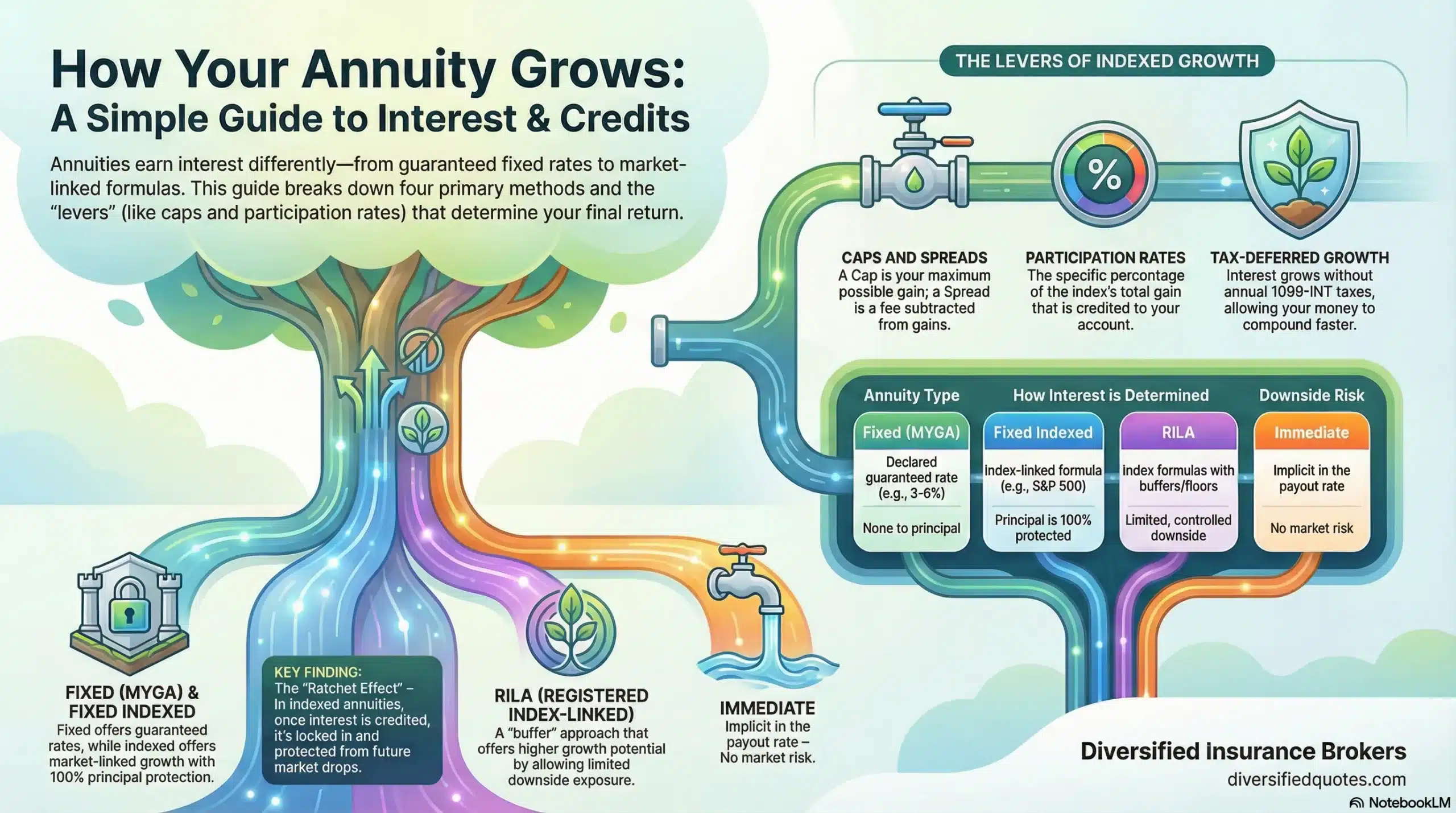
Annuities can be used in several post-divorce planning roles. Some people use fixed or indexed annuities to protect principal and build stable accumulation. Others use annuities with income-focused features to build a predictable retirement paycheck. Others use shorter-term MYGAs to lock in a guaranteed rate while they decide what the next stage of life looks like.
If you’re comparing term options and trying to understand what “short-term” can look like, best short-term MYGA annuities is a helpful resource because it frames how shorter multi-year guarantees can be used when someone wants stability without locking up money for a long surrender schedule.
Some people also explore whether a fixed indexed annuity makes sense for post-divorce rebuilding because it can offer a balance between growth potential and protection from market losses. If you’re exploring that concept, fixed indexed annuities with lifetime income riders can be a useful educational page, especially if the goal is to build income later rather than just accumulate value.
Practical Checklist: What to Gather Before You Make Decisions
Before you negotiate annuity terms in a divorce settlement, it helps to gather the information that drives the real outcomes. Most of the mistakes we see come from incomplete information or assumptions about what the contract allows.
Here is what you want in hand:
Recent statement showing account value and surrender value. These may differ materially during the surrender period.
Surrender charge schedule and free withdrawal rules. This shows the cost of moving money and the amount that can be withdrawn annually without penalty. Reference: annuity free withdrawal rules.
Market value adjustment provision (if applicable). This is critical for many fixed annuities in a rising or falling rate environment. Reference: what is a market value adjustment.
Rider page (income rider, enhanced death benefit, long-term care rider, etc.). Riders can change both value and division options.
Contract ownership and annuitant details. Division mechanics depend heavily on ownership structure.
Tax status: qualified vs. non-qualified. The tax path of division differs significantly.
When you have these items, it’s much easier to choose a division method that preserves the most value and avoids accidental tax costs.
Why Work with Diversified Insurance Brokers
Divorce is already complex. The last thing you need is confusion about an annuity contract that was supposed to provide security. We’re a fiduciary, family-owned agency licensed in all 50 states. For decades, we’ve helped clients protect income, preserve value, and make informed decisions during major financial transitions. Our advisors compare annuity options across top-rated carriers, review contract details, and help you understand the practical implications of splitting, transferring, keeping, or repositioning an annuity.
We also help many clients evaluate whether an existing annuity still makes sense after divorce or whether a new strategy fits better. For example, someone who previously planned for joint retirement income may now need a different structure for individual income planning. Others may want to shorten surrender timelines, prioritize liquidity, or use a conservative approach to rebuild confidence. Seeing today’s marketplace can help frame those decisions, which is why we keep a current overview here: current annuity rates.
Review Your Annuity Options After Divorce
Explore current annuity rates and contract structures so you can make informed, tax-aware decisions for your next chapter.
Financial Protection Essentials
Annuity divorce planning, bonus comparisons, withdrawal rules, and income protection strategies.
Financial Protection Essentials
Employer health planning, high-risk life insurance guidance, retirement transitions, and long-term care comparison tools.
Talk With an Advisor Today
Choose how you’d like to connect—call or message us, then book a time that works for you.
Schedule here:
calendly.com/jason-dibcompanies/diversified-quotes
Licensed in all 50 states • Fiduciary, family-owned since 1980
FAQs: How Annuities Are Divided in Divorce
Are annuities considered marital property?
In most cases, yes — if the annuity was purchased or funded during the marriage. Pre-marriage annuities may be separate property unless commingled.
How are annuities valued during divorce?
Valuation depends on the annuity type, cash value, and income benefits. Fixed annuities use account value; income annuities may use present value calculations.
Do I need a QDRO to divide an annuity?
Only if it’s a qualified annuity inside a retirement plan or IRA. Non-qualified annuities follow regular ownership transfer or surrender procedures.
Can dividing an annuity trigger taxes?
Yes. Improper division may cause taxable gains or penalties. Always coordinate with a financial advisor to preserve tax-deferred status.
What if my annuity has a surrender charge?
You may offset it by transferring to a bonus annuity to recover lost value and maintain tax-deferred growth.
Can I keep my annuity after divorce?
Yes, if awarded by the court. You may need to retitle ownership or adjust beneficiaries to reflect your post-divorce plan.
Should I buy a new annuity after divorce?
Many do. A fixed indexed annuity can provide guaranteed income and financial independence after separation.
About the Author:
Jason Stolz, CLTC, CRPC and Chief Underwriter at Diversified Insurance Brokers (NPN 20471358), is a senior insurance and retirement professional with more than two decades of real-world experience helping individuals, families, and business owners protect their income, assets, and long-term financial stability. As a long-time partner of the nationally licensed independent agency Diversified Insurance Brokers, Jason provides trusted guidance across multiple specialties—including fixed and indexed annuities, long-term care planning, personal and business disability insurance, life insurance solutions, Group Health, and short-term health coverage. Diversified Insurance Brokers maintains active contracts with over 100 highly rated insurance carriers, ensuring clients have access to a broad and competitive marketplace.
His practical, education-first approach has earned recognition in publications such as VoyageATL, highlighting his commitment to financial clarity and client-focused planning. Drawing on deep product knowledge and years of hands-on field experience, Jason helps clients evaluate carriers, compare strategies, and build retirement and protection plans that are both secure and cost-efficient. Visitors who want to explore current annuity rates and compare options across multiple insurers can also use this annuity quote and comparison tool.
