
Travel Insurance for Youth Mission Trips

Jason Stolz CLTC, CRPC
Travel insurance for youth mission trips is not a “nice to have” add-on—it’s the risk-management layer that helps churches, ministries, and nonprofits protect students and leaders when plans change or a medical event happens far from home. Youth mission travel is different from a standard vacation: you’re moving as a group, you’re often working with your hands, you may be traveling into rural areas, and you’re responsible for minors whose parents expect clear emergency procedures.
At Diversified Insurance Brokers, we help youth mission leaders choose coverage that matches the actual trip: the destination, the length of the mission, the activities involved (construction, outreach, community support, disaster relief), and the level of medical access where you’re going. The goal is simple—if something happens, your team can get care quickly, leaders have a clear support process, and the financial exposure is controlled.
This page breaks down what to look for in travel insurance for youth mission trips, how travel medical coverage differs from trip protection, which benefits matter most for teen teams, and the common mistakes that create problems during claims or emergencies.
Get Coverage for Your Youth Mission Trip
Apply instantly for travel medical coverage built for international trips, with options that can include evacuation and 24/7 assistance.
Want us to sanity-check your coverage before you buy?
Send your destination(s), dates, approximate roster size, and the type of service work. We’ll help confirm the coverage matches youth mission travel and explain what matters most.
Why travel insurance is essential for youth mission trips
Youth mission trips create a unique combination of risks: teens are more likely to get sick from food or water changes, they often push through early symptoms to “finish the work,” and they can be exposed to heat, dehydration, and minor injuries that become bigger problems in remote locations. At the same time, leaders are responsible for medical decisions, parent communication, and logistics—often in an unfamiliar country with different healthcare norms.
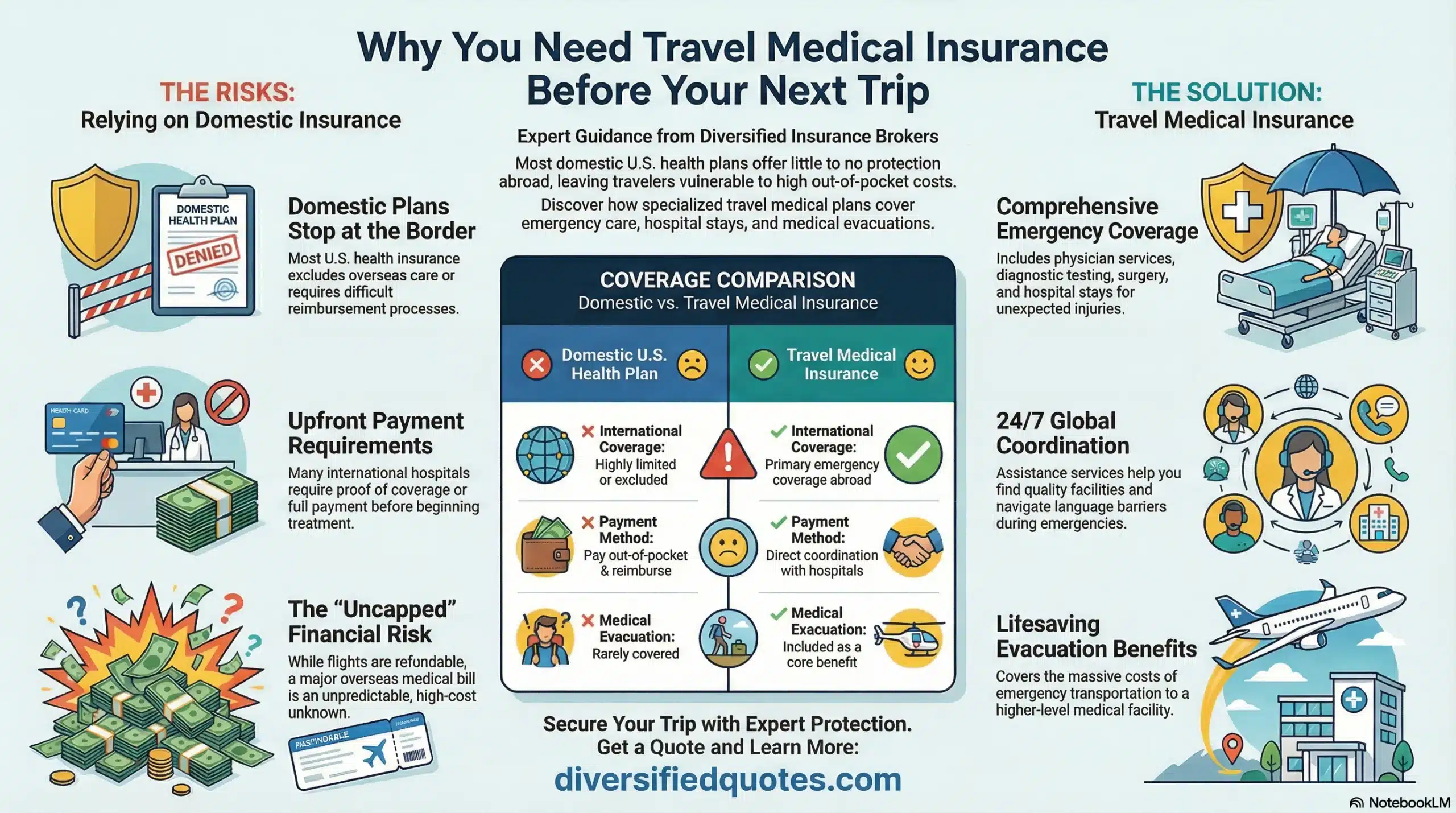
The most common planning gap is assuming domestic health insurance will handle everything. Many U.S. plans provide limited overseas benefits—or none at all—and it is common for international providers to require payment at the time of service. That’s why travel medical insurance is often the foundation of travel insurance for youth mission trips: it’s designed to cover emergency treatment abroad and provide a support process for finding care when you don’t know the system.
If your team is heading into areas with limited medical infrastructure, the evacuation component becomes just as important as the medical benefit itself. Understanding emergency medical evacuation insurance is one of the smartest steps a youth mission leader can take before the trip.
Travel medical coverage vs. trip protection: what matters for teen mission teams
People use the phrase “travel insurance” to describe different products. For youth mission travel, it helps to separate the two major categories so you buy the correct tool. Travel medical insurance focuses on illness and injury during the trip—doctor visits, hospital care, diagnostics, prescriptions tied to a covered event, and often evacuation benefits depending on the plan you choose. If your primary worry is “What happens if someone needs care overseas?” travel medical is the core.
Trip protection focuses on the financial side of the travel booking—delays, interruptions, cancellations, and sometimes baggage issues. For some youth mission trips, cancellation protection matters because airfare and program costs can be non-refundable, and a group cancellation can create a significant financial hit. For other trips, the bigger unknown is medical cost exposure overseas. Many groups choose to prioritize medical/evacuation first, then layer additional protection if the trip cost warrants it.
If you’re looking for the “medical-first” approach (common for missions), start with travel medical insurance and then decide whether you also need trip cost protection based on how non-refundable your trip budget is.
Unique risks for youth mission groups
Teen mission teams often travel into regions where infrastructure is limited, and the schedule can be physically demanding. A typical week might include construction or clean-up work, outreach events, long bus rides, and outdoor service projects in heat or humidity. That combination increases the likelihood of dehydration, heat illness, strains and sprains, minor wounds that can become infected, and stomach-related illness from food or water changes.
Youth teams can also face logistical risks: unpredictable weather disruptions, transportation changes, lost travel documents, or delayed flights that affect group coordination. While trip issues are frustrating, the mission-critical concern is usually medical access and emergency response—especially when parents are at home and leaders need immediate clarity about next steps.
If your itinerary includes higher-risk environments or limited medical access, you may also want to understand what “higher-risk” travel planning means in plain English: high risk travel insurance.
What travel medical policies typically cover for youth mission trips
High-quality travel medical coverage for mission teams is typically built around emergency treatment during the trip window. Depending on the plan configuration, that can include emergency medical expenses for illness or injury, hospital and physician services, diagnostic testing tied to a covered event, and prescriptions related to the covered condition. Many plans also include repatriation benefits and a 24/7 assistance layer that helps leaders coordinate care in-country.
For youth travel, the evacuation layer is often the “make or break” benefit. If a teen needs advanced care not available locally, evacuation benefits can help coordinate and cover transportation to an appropriate facility. This is why leaders frequently review travel medical coverage alongside evacuation education such as emergency travel health insurance and evacuation-focused planning.
For teams that include foreign nationals traveling into the U.S. for service projects (or multi-national mission teams), specialized structures may apply. In those cases, you may also find it helpful to review emergency travel health insurance for foreign nationals.
Need coverage quickly?
Many groups secure travel medical coverage online and finalize trip planning knowing emergency support and medical protection are in place.
How to choose the right policy for your youth group
The best way to choose travel insurance for youth mission trips is to match the policy to the “real mission.” Start with destination realities: are you staying in an urban area with strong medical access, or traveling into rural locations where advanced care is limited? Next, look at trip duration and the pace of activity—construction, outreach, walking-heavy schedules, heat exposure, and long transportation days all increase medical probability.
Group size matters because more travelers increases the chance of at least one medical event. Leaders should also confirm whether the church, school, mission board, or partnering organization requires specific minimum limits for students and adult leaders. Finally, confirm that planned activities are compatible with the coverage—some plans treat organized activities differently than passive tourism, and you do not want to discover an exclusion after an injury.
If you are building a protection stack for multiple ministry trips during the year, it can help to compare mission-focused structures, including mission trip travel insurance and broader group planning like travel insurance for church groups.
Support for parents and group leaders
Parents are usually not worried about “minor inconvenience” risks—they’re worried about worst-case scenarios: a hospitalization, a serious injury, or a situation that requires evacuation and immediate decision-making. Travel medical coverage helps by establishing a clear path to care and creating a support process that leaders can use in real time.
For leaders, the value is often clarity and coordination. When a medical event happens, the pressure is high: you’re managing the student, contacting parents, coordinating with local providers, and making decisions about whether local care is adequate. A plan that includes emergency assistance resources can reduce confusion and help leaders stay focused on the student’s wellbeing.
If your team includes youth sports outreach components (clinics, camps, training programs), you may also want to review activity-adjacent planning such as travel medical for youth sports, since the exposure profile can be similar when physical activity increases injury likelihood.
Tell us what the trip actually looks like
A “youth mission trip” can mean very different things. Share the destination, housing type, transportation plans, and service activities so we can point you toward coverage that fits.
Why work with Diversified Insurance Brokers?
Youth mission coverage should be simple to buy, but it should not be simplistic. The most expensive problems happen when leaders assume the plan is “for travel” and never confirm that it aligns with the group’s activities, destination risk, and emergency logistics. Our job is to keep the selection practical: match the plan to the trip and reduce blind spots before you leave.
We also help churches and mission organizations plan consistently across different trip types. Many ministries run multiple programs—youth missions, adult missions, humanitarian support, or outreach travel—and each one can have a different risk profile. That’s why we often cross-reference coverage for missionary groups and humanitarian aid workers when trip conditions are more complex.
The result is not “more insurance.” The result is the right protection for the mission—so leaders can focus on the work and families can feel confident their students are supported if something happens.
Get a clear recommendation for your youth mission team
If you’re comparing options, we’ll help you choose a plan that fits your destination, duration, and activities—and confirm the key details leaders care about.
Related Travel Medical Pages
Explore travel medical coverage, emergency support, and evacuation planning for international mission travel.
Related Mission & Group Travel Pages
Compare coverage setups for church groups, missionary organizations, and other service-focused travel.
Talk With an Advisor Today
Choose how you’d like to connect—call or message us, then book a time that works for you.
Schedule here:
calendly.com/jason-dibcompanies/diversified-quotes
Licensed in all 50 states • Fiduciary, family-owned since 1980
FAQs: Travel Insurance for Youth Mission Trips
Why do youth mission trips need travel insurance?
Youth mission trips involve international travel, hands-on service work, and environments where medical facilities may be limited. Travel insurance ensures students and leaders are protected with emergency medical care, evacuation, and 24/7 global support.
Does travel medical insurance cover emergency evacuation?
Yes. Travel medical plans typically include emergency medical evacuation to the nearest capable facility, and many also include political or security evacuation when needed.
Does my child’s domestic health plan work overseas?
Most U.S. health plans do not provide coverage outside the country, and almost none include emergency evacuation. Travel medical insurance fills these gaps for mission teams.
Can parents buy coverage individually for their teen?
Yes. Parents can purchase individual travel medical coverage, or group leaders can enroll the entire mission team under a group plan to simplify administration.
Are trip delays and lost baggage included?
Many travel medical policies include or offer optional benefits such as trip delay, trip interruption, and baggage protection, which are important for group logistics.
Does travel insurance cover service-related injuries?
Yes. If a student is injured during construction work, outreach activities, or other mission-related service, travel medical insurance provides hospitalization, treatment, and follow-up care when abroad.
Is group travel insurance cheaper than individual plans?
Group plans for youth mission trips often provide lower per-person cost and easier administration, though individual plans may be used when groups are smaller or families prefer to manage coverage independently.
About the Author:
Jason Stolz, CLTC, CRPC and Chief Underwriter at Diversified Insurance Brokers (NPN 20471358), is a senior insurance and retirement professional with more than two decades of real-world experience helping individuals, families, and business owners protect their income, assets, and long-term financial stability. As a long-time partner of the nationally licensed independent agency Diversified Insurance Brokers, Jason provides trusted guidance across multiple specialties—including fixed and indexed annuities, long-term care planning, personal and business disability insurance, life insurance solutions, Group Health, and short-term health coverage. Diversified Insurance Brokers maintains active contracts with over 100 highly rated insurance carriers, ensuring clients have access to a broad and competitive marketplace.
His practical, education-first approach has earned recognition in publications such as VoyageATL, highlighting his commitment to financial clarity and client-focused planning. Drawing on deep product knowledge and years of hands-on field experience, Jason helps clients evaluate carriers, compare strategies, and build retirement and protection plans that are both secure and cost-efficient. Visitors who want to explore current annuity rates and compare options across multiple insurers can also use this annuity quote and comparison tool.
