
Disability Income Insurance for Accountants

Jason Stolz CLTC, CRPC
Accountants and certified public accountants (CPAs) play a critical role in financial systems, tax compliance, business advisory services, and corporate decision-making. The profession requires strong analytical ability, concentration, long hours of focused work, and the capacity to manage complex financial data. While accounting is often viewed as a stable and secure profession, it still carries financial risk if illness or injury prevents a professional from working.
Disability income insurance is designed to protect professionals from the financial consequences of losing their income due to medical conditions. For accountants, income protection is especially important because the profession often involves many years of education, professional licensing, and long-term income growth. A disability that interrupts an accountant’s ability to work could significantly impact lifetime earnings and financial stability.
Many accounting professionals build long careers that extend through decades of peak earning potential. Partners in accounting firms, corporate financial officers, and independent CPAs frequently experience their highest income levels in mid to late career stages. Protecting the ability to earn income during these years is an essential component of financial planning.
Disability income insurance provides a financial safety net by replacing a portion of income if a covered illness or injury prevents an accountant from performing their professional duties. These policies are specifically designed to support professionals whose income depends heavily on cognitive ability, concentration, and productivity.
Why Accountants Need Disability Income Protection
The accounting profession relies heavily on mental focus, analytical reasoning, and sustained productivity. Unlike physically demanding occupations where injuries are the primary risk, accountants face disability risks related to both physical and cognitive health conditions.
Accountants frequently work extended hours during tax seasons, audit periods, and financial reporting cycles. These periods require sustained concentration, careful review of financial documents, and precise analysis. Medical conditions that affect cognitive function, energy levels, or mental clarity can significantly interfere with the ability to perform these duties.
Conditions such as neurological disorders, severe anxiety, depression, autoimmune diseases, and chronic fatigue can impact an accountant’s ability to maintain productivity. Vision problems, repetitive stress injuries, and other health issues can also interfere with the daily responsibilities required in accounting and financial analysis.
Because accountants often work in high-responsibility roles involving financial accuracy and regulatory compliance, even moderate impairments in concentration or productivity can prevent them from performing their job effectively.
Many professionals also evaluate broader financial planning strategies to understand how income loss could impact long-term financial goals. Tools such as investment risk analysis can help individuals assess how financial disruptions could affect retirement planning and wealth accumulation.
Income Risk for Accounting Professionals
Accountants often experience predictable career income progression. Early career professionals may begin working for accounting firms or corporations with moderate salaries that grow significantly over time. As professionals gain experience and professional certifications such as CPA designation, their earning potential increases.
Mid-career accountants may move into management roles, advisory positions, or specialized tax planning work. Partners in accounting firms or senior corporate finance professionals often earn significantly higher income levels later in their careers.
This long-term income trajectory creates substantial financial exposure if a disability interrupts the ability to work. Losing income even temporarily during peak earning years can significantly impact retirement savings, investment contributions, and long-term wealth accumulation.
For professionals who operate independent accounting practices or consulting businesses, the financial impact can be even greater. Self-employed accountants depend directly on their ability to perform billable work. If illness or injury prevents them from working, business revenue may stop entirely.
Disability income insurance helps mitigate this risk by replacing a portion of income while recovery occurs.
How Disability Insurance Works for Accountants
Disability income insurance provides monthly benefit payments when a policyholder becomes unable to perform their occupational duties due to illness or injury. These payments are designed to replace a portion of lost income so the insured individual can maintain financial stability during recovery.
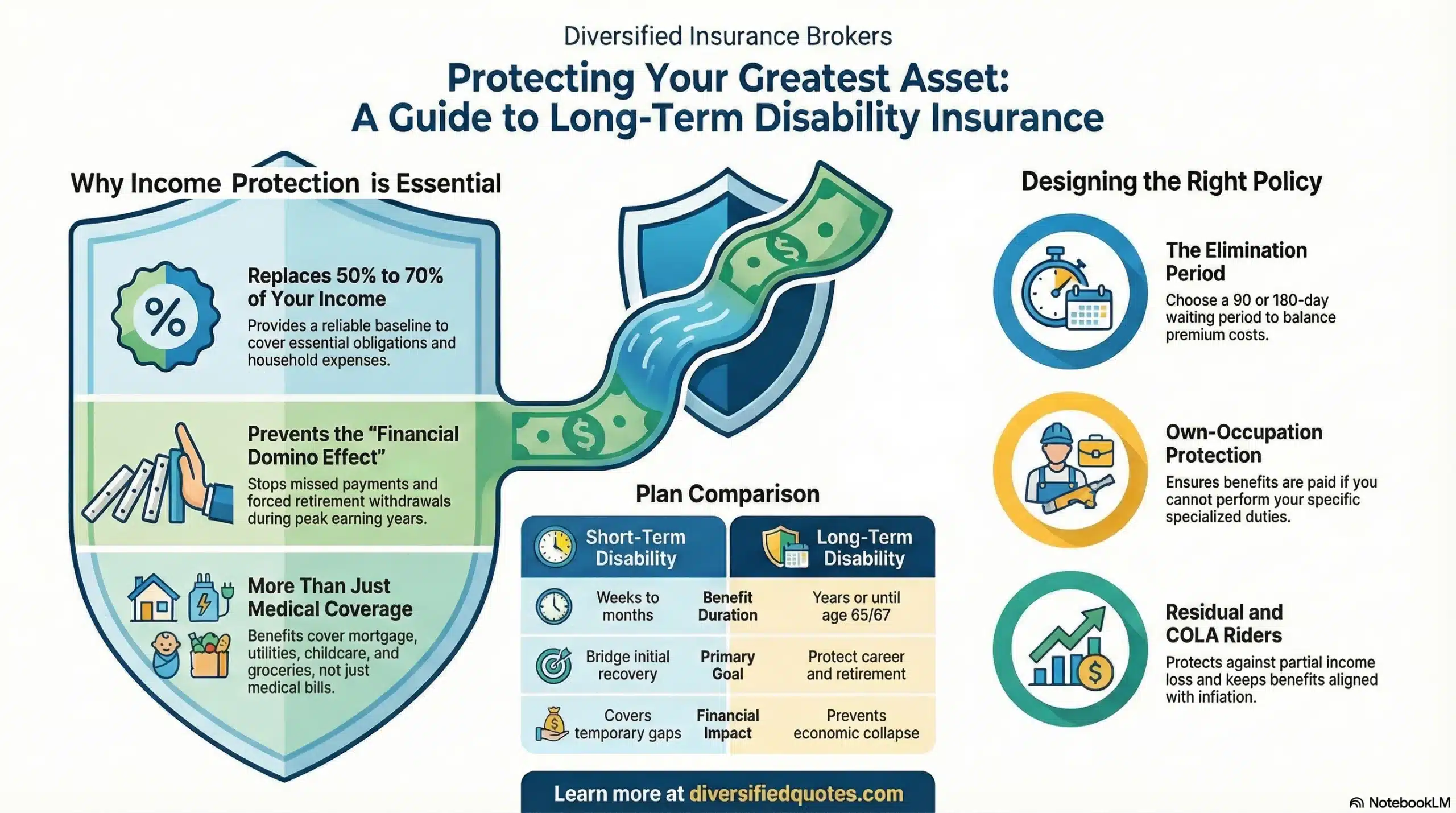
Policies typically replace between fifty and seventy percent of pre-disability income depending on underwriting guidelines and existing coverage. The goal is to provide enough income to maintain financial stability without creating incentives to remain disabled.
Several policy features determine how benefits are paid. One important feature is the elimination period, which is the waiting period before benefits begin. Many professionals choose elimination periods of ninety or one hundred eighty days, coordinating the waiting period with personal savings or employer benefits.
The benefit period determines how long payments continue. Some disability insurance policies provide benefits for several years, while others continue payments until retirement age if the disability persists.
Another critical feature is the definition of disability. Many high-quality policies for professionals use an “own occupation” definition. This means the insured may qualify for benefits if they cannot perform the duties of their specific occupation even if they are capable of working in another field.
For accountants, this protection is particularly valuable because the profession requires specialized expertise and concentration that may not easily translate into other careers.
Residual Disability Protection
One of the most important features for accounting professionals is residual disability protection. Unlike total disability, which occurs when someone cannot work at all, residual disability benefits provide income support if a professional can still work but experiences reduced earnings due to a medical condition.
For example, an accountant recovering from illness may return to work part-time or with reduced capacity. They may be able to serve fewer clients, work shorter hours, or reduce their workload during recovery.
Residual disability benefits provide partial income replacement during this period. These benefits help ensure that professionals are not forced to choose between working beyond safe limits or experiencing severe income loss during recovery.
Designing Disability Coverage for Accountants
Disability insurance policies for accountants are typically designed to reflect the professional nature of the occupation. Coverage often includes a benefit period extending to retirement age, ensuring long-term income protection if a permanent disability occurs.
Elimination periods are often coordinated with available savings or employer-provided short-term disability programs. Professionals with strong emergency savings may choose longer elimination periods in exchange for lower premiums.
Many policies also include benefit increase features that allow coverage to grow over time as income increases. This feature can be particularly valuable for younger professionals whose earnings are expected to grow significantly throughout their careers.
Cost-of-living adjustment riders may also increase benefits during long-term disabilities to help maintain purchasing power over time.
The Financial Impact of Disability
For accounting professionals, the financial consequences of disability extend beyond lost salary. Many professionals have significant financial obligations including mortgages, education expenses, retirement contributions, and family financial responsibilities.
Without disability income protection, individuals may be forced to rely on personal savings to cover these expenses. Over time, prolonged income loss could deplete retirement accounts or investment portfolios that were intended for long-term financial security.
Professionals nearing retirement may also explore guaranteed income strategies designed to provide stable income streams later in life. Some individuals research topics such as bonus annuity with lifetime income as part of retirement planning.
Protecting income during working years helps ensure that retirement planning strategies remain intact even if unexpected health issues occur.
Request Disability Insurance Quotes
Comparing disability insurance policies from multiple carriers allows accountants to evaluate coverage options designed specifically for professionals. Independent advisors can help determine appropriate benefit levels, elimination periods, and policy riders based on individual financial goals and income levels.
Long-Term Financial Protection for Accounting Professionals
Accountants spend their careers helping individuals and businesses manage financial risk. Protecting their own income is an equally important component of responsible financial planning.
Disability income insurance ensures that a temporary or permanent health condition does not undermine years of hard work and career development. By securing income protection early in their careers, accounting professionals can protect their financial future while continuing to build wealth and long-term security.
Related Pages
Financial Protection Essentials
Talk With an Advisor Today
Choose how you’d like to connect—call or message us, then book a time that works for you.
Schedule here:
calendly.com/jason-dibcompanies/diversified-quotes
Licensed in all 50 states • Fiduciary, family-owned since 1980
Many accountants rely heavily on their ability to concentrate, analyze financial information, and maintain consistent productivity. If illness or injury prevents an accountant from performing these duties, disability income insurance can help replace a portion of lost earnings and maintain financial stability.
Yes. Certified public accountants and other accounting professionals typically qualify for disability income insurance. Because accounting is considered a professional occupation, many insurance carriers offer favorable underwriting classifications and policy options designed for professionals.
Most disability insurance policies replace between 50% and 70% of a person’s income. Accountants typically choose benefit amounts that allow them to cover essential living expenses such as housing, family costs, insurance premiums, and retirement savings contributions.
Medical conditions that affect concentration, vision, mobility, or mental health can interfere with an accountant’s ability to perform professional duties. Examples include neurological disorders, severe anxiety or depression, chronic fatigue conditions, vision problems, and injuries that limit the ability to work for extended periods.
Own-occupation disability coverage can be important for accountants because it focuses on the ability to perform the duties of the insured’s specific profession. If an accountant cannot perform accounting work due to illness or injury, they may qualify for benefits even if they could technically work in a different field.
Residual disability coverage provides partial benefits if an accountant can still work but experiences reduced income due to illness or injury. For example, if a medical condition limits the number of clients or hours an accountant can work, residual disability benefits may help replace a portion of the lost income.
About the Author:
Jason Stolz, CLTC, CRPC and Chief Underwriter at Diversified Insurance Brokers (NPN 20471358), is a senior insurance and retirement professional with more than two decades of real-world experience helping individuals, families, and business owners protect their income, assets, and long-term financial stability. As a long-time partner of the nationally licensed independent agency Diversified Insurance Brokers, Jason provides trusted guidance across multiple specialties—including fixed and indexed annuities, long-term care planning, personal and business disability insurance, life insurance solutions, and short-term health coverage. Diversified Insurance Brokers maintains active contracts with over 100 highly rated insurance carriers, ensuring clients have access to a broad and competitive marketplace.
His practical, education-first approach has earned recognition in publications such as VoyageATL, highlighting his commitment to financial clarity and client-focused planning. Drawing on deep product knowledge and years of hands-on field experience, Jason helps clients evaluate carriers, compare strategies, and build retirement and protection plans that are both secure and cost-efficient. Visitors who want to explore current annuity rates and compare options across multiple insurers can also use this annuity quote and comparison tool.
