
How Much Long Term Care Insurance Do I Need?

Jason Stolz CLTC, CRPC
How much long term care insurance do I need? It’s one of the hardest questions in retirement planning because there is no single “right” number. The cost of care depends on where you live, whether you receive care at home or in a facility, how long you need care, and whether your goal is to protect all of your assets or mainly protect a spouse and preserve lifestyle. The good news is you don’t need a perfect forecast to build a smart plan. You need a benefit design that meaningfully reduces risk, stays affordable, and fits how you actually want care to look.
For many families, long term care insurance is not about covering every possible dollar of future expenses. Instead, it’s about creating a predictable pool of money so your spouse and family aren’t forced to spend down savings, sell assets, or drastically change their lifestyle if you need extended care. A well-sized plan can reduce the “financial shock” of care, protect retirement income, and give the healthy spouse more options and control. If you want a preview of what carriers require and how benefits are triggered, it can help to understand how to qualify for long term care insurance before you decide how much coverage to buy.
At Diversified Insurance Brokers, we help families size LTC coverage based on practical goals, not hypothetical extremes. The best policy is the one that fits your real-world budget and reduces your most meaningful risks. That usually means combining the right monthly benefit, a reasonable benefit period, a deductible-like elimination period, and inflation protection that matches your age and time horizon. Then we coordinate those choices with your income sources, savings, and what you want to preserve.
Get a Personalized LTC Coverage Recommendation
Tell us your age, health, and goals and we’ll recommend benefit amounts that match your situation.
How Much Long Term Care Insurance Do I Need for My Situation?
Instead of chasing a magic number, think in terms of goals and protection levels. Most people fall into one of three planning categories. Each category can be a smart choice depending on your assets, income sources, family situation, and how strongly you want to preserve your estate.
Full protection means you want insurance to cover most or all likely long term care costs. This is often a fit for households that want to preserve a large estate, protect business interests, or keep retirement withdrawals predictable even in a long claim scenario. Full protection can be powerful, but it can also be expensive if you push benefits too high or choose rich inflation options later in life.
Shared protection means you want insurance to share costs with your income, investments, or family resources. This is the most common approach. Instead of trying to insure the entire bill, you design a benefit that covers the gap between expected care costs and the income you can generate safely in retirement. This keeps premiums more manageable and still reduces the most painful outcomes.
Safety-net protection means you mainly want to protect a spouse or a core block of assets from being wiped out. In many households, the biggest fear isn’t “paying every dollar of care.” It’s the idea that the healthy spouse will be forced to liquidate assets, leave the home, or drastically reduce lifestyle. A smaller policy can still create meaningful leverage if it covers the worst years or the most expensive portion of care.
The question “How much long term care insurance do I need?” becomes: How much risk do I want the insurance company to take, and how much risk am I willing to keep? Your answer depends on the mix of assets you have, the stability of your income sources, and how important it is to preserve your estate.
Key Factors That Determine How Much Long Term Care Insurance You Need
To size a policy correctly, you’ll want to look at at least five factors: local cost of care, your willingness to self-fund, benefit duration, inflation protection, and your health/age profile. Each factor changes the benefit level that makes sense.
1) Cost of Care Where You Live (or Plan to Retire)
Long term care costs vary dramatically from one region to another. Urban areas and high-cost states often see much higher rates for nursing homes, assisted living, and home care than smaller towns or rural areas. Your policy should be sized to your expected reality, not a national average that may not reflect your market. It is also important to consider if you plan to live (and use) Long Term Care benefits overseas.
A reasonable starting point is to estimate the typical monthly cost in your area for three settings: home care, assisted living, and nursing facility care. Most people do not need to insure the single most expensive facility in the area, but your benefit should be realistic enough that it makes a meaningful dent in costs. A policy that pays far below local reality can still help, but it may not deliver the “peace of mind” you expect.
It’s also important to separate what long term care insurance covers from what Medicare does. Many people assume Medicare will pay for long-term custodial care. In general, Medicare is focused on short-term skilled care and rehabilitation under specific conditions, not extended custodial assistance. That’s why many families review the differences in does Medicare cover long term care while they size their policy. Clarity on this point helps you avoid building a plan on an assumption that won’t hold up in real life.
2) How Much of the Risk You’re Willing to Self-Fund
Self-funding is part of almost every long term care plan, whether people realize it or not. Even with insurance, you may pay for the first phase of care during an elimination period, and you may choose a benefit that covers only a portion of expected costs.
If you have significant retirement income from pensions, annuities, or investments, you may decide to use long term care insurance to cover a portion of the cost while your existing income and assets cover the rest. This approach often produces the best “value” because you are not paying premiums to insure costs you could already handle comfortably. Instead, you use insurance to protect against the part of the risk that could change your lifestyle or drain assets quickly.
For example, if care is projected at $9,000 per month and you can safely generate $4,000 from Social Security and portfolio income, you might size a policy around a $5,000 monthly benefit. That still creates real leverage and protects the household, but it keeps premiums more reasonable than insuring the full $9,000. The concept is simple: insure the gap, not every dollar.
3) How Long You Want Benefits to Last
The benefit period is one of the most powerful levers in policy sizing. Benefit periods often include two, three, five, or more years, and some designs are built around shared pools between spouses. The benefit period is essentially the duration the policy will pay once you qualify and the claim begins.
Many people aim to insure the “most likely” window of care usage rather than the extreme tail risk. Others want coverage that is strong enough to handle a longer event like dementia-related care that can last many years. The right answer depends on your assets and your goal. If you have strong assets, you may be comfortable with a shorter benefit period that protects against the first few years while you keep a larger reserve for longer durations. If preserving the estate is the goal, you may favor a longer benefit period or a shared pool approach.
Couples often benefit from shared pool strategies because they improve flexibility. If one spouse needs extended care, the pool can be drawn down without forcing the other spouse to carry an independent full-sized plan alone. If you want to understand why shared pools can be so powerful, review long term care insurance with shared benefits.
4) How Much Inflation Protection You Need
Inflation protection is often as important as the starting benefit. Care costs can rise over time, and a policy that looks sufficient today may be inadequate in 15 or 20 years if it does not grow. The younger you are when you buy, the more important inflation protection becomes because you have more time before you’re likely to use benefits.
Modern policies may offer different inflation structures, including simple or compound growth options, step-up features, and other designs. The best approach is usually to model a few inflation levels and see how they affect both future benefit power and premium. Many people find a middle ground that preserves purchasing power without making premiums too heavy.
Some people also care about “getting value back” if benefits are never used. In that case, designs that include refund features can be appealing. If you want to see how refund mechanics can change the value conversation, review long term care insurance with return of premium.
5) Your Health, Age, and Family History
Your health profile influences both what you can qualify for and what coverage level is realistic. In general, younger and healthier applicants have more options and better pricing. If there is a family pattern of dementia, stroke, or other chronic conditions, you may want stronger benefit duration or design flexibility.
If you are applying later—especially after age 60—the strategy is often to size benefits carefully so premiums remain sustainable. You may still be able to get meaningful protection, but the plan design typically needs to be more intentional. If you are in this category, resources like can you still get long term care insurance after age 60 can help you understand what’s realistic and how to adjust benefit levels to match both underwriting and budget.
How Much Long Term Care Insurance Do I Need at Different Ages?
“How much long term care insurance do I need?” looks different at 50 than at 70. Life stage affects how much time inflation has to work, how likely underwriting is to be smooth, and how much premium budget you want to commit.
Planning in Your 50s
In your 50s, you’re often in one of the best windows to lock in coverage because underwriting tends to be smoother and you have time to build inflation protection into the design. At this stage, many people choose a starting benefit that reflects today’s costs and pair it with an inflation structure that keeps pace over the long run.
The strategic advantage of buying in your 50s is that you can often build a plan that is not overly “rich” today, but grows into something very meaningful by the time you are in your 70s or 80s. That can keep premiums reasonable while still addressing long-term risk.
Planning in Your Early 60s
In your early 60s, many people still qualify for robust coverage, but underwriting is more sensitive to medical history and pricing moves upward. As a result, many clients in their early 60s choose a benefit that covers a core portion of expected costs rather than 100%, and then coordinate insurance with retirement income sources and investment strategy.
Some households also explore tax-efficient funding strategies, especially if they have non-qualified assets they could reposition. If you want to understand asset-based planning structures that can support LTC needs, it can be helpful to explore designs like a non-qualified long term care annuity. One reason people consider certain non-qualified annuity-based LTC designs is that qualified long-term care reimbursements can be structured in a tax-favored way when implemented correctly, which can change the “effective cost” of care planning for some households.
Planning in Your Late 60s and 70s
By the late 60s and 70s, it may still be possible to get coverage, but benefit levels and premium costs often need to be calibrated carefully. Many people shift from “fully funding everything” to “protecting the spouse and the core asset base.” That often means choosing a benefit that meaningfully offsets care costs without forcing an unsustainable premium.
At this stage, couples planning becomes especially important. Shared pools and coordinated design strategies can create more protection without simply doubling costs. The plan should reflect household reality: if one spouse needs care, the other spouse is the one living through the financial consequences.
How Much Long Term Care Insurance Do I Need for Home Care vs Nursing Home?
Your policy should reflect where you’re most likely to receive care. Many people prefer to start with home care and only transition to assisted living or nursing facility care if necessary. This preference affects how you size benefits because home care is often billed hourly while facilities are often billed daily or monthly.
When you build a plan that assumes home care first, you’re often deciding how many hours per day you want to cover and whether family caregiving will play a role. Some families assume 4 hours per day for a phase, then 8 hours, and then a transition to a facility if needed. Others assume a faster transition to facility care. The right benefit amount should be flexible enough to help in multiple settings because you may not know exactly how care unfolds.
Most modern LTC policies are designed to pay in different settings. What matters is that the benefit pool is large enough—and grows sufficiently—to meaningfully offset the cost of care wherever it happens. To understand how insurers measure when you need help, it’s useful to review Activities of Daily Living, because those definitions often trigger eligibility for benefits.
Elimination Periods: The “Deductible” You Choose
One of the simplest ways to control premium while still building meaningful protection is the elimination period. The elimination period functions like a deductible measured in time. You pay for care out of pocket during that initial window, and then benefits begin after the elimination period is satisfied.
A common mistake is choosing an elimination period without thinking about cash reserves. A longer elimination period can reduce premiums, but you need a clear plan for paying those first weeks or months of care. Many households choose an elimination period that aligns with an emergency fund or a reserve account, allowing them to self-fund early care while still protecting against prolonged care.
If you want more detail on how elimination periods work and what “calendar days” and “service days” can mean in practice, review LTC elimination periods explained.
Model Benefit Amounts and Premium Tradeoffs
We can compare multiple monthly benefits, elimination periods, and inflation options so you can pick the best-fit design.
Taxes and “How Much Long Term Care Insurance Do I Need?”
Tax rules can influence how much coverage you decide to buy and how you fund it. For some people, a portion of premiums may qualify for deductions depending on tax circumstances, and benefits are often treated favorably when used for qualified long term care services. Understanding tax mechanics can sometimes justify slightly stronger coverage because the after-tax cost of planning can be lower than people expect.
To explore how tax rules may apply, many people review educational material like the tax benefits of long term care insurance and then coordinate decisions with their tax professional. The key is not to buy coverage “because of taxes,” but to understand taxes so you can size coverage more intelligently.
How to Decide How Much Long Term Care Insurance You Need
When you’re ready to narrow your policy design, a structured conversation usually covers your age and health profile, where you plan to live, how you want care to start, your income sources, and what assets you are trying to protect. This is where planning becomes personal. The “right” policy is the one that fits your household reality and reduces the risks you care about most.
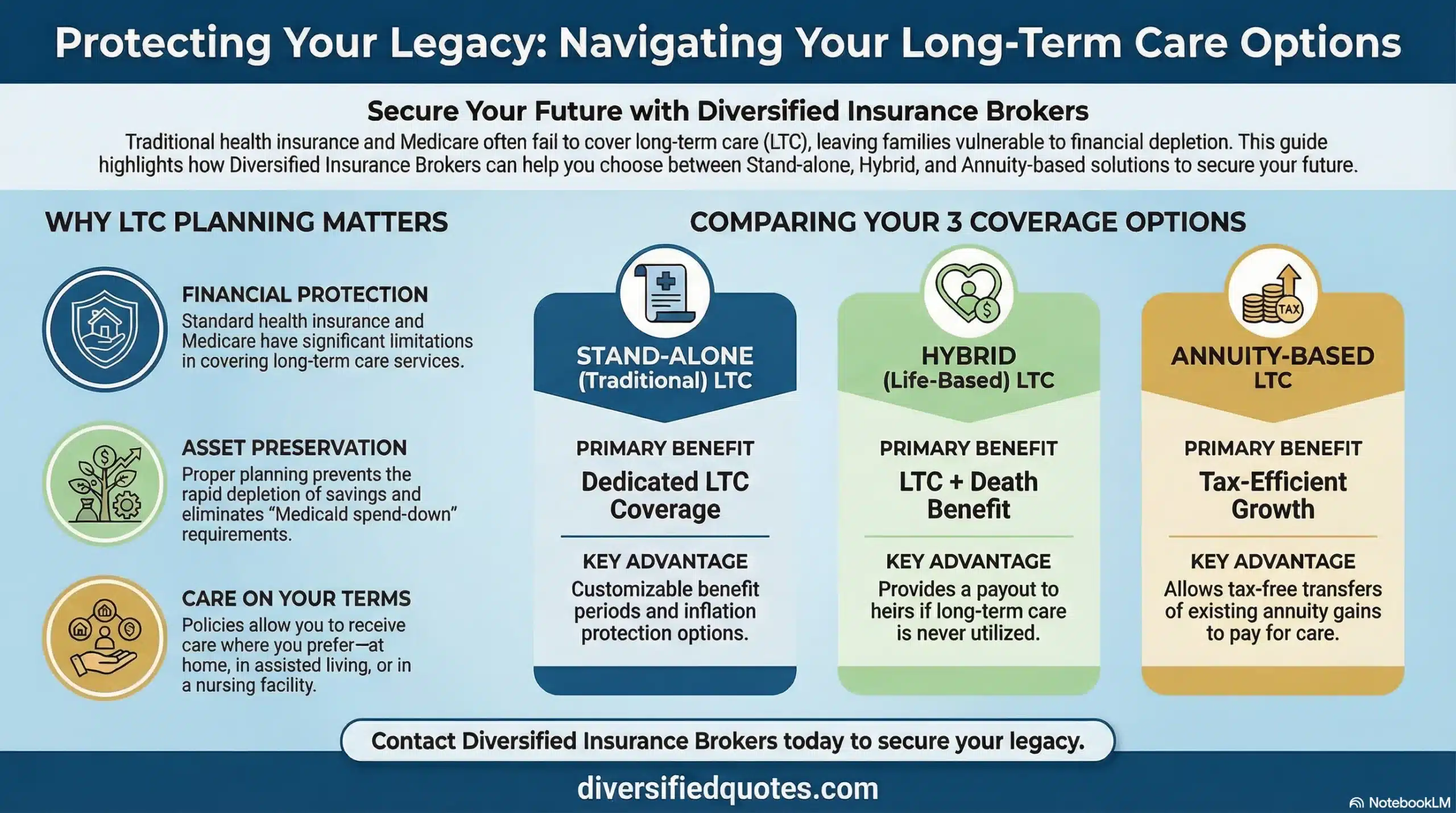
From there, you can test different combinations of monthly benefit, benefit period, inflation protection, and elimination periods. This is where many families discover the “sweet spot” design: a policy that meaningfully reduces risk without over-insuring and overpaying. For some households, traditional standalone coverage is ideal. For others, hybrid or asset-based solutions may provide a better value structure because they create value even if benefits are never used.
In higher-asset households, long-term care planning often becomes part of broader wealth protection strategy. Some families explore how asset preservation concepts connect to LTC planning by reviewing related planning topics like how the wealthy stay wealthy, then tailoring LTC decisions around those principles. The point is not that you need to be “wealthy” to plan well. The point is that thoughtful risk transfer and thoughtful asset protection often go together.
Finally, remember that LTC planning is not just about you. It’s about the people who would be impacted by your care needs. A well-sized policy reduces the emotional and financial burden on a spouse and family, which is one of the most important “returns” long-term care insurance can provide.
Get Your Recommended Coverage Range
We’ll recommend a benefit range based on your assets, income, location, and care preferences—then compare carriers.
Related Long-Term Care Pages
Use these pages to refine benefit design, understand approvals, and coordinate coverage for couples.
Related Planning Topics
Explore how LTC planning connects to retirement income, care triggers, and asset-based alternatives.
Talk With an Advisor Today
Choose how you’d like to connect—call or message us, then book a time that works for you.
Schedule here:
calendly.com/jason-dibcompanies/diversified-quotes
Licensed in all 50 states • Fiduciary, family-owned since 1980
FAQs: How Much Long Term Care Insurance Do I Need?
Is there a standard amount of long term care insurance everyone should buy?
No. The amount of long term care insurance you need depends on your age, health, assets, income, local care costs, and how much risk you want to self-fund versus transfer to an insurance company.
How do I estimate future long term care costs?
You can start by looking at current nursing home, assisted living, and home care rates in your area, then apply a reasonable inflation assumption. An advisor can help you translate those estimates into monthly and total benefit amounts.
Should my long term care benefits cover 100% of projected costs?
Not necessarily. Many people design policies to cover a portion of the cost and use income or savings to pay the rest. The right mix depends on how much you want to protect your spouse and assets from a worst-case scenario.
How long should my long term care benefits last?
Common choices are two, three, or five years, and some couples choose a shared benefit pool. The best option depends on your budget, health history, and how much of a long claim you want to insure.
How important is inflation protection on long term care insurance?
Inflation protection is critical if you are buying coverage years before you are likely to need care. It helps your benefits keep pace with rising care costs so your policy remains meaningful in the future.
Can I adjust how much long term care insurance I have later?
Some policies allow benefit increases, riders, or upgrades in the future, often subject to underwriting and additional premiums. It is usually easier and more cost-effective to build a solid base of coverage when you first apply.
Is it better to buy long term care insurance in my 50s or 60s?
Many people aim for their 50s or early 60s. Buying earlier often means better health, more options, and stronger inflation protection. Waiting can lead to higher premiums or limited choices if health changes.
Can annuities help pay for long term care if my policy isn’t large enough?
Yes. Certain annuity strategies can be designed to help fund long term care needs, either through dedicated riders or by providing extra income that works alongside a long term care policy and other resources.
About the Author:
Jason Stolz, CLTC, CRPC and Chief Underwriter at Diversified Insurance Brokers (NPN 20471358), is a senior insurance and retirement professional with more than two decades of real-world experience helping individuals, families, and business owners protect their income, assets, and long-term financial stability. As a long-time partner of the nationally licensed independent agency Diversified Insurance Brokers, Jason provides trusted guidance across multiple specialties—including fixed and indexed annuities, long-term care planning, personal and business disability insurance, life insurance solutions, Group Health, and short-term health coverage. Diversified Insurance Brokers maintains active contracts with over 100 highly rated insurance carriers, ensuring clients have access to a broad and competitive marketplace.
His practical, education-first approach has earned recognition in publications such as VoyageATL, highlighting his commitment to financial clarity and client-focused planning. Drawing on deep product knowledge and years of hands-on field experience, Jason helps clients evaluate carriers, compare strategies, and build retirement and protection plans that are both secure and cost-efficient. Visitors who want to explore current annuity rates and compare options across multiple insurers can also use this annuity quote and comparison tool.
