
Is Disability Insurance Worth It

Jason Stolz CLTC, CRPC
For many people, their earning power is their most important asset — and losing it due to illness, injury, or disability could derail years of financial planning. That’s why disability insurance matters. But the question is valid: Is disability insurance worth it? For a large portion of working Americans — especially those with dependents, debt, or a limited safety net — the answer is often yes. The reason is simple: most household financial plans assume your income keeps arriving on schedule. When a health event interrupts that income, the pressure shows up immediately, and the choices people make under pressure are often expensive. This guide breaks down when disability coverage makes sense, what to watch out for, and how to decide if it’s a smart move for your financial well-being.
To keep this practical, it helps to separate two ideas. First: disability insurance is not meant to make you “whole” financially. It’s meant to keep you stable and functional. Second: the value of disability insurance is highly personal. The same policy can be “absolutely worth it” for one household and “unnecessary” for another — not because the product is better or worse, but because their income risk, savings, and obligations are different.
At Diversified Insurance Brokers, we help clients evaluate disability insurance the way it should be evaluated: as a cash-flow defense tool. We compare carriers, clarify contract language, and structure benefits around your actual monthly obligations and risk window — so you’re not overpaying, but you also aren’t relying on wishful thinking when a real health event occurs.
Find Out If Disability Insurance Is Worth It for You
Answer a few questions and we’ll help you evaluate coverage options based on your income, occupation class, savings buffer, and goals.
Quick, confidential, and designed for real-world budgets.
Why Disability Insurance Matters
Life is unpredictable. Accidents happen, illnesses show up, recovery takes longer than expected, and medical conditions can reduce work capacity in ways that don’t look dramatic on the outside. Disability insurance protects you while you’re alive by replacing part of your income if you can’t work due to a qualifying sickness or injury. Without it, even a short-term disruption can drain savings, create debt, or force early withdrawals from accounts you intended to leave alone.
One of the reasons the “worth it” question comes up so often is that many people assume disability means a permanent, career-ending situation. In real life, disability is frequently a capacity problem. You might be restricted from full-time hours. You might have a recovery period after surgery. You might be dealing with pain, fatigue, medication effects, or cognitive limitations that make it impossible to perform at the same level. That’s why disability insurance is often framed as a core part of income protection, similar to the logic behind why you need disability insurance even if you’re young and healthy. You’re not buying it because you expect the worst. You’re buying it because the cost of being unprepared is so high.
Disability coverage can be particularly important for self-employed individuals because there is no employer benefits department to fall back on. If your income comes from your own production, your business, or contract work, your paycheck can stop instantly when you stop working. That’s also why people increasingly prefer self-service or online solutions, using guides like how to buy disability insurance online and how to buy short-term disability insurance online to get protected quickly and privately.
What “Worth It” Really Means in Disability Insurance
When people ask “Is disability insurance worth it?” they’re usually trying to answer one of three underlying questions:
1) Can I survive financially without working for a while? This is about cash reserves, flexibility, and how dependent the household is on one paycheck.
2) If I couldn’t work, would I be forced into expensive decisions? Things like credit card debt, 401(k) withdrawals, borrowing from family, missing payments, or pausing retirement contributions.
3) If disability changed my career trajectory, could I still stay on track long-term? This is about protecting the plan, not just paying bills. Many people “get through” a short disruption but take years to recover financially because they depleted savings and lost compounding time.
Disability insurance is “worth it” when it prevents expensive choices, protects stability, and preserves momentum. It’s less about whether you could technically survive and more about whether you would be forced into a version of life you don’t want — selling assets, taking on debt, or permanently delaying goals.
When Disability Insurance Is a Smart Move
Disability insurance tends to deliver the most value when you fit one or more of these scenarios. Think of these as “high leverage” situations where losing income creates outsized damage.
You are the primary (or only) earner. If most of the household depends on your income, disability insurance is often the simplest way to prevent financial instability. In these households, the risk is concentrated, so the protection is often worth it.
You have high fixed expenses. Mortgage or rent, childcare, tuition, debt payments, insurance premiums, and other recurring commitments often don’t scale down quickly. If your budget is mostly fixed, income disruption is harder to absorb without protection.
You are early-to-mid career and still building your plan. In your 20s, 30s, and 40s, you’re in the “compounding decade(s).” A disability that forces you to stop contributing to retirement accounts, pause debt payoff, or drain emergency savings can cause long-term damage that’s hard to see in the moment. This is one reason many professionals use disability insurance as a foundational layer and then build other planning tools around it.
You’re self-employed or income is production-based. If your income depends on billable hours, sales production, client retention, or hands-on work, disability often hits harder. A reduced workload can create a reduced paycheck, and recovery isn’t always linear. The ability to stabilize cash flow during a slow recovery is often what makes the coverage “worth it.”
You work in higher-risk or physically demanding roles. Injury risk can be higher, and a condition that would be manageable in a desk job can be career-disruptive in a physical role. Some individuals also layer protection, pairing disability with complementary coverage like accident insurance when appropriate, especially if their risk profile is more injury-exposed.
You have limited savings. If you don’t have a meaningful emergency fund, disability insurance can function like a stability tool. Without it, the “plan” often becomes borrowing, withdrawing, or missing payments.
What Disability Insurance Offers — and What It Doesn’t
Good disability policies don’t just pay a benefit. They define when benefits start, how long they can last, and what counts as disability. Those definitions are where real-world outcomes are decided. When evaluating whether disability insurance is worth it, you want to understand these components clearly.
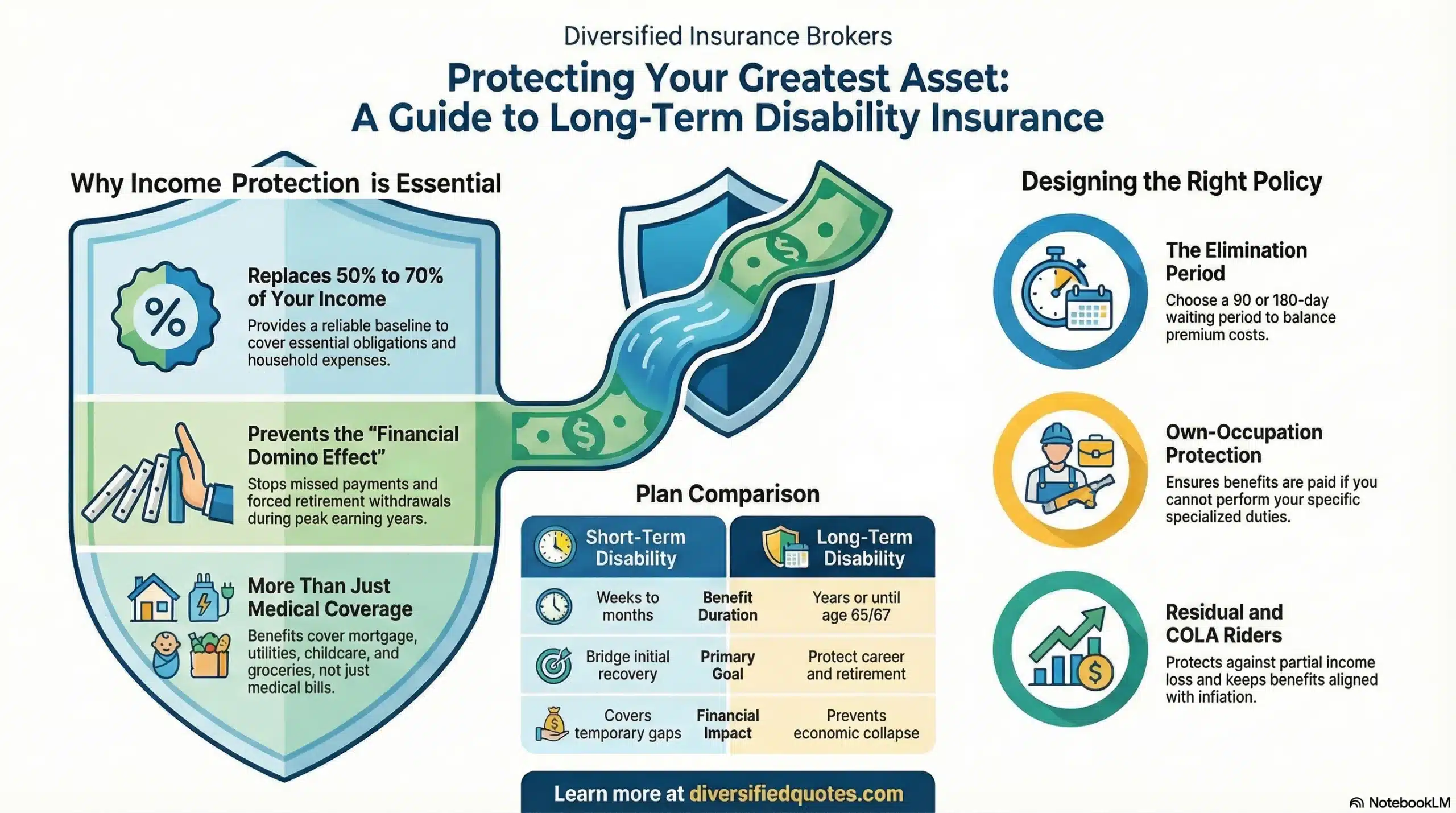
It offers income replacement. Disability insurance replaces a portion of your income during an approved claim. That cash flow can keep housing stable, prevent debt escalation, and help you avoid draining long-term accounts during a vulnerable period.
It offers clarity and predictability. The best disability plan is not the one with the lowest premium. It’s the one that behaves predictably in realistic claim scenarios. That means clearly understanding elimination periods, benefit periods, and definitions of disability.
It does not replace 100% of income. Most designs replace a portion rather than the full paycheck. That’s intentional. Policies are structured to stabilize the household while still preserving motivation to return to work when medically appropriate. The exact replacement percentage depends on income level and carrier limits.
It does not eliminate all claim friction. Disability claims are evaluated based on medical documentation, occupational duties, and policy definitions. A strong policy can still require paperwork during a claim. The goal is not “zero friction.” The goal is a contract that makes outcomes consistent and fair for realistic medical scenarios.
It does not cover every scenario. Policies have exclusions, limitations, and pre-existing condition rules. Understanding those is part of the “worth it” analysis because the value of a policy depends on whether it protects your most realistic risks.
The Definition That Often Decides Whether It’s Worth It
One of the most important “make or break” decisions is the definition of disability — especially the difference between own-occupation and any-occupation coverage. If you do specialized work, a broad definition that requires you to be unable to do “any job” can feel like a policy that exists on paper but fails you in real life.
With own-occupation disability insurance, the definition generally focuses on whether you can perform the material and substantial duties of your own job (or specialty). That matters when you could technically work, but not in the same capacity, not at the same productivity, or not with the same earnings potential. For many professionals, the definition is the product. If the definition matches reality, the coverage is worth it. If it doesn’t, the policy can feel like a frustrating expense.
Short-Term vs. Long-Term Disability: What’s Right for You?
Short-term and long-term disability are often discussed as if you have to choose one. In reality, many people do best with a layered strategy that reflects how disability usually unfolds: immediate cash flow disruption first, then a longer risk window if recovery takes longer.
Short-term disability typically protects the first weeks or months. It’s especially valuable when your risk is “a gap in paychecks” rather than a permanent career loss. Short-term coverage is also often the preferred path for people who want speed and simplicity. If you want a self-directed approach, buying short-term disability online can be a practical solution for quick protection.
Long-term disability protects the bigger tail risk: the disability that lasts years or changes work capacity permanently. If you’re the primary earner, have major obligations, or are early-to-mid career, long-term disability is often where the “worth it” value is highest because it prevents catastrophic long-term derailment. For a deeper understanding of that risk window, review long-term disability insurance.
It’s also important to understand that many employer plans provide some long-term disability coverage but may cap benefits at a level that leaves a gap. In those cases, an individual policy may be less about “adding another policy” and more about completing the protection you assumed you had.
Cost-Benefit Tradeoffs: Is It Worth the Premium?
The premium is the part people feel monthly. The risk is the part people underestimate. That’s the core tension. If you want a rational “worth it” decision, compare premium to the economic impact of a disability instead of comparing premium to “zero.” A disability doesn’t have to be permanent to be financially damaging. A three-month disruption can still create debt, missed payments, and lost retirement contributions that take years to unwind.
Premiums vary based on age, occupation class, benefit design, and policy definition. If you want to connect the dots between design choices and premium impact, our guide on how much disability insurance costs is designed specifically for that. Many people discover that the “expensive” feeling disappears when they adjust the elimination period or benefit design to match their savings buffer.
On the other hand, it’s also true that disability insurance is not automatically worth it for every scenario. If you have substantial liquid reserves, strong passive income, minimal fixed expenses, and a household structure that can absorb a long gap without forced financial decisions, you may decide the premium is unnecessary. That’s not a “right or wrong” outcome. That’s the product doing its job: you’re evaluating risk and deciding whether you want to transfer it to an insurer.
How to Choose a Policy That’s Actually Worth It
The best disability insurance policy is the one that matches your real risk and behaves the way you expect. When people buy a policy that isn’t worth it, it’s often because they focused on price first and definitions second. Here are the practical factors that most often determine whether the policy feels valuable later.
Start with the definition. If your work is specialized, consider own-occupation definitions and make sure the policy aligns with how you earn. If your work is less specialized, you may still want strong definitions, but the “own-occ” premium increase may not be necessary for every role.
Choose an elimination period you can realistically absorb. If you have a real emergency fund or sick leave, you can often extend the waiting period and lower premium without weakening the core protection.
Pick a benefit period that matches your true risk window. If the goal is “I want the plan protected until retirement,” the benefit period should reflect that. If the goal is “I want a bridge during recovery,” a shorter benefit period may be appropriate.
Value residual or partial disability protections. Many real-world disabilities are not all-or-nothing. A policy that helps during reduced earnings periods can be the difference between “this policy saved us” and “this didn’t help when I needed it most.”
Be cautious with riders. Riders can add value, but they can also inflate premium without solving a real problem. A good design adds riders only when they connect directly to your situation.
Compare carriers. Different carriers treat the same occupation and health history differently. Shopping intelligently is often the easiest way to improve value without sacrificing protection.
When Might Disability Insurance Not Be Worth It?
There are scenarios where disability insurance may offer limited value. These are not “rules,” but they are common patterns.
You’re near retirement and earned income is no longer the engine. If retirement is close and your plan is not dependent on ongoing earnings, the value of disability insurance can decrease.
You have substantial liquid savings and minimal fixed costs. If you can cover multiple years of expenses without forced financial decisions, you may decide self-insuring makes more sense.
Your household can absorb a gap without major tradeoffs. Dual-income households with strong buffers sometimes decide the premium isn’t necessary. The question becomes: would a disability force you to change your lifestyle, sell assets, or create debt — or would it simply be an inconvenience you can absorb?
You prefer a different risk strategy. Some people intentionally choose to keep higher cash reserves and accept certain risks rather than paying ongoing premiums. That can be rational when the numbers support it and the household truly has flexibility.
How We Help at Diversified Insurance Brokers
Disability insurance is one of the most contract-driven coverages in the market. Small wording differences can change real outcomes. At Diversified Insurance Brokers, we help clients evaluate whether disability coverage is worth it based on their income model, occupation, and risk window. We explain definitions and riders in plain English, compare options, and help you structure a plan that protects your paycheck without being overbuilt.
If you’re not sure where you fit, the easiest next step is to request a review. We’ll help you map the decision to your situation: income stability, obligations, employer coverage gaps, and the level of protection that would keep your household stable in a real-world disability scenario.
Get a Disability Insurance Review
Complete the form and we’ll help you evaluate your options and compare coverage designs that match your income and goals.
Talk With an Advisor Today
Choose how you’d like to connect—call or message us, then book a time that works for you.
Schedule here:
calendly.com/jason-dibcompanies/diversified-quotes
Licensed in all 50 states • Fiduciary, family-owned since 1980
FAQs: Is Disability Insurance Worth It?
What does disability insurance actually cover?
Disability insurance replaces a portion of your income if you can’t work due to a qualifying illness or injury. Depending on the policy, benefits may continue for months, years, or up to retirement age, helping you pay everyday bills while you recover.
Who needs disability insurance the most?
People who rely heavily on their paycheck — especially primary breadwinners, self-employed workers, and those with mortgages, debt, or dependents — tend to benefit the most. If losing your income for even a few months would create serious financial stress, disability insurance is worth a close look.
Is disability insurance through my employer enough?
Employer plans are a great starting point, but they often replace only a portion of income, may exclude bonuses, and usually end when you leave the job. Many people add an individual policy to increase benefits, lock in portable coverage, and customize the definition of disability.
How expensive is disability insurance?
Costs vary based on age, health, occupation, benefit amount, and benefit period. As a rough guideline, premiums might range from 1–3% of your annual income for solid long-term coverage. Adjusting waiting periods, benefit lengths, and riders can help fit coverage into your budget.
What’s the difference between short-term and long-term disability insurance?
Short-term disability typically pays benefits for a few months up to about a year and is often used for temporary conditions, such as recovery from surgery. Long-term disability is designed for serious illnesses or injuries that last years, sometimes paying benefits up to retirement age if you remain disabled.
How do “own-occupation” and “any-occupation” definitions affect my coverage?
An own-occupation policy pays benefits if you cannot perform the material duties of your specific job, even if you could work in another role. An any-occupation policy only pays if you are unable to work in any reasonable job based on your education and experience, which is a much tougher standard to meet.
Can I be denied disability insurance because of health or job risk?
Yes. Pre-existing conditions, high-risk occupations, or dangerous hobbies can lead to higher premiums, policy exclusions, or even declinations. Working with a broker who understands high-risk underwriting and has access to multiple carriers can improve your chances of finding suitable coverage.
When might disability insurance not be worth it?
If you have substantial liquid savings, strong passive income, or are close to retirement with minimal expenses, you may decide that premiums are not justified. In those cases, some people choose to self-insure by relying on savings and other resources instead of purchasing a separate policy.
About the Author:
Jason Stolz, CLTC, CRPC and Chief Underwriter at Diversified Insurance Brokers (NPN 20471358), is a senior insurance and retirement professional with more than two decades of real-world experience helping individuals, families, and business owners protect their income, assets, and long-term financial stability. As a long-time partner of the nationally licensed independent agency Diversified Insurance Brokers, Jason provides trusted guidance across multiple specialties—including fixed and indexed annuities, long-term care planning, personal and business disability insurance, life insurance solutions, Group Health, and short-term health coverage. Diversified Insurance Brokers maintains active contracts with over 100 highly rated insurance carriers, ensuring clients have access to a broad and competitive marketplace.
His practical, education-first approach has earned recognition in publications such as VoyageATL, highlighting his commitment to financial clarity and client-focused planning. Drawing on deep product knowledge and years of hands-on field experience, Jason helps clients evaluate carriers, compare strategies, and build retirement and protection plans that are both secure and cost-efficient. Visitors who want to explore current annuity rates and compare options across multiple insurers can also use this annuity quote and comparison tool.
