
Travel Medical and Evacuation from France

Jason Stolz CLTC, CRPC
Travel to France is often “routine” from a destination standpoint, but the moment a real medical event happens, the logistics can become anything but routine. A surprise ER visit in Paris, a broken ankle on uneven streets in Lyon, an infection that needs imaging and follow-up, or a sudden cardiac event while you’re touring the countryside can turn into a high-cost problem quickly. The biggest issue for most travelers isn’t whether France has good care—it does. The issue is how you access that care as a visitor, how the bills are handled, and what happens when a physician recommends a higher level of care or a return home under medical supervision.
At Diversified Insurance Brokers, we build travel medical and evacuation coverage around the real-world “what if” scenarios travelers face in France. That includes short trips, multi-city itineraries, river cruises, extended stays, and even travelers who are mixing leisure and work. The goal is straightforward: help you travel with a plan that can respond when something goes wrong, without forcing you to drain savings or scramble through fine print from overseas.
If you want a broader overview of how travel medical policies work in general, start here: travel medical insurance. From there, it becomes much easier to understand what to prioritize for France specifically—especially for travelers who want strong hospital access, reasonable deductibles, and benefits that still function if a trip changes midstream.
Compare Travel Medical + Evac Options for France
Use the quote link below to compare travel medical and evacuation plans designed for international trips, then select coverage that fits your dates, age, and travel style.
Why travel medical coverage matters even in a “safe, modern” destination like France
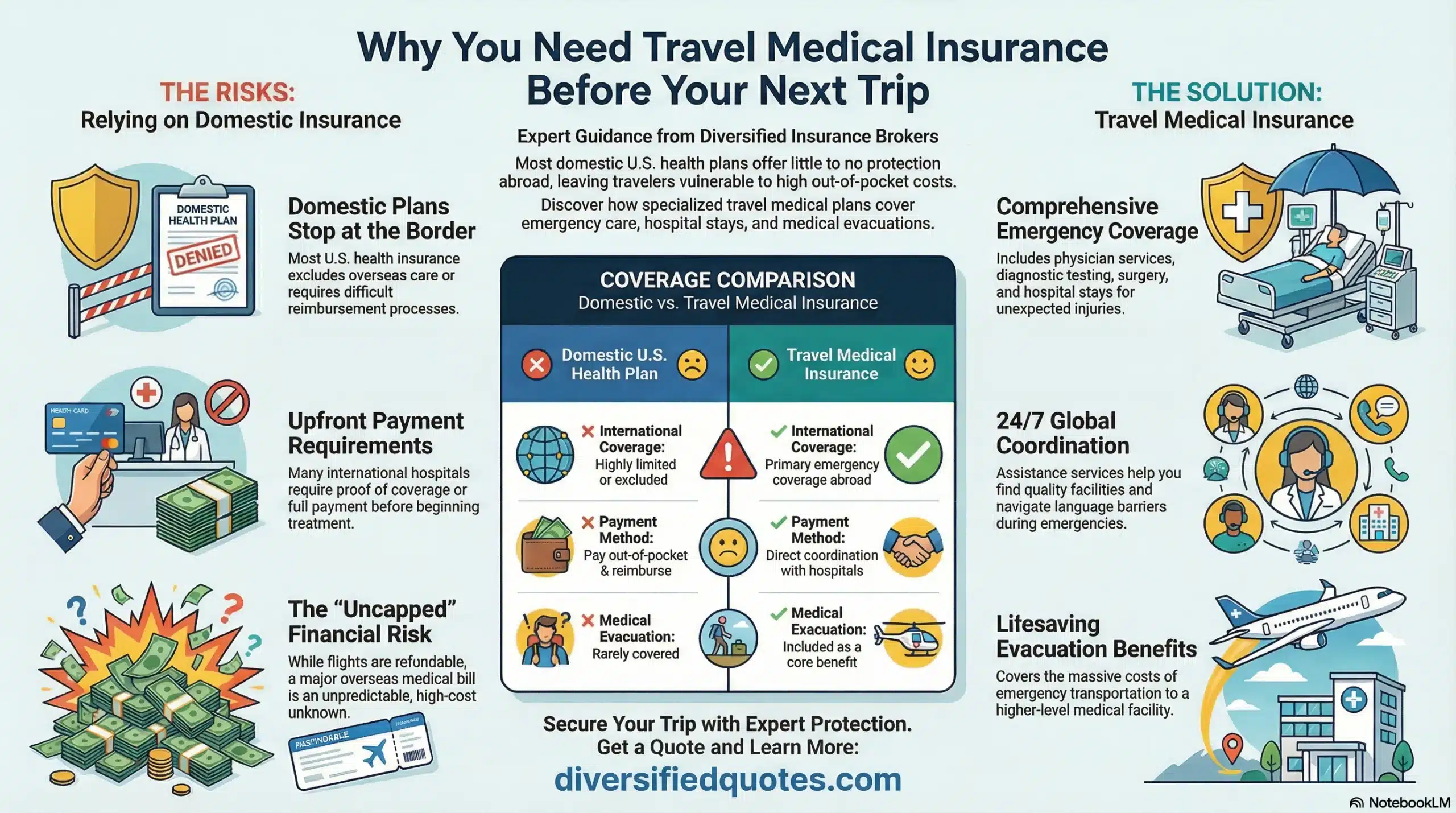
France is not a high-risk destination in the way people typically mean it. There’s excellent infrastructure, reliable emergency services, and a strong health system. But the challenge for U.S. travelers (and many international travelers) is that domestic health coverage often does not travel with you the way you assume it will. Some plans offer limited emergency reimbursement outside the U.S., and some offer none. Even when there is a reimbursement benefit, you may still face up-front payments, documentation hurdles, and claim timing issues while you are trying to recover.
That’s why dedicated travel medical coverage can be so valuable: it is built for the “visitor” scenario. It is designed to respond to sudden illness and injury abroad, provide a structured claims process, and—depending on the plan—support the practical next steps, including coordination with medical providers and transportation decisions if you can’t safely continue your trip.
Most travelers don’t think about evacuation until they hear a phrase like “you shouldn’t fly commercial right now,” or “you need monitoring during transport,” or “you’re stable, but the safest plan is to move you to a facility that can handle your specific complication.” That is the gap evacuation coverage is intended to address. If you want a deeper dive into what evacuation benefits typically include, see: emergency medical evacuation insurance.
What “travel medical + evacuation” should cover for trips to France
A strong France-focused setup starts with the basics—hospital and physician coverage for unexpected events—then expands into the areas that become financially painful when a situation escalates. The right configuration depends on your age, trip length, activities, and comfort level with deductibles, but most travelers want a plan that meaningfully covers emergency treatment, diagnostics, and prescriptions while they are away.
Evacuation is where travelers can unintentionally underinsure. Many people assume “evacuation” only means dramatic rescues from remote terrain. In reality, evacuation decisions are often medical and logistical rather than cinematic. It can mean transport to a better-equipped hospital in another region, transport to the nearest facility that can manage your condition, or medical repatriation back home after stabilization. These are expensive scenarios, and the cost exposure is one reason travelers pair medical benefits with evacuation support rather than relying on reimbursement-only arrangements.
For travelers who want a helpful framework for understanding how global coverage differs from domestic coverage, this guide adds good context: international travel health coverage. It’s especially useful if you’re comparing a short-term travel plan against longer-duration options for extended stays.
France-specific scenarios that commonly drive claims
France travel tends to involve walking—often a lot of it. Slips and falls on stone steps, ankle injuries on uneven sidewalks, and knee or hip flare-ups from day-long touring are some of the most common “vacation” claim drivers. Add in seasonal illnesses, food-related reactions, and complications from pre-existing conditions that become urgent during travel, and you can see why many travelers want coverage that does not rely on “hoping nothing happens.”
Another common pattern is “it starts small, then grows.” A mild infection becomes a fever, then needs antibiotics, then needs imaging or lab work. A respiratory issue triggers a clinic visit, then escalates to a hospital visit. These are the scenarios where the difference between “coverage exists in theory” and “coverage works smoothly in practice” becomes very real.
For travelers who want a plan designed for urgent issues while abroad, this page provides additional helpful framing: emergency travel health insurance. It’s a strong fit conceptually for travelers who want coverage focused on sudden events rather than routine care.
Trip length, lifestyle, and why France travel isn’t always “just a vacation”
France travel can look very different depending on your reason for going. A one-week vacation has different needs than a four-week stay, and a multi-country itinerary crossing borders has different risk points than a single-city trip. Travelers who are working remotely for part of the trip, or who are extending travel into neighboring countries, often want benefits that do not become confusing the moment the trip changes.
We also see travelers head to France for study programs, academic travel, and longer educational stays. These trips often require more robust protection because the “chance of needing care” rises simply due to time abroad. If you’re in that category, this resource can be useful: travel medical insurance for studying abroad.
Similarly, more travelers are mixing France with remote work or extended “slow travel.” When you’re abroad for longer stretches, you may want coverage that aligns with that lifestyle rather than a bare-bones emergency-only mindset. If that’s you, here’s a relevant supporting read: travel insurance for digital nomads.
Older travelers: why the right structure matters more than the marketing
France is a popular destination for retirees and multi-generational family trips. For older travelers, the biggest risk isn’t that France is “unsafe.” It’s that the probability of needing care rises with age, and the cost of a complicated event can be dramatically higher. That makes the structure of the plan—limits, deductibles, and the way evacuation is handled—more important than a headline price.
In many cases, the best plan for an older traveler is not the cheapest plan. It is the plan that is least likely to fail when it matters. That usually means selecting reasonable medical limits, choosing a deductible that fits the traveler’s budget, and making sure evacuation benefits are meaningful rather than token. If you’re comparing options for a parent or grandparent, this guide can help you think through the right approach: travel medical insurance for seniors.
How to think about deductibles and “pay first, reimburse later” realities
Travel medical plans can differ in how they handle payments. Some operate more like reimbursement: you may pay up front, then submit documentation. Some have networks and assistance teams that coordinate care and can help with payment arrangements in certain cases. In a real emergency, your priority is not paperwork—it’s getting appropriate treatment. A well-structured plan makes the process easier, not harder.
Deductibles are also a practical decision. A higher deductible can lower premium, but it also increases out-of-pocket exposure at the worst time. Many travelers prefer a moderate deductible because it keeps the plan affordable while still reducing the risk of a “big bill” scenario.
What evacuation actually looks like for France travelers
Evacuation is not always “fly home immediately.” Often, it is a decision about what is medically appropriate and what is safe. If you are stable and can fly commercial, your plan might coordinate a repatriation that includes medical oversight but does not require specialized aircraft. If you cannot safely fly commercial, a higher level of transport may be recommended. Sometimes it’s not even “home” as the destination—it’s a different facility within France or a nearby country where specialized care is available.
When these decisions happen, travelers are rarely in a position to shop for services. That’s why we treat evacuation coverage as a planning decision, not a last-second purchase. It’s also why the assistance component matters. A good plan should provide access to a team that can coordinate logistics, communicate with providers, and help you understand options without guessing.
Mid-page CTA: compare plans built for France travel
Compare Travel Medical + Evac Options for France
Use the quote link below to compare travel medical and evacuation plans designed for international trips, then select coverage that fits your dates, age, and travel style.
When “travel medical” is enough—and when you should emphasize evac
Some trips to France are low intensity: you’re mostly in major cities, you’re not doing strenuous activities, and you have a straightforward itinerary. In those cases, your medical coverage limit and deductible may be the most important variables, and evacuation may feel like a secondary consideration.
But other trips elevate the importance of evacuation. If you’re traveling with a medical history that could complicate treatment, if your itinerary is fast-paced across multiple regions, if you are traveling with someone who would struggle to navigate a crisis alone, or if you simply want a “plan B” when physicians recommend transfer, then evacuation benefits deserve a more central role in plan design.
How we help clients choose the right structure for France
Our job is to reduce confusion and make the decision practical. We look at your travel dates, your age, your general health profile, and how you want the plan to behave if something happens. Then we help you select coverage that matches your risk and comfort level without overbuying features you’ll never use.
We also pressure-test the plan against “real-life” situations. What happens if you need a specialist? What happens if a provider recommends imaging? What happens if you need care across multiple days? What happens if you need to be transported to a different facility? Travel insurance is only as good as the clarity of its benefits and the way it performs when you’re tired, stressed, and far from home.
Related pages
Related Travel Medical Pages
If you’re comparing France coverage against other travel profiles, these resources can help you choose the right structure.
Related Destination Pages
If you’re building a multi-country itinerary or comparing coverage needs by destination, these pages can help.
Get Travel Medical + Evac Coverage for France
Select travel dates, compare options, and choose a plan that protects you from major medical and transportation costs while abroad.
Talk With an Advisor Today
Choose how you’d like to connect—call or message us, then book a time that works for you.
Schedule here:
calendly.com/jason-dibcompanies/diversified-quotes
Licensed in all 50 states • Fiduciary, family-owned since 1980
FAQs: Travel Medical and Evacuation from France
Do I really need travel medical insurance for France?
Many travelers do, especially if their U.S. health coverage is limited overseas or reimburses slowly. Travel medical coverage is built specifically for sudden illness and injury while abroad, which helps avoid large out-of-pocket costs and claim confusion mid-trip.
What’s the difference between travel medical and medical evacuation?
Travel medical helps pay for treatment like doctor visits, hospital care, diagnostics, and prescriptions while you’re in France. Evacuation benefits help cover medically necessary transport—either to a different facility or back home—when a physician recommends it and a normal trip home is not appropriate.
How do deductibles work on travel medical plans?
Deductibles are the portion you pay before the plan begins paying covered expenses. A higher deductible can lower premium, but it increases out-of-pocket exposure if you need care. Many travelers choose a moderate deductible for a better balance.
Will the plan cover me if I travel to nearby countries during the same trip?
Often yes, but it depends on the policy territory and how your travel dates are defined. If your France trip includes side trips, your safest approach is choosing dates that cover the entire itinerary and confirming the plan’s geographic coverage.
Is evacuation only for remote rescues?
No. Evacuation is often used for transfers between medical facilities or medically supervised transport decisions that happen after stabilization. It’s less about “rescue drama” and more about medically appropriate logistics.
Are older travelers able to get travel medical coverage for France?
Yes, many plans offer options for older ages. The best fit usually comes down to benefit limits, deductibles, and how the plan coordinates care and transportation if something becomes complicated.
Does travel medical insurance cover pre-existing conditions?
Some plans offer limited pre-existing condition coverage if you meet specific timing or stability rules. This is highly plan-specific, so it’s important to review the policy definition and any look-back periods before you buy.
When should I buy travel medical coverage for France?
Most travelers buy soon after booking flights or lodging so the plan is in place early. If you’re comparing options, it’s still smart to secure coverage well before departure rather than waiting until the week of travel.
About the Author:
Jason Stolz, CLTC, CRPC and Chief Underwriter at Diversified Insurance Brokers (NPN 20471358), is a senior insurance and retirement professional with more than two decades of real-world experience helping individuals, families, and business owners protect their income, assets, and long-term financial stability. As a long-time partner of the nationally licensed independent agency Diversified Insurance Brokers, Jason provides trusted guidance across multiple specialties—including fixed and indexed annuities, long-term care planning, personal and business disability insurance, life insurance solutions, Group Health, and short-term health coverage. Diversified Insurance Brokers maintains active contracts with over 100 highly rated insurance carriers, ensuring clients have access to a broad and competitive marketplace.
His practical, education-first approach has earned recognition in publications such as VoyageATL, highlighting his commitment to financial clarity and client-focused planning. Drawing on deep product knowledge and years of hands-on field experience, Jason helps clients evaluate carriers, compare strategies, and build retirement and protection plans that are both secure and cost-efficient. Visitors who want to explore current annuity rates and compare options across multiple insurers can also use this annuity quote and comparison tool.
