
Advance on a Pending Lawsuit – Fast Legal Funding Now

When a lawsuit is ongoing, bills and living expenses don’t wait. Waiting months—or even years—for your case to settle can create serious financial stress, especially if an injury keeps you from working or forces ongoing treatment. That’s where an advance on a pending lawsuit can help. This type of funding lets qualified plaintiffs access a portion of a future settlement now, so you can cover urgent expenses while your attorney continues working toward the best possible outcome.
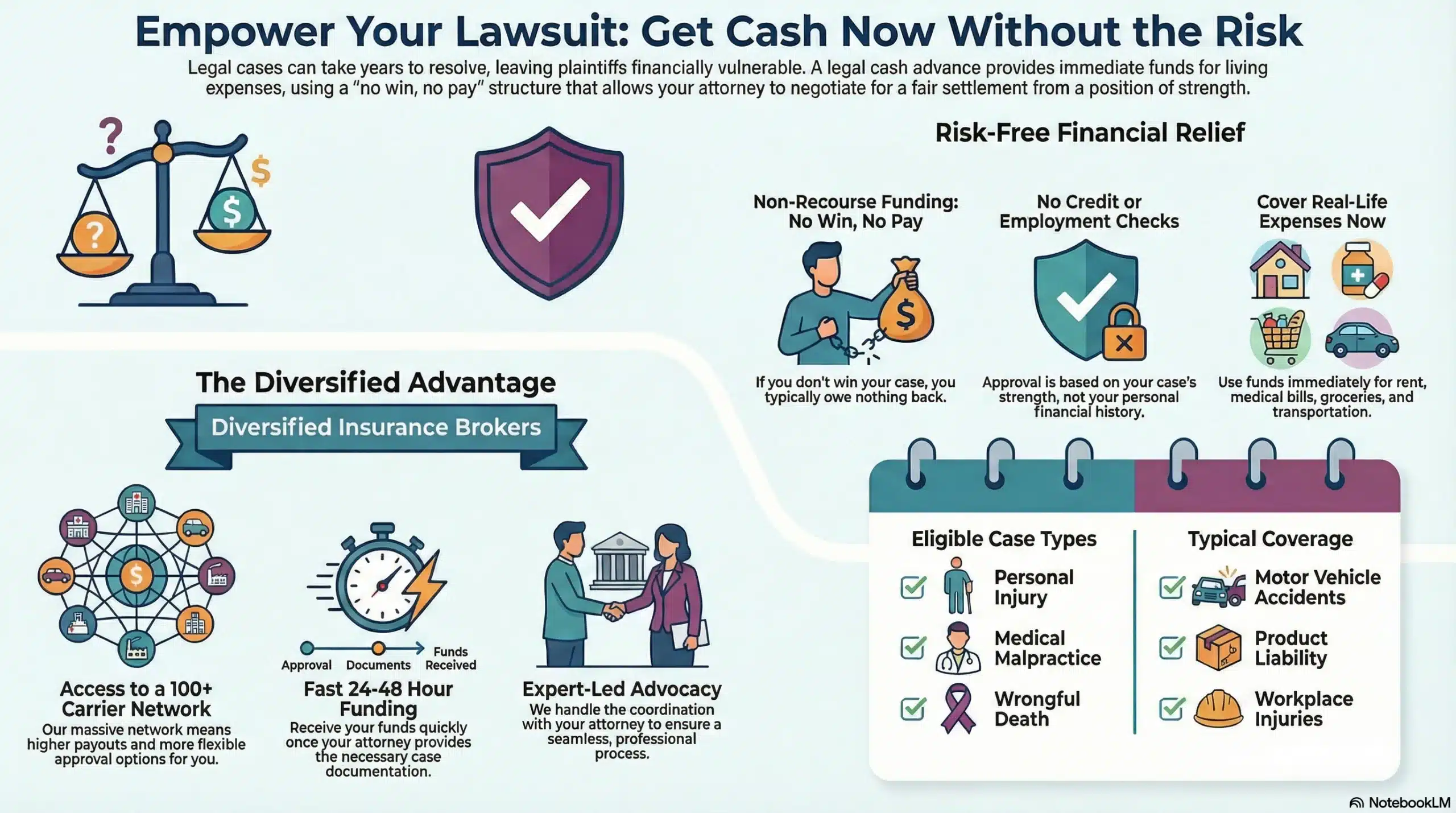
An advance on a pending lawsuit is commonly referred to as pre-settlement funding, legal funding, or a lawsuit cash advance. Many people call it a “lawsuit loan,” but in most situations it doesn’t function like a traditional loan. Instead, it’s typically non-recourse, which means repayment is generally required only if your case resolves successfully through settlement or verdict. If there is no recovery, you usually do not repay. The decision is based primarily on the merits of your claim—not your credit score, income, or employment history.
At Diversified Insurance Brokers, we help connect plaintiffs with reputable funding sources and keep the process organized by coordinating directly with your attorney. The goal is simple: help you pursue an advance amount that truly solves your short-term problem without creating unnecessary surprises later when your case resolves.
Request Your Lawsuit Advance
Apply today and see how much you can receive before your case is resolved.
What Is an Advance on a Pending Lawsuit?
An advance on a pending lawsuit is a cash advance provided to plaintiffs with an active legal claim who are awaiting settlement or trial. This funding is generally based on the expected value and strength of your case, not your personal credit profile. In most arrangements, you make no monthly payments while the case is pending, because repayment typically occurs only after your case ends and funds are disbursed.
If you’re researching this topic, you may also see the phrase “cash before a case settles.” That is the same general concept, and you can read more detail on this here: Get Cash Before Case Settles. If you’re looking for a broader overview of lawsuit-related funding options, the page Lawsuit Settlement Loans explains how these programs are commonly structured and why they’re different from bank loans.
One of the most important things to understand is that the advance is usually a lien on the case proceeds. Your attorney typically acknowledges the funding agreement, and repayment is made directly out of the settlement funds when they are received. This is why attorney participation is required and why a quick approval depends heavily on how fast the necessary documents can be shared.
Why Plaintiffs Use Lawsuit Advances
Most people don’t seek pre-settlement funding because they want extra spending money. They seek it because a legal delay can create a real financial emergency. A pending case can interrupt income, increase medical costs, and force families to make difficult choices—like skipping treatment, falling behind on housing payments, or accepting a low settlement simply to keep life moving.
A properly structured advance can provide breathing room so you can stay current on essential expenses—rent or mortgage, utilities, groceries, transportation, childcare, and medical bills—without sacrificing your legal strategy. When you can cover basics, your attorney can focus on building the case the right way: completing treatment, gathering records, documenting damages, negotiating liens, and pushing back on low offers.
That said, funding should be used carefully. Costs typically grow over time, so requesting only what you truly need can help protect your net proceeds later. If you want a quick high-level explanation of how these advances work, visit Get Lawsuit Money for an overview and next steps.
How Approval Decisions Are Made
Unlike a bank, a legal funding company does not primarily underwrite you—it underwrites your case. Funding decisions are usually based on a few core factors: liability strength (who is at fault and how clear it is), damages (injury severity, medical documentation, and treatment consistency), insurance coverage or defendant collectability, expected timeline, and any existing liens or prior advances.
In practical terms, that means two people can request the same amount and receive very different results based on case facts. A clear-liability auto accident with sufficient policy limits and well-documented medical treatment tends to be easier to fund than a case with disputed liability, incomplete treatment, minimal insurance coverage, or gaps in documentation.
If you’re early in the process, some funders may suggest waiting until certain milestones occur—like completed treatment, a demand package, or clearer insurance confirmation—because those developments can support a stronger offer. Applying now is still worthwhile because it can tell you what’s possible today and what steps might improve options later.
How Much Money Can You Receive?
Advance amounts vary widely and depend on the anticipated net recovery. Funding companies generally advance only a portion of the expected net proceeds to protect the case and ensure you still receive meaningful funds when it resolves. Your attorney fees, medical liens, and any existing advances can reduce the available “net,” which affects the maximum amount a funder is willing to offer.
It’s also important to understand that a larger advance is not always better. Because costs can accrue, the most responsible approach is to request an amount that solves the specific problem you have right now. If you need enough to cover rent, a car payment, and essential medical co-pays for a short period, that may be very different from requesting the maximum possible amount. Keeping the request targeted can help protect your future recovery.
If you’re comparing pages and options, you may also want to review Get Cash Before Lawsuit Settles, which focuses on this “bridge financing” concept and what funders typically require.
What Types of Cases Are Eligible?
Many lawsuit cash advances are approved for personal injury claims where the plaintiff is represented by an attorney working on contingency. Common examples include auto accidents, commercial truck accidents, slip-and-falls and premises liability, workplace and third-party injuries, product liability claims, and some wrongful death cases.
Medical malpractice can qualify, but underwriting may be more selective because those cases often take longer and require more expert review. Workers’ compensation varies by state and funding source; some providers do fund it, while others focus primarily on personal injury and civil litigation claims. If you’re unsure whether your case qualifies, applying is the fastest way to find out because the funding company can review your situation directly with your attorney.
Why Work With Diversified Insurance Brokers?
Our job is to help you navigate the process with clarity and speed. We connect you with reputable funding sources, help you understand what information will be requested, and keep communication streamlined with your attorney so your case can be evaluated efficiently. Because underwriting is case-based, the “right” funding source can depend on case type, venue, and timeline. Matching your case correctly can help you avoid delays and confusion.
We also focus on responsible strategy. Many plaintiffs have never reviewed a legal funding agreement before, and it’s easy to overlook how timelines can affect payoff amounts. We encourage clients to keep requests realistic, avoid stacking multiple advances unless truly necessary, and confirm that terms are clear before signing.
How This Helps Plaintiffs Stay Financially Stable
When you secure lawsuit money now, you can cover essential expenses without feeling pressured to accept a low settlement just to keep the lights on. That breathing room can be especially valuable if you’re still treating, still waiting on records, or still negotiating with insurers. The best outcomes often come from patient case development, and financial stability supports that.
At the same time, some plaintiffs use the waiting period to stabilize other parts of their finances. Depending on your needs, tools like short-term health insurance can help bridge medical coverage gaps, and disability insurance can protect income if injuries prevent work. These aren’t replacements for legal funding, but they can reduce stress and lower the amount you need to advance.
Our Simple Process
The process is designed to be straightforward, but attorney cooperation is essential because the funding decision relies on verified case information. Once you submit your request, we coordinate with your attorney to provide the necessary documentation to the funding source. The funder reviews liability, damages, and coverage, then issues an approval decision (or requests additional information). After approval and signed documents, funds are released, often by ACH or wire transfer.
If you want the fastest possible timeline, the most helpful step is ensuring your attorney’s office knows a request is coming and can share documents promptly. In many cases, speed is less about the underwriting itself and more about how quickly the file becomes complete.
Get the Most Cash for Your Case
Apply now for an advance on a pending lawsuit with no risk if you don’t win.
Related Pages
Financial Protection Essentials
High-risk life insurance planning, disability income protection with COLA, and financial institution reviews.
Talk With an Advisor Today
Choose how you’d like to connect—call or message us, then book a time that works for you.
Schedule here:
calendly.com/jason-dibcompanies/diversified-quotes
Licensed in all 50 states • Fiduciary, family-owned since 1980
FAQs: Advance on a Pending Lawsuit
What is an “advance on a pending lawsuit” (pre-settlement funding)?
It’s a cash advance against the potential proceeds of your legal claim. Funds are typically repaid from your settlement or judgment at the end of the case. Learn more about how pre-settlement funding works.
Is this a loan or non-recourse funding?
Most lawsuit advances are non-recourse, meaning you generally owe nothing if you lose your case. Repayment happens only if you recover money. You can review additional details on legal funding structures.
Who qualifies for a lawsuit cash advance?
You typically need an active claim with an attorney, supporting documentation, and a liable party or insurance coverage with a realistic chance of recovery. Qualification guidelines are explained in how pre-settlement funding works.
How much money can I receive?
Amounts depend on case facts and estimated value. Providers often fund only a portion of the anticipated net proceeds so you still receive meaningful funds after attorney fees, liens, and repayment. See typical ranges in how much you can get from pre-settlement funding.
How fast can I get funds?
Timelines vary by provider and how quickly your attorney shares documents. Many approvals can move quickly once the file is complete. Some options for faster access are discussed in lawsuit funding fast legal cash advances.
Do you check my credit score or employment?
Underwriting generally focuses on the merits of your case. Many providers do not require a credit check or proof of employment because repayment comes from the settlement. More details are covered in cash advance for lawsuit explanations.
What fees or rates apply to lawsuit advances?
Costs may include funding fees and charges that can increase over time. The structure varies by provider, so you and your attorney should review the agreement carefully. You can compare pros and cons at pros and cons of pre-settlement funding.
Will I owe anything if I lose my case?
With non-recourse funding, you generally do not repay if there is no recovery. Confirm this in the written agreement. Learn more about risk considerations in is pre-settlement funding worth it.
Can I request more than one advance?
Sometimes. Additional funding depends on case progress, updated valuations, and attorney approval. Funding options may expand as your case develops, similar to what’s discussed in how to get lawsuit money.
Does my attorney have to be involved?
Yes. Your attorney typically provides documents, signs acknowledgments, and repays the advance plus agreed costs from settlement funds in trust at the end of the case. See how coordination works in get cash before lawsuit settles.
Are there restrictions by state?
Some states regulate or limit lawsuit funding. Availability and terms vary by location and case type, including specific categories like slip and fall lawsuit funding.
What can I use the money for?
Common uses include rent or mortgage, utilities, groceries, medical bills, transportation, and other essential living expenses while your case is pending. Funding structures are outlined in settlement funding access options.
About the Author:
Jason Stolz, CLTC, CRPC and Chief Underwriter at Diversified Insurance Brokers, is a senior insurance and retirement professional with more than two decades of real-world experience helping individuals, families, and business owners protect their income, assets, and long-term financial stability. As a long-time partner of the nationally licensed independent agency Diversified Insurance Brokers, Jason provides trusted guidance across multiple specialties—including fixed and indexed annuities, long-term care planning, personal and business disability insurance, life insurance solutions, and short-term health coverage. Diversified Insurance Brokers maintains active contracts with over 100 highly rated insurance carriers, ensuring clients have access to a broad and competitive marketplace.
His practical, education-first approach has earned recognition in publications such as VoyageATL, highlighting his commitment to financial clarity and client-focused planning. Drawing on deep product knowledge and years of hands-on field experience, Jason helps clients evaluate carriers, compare strategies, and build retirement and protection plans that are both secure and cost-efficient.
