
How Does Life Insurance Work

Jason Stolz CLTC, CRPC
How does life insurance work? It’s one of the most important questions you can ask when you’re trying to protect your family, your home, and the lifestyle you’ve built. At Diversified Insurance Brokers—a fiduciary, family-owned agency licensed nationwide—we help clients understand how life insurance actually functions in real life, not just in marketing language. At its core, life insurance is a contract that turns an uncertain financial event into a certain one: if you pass away, your beneficiaries receive a death benefit that can replace income, pay off debt, cover final expenses, or preserve your family’s plan during a difficult transition.
Most people only see life insurance as “a policy that pays out when you die.” That’s true, but it’s incomplete. In practice, life insurance is a planning tool that can protect a household’s cash flow, create stability when one person’s income disappears, and help a surviving spouse avoid selling assets at the wrong time. It can also be used for business continuity, estate planning, and specialized needs like lifelong support for a dependent with disabilities. The key is matching the policy type, term length, and coverage amount to the job you need the policy to do.
To make smart decisions, you don’t need to memorize insurance jargon. You just need to understand a few fundamentals: what the insurer is promising, what you are obligated to do to keep the policy in force, how underwriting affects pricing, and which policy category actually fits your timeline. When you understand those basics, you can compare options confidently—whether you’re buying coverage for the first time, reviewing an older policy, or exploring new coverage because life changed.
See Real Life Insurance Pricing for Your Age
The fastest way to understand how life insurance works is to see how age, term length, and health class change the premium. Compare options first—then design the right plan.
If you already have term insurance, also review how converting term to permanent life insurance works so you don’t miss valuable options.
What life insurance actually does for your family
Life insurance is designed to answer a practical question: if your income stops tomorrow, how does your family keep paying the bills next month and next year? That’s why the most common purpose is income replacement. A death benefit can help cover everyday living expenses, mortgage payments, childcare costs, and the gap between what a surviving spouse earns and what the household needs to maintain stability.
But life insurance can also protect your family from “forced decisions.” Without a death benefit, many families have to make expensive choices quickly—selling a home, draining retirement accounts, taking on high-interest debt, or pulling children out of school plans. When coverage is in place, the surviving family has time. That breathing room is part of the value of a properly designed policy.
Life insurance can also function as debt protection. If you have a mortgage, car loans, student loans with co-signers, or business obligations that don’t disappear when you do, a death benefit can eliminate those pressures. For many families, a paid-off home changes everything. It lowers monthly expenses and reduces the amount of income a surviving spouse needs to earn to keep the plan intact.
Another major purpose is legacy planning. Some people want to leave money to children, fund grandkids’ education, support a charity, or provide for a dependent who will need lifelong care. In that world, the death benefit isn’t just replacing income—it’s creating a controlled transfer of wealth. That’s why people sometimes explore advanced planning topics like life insurance strategies the wealthy use once they understand the basics.
How premiums and death benefits work
A life insurance policy is a contract with defined rules. You pay premiums on a schedule (monthly, quarterly, or annually). In exchange, the insurer promises to pay a death benefit if you pass away while the policy is in force. The death benefit amount is chosen at application—$250,000, $500,000, $1,000,000, and so on—and it should reflect your goals: replacing income, paying off debts, covering final expenses, or creating a legacy.
Pricing is based on risk. The insurer looks at your age, health, build, family history, lifestyle, occupation, and sometimes hobbies. Those factors influence underwriting class, which directly influences premium. In plain language: the healthier and lower-risk you appear to the insurer, the less you pay for the same coverage amount.
Once your policy is issued, most policies are designed so that your health changes later do not change your premium. That’s one of the big reasons people choose life insurance earlier rather than later. If you wait until after a diagnosis, you may still be insurable, but pricing and options can change. If you want a clear overview of how your current health impacts your options, start with life insurance with pre-existing conditions and then come back to this page with that context.
When the insured person passes away, beneficiaries file a claim with the insurance company. The insurer confirms the policy was active and that the claim documentation is complete. Once approved, the death benefit is paid out to beneficiaries. In many cases, beneficiaries choose a lump sum. Some insurers also allow structured payments, which can help with budgeting and long-term planning. The key point is that the death benefit is designed to provide a predictable injection of cash at the time a family is most vulnerable.
Term life insurance vs. permanent life insurance
Most life insurance falls into two broad categories: term and permanent. Understanding this difference is the heart of understanding how life insurance works. The policy category determines how long coverage lasts, how premiums behave, and whether a cash value component exists.
Term life insurance covers you for a specific period, such as 10, 20, or 30 years. If you pass away during that term, your beneficiaries receive the death benefit. If you outlive the term, coverage ends unless you renew, extend, or convert (depending on policy provisions). Term is popular because it provides a large death benefit for a comparatively low cost, especially when purchased at younger ages.
Term is often used to protect families during high-responsibility years: paying down a mortgage, raising kids, building savings, or funding education. It is designed for a finite problem: “If something happens during the next 20 years, my family is protected.” For many households, that is exactly the right solution, especially when budgets are tight and priorities are high.
Permanent life insurance is designed to last for your entire lifetime, as long as the policy is properly funded and kept in force. Permanent policies typically cost more than term because the insurer expects to pay a claim at some point, not just during a set window. Permanent coverage is often used when the need for coverage doesn’t have a clear end date—such as estate planning, lifelong dependent care, or legacy planning. It can also be used as a long-term financial tool because many permanent policies build a cash value component.
Some families don’t choose “term or permanent.” They choose a blend. A common strategy is using term to cover the big temporary risks (income replacement, mortgage payoff) and permanent to cover a smaller lifelong need (final expenses, legacy, dependent support). This approach can keep premiums manageable while still building a long-term foundation.
How cash value works in permanent life insurance
Cash value is one of the main reasons permanent insurance looks complicated from the outside. A portion of your premium is used for insurance costs, and a portion can build cash value inside the policy. That cash value typically grows tax-deferred under the rules of the policy. Over time, cash value can become a meaningful asset that can be accessed through loans or withdrawals—depending on policy type and how it is structured.
Cash value is not “free money,” and it’s not designed to replace retirement investing for most people. It is a feature that can support flexibility. For example, some families use cash value to create an emergency buffer, to help during a career transition, or to provide liquidity for a planned expense. When used wisely, it can add resilience to a financial plan.
It’s important to understand that taking money out of a policy can reduce the death benefit and can create long-term consequences if not managed carefully. Loans may accrue interest, and excessive withdrawals or loans can jeopardize the policy if the cash value can’t support ongoing costs. That’s why we focus on designing policies with realistic goals, clear funding expectations, and a plan for how cash value is intended to be used.
If you’re comparing term and permanent options and want to focus on simplicity, start by clarifying the role: do you need coverage for a period of time, or do you need it for life? Once you answer that, the product comparison becomes clearer.
What “underwriting” means and why it impacts price
Underwriting is the process an insurance company uses to decide whether to approve coverage and what premium to charge. Underwriting can range from very simple to highly detailed depending on the policy type and coverage amount. A fully underwritten policy might include a health questionnaire, prescription database check, medical records review, and a short exam that measures height, weight, blood pressure, and sometimes lab work.
Other policies are simplified issue, which means fewer requirements and potentially faster approval. Simplified issue can be useful for smaller face amounts or for people who want a faster, less invasive process. The tradeoff is that simplified policies are often more expensive per dollar of coverage because the insurer has less information and is taking more uncertainty.
Underwriting is where many applicants get confused, because two people of the same age can get very different prices. Differences in build, blood pressure, cholesterol, family history, prescriptions, tobacco use, and even driving history can affect the result. This is also why shopping carriers matters. Different insurers can view the same situation differently, especially for people with mild health issues or older records that are stable today.
If you’re worried about eligibility, it helps to know you usually have options even when underwriting is not perfect. That’s why we created resources like life insurance with pre-existing conditions, which helps you understand what carriers typically care about and what details matter most in the application.
How policy “ownership” and beneficiaries work
Life insurance has three main roles: the insured person, the policy owner, and the beneficiary. Most of the time, the insured and the owner are the same person, but not always. A spouse might own a policy on the other spouse. A business might own a policy on a key employee. A trust might own a policy for estate planning. Ownership matters because the owner controls the policy: choosing beneficiaries, changing coverage (when allowed), and deciding how premiums are paid.
Beneficiaries are the people or entities that receive the death benefit. You can name primary beneficiaries and contingent beneficiaries. Primary beneficiaries receive the benefit first. Contingent beneficiaries receive the benefit if the primary beneficiary has passed away or cannot receive the payout. Beneficiary designations should be reviewed after major life events such as marriage, divorce, births, deaths, or changes in business structure.
Most life insurance death benefits are paid directly to beneficiaries and are not subject to probate when the beneficiary designations are properly completed. That can speed up access to funds during a difficult time and reduce legal friction.
How long should your term be?
Choosing the right term length is one of the most practical decisions in life insurance. The correct term is the one that covers the years when your financial responsibilities are highest. For many families, that’s tied to a mortgage payoff timeline, the years until children are financially independent, or the years until retirement when income replacement becomes less relevant.
Some people buy 10-year term because it’s the cheapest today, then realize they still need coverage at the end of the term—often when they’re older and premiums are much higher. Others buy 30-year term when they only needed 20, paying more than necessary for years. The right decision is a balance between budget and certainty. If you want to compare approaches, our resource on converting term to permanent life insurance can be helpful, because conversion privileges can change the long-term value of a term policy.
Another practical consideration is whether your term policy has flexibility. Some policies allow conversion to permanent coverage without new medical underwriting. That can be valuable if your health changes later. Not every policy is identical, and it’s one more reason to compare carriers and contract provisions, not just the premium number.
Do you still need life insurance in retirement?
Many people assume they won’t need life insurance once they stop working. Sometimes that’s true. If you have significant assets, no debt, and your spouse can maintain lifestyle without your income, the need for a large death benefit may decrease. But retirement often creates new reasons to consider life insurance, especially when people want to protect a surviving spouse, cover taxes, fund a legacy, or maintain a plan without forcing asset sales.
If you’re exploring this question, you might find it helpful to review do I still need life insurance in retirement? and do you still need life insurance after retirement?. Those pages help you think through how retirement income, survivor planning, and long-term goals affect the decision.
In some retirement plans, people also compare life insurance to other tools—especially when the goal is predictable income or legacy planning. Some retirees explore annuities for guaranteed income and life insurance for death benefit planning, while others consider whether an annuity can serve as a partial alternative in specific situations. If you’re thinking through those tradeoffs, you may want to read is life insurance a good investment? and then decide what role insurance should play in your broader plan.
Final expense and burial coverage: the “smaller policy” decision
Final expenses are real, and they often surprise families. Funeral costs, medical bills, and other end-of-life expenses can create immediate pressure. This is why many older adults choose smaller policies designed to cover final expenses rather than larger income-replacement policies. These policies are often permanent and intended to be kept for life.
If you’re comparing these options, it helps to start with what is burial insurance and who needs it. That page explains how burial coverage works and who it tends to fit best. You can also compare policy types through whole life burial insurance vs term and final expense life insurance vs term life insurance, which helps clarify why final expense policies are structured differently than traditional term coverage.
Some families are specifically planning for older relatives and want to understand what is realistic after age 80. If that’s your situation, burial insurance for parents over 80 can help you set expectations and choose the right approach.
Life insurance for specialized situations
Not all life insurance planning is “standard.” Many families need coverage for specialized situations: hazardous occupations, unique travel patterns, higher-risk hobbies, or complex medical histories. Others need coverage for a specific planning goal: special needs planning, business protection, or high-value estate planning.
For example, families caring for a dependent with lifelong needs often want a policy that ensures ongoing support when parents are gone. If that’s your world, special needs life insurance can help you understand how policies are structured and what to watch out for. In other scenarios, occupation drives underwriting and product choice. That’s why we publish occupation-specific resources and help clients navigate insurer guidelines that can vary widely from one carrier to another.
How much life insurance do you need?
There isn’t one perfect number, but there is a clear process. Start by identifying what your family would need if your income disappeared: monthly living expenses, mortgage payments, childcare, education goals, debt payoff, and any financial obligations that would remain. Then consider existing assets: savings, investments, retirement accounts, and any employer-provided life insurance. The gap between needs and assets is where life insurance can make the plan work.
Some families use a simple rule of thumb such as 10–15x income. That can be a good starting point, but it can also under-insure or over-insure depending on your debts and savings. A more accurate approach is to estimate how long income replacement is needed and how much monthly support a surviving spouse would need. That’s the approach we use when designing coverage, because it’s based on the reality of a household budget, not a one-size-fits-all math shortcut.
As your life changes, your coverage should be reviewed. Marriage, having children, buying a home, starting a business, paying off debt, and approaching retirement are all events that can change what “enough” means. This is also why buying the cheapest policy isn’t always the best plan. If your policy ends before your need ends, you could be forced to re-apply later at a higher cost. That’s exactly what many people discover when they learn the hidden costs of waiting to buy life insurance.
Common mistakes people make when buying life insurance
One common mistake is focusing on price without understanding the policy’s purpose. A low premium is great if the policy actually covers the years you need protection. Another mistake is buying only employer-provided life insurance and assuming it will always be there. Employer coverage can be valuable, but it can change if you switch jobs, reduce hours, or retire. Many families use employer coverage as a supplement, not the full foundation.
Another mistake is ignoring conversion options. Term conversion can be an important escape hatch if your health changes. If conversion is valuable to you, read convert term to permanent life insurance and make sure you understand how deadlines, conversion classes, and product availability affect your long-term flexibility.
Finally, some people assume that if they have “some coverage,” they’re done. But life insurance is most effective when it is coordinated with your full plan: debt, savings, retirement, and long-term goals. The best policy is the one that prevents a financial breakdown when life is hardest.
Instant life insurance quotes
The clearest way to understand how life insurance works for you is to see real pricing based on your age, the term length you choose, and the coverage amount you want. Use the instant quote tool below to explore options quickly. Once you have a baseline, we can help you decide whether a term policy, a permanent policy, or a combination is the best fit for your goals and timeline.
Instant Life Insurance Quote
Compare term lengths and coverage amounts instantly to see how pricing changes by age and health class.
If you’re unsure which term length is right, compare your timeline against your biggest obligations—mortgage, kids, and retirement horizon—before choosing.
Why work with Diversified Insurance Brokers
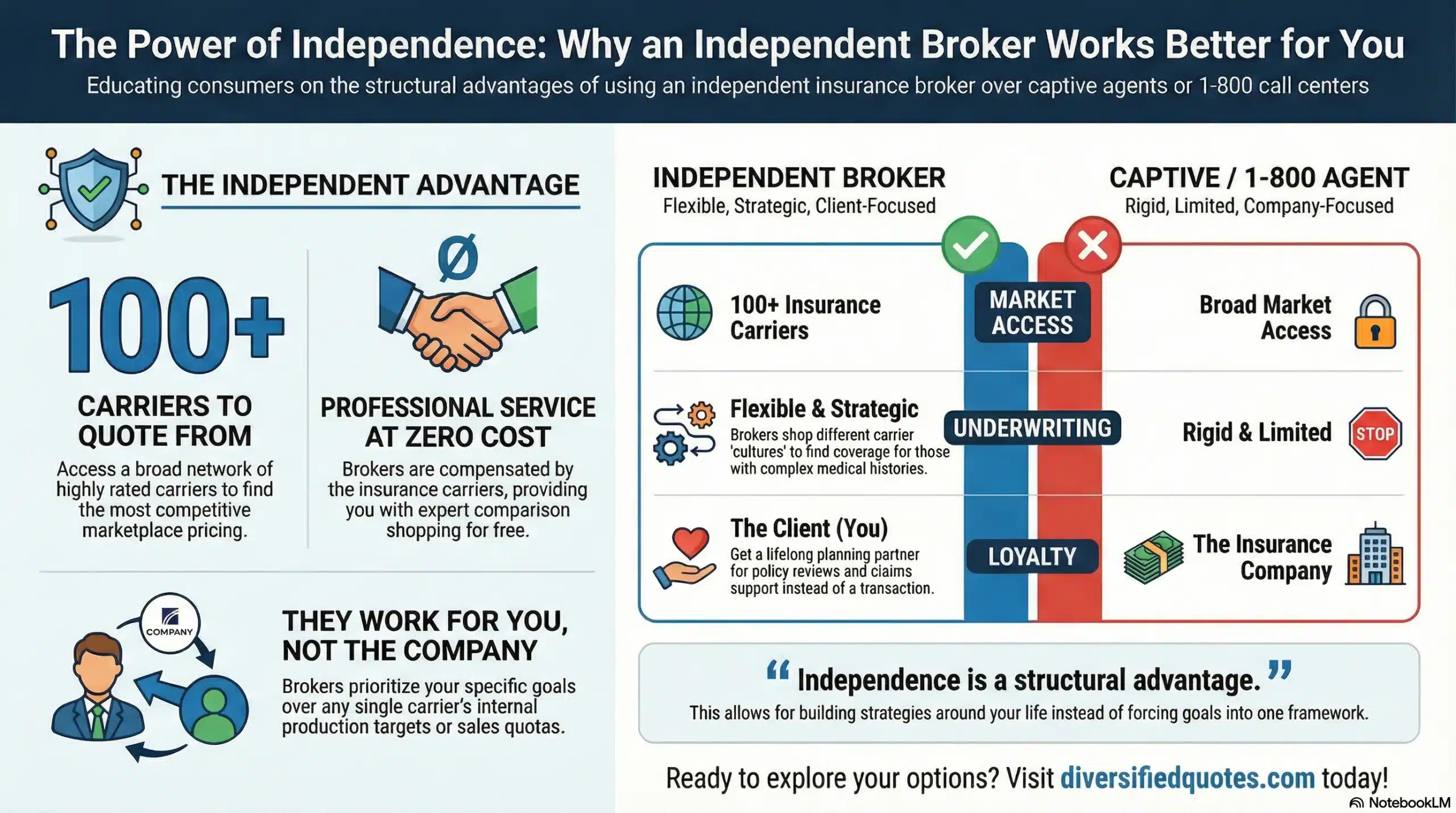
Life insurance isn’t just about approval. It’s about designing the right coverage that stays in place when it matters, fits your budget, and aligns with your plan. As independent advisors, we compare options across many carriers so you can see differences in pricing, underwriting appetite, conversion options, and contract structure. That matters even more if you have a complex medical history, a higher-risk occupation, or a need that doesn’t fit the “standard” application profile.
We also focus on clarity. We want you to understand what you own, why you own it, and how it fits into your long-term plan. Whether you want coverage for a young family, protection for a spouse in retirement, or a plan that supports a special needs beneficiary, the goal is the same: build a strategy that is understandable, measurable, and aligned with the outcome you care about most.
Want Help Comparing the Right Life Insurance Plan?
If you’ve already checked pricing, the next step is matching coverage to your goals—income replacement, debt payoff, legacy, or retirement planning.
Related Pages
Life insurance education resources to help you evaluate timing, underwriting, occupation risk, and special planning situations with clarity.
Financial Protection Essentials
Carrier reviews, occupational disability planning, supplemental accident protection, and senior-focused burial options.
Compare Term Life Insurance Lengths
Explore different term periods to find coverage that best matches your timeline and budget.
Talk With an Advisor Today
Choose how you’d like to connect—call or message us, then book a time that works for you.
Schedule here:
calendly.com/jason-dibcompanies/diversified-quotes
Licensed in all 50 states • Fiduciary, family-owned since 1980
FAQs: How Does Life Insurance Work
What is the main purpose of life insurance?
The primary purpose of life insurance is to provide a tax-free lump-sum payment to your beneficiaries when you pass away, helping replace income, pay off debts, and cover major expenses like a mortgage, college, or final costs.
What is the difference between term and permanent life insurance?
Term life insurance provides coverage for a set period, such as 10, 20, or 30 years, while permanent life insurance is designed to last your entire life and can build cash value over time. Term is usually lower cost, and permanent offers long-term protection and additional benefits.
How are life insurance premiums determined?
Premiums are based on your age, health, lifestyle, coverage amount, and policy type. Younger, healthier applicants generally pay lower premiums, while factors like tobacco use, medical history, and high-risk occupations can increase the cost.
Do my beneficiaries have to pay taxes on the death benefit?
In most cases, life insurance death benefits are paid to beneficiaries income tax-free. However, interest earned on the benefit or certain estate situations may create tax considerations, so it is wise to review your overall plan with a qualified professional.
Can I change my beneficiaries later?
Yes. As long as you have not made your beneficiaries irrevocable, you can update them at any time to reflect changes such as marriage, divorce, new children, or other life events. Keeping beneficiary designations current is an important part of your plan.
What is cash value in a life insurance policy?
Cash value is a savings component inside many permanent life insurance policies. It grows tax-deferred over time and can be accessed through policy loans or withdrawals. Using cash value may reduce the death benefit if not managed carefully.
Do I still need life insurance if I am close to retirement?
Many people still benefit from life insurance near or during retirement, especially if a spouse depends on their income, there are outstanding debts, or they want to cover final expenses or leave a legacy. The right amount and type of coverage may change as you approach retirement.
What happens if I miss a premium payment?
Most policies include a grace period, typically around 30 days, to make a late payment before coverage lapses. If a policy does lapse, you may be able to reinstate it within a certain time frame, but you may need to answer health questions or complete new underwriting.
How much life insurance coverage do I need?
The amount of coverage you need depends on your income, debts, family size, long-term goals, and how many years your loved ones would need support. Many families start by considering 10 to 15 times annual income, then adjust for their specific situation.
Can I have more than one life insurance policy?
Yes. Many people layer policies, such as combining a base permanent policy with one or more term policies for specific time periods or goals. Insurance companies may place overall limits based on your income and financial profile, but multiple policies are common.
About the Author:
Jason Stolz, CLTC, CRPC and Chief Underwriter at Diversified Insurance Brokers (NPN 20471358), is a senior insurance and retirement professional with more than two decades of real-world experience helping individuals, families, and business owners protect their income, assets, and long-term financial stability. As a long-time partner of the nationally licensed independent agency Diversified Insurance Brokers, Jason provides trusted guidance across multiple specialties—including fixed and indexed annuities, long-term care planning, personal and business disability insurance, life insurance solutions, Group Health, and short-term health coverage. Diversified Insurance Brokers maintains active contracts with over 100 highly rated insurance carriers, ensuring clients have access to a broad and competitive marketplace.
His practical, education-first approach has earned recognition in publications such as VoyageATL, highlighting his commitment to financial clarity and client-focused planning. Drawing on deep product knowledge and years of hands-on field experience, Jason helps clients evaluate carriers, compare strategies, and build retirement and protection plans that are both secure and cost-efficient. Visitors who want to explore current annuity rates and compare options across multiple insurers can also use this annuity quote and comparison tool.
