
Travel Medical and Evacuation from Japan

Jason Stolz CLTC, CRPC
Planning a trip to Japan is exciting—Tokyo neighborhoods, Kyoto temples, Osaka food, onsen towns, bullet trains, and day trips that feel like you’re stepping into a different world. But even in one of the safest, most organized countries to travel to, unexpected medical situations still happen: stomach illnesses, falls on stairs, flu, allergic reactions, sports injuries, dehydration, or a sudden flare-up of a pre-existing condition.
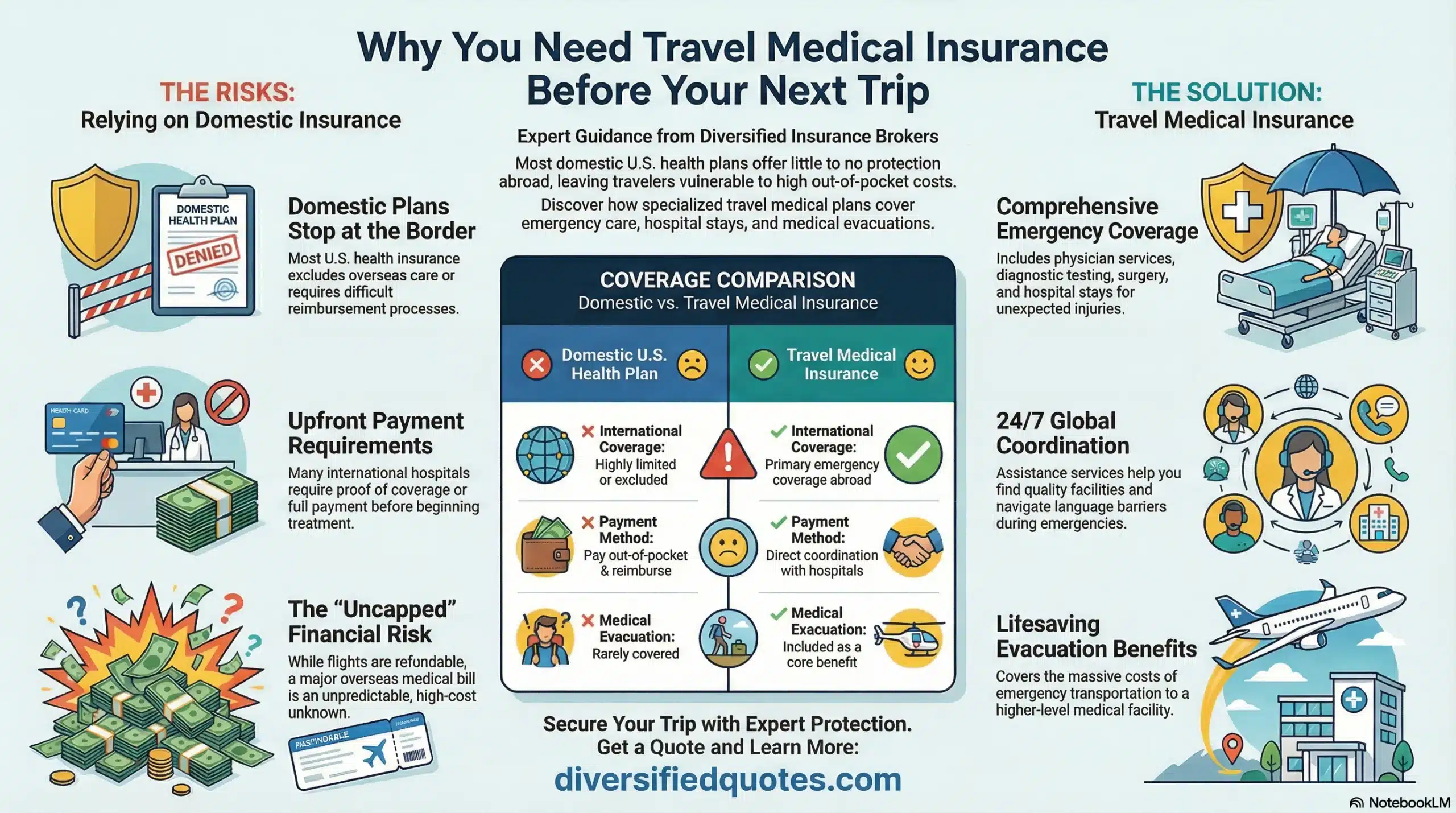
That’s why travel medical insurance and emergency medical evacuation coverage matter for Japan. The question is rarely whether Japan has good hospitals (it does). The real issue is what happens when you need care quickly, you’re navigating a language barrier, you’re asked to pay at the point of service, you don’t know which facility is appropriate, or you need coordinated transport after a serious injury.
At Diversified Insurance Brokers, we help travelers nationwide compare travel medical and evacuation plans for Japan and the rest of Asia, so your coverage matches your trip length, traveler ages, health history, and the activities you’ll be doing (big-city travel, ski trips, hiking, multi-city itineraries, cruises, or study abroad). The goal is straightforward: choose a plan you can actually use under stress, not just a policy that looks good on a quote screen.
Compare Travel Medical & Evacuation Options for Japan
If you want to match coverage to your dates, ages, and itinerary, start here and compare plan designs side-by-side.
Why travel medical coverage still matters in Japan
Japan has an advanced healthcare system and high standards of care—especially in major metro areas like Tokyo, Yokohama, Osaka, Kyoto, Sapporo, Fukuoka, and Nagoya. But travelers often run into practical issues that domestic insurance doesn’t solve well: up-front payment requests, reimbursement paperwork, unfamiliar care pathways, and difficulty finding the “right” facility quickly. Even something as simple as confirming which clinic is open late, where you can get imaging, or how to handle prescriptions can become a time-consuming challenge when you’re far from home.
Travel medical plans are designed for the travel context: they can help pay eligible medical expenses, and many include assistance services that help you locate care and coordinate next steps. For a bigger picture explanation of how these plans work, see our overview of travel medical insurance.
What travel medical insurance typically covers while you’re in Japan
Travel medical coverage is generally built for sudden, unexpected medical needs during your trip. That can include urgent care or ER treatment, doctor services, diagnostic testing, hospital stays, and prescriptions tied to a covered event. The specific coverage depends on the plan design (deductible, maximum limit, and benefit definitions), but the “real-world” value is usually the same: you have a plan designed to respond quickly when you’re outside your normal healthcare network.
Japan itineraries tend to move fast—train travel between cities, packed sightseeing days, and long walking distances. That creates a common scenario: a minor issue becomes disruptive because you’re changing hotels tomorrow or boarding a flight soon. Getting clarity quickly matters. A plan with responsive assistance services can reduce friction when you need to make decisions under time pressure.
What emergency medical evacuation does for a Japan trip
Emergency medical evacuation coverage focuses on medically necessary transport and coordination when you need a higher level of care than what’s available locally, or when continuing travel is unsafe without supervised transport. Many people assume evacuation only matters in remote destinations. In reality, evacuation can also matter in developed countries if your situation requires specialized care, you’re in a rural area, or you need coordinated transport after an accident.
Japan has excellent tertiary hospitals, but the “need” for evacuation is often tied to the specifics of your situation and location: a serious injury while skiing in Hokkaido, an accident on a rural road, a multi-step hospitalization where you need to transfer to a more appropriate facility, or a case where repatriation becomes medically appropriate. Plan wording matters—especially how “medical necessity” is determined and who coordinates the decision.
If you want a clear breakdown of how evacuation benefits typically work, review emergency medical evacuation insurance.
Japan-specific scenarios where coverage decisions matter
Long walking days + stairs + train stations are a surprisingly common source of injuries in Japan. Slips, ankle sprains, and falls happen more often when people are jet-lagged and walking 15,000–25,000 steps a day. Even if treatment is straightforward, you may need imaging, a brace, or follow-up care—and you’ll want a plan that’s easy to use quickly.
Skiing and snow travel adds a different layer of risk. If you’re heading to Niseko, Furano, Hakuba, or other winter destinations, an injury can turn into a coordination event: appropriate orthopedic evaluation, determining whether you can safely fly, and deciding if supervised transport is needed. That’s where evacuation design and assistance services can become more important than most travelers expect.
Food-related illness and dehydration are also common travel disruptors. The medical costs might not be massive, but the ability to get care quickly and keep your trip on track can be the deciding factor—especially if you’re on a multi-city schedule.
If Japan is part of a longer itinerary (Japan + Korea + Taiwan, or Japan + Southeast Asia), it helps to understand territory and plan-structure rules for multi-country travel. Our guide to international travel health coverage can help frame those decisions.
How to pick coverage limits for Japan without guessing
Instead of selecting coverage based purely on price, align the plan to the scenarios that would create financial stress or logistical chaos. In practice, travelers usually decide on: (1) a deductible they’d be comfortable paying in an unexpected event, (2) a medical maximum that matches trip length and traveler age, and (3) evacuation benefits that fit their itinerary and activity level.
For older travelers or travelers with known health histories, higher medical limits and stronger assistance services are usually worth prioritizing. If you’re traveling for an anniversary trip and want to reduce “trip disruption” stress, it can also help to understand how the plan treats secondary travel issues like lodging disruptions. For that angle, see travel lodging and pet care benefits explained.
Traveling to Japan at 60, 70, or beyond
Japan is a fantastic destination for older travelers, but age changes how you should evaluate coverage. Even a minor issue can require more testing or observation, and it’s more common to need follow-up care “just to be safe.” If you’re buying coverage for parents or grandparents traveling to Japan, focus on medical limits, clarity around pre-existing condition language, and assistance responsiveness.
If you’re shopping specifically for older travelers, start with our guide to travel medical insurance for seniors.
Choose a plan you can actually use in Japan
If the main goal is fewer surprises overseas, prioritize medical limits, evacuation definitions, and assistance services—not just the lowest premium.
Pre-existing conditions and why the wording matters
Pre-existing conditions are one of the most important plan details to evaluate before a Japan trip—especially if you have a known history like hypertension, diabetes, asthma, prior cardiac events, autoimmune conditions, or recurring GI issues. Plans define “pre-existing” differently, and eligibility can depend on stability windows and timing rules. The best approach is not to assume; it’s to compare the plan definition and make sure it matches what you want coverage to do during the trip.
If Japan is a high-walking, high-activity trip, and you’re managing a condition that could plausibly flare up, selecting the right plan design upfront can make a major difference in how smooth your experience is if you need care.
Longer stays in Japan: extended travel, study abroad, and multi-month trips
Japan is a popular destination for longer visits—study abroad, language programs, internships, extended tourism, and multi-month itineraries. Longer stays naturally increase the likelihood of needing some kind of care, so plan structure becomes more important. If you’re staying longer than a typical vacation, compare options built for longer-duration international travel and make sure the coverage dates match your full timeline.
If you’re planning a semester-style trip, our guide to travel medical insurance for studying abroad can help you evaluate what to prioritize.
How claims typically work if you need care in Japan
If it’s an emergency, the priority is always care first. Once you’re stable, the most important practical step is collecting documentation early: itemized bills, clinical notes, proof of payment (if you paid), and any discharge summaries. In Japan, where you may be moving to another city quickly, collecting documentation before leaving the facility helps prevent the most common frustration—trying to chase paperwork after you’re already on a Shinkansen to the next destination.
Many travel medical plans involve reimbursement for certain services, while others may coordinate support through assistance services depending on the situation. Either way, documentation is what makes the process smoother.
If you want to explore more options for travelers who are mixing Japan with other countries, our broader collection of resources under short-term and travel medical can help you compare how different plan types fit different travel styles.
Related Travel Medical Pages
If you’re still comparing plan structure and evacuation benefits, these are the best pages to review next.
Related Travel Situation Pages
Coverage needs change depending on why you’re traveling and how long you’ll be abroad.
Get coverage set before departure
It’s easier to choose the right plan before you travel—when you can compare benefits calmly and match coverage to your itinerary.
Talk With an Advisor Today
Choose how you’d like to connect—call or message us, then book a time that works for you.
Schedule here:
calendly.com/jason-dibcompanies/diversified-quotes
Licensed in all 50 states • Fiduciary, family-owned since 1980
FAQs: Travel Medical and Evacuation from Japan
Do I need travel medical insurance for Japan if the hospitals are excellent?
Japan has excellent hospitals, but travelers can still face up-front payment requests, reimbursement paperwork, and coordination challenges. Travel medical coverage helps reduce financial exposure and typically includes assistance services to help you navigate care while abroad.
What does emergency medical evacuation mean for a Japan trip?
Evacuation coverage focuses on medically necessary transport and coordination—such as transferring you to an appropriate facility or arranging supervised transportation when continuing travel is unsafe. Plan definitions and medical-necessity rules are the key details to compare.
If I’m skiing in Japan, does that change what coverage I should buy?
Yes. Ski trips increase the chance that an injury becomes a multi-step event requiring imaging, specialist care, and possibly supervised transport. In those cases, evacuation benefits and assistance coordination can matter as much as the medical limit.
Is travel medical insurance the same thing as trip cancellation insurance?
No. Travel medical insurance is primarily about emergency medical care during the trip. Trip cancellation and interruption benefits are separate and focus on prepaid trip costs if covered events disrupt travel.
How do pre-existing conditions typically work with travel medical plans for Japan?
Plans define “pre-existing conditions” differently and may include timing rules or stability requirements. If you have a known health history, compare the plan’s definition carefully so you understand how it applies to your trip.
Do I have to pay out of pocket in Japan and get reimbursed?
It depends on the plan and the facility. Some situations involve paying and seeking reimbursement, while other situations may include assistance coordination. Either way, keep itemized bills, clinical notes, and proof of payment.
What should I do first if I need care while I’m in Japan?
If it’s an emergency, get care immediately. As soon as practical, contact the plan’s assistance services so you can be guided to appropriate facilities and understand what documentation to collect for claims.
Does coverage still work if Japan is part of a multi-country Asia trip?
Many travel medical plans are designed for multi-country travel, but you should confirm territory rules and make sure your coverage dates match the full itinerary. If you change countries frequently, assistance responsiveness becomes even more important.
Is travel medical coverage worth it for a short Japan trip?
For many travelers, yes—because even short trips can involve unexpected medical needs, and the biggest value is fewer out-of-pocket surprises plus access to assistance services if something happens.
Does travel medical replace my U.S. health insurance?
No. Travel medical coverage is designed for emergencies during travel. It’s not a replacement for domestic health insurance and typically does not cover routine care outside the scope of the trip.
About the Author:
Jason Stolz, CLTC, CRPC and Chief Underwriter at Diversified Insurance Brokers (NPN 20471358), is a senior insurance and retirement professional with more than two decades of real-world experience helping individuals, families, and business owners protect their income, assets, and long-term financial stability. As a long-time partner of the nationally licensed independent agency Diversified Insurance Brokers, Jason provides trusted guidance across multiple specialties—including fixed and indexed annuities, long-term care planning, personal and business disability insurance, life insurance solutions, Group Health, and short-term health coverage. Diversified Insurance Brokers maintains active contracts with over 100 highly rated insurance carriers, ensuring clients have access to a broad and competitive marketplace.
His practical, education-first approach has earned recognition in publications such as VoyageATL, highlighting his commitment to financial clarity and client-focused planning. Drawing on deep product knowledge and years of hands-on field experience, Jason helps clients evaluate carriers, compare strategies, and build retirement and protection plans that are both secure and cost-efficient. Visitors who want to explore current annuity rates and compare options across multiple insurers can also use this annuity quote and comparison tool.
