
Travel Medical Insurance for Large Groups

Jason Stolz CLTC, CRPC
When large groups travel together—whether for business, education, athletics, volunteer programs, conferences, or international initiatives—the medical risk profile changes. It’s not that every traveler is high risk. It’s that more travelers creates more opportunities for something to happen: foodborne illness, dehydration, slips and falls, infections, asthma flare-ups, allergic reactions, sports injuries, and urgent care needs that are hard to coordinate when you’re away from home.
Travel medical insurance for large groups is designed to address that reality by providing temporary medical coverage for illness and injury while traveling. Instead of relying on everyone’s personal health plan to behave the same way in a new location—or expecting participants to buy coverage on their own—large-group travel medical planning creates consistency, simplifies administration, and reduces financial exposure for organizers.
At Diversified Insurance Brokers, we help organizations evaluate travel medical insurance solutions that scale efficiently for large groups. The goal is simple: when someone needs care, the group has a clear plan, a clear process, and coverage that supports quick decision-making without financial friction.
Protect Large Groups While Traveling
Share your group size, destination(s), dates, traveler ages, and what the group will be doing. We’ll help you identify travel medical coverage that matches large-group logistics and real-world risk.
Get Travel Medical Quotes for Large Groups
Use the quoting tool to compare travel medical and evacuation plan options based on destination and dates. This is the fastest way to see benefit structures and pricing.
Why travel medical insurance is critical for large groups
As group size increases, the probability that someone needs medical care increases as well. A single urgent care visit can derail schedules, transportation plans, supervision requirements, and communication back home. For organizers, the challenge isn’t just the medical issue—it’s the coordination: deciding where to go, ensuring the traveler gets appropriate care, handling payments, and keeping the rest of the group moving safely.
Travel medical insurance helps reduce the most common friction points during group travel emergencies. It supports faster decision-making by reducing cost uncertainty, and it usually includes assistance resources that help locate appropriate care and guide next steps. That clarity is valuable when you’re managing dozens of travelers and you need a reliable process—not improvised solutions.
From a risk-management standpoint, group travel medical planning also helps reduce out-of-pocket exposure and can support clearer expectations for participants. When coverage is consistent across the group, the emergency response process becomes easier to communicate and easier to execute.
Common types of large group travel
Large-group travel spans many categories. Corporate travel may include conferences, incentive travel, or multi-city itineraries where schedule disruptions cause cascading costs. Educational travel can include study programs, competitions, campus trips, research travel, and international experiences where students need access to care in unfamiliar systems. Athletic travel adds physical exposure—injuries, overuse issues, concussions, sprains, and urgent evaluations that are hard to coordinate when you’re traveling.
Faith-based and volunteer groups often involve service projects, travel into rural regions, and a broader age range across participants. Conference and association groups may travel with tight agendas and multiple events that require consistent traveler readiness. Each scenario introduces different medical and logistical risk, which is why coverage should be selected with the group’s actual activities in mind rather than buying the same plan for every trip.
The practical approach is to treat coverage like a trip component: it needs to fit the destination, the itinerary, and the group’s purpose—not just the budget.
What travel medical insurance typically covers
Travel medical insurance focuses on healthcare needs during travel. Coverage commonly includes emergency medical treatment, physician visits, hospitalization, diagnostic testing, and prescriptions tied to covered conditions during the trip. Because coverage is temporary and tied to travel dates, it can be a cost-efficient solution for large groups compared to long-term international medical programs.
Many plans also include emergency medical evacuation and repatriation. For international travel or remote destinations, evacuation planning is often one of the most important benefits. If an injury or illness occurs where local medical infrastructure is limited, the ability to coordinate transport to a suitable facility can be the difference between a manageable disruption and a major crisis.
If evacuation planning is a priority for your itinerary, this page may also be helpful as you compare approaches: Emergency Medical Evacuation Insurance.
Domestic vs. international group travel
Domestic group travel still carries medical and administrative risk. Out-of-network emergency care can create major costs, and the logistics of coordinating care for multiple participants can disrupt supervision, schedules, and transportation. Even when travelers have personal health insurance, organizers often prefer a consistent travel medical strategy because consistency reduces confusion during emergencies.
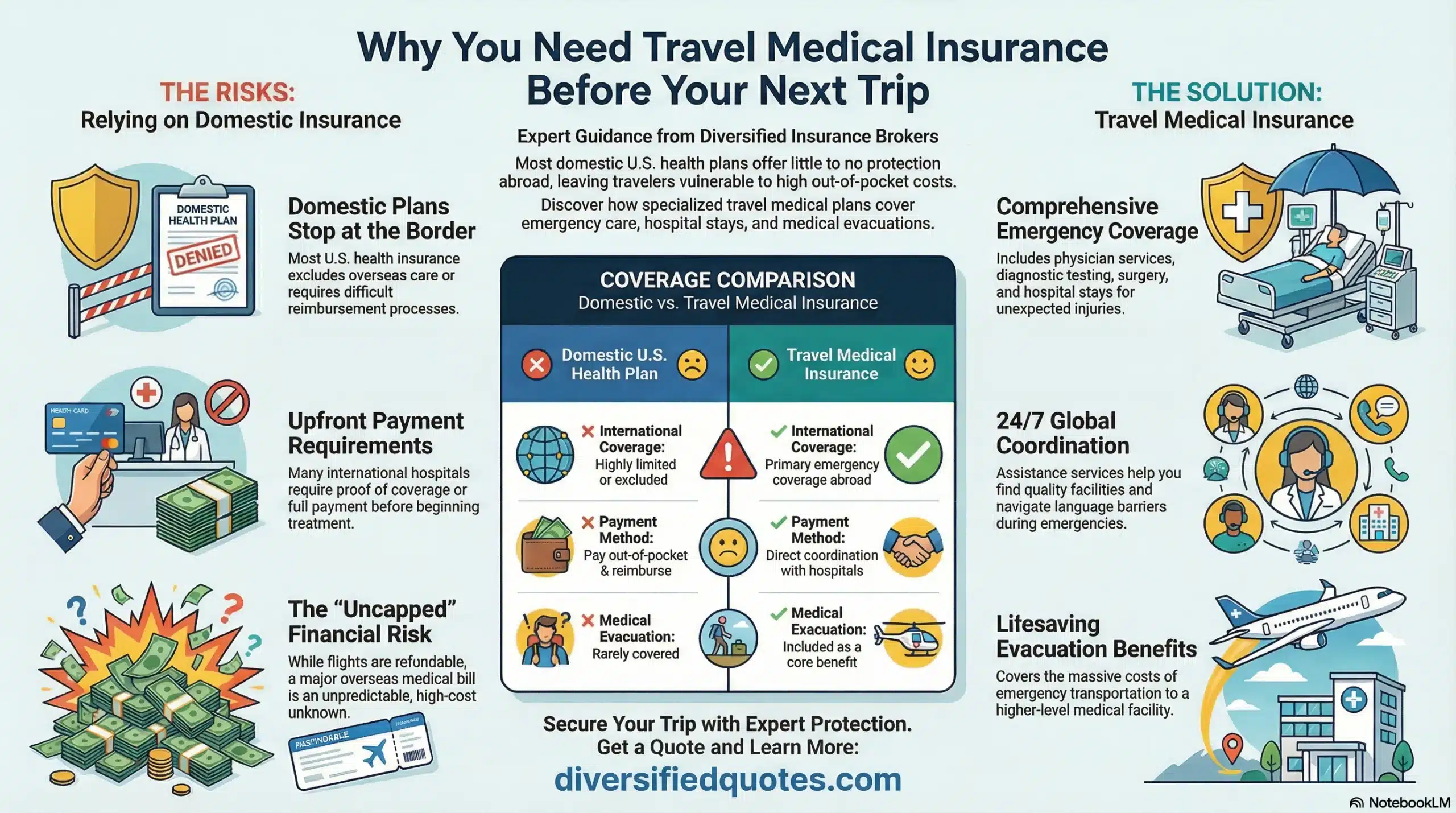
International group travel increases complexity. Many U.S. health plans provide limited or no coverage outside the country, and foreign providers may require payment up front. Travel medical coverage helps remove those barriers so care can proceed without delays driven by cost uncertainty. For emergency-only designs and certain traveler eligibility scenarios, these pages can help you compare the right structure: Emergency Travel Health Insurance, Emergency Travel Health Insurance for Foreign Nationals, and Emergency Travel Medical Insurance for U.S. Citizens.
The main goal is always predictable access to care. The “right” plan is the plan that allows the group to respond quickly when someone needs help.
Group travel medical plans vs. requiring individual purchases
Large groups typically benefit from group-oriented travel medical planning rather than leaving coverage decisions to each participant. When individuals purchase coverage on their own, organizers can end up with gaps, inconsistent benefits, and confusion about emergency procedures. That inconsistency becomes a problem when an organizer is trying to coordinate care for someone who has different coverage—or no coverage at all.
Group planning streamlines enrollment, standardizes coverage dates, and helps leaders communicate one set of emergency steps. That consistency is often worth more than minor pricing differences between individual policies. In situations where participants travel different durations or arrive from different locations, a hybrid approach can still work, but it requires intentional planning to avoid coverage gaps.
If your group’s schedule is complex, we can help you choose an approach that still keeps administration straightforward while maintaining strong protection across participants.
Need help matching coverage to group activities?
Tell us if your large group includes athletics, volunteer work, youth programs, conferences, or higher-risk destinations. We’ll help you avoid plan gaps and choose a structure that fits how your group actually travels.
Eligibility and underwriting for large groups
Travel medical insurance is generally structured for streamlined enrollment. Pricing and eligibility commonly reflect age, destination, trip length, and coverage selections rather than medical exams. That simplicity makes it practical even for larger groups and shorter planning timelines, while still providing meaningful medical and evacuation benefits during the travel period.
Pre-existing condition rules can vary by plan, which matters when a large group includes older travelers or participants with known medical concerns. The correct approach is to align expectations with plan terms and choose coverage that supports the group’s risk profile. For organizations that travel internationally on a recurring basis, it can also be useful to compare short-term travel medical coverage against longer-term options such as international health insurance.
Ultimately, the goal is to choose a plan that is easy to administer, easy to communicate, and strong where the group needs it most.
Administrative simplicity for organizers
One of the most valuable features of a group travel medical strategy is administrative efficiency. Enrollment can be consolidated, coverage periods can be standardized, and emergency steps can be communicated consistently. During a stressful situation, clarity matters. When participants know how to access care, who to contact, and what information to provide, the response becomes faster and less disruptive.
Many organizers include travel medical details in pre-trip materials so participants understand what coverage is in place and how to use it. That simple step—clear documentation and one set of procedures—can reduce confusion and reduce escalation when an incident occurs.
For large groups, the “best” plan isn’t always the one with the most features. It’s the plan that supports a clean, predictable emergency process when you actually need it.
Common mistakes large groups make
A common mistake is assuming personal health insurance will be enough for travel. Another is selecting coverage without confirming that the group’s activities are compatible with coverage expectations. Athletic travel, volunteer work, and physically demanding programs can change the risk profile and should be matched to an appropriate plan structure.
Groups also run into problems when coverage is secured late. Last-minute planning can reduce options and create gaps for late registrants. The result is often a patchwork approach that looks fine until someone needs care and the group realizes coverage isn’t consistent. A better approach is to plan coverage early and keep a simple process for adding participants.
Finally, many groups underprioritize evacuation. If you’re traveling internationally or to locations with limited medical infrastructure, evacuation planning should be a central decision point, not an afterthought.
Risk management for large group travel
Travel medical insurance is one component of a broader risk-management strategy. It doesn’t replace liability or accident coverage, but it addresses one of the most frequent and costly exposures: medical events that require urgent care, hospitalization, or evacuation while traveling. For organizations responsible for large groups, that exposure is not theoretical. It’s statistically more likely simply because of the number of travelers involved.
If your large group travels to destinations with higher safety concerns, political instability, or remote settings, it can also be useful to review planning approaches tied to high risk travel insurance and to ensure emergency support resources are part of the overall plan.
For organizers, the benefit of travel medical planning is clarity. When something happens, you have a process and coverage that supports the group’s decision-making.
How Diversified Insurance Brokers helps large groups
We help organizations design travel medical strategies that scale for large groups. The process starts with your destination, dates, group composition, traveler ages, and planned activities. Then we help compare plan options, clarify exclusions, and align coverage with real-world travel risk. Our aim is to reduce uncertainty so organizers and participants can focus on the purpose of the trip.
If your organization is balancing cost and coverage, it may also help to review the difference between medical-focused protection and broader trip protection strategies. For example, some groups exploring affordability comparisons begin with resources like Is Travel Medical Insurance Expensive? and then layer in the specific medical and evacuation protection the itinerary actually requires.
If you want to move quickly, run quotes to see plan options and then send us your group details so we can help you confirm the best fit.
Compare travel medical and evacuation options for your large group
Use the quoting tool to compare coverage levels and evacuation benefits based on your destination and dates, then we’ll help you verify the plan aligns with large-group logistics.
Request a quick plan check for your itinerary
If you’re coordinating dozens of travelers, a quick review can prevent gaps. Send your destination, dates, group size, and activities and we’ll help you confirm the coverage approach.
Related Travel Insurance Pages
Keep exploring large-group travel protection, evacuation planning, emergency travel health coverage, and international medical options.
Talk With an Advisor Today
Choose how you’d like to connect—call or message us, then book a time that works for you.
Schedule here:
calendly.com/jason-dibcompanies/diversified-quotes
Licensed in all 50 states • Fiduciary, family-owned since 1980
What qualifies as a large group for travel medical insurance?
A large group typically includes 10 or more travelers, though eligibility and pricing may vary by carrier.
Is travel medical insurance required for large groups?
It is often required by organizers, host institutions, or international partners, and is strongly recommended.
Does coverage apply to all participants?
Yes, group travel medical plans generally cover all enrolled participants for the duration of the trip.
Does travel medical insurance cover group activities?
Coverage depends on the activity. Plans must be reviewed to ensure organized group activities are included.
Is emergency medical evacuation included?
Most comprehensive group travel medical plans include emergency medical evacuation benefits.
Can coverage be arranged quickly for large groups?
Yes. Travel medical insurance typically involves minimal underwriting and can often be arranged quickly.
What about pre-existing conditions?
Coverage for pre-existing conditions varies by plan and may be limited or excluded.
About the Author:
Jason Stolz, CLTC, CRPC and Chief Underwriter at Diversified Insurance Brokers (NPN 20471358), is a senior insurance and retirement professional with more than two decades of real-world experience helping individuals, families, and business owners protect their income, assets, and long-term financial stability. As a long-time partner of the nationally licensed independent agency Diversified Insurance Brokers, Jason provides trusted guidance across multiple specialties—including fixed and indexed annuities, long-term care planning, personal and business disability insurance, life insurance solutions, Group Health, and short-term health coverage. Diversified Insurance Brokers maintains active contracts with over 100 highly rated insurance carriers, ensuring clients have access to a broad and competitive marketplace.
His practical, education-first approach has earned recognition in publications such as VoyageATL, highlighting his commitment to financial clarity and client-focused planning. Drawing on deep product knowledge and years of hands-on field experience, Jason helps clients evaluate carriers, compare strategies, and build retirement and protection plans that are both secure and cost-efficient. Visitors who want to explore current annuity rates and compare options across multiple insurers can also use this annuity quote and comparison tool.
