
Tax Advantages of Long Term Care Insurance

Jason Stolz CLTC, CRPC
Tax Advantages of Long Term Care Insurance can make long term care (LTC) planning significantly more affordable when you understand how premiums and benefits are treated—and how different policy types are structured. The goal is rarely “buy a policy and hope you use it.” The goal is to create a plan that protects retirement income and assets from the cost of home care, assisted living, memory care, or nursing care, while also taking advantage of any tax-favored rules that may apply. At Diversified Insurance Brokers, we help clients in all 50 states compare traditional LTC, hybrid life + LTC policies, and annuity-based LTC designs so they can understand the after-tax cost and the real-world tradeoffs before committing.
One reason this topic matters is that long term care planning doesn’t happen in a vacuum. A large care event can force taxable withdrawals, accelerate required distributions, and change how Social Security and other income sources are taxed. The more tax-efficient your LTC strategy is, the easier it is to protect the rest of your retirement plan. If you’re still in the early stage of deciding what type of coverage to explore, start with a broad overview of long term care planning strategies, then come back to the tax layer once you know which direction fits your goals.
See Your LTC Plan After Taxes
We’ll compare traditional and hybrid designs and show how deductions, HSA funding, and 1035 exchanges may reduce your net cost.
Why long term care insurance can be tax-favored
Long term care insurance sits in a unique place in the tax rules because qualified LTC coverage is generally treated more like health insurance than like “financial insurance.” That distinction is important. It’s the reason certain premium payments can potentially qualify for deductions in the right scenario, and it’s the reason qualified LTC benefits are commonly paid tax-free when you need care. In simple terms, the tax advantages are designed to make it easier for families to plan for a common, expensive risk without having to drain assets first.
However, “tax-favored” does not mean “simple.” The exact treatment depends on the policy structure and how it’s funded. For example, a traditional stand-alone LTC policy behaves differently than a hybrid life insurance policy with LTC benefits, and both can differ from an annuity-based LTC design that repositions existing assets. Before you compare plans purely on premium, it helps to understand how policy types differ in the first place—see hybrid life vs. traditional long term care insurance for a clear overview.
Premium deductions: how they generally work
The phrase “deductible premiums” is often used loosely online, which is where families get confused. The cleaner way to think about it is this: in many situations, traditional LTC premiums may be treated as eligible medical expenses, and that can create deduction opportunities depending on how you file, your income, and your overall medical expenses for the year. In other situations—particularly for certain business owners—the deduction opportunity can be more direct. The details matter, and the “best” route depends heavily on how you earn income and how your coverage is structured.
If your goal is to maximize possible deduction leverage, traditional LTC tends to be the policy type most often associated with that conversation, because it is pure care coverage rather than a blended policy. If your goal is to maximize predictability and value-return features (like legacy value if care is never needed), then hybrid designs may be attractive even if the deduction angle is not as central. If you want to reduce the fear of paying premiums and never using benefits, you can also compare value-protection features such as long term care insurance with return of premium.
Tax-free benefits: the part most people overlook
The most meaningful tax advantage for many families is not the premium deduction—it’s what happens during a claim. When long term care benefits are paid for qualified care expenses, they are commonly received tax-free. That matters because a long care event is often the exact moment families begin pulling extra money from retirement accounts or taxable investments to cover expenses. If LTC benefits can replace those withdrawals, it can help stabilize the tax picture and reduce the risk of cascading costs.
This is one reason it’s helpful to understand what triggers LTC benefits and what “qualified care” typically means. Even though this page focuses on taxes, benefit triggers and care definitions drive how the tax advantage plays out in the real world. If you want a practical foundation on how care need is measured, review who qualifies for long term care insurance and then connect that understanding to tax planning decisions like benefit levels and inflation.
HSA funding: using pre-tax dollars to reduce net cost
Health Savings Accounts (HSAs) can be a powerful tool in LTC planning because HSA dollars are inherently tax-advantaged. In many cases, HSA funds can be used toward certain long term care premium amounts within limits, effectively converting part of your premium expense into a pre-tax expense. Conceptually, that can be one of the cleanest ways to reduce net cost because you’re not relying on itemized deductions or complex thresholds—you’re simply using an account that was designed to pay for health-related expenses.
From a planning standpoint, HSA use is usually most impactful when it is coordinated early and consistently, rather than treated as an afterthought. If you’re already building a broader LTC plan, you can also model how HSA funding works alongside benefit design choices like shared pools for couples—see long term care insurance with shared benefits to understand why couples often structure plans differently than individuals.
1035 exchanges: repositioning existing policies without triggering tax
A 1035 exchange is one of the most practical tax tools in the LTC world because it can allow you to reposition existing policy value into a different contract type without creating immediate taxable income. Many families have an old life insurance policy they no longer need in its current form, or a non-qualified annuity that is underused, underperforming, or no longer aligned with goals. In the right situation, a 1035 exchange can redirect that value into a long term care strategy—often a hybrid design—so the money is working toward the risk you’re actually trying to hedge.
This approach is especially common for people who prefer to avoid adding a new monthly premium out of cash flow. Instead, they reposition an existing asset and convert it into a structured LTC benefit plan. If you prefer a single deposit approach, you may also want to explore single pay long term care insurance as a framework for how these strategies are designed.
Traditional vs. hybrid vs. annuity-based LTC: the “tax logic” is different
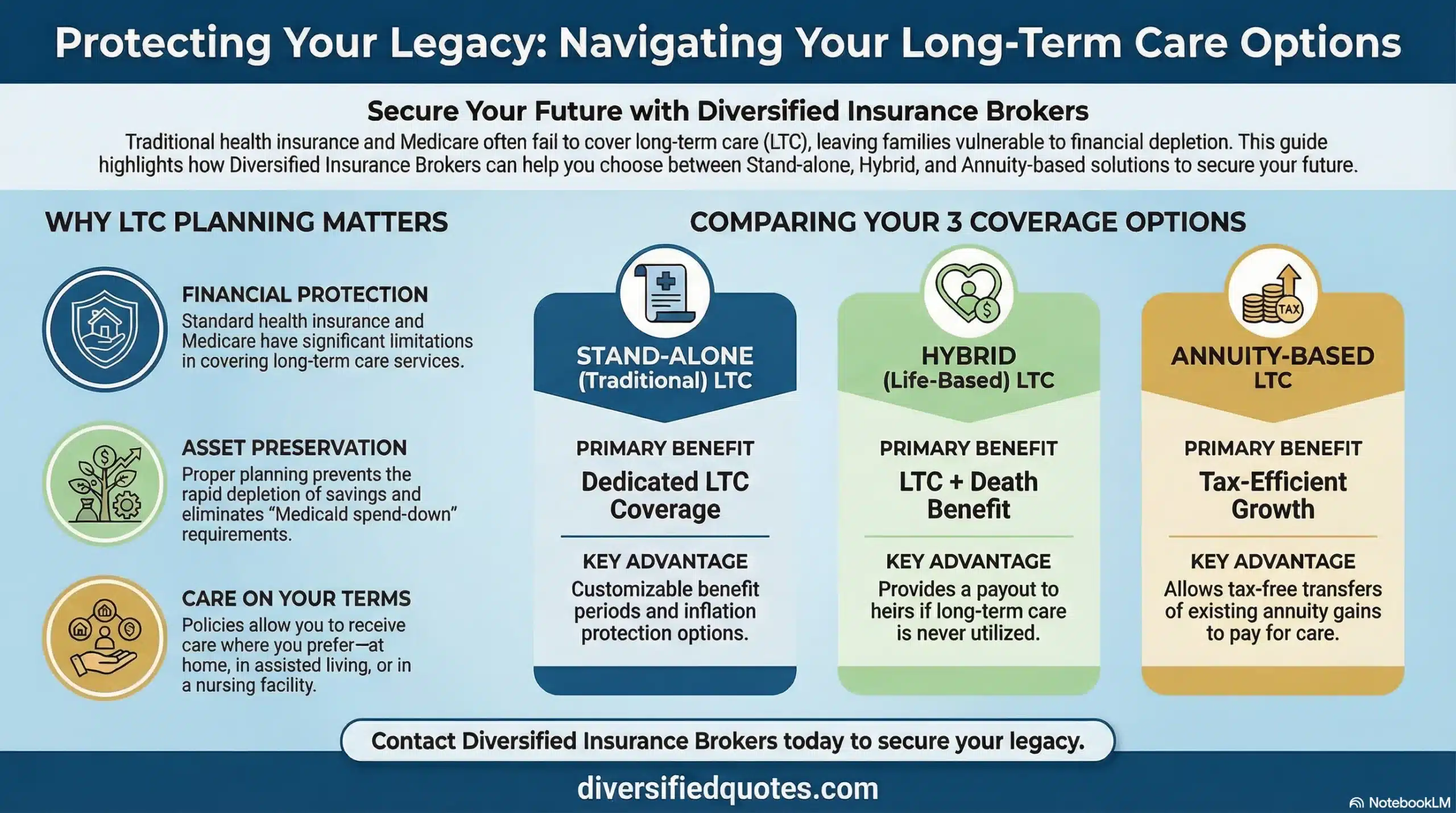
Families often assume the “tax advantages” are identical across all LTC solutions. In practice, the tax logic differs because the product chassis differs. Traditional long term care insurance is pure care coverage. Hybrid policies may pair care benefits with life insurance value. Annuity-based LTC designs often combine an annuity value with a benefit multiplier or enhanced payout mechanism for qualified care. These are not just marketing differences—they influence how premiums are funded, how value is accessed, and how benefits integrate with retirement income planning.
If you dislike the possibility of future premium changes and want greater predictability, hybrid designs may feel more comfortable. If you want maximum LTC leverage per premium dollar and you’re comfortable with the policy mechanics, traditional LTC may be the most efficient. If you have non-qualified assets you’d like to reposition and you want a tax-sensitive way to create a care pool, annuity-linked planning may be attractive—see non qualified long term care annuity for that style of strategy.
Why “tax advantages” should be modeled with your retirement income picture
Long term care planning can change how your retirement income plan behaves under stress. A care claim may cause higher withdrawals, more taxable income, and faster asset depletion—especially if the household is trying to keep the healthy spouse financially stable. When LTC benefits are structured tax-efficiently, they can reduce the need for reactive withdrawals and improve the longevity of the plan.
This is why we encourage clients to model the plan in terms of “net cost” and “net protection,” not just premium. If you are planning to use annuities for retirement income, LTC strategy also needs to coordinate with how income is generated, how beneficiaries are protected, and how withdrawals impact tax brackets. For context on how policy benefits and protection tools can integrate, review annuity benefits as an educational primer and then connect it back to your LTC structure.
State incentives and Partnership planning
Federal rules are only part of the tax conversation. Many states provide additional deductions or credits, and some states have long term care Partnership programs that can influence how people structure coverage—especially when asset protection planning is important. Partnership planning is not “tax planning” in the pure sense, but it is often discussed alongside tax advantages because it influences net outcomes and the way assets are preserved in a worst-case scenario. If you want to understand that layer, explore LTC Partnership reciprocity and how Partnership qualification affects planning across state lines.
To pressure-test how different benefits, inflation options, and elimination periods affect premium and long-term value, you can also use the long term care insurance calculator as a starting point. Even if you ultimately pursue a hybrid or asset-based plan, the calculator helps you understand the benefit sizing logic that underwriters and planners use.
Compare Traditional vs. Hybrid LTC (With Net Cost)
We’ll show how benefit design and funding method may affect your taxes now and your retirement cash flow later.
How we help you apply the tax advantages correctly
There is a big difference between “tax advantages exist” and “your plan actually captures them.” The right approach starts with product selection (traditional vs. hybrid vs. annuity-based), then moves into benefit design (benefit amounts, inflation protection, elimination periods), then into funding strategy (cash flow, HSA use, 1035 exchanges), and finally into coordination (retirement income sources, spouse protection, and legacy goals). The correct plan is not the plan with the most features. It’s the plan that balances leverage, predictability, and affordability—while aligning with your real tax situation.
We also help you avoid the common trap of over-insuring or under-insuring. Tax efficiency doesn’t matter if the plan is too expensive to keep long-term or too small to be meaningful in a care event. If you’re still deciding how much protection you need, you may want to read how much long term care insurance do I need and then bring that benefit sizing back into the tax planning discussion.
Next steps
If you want to use the tax advantages of long term care insurance intelligently, the next step is not to pick a carrier based on a brochure. The next step is to decide which policy structure fits your goals, then model the plan in after-tax terms so you understand what you’re really paying and what you’re really protecting. Once those decisions are clear, comparing carriers becomes easier because you’re comparing the right plan designs—not just random premium quotes.
Get Your Tax-Efficient LTC Plan
Answer a few questions about age, health, and goals. We’ll respond with options and the smartest way to structure them.
Related Pages
Related Long Term Care Pages
Continue learning with these focused resources.
Talk With an Advisor Today
Choose how you’d like to connect—call or message us, then book a time that works for you.
Schedule here:
calendly.com/jason-dibcompanies/diversified-quotes
Licensed in all 50 states • Fiduciary, family-owned since 1980
Frequently Asked Questions
Are long-term care insurance benefits taxable?
Benefits from qualified LTC policies are generally received tax-free when used for qualified long-term care services, whether paid as indemnity or reimbursement, up to applicable per-diem limits.
Can I deduct LTC premiums on my taxes?
Yes—traditional LTC premiums can be deductible subject to age-based IRS limits and the 7.5% AGI medical threshold if you itemize. Self-employed individuals may deduct eligible amounts without itemizing, up to IRS limits.
Do business owners get better deductions?
Often. C-corporations may deduct up to 100% of premiums as a fringe benefit. Pass-through owners (S-corp/LLC) may receive deductions based on age-based limits and entity rules.
Can I use an HSA to pay LTC premiums?
Yes. HSA funds can pay traditional LTC premiums up to the IRS age-based maximums, making those dollars pre-tax.
What’s the tax advantage of a hybrid LTC policy?
Hybrids can be funded with cash or via a 1035 exchange from an existing life or annuity contract, allowing you to reposition gains without current taxation. Benefits for qualified care are generally tax-free.
How do Partnership policies affect taxes?
Partnership policies don’t change federal tax treatment, but they provide dollar-for-dollar asset protection for Medicaid eligibility—an indirect financial advantage that complements tax benefits.
Do states offer additional LTC tax breaks?
Many states offer deductions or credits for qualified LTC premiums. We compare your resident state(s) and match incentives to the most competitive carriers.
About the Author:
Jason Stolz, CLTC, CRPC and Chief Underwriter at Diversified Insurance Brokers (NPN 20471358), is a senior insurance and retirement professional with more than two decades of real-world experience helping individuals, families, and business owners protect their income, assets, and long-term financial stability. As a long-time partner of the nationally licensed independent agency Diversified Insurance Brokers, Jason provides trusted guidance across multiple specialties—including fixed and indexed annuities, long-term care planning, personal and business disability insurance, life insurance solutions, Group Health, and short-term health coverage. Diversified Insurance Brokers maintains active contracts with over 100 highly rated insurance carriers, ensuring clients have access to a broad and competitive marketplace.
His practical, education-first approach has earned recognition in publications such as VoyageATL, highlighting his commitment to financial clarity and client-focused planning. Drawing on deep product knowledge and years of hands-on field experience, Jason helps clients evaluate carriers, compare strategies, and build retirement and protection plans that are both secure and cost-efficient. Visitors who want to explore current annuity rates and compare options across multiple insurers can also use this annuity quote and comparison tool.
