
Travel Medical and Evacuation from Germany

Jason Stolz CLTC, CRPC
Travel medical and evacuation coverage for Germany is one of those decisions that feels “optional” right up until the moment it isn’t. Germany is modern, well organized, and known for high-quality healthcare—but that doesn’t automatically mean your U.S. health plan will pay, that you’ll avoid expensive out-of-network billing, or that you can get home quickly if a doctor recommends returning to the U.S. for treatment. Travel medical insurance is built to solve the practical realities of care overseas: unexpected ER visits, hospital stays, urgent prescriptions, imaging, specialist follow-ups, and the logistics that come with navigating a foreign medical system when you’re stressed, sick, or injured.
At Diversified Insurance Brokers, we design travel medical and evacuation protection as a simple “guardrail” around your trip so one incident doesn’t become a financial or logistical nightmare. The right plan can help cover eligible medical costs in Germany, coordinate care, and provide evacuation or repatriation benefits when it’s medically appropriate. If your travel involves multiple countries, tight schedules, or older family members, the value of strong assistance services and clear coverage terms becomes even more important—because your biggest risk is rarely the city you’re visiting. It’s the combination of timing, uncertainty, and the cost of solving problems quickly when you’re far from home.
Get a Travel Medical & Evac Plan for Germany
Choose coverage built for real-world travel—medical care overseas, evacuation coordination, and support if plans change.
Germany is part of the Schengen Area, so travelers often combine Germany with nearby destinations in a single itinerary. That’s where trip design matters. If you’re visiting Berlin, Munich, Frankfurt, Hamburg, Cologne, or smaller towns along the Rhine or Bavaria, the medical environment is consistently strong—but a traveler’s cost exposure can still be substantial. Hospitals and clinics may require payment arrangements, foreign billing can be confusing, and your domestic insurance carrier may treat non-U.S. services as out of network, subject to separate deductibles, separate reimbursement rules, or no reimbursement at all. Travel medical insurance is meant to step into that gap so you can focus on getting care instead of negotiating financial terms while you’re unwell.
Evacuation coverage is the second piece many travelers underestimate. Evacuation isn’t just about extreme situations. It can apply when you’re in a location where appropriate treatment isn’t available, where a specialist bed is needed, where you’re stable but must be moved to a higher level of care, or when a physician recommends return to your home country for continued treatment. The practical value is that evacuation benefits are typically paired with a 24/7 assistance team that coordinates transport, paperwork, and medical handoffs. That coordination matters because an evacuation is rarely “one phone call.” It’s a process, and it’s expensive without a plan built to handle it.
If you want a broader overview of how travel medical protection is generally structured, start with our foundational guide on travel medical insurance. It explains how coverage is typically designed, what common exclusions look like, and why assistance services can matter as much as the benefit amount. Germany is a “traditional travel” destination, but the logic is the same: your trip is smoother when you have a plan that pays eligible expenses and coordinates solutions quickly.
What travel medical insurance helps cover in Germany
Travel medical plans are designed for unexpected medical needs that happen while you’re outside your home country. In Germany, that can include anything from a sudden flu that escalates into a high fever requiring urgent evaluation, to an injury on a walking tour, to a food-related illness that turns into dehydration requiring IV fluids. Plans often include eligible coverage for emergency room visits, hospital admission, outpatient physician care, urgent care, diagnostics like X-rays or CT scans, prescription medications that are medically necessary after an incident, and follow-up care related to a covered event.
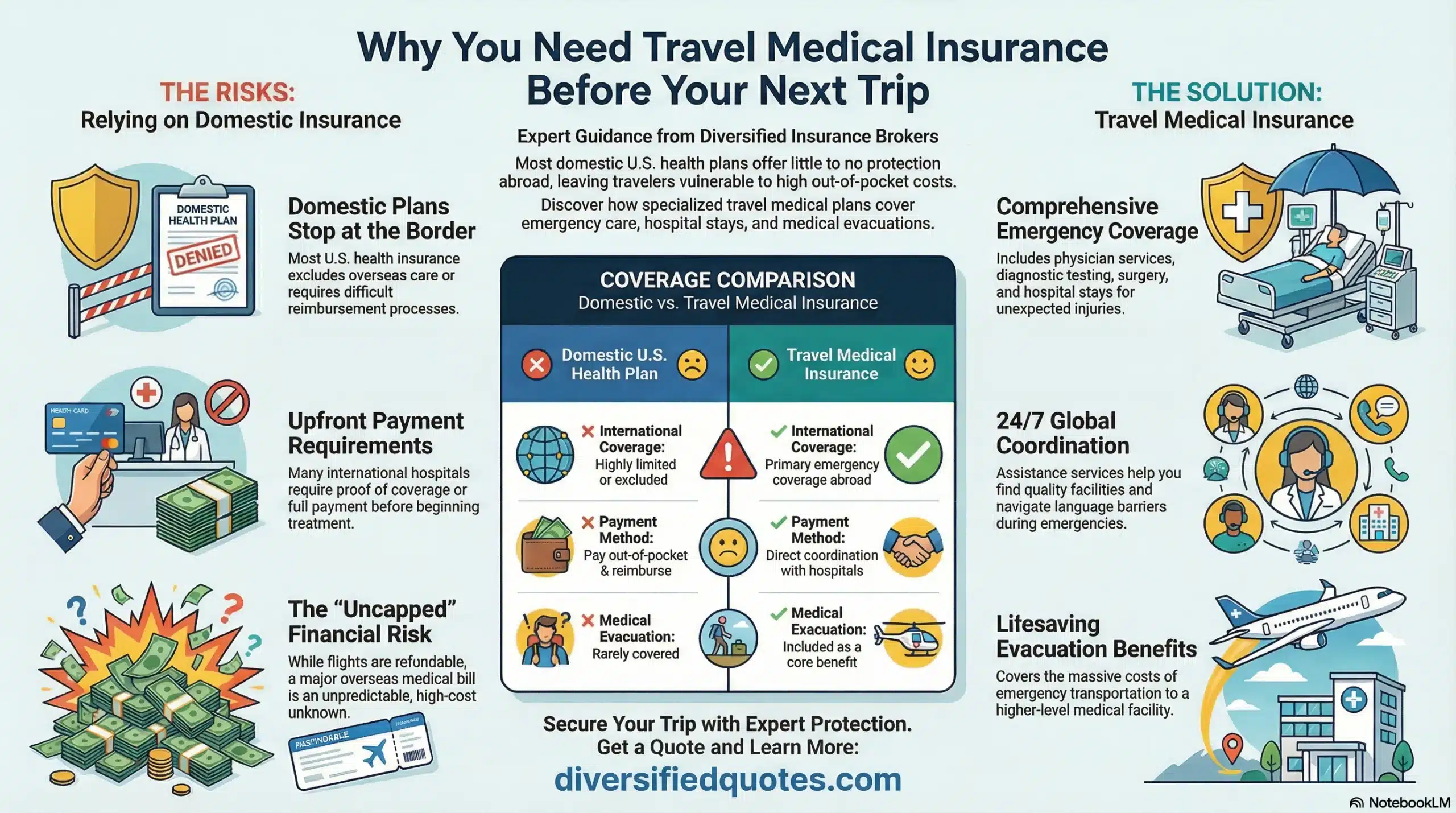
Many travelers assume their credit card benefit will handle these costs. In practice, credit card benefits vary widely and often come with strict limitations, narrow definitions of covered events, and reimbursement structures that don’t help you when you need a solution in real time. A travel medical plan is designed to be primary protection for eligible overseas medical costs, supported by assistance services that can help you find care, direct you to appropriate facilities, and help manage the paperwork of an unfamiliar system.
Travel medical also becomes more valuable when your trip includes activities that raise the likelihood of an injury or urgent visit. Germany is a hub for city walking, cycling, hiking in the Alps or the Black Forest, skiing or winter travel, festivals and crowded public events, and heavy driving for road trips across regions. The risk isn’t that Germany is unsafe. The risk is that active travel increases the chance of “ordinary injuries” that turn into expensive medical bills if you don’t have a plan built to pay eligible costs abroad.
Why U.S. health insurance often falls short overseas
Some U.S. plans offer limited emergency coverage abroad, but it’s rarely as simple as “they’ll cover it.” Even when overseas emergency services are technically covered, reimbursement may require extensive documentation, translation, or proof that the care was an emergency under your plan’s definition. Many plans treat foreign providers as out of network, which can mean higher cost sharing, separate deductibles, or limited reimbursement. Some plans exclude overseas coverage altogether, and many travel scenarios involve urgent-but-not-life-threatening care that still costs real money and still needs to be handled quickly.
Another gap is assistance and coordination. Domestic health insurance is not typically built to help you find a clinic in Germany, understand which hospital is appropriate for your situation, coordinate medical records across countries, or manage an evacuation decision. Travel medical plans are structured for those realities, which is why the service component is as important as the dollar limits.
If you’re trying to build a broader “travel health” framework—especially for multi-country trips or longer stays—our guide to international travel health coverage can help you understand the difference between short-term trip coverage, longer-term options, and how plan design changes when your travel pattern changes. Germany trips can be short, but many travelers combine them with longer European travel, and the right structure depends on how you’re actually traveling.
Evacuation and repatriation in a Germany travel plan
Medical evacuation coverage is not something most travelers “plan” to use, but it’s one of the most meaningful protections when you want a plan that handles worst-case logistics. Evacuation can mean transport to the nearest appropriate facility, transport to a different city for specialist treatment, or transport back to your home country if medically recommended. It’s not automatically “air ambulance back to the U.S.” It’s a benefit tied to medical necessity, the recommendation of treating physicians, and the plan’s assistance team.
Repatriation benefits typically address returning remains to the home country in the event of death. That is a difficult topic, but it is also a real logistical expense that can be significant. A solid plan makes those procedures simpler for your family by coordinating transport and handling eligible costs.
If you want a more detailed explanation of how evacuation benefits are commonly written and coordinated, review emergency medical evacuation insurance. It breaks down how evacuation is triggered, what coordination typically looks like, and why assistance is often the deciding factor between a smooth resolution and a stressful one.
Pre-existing conditions and what “coverage” really means
One of the most common points of confusion in travel medical planning is pre-existing conditions. Travelers often assume a plan will cover anything that happens. In reality, coverage depends on how the plan defines a pre-existing condition, whether it offers a waiver, and whether the traveler meets the timing requirements. Some plans can cover acute onset of certain conditions or offer pre-existing condition waivers if enrollment occurs within a defined window. Others exclude anything related to a known condition entirely.
This matters because travel can aggravate health issues in subtle ways. Long flights can affect circulation, walking-heavy days can flare joint problems, changes in diet can trigger digestive issues, and stress can worsen underlying conditions. The right way to approach this is not to assume “it’s covered” or “it’s not covered,” but to choose a plan whose language fits your needs and to enroll with timing that preserves the best available options.
For older travelers, plan choice is even more important because the probability of needing care increases with age, and because certain benefit designs are better suited to seniors. If a parent or grandparent is joining your Germany trip—or you’re planning a multi-generational itinerary—start with travel medical insurance for seniors. It’s a practical way to understand which plan features matter most when age and medical history are part of the equation.
Trip length, itinerary, and how to pick benefit limits
Choosing a plan is not just “buy travel insurance.” It’s choosing limits and features that match the trip. For Germany travel, benefit limits often depend on how long you’re gone, how many countries you’re visiting, and how willing you are to self-fund smaller incidents. For a short trip, many travelers choose a plan that is primarily focused on emergency events and evacuation, with medical limits high enough to handle a major event but not necessarily designed for extended overseas treatment. For longer trips—especially if you’re staying weeks or months—you may want broader outpatient coverage and a structure that supports continuity of care.
Deductibles and coinsurance also matter. A lower deductible can make sense if you want the plan to pay earlier for common incidents. A higher deductible can reduce premiums if you’re comfortable self-funding smaller medical events. The right choice is the one that keeps the plan in place (because it fits your budget) while still protecting you from the expenses you would struggle to pay out-of-pocket if something major happens.
For travelers visiting Germany for school, academic programs, internships, or longer study periods, the plan decision often becomes more “health coverage while abroad” than “trip coverage.” If that’s your scenario, review travel medical insurance for studying abroad, because the timing, documentation, and coverage expectations can be different when your travel is tied to a program.
Real-world scenarios Germany travelers should plan for
Scenario 1: An injury during a walking-heavy itinerary. Germany travel often involves long days on foot. A slip on wet cobblestones, a fall on a stairway, or a cycling incident can turn into an urgent orthopedic visit, imaging, and follow-up. A travel medical plan can help cover eligible emergency and outpatient costs and coordinate where to go for care.
Scenario 2: A sudden illness that requires observation. Viral illnesses, high fevers, dehydration, or respiratory symptoms can lead to evaluation and short hospital observation. Even if you’re discharged the same day, costs can add up quickly, and navigating payment and paperwork is much easier when a plan is designed for overseas incidents.
Scenario 3: A situation where the “best answer” is returning home. Sometimes the medical issue isn’t that Germany can’t treat it—it’s that the right plan is to stabilize the patient and continue treatment back home, close to their medical records and long-term providers. Evacuation benefits help coordinate that process when it is medically recommended, which can protect both finances and decision-making.
Scenario 4: A non-medical disruption that becomes a medical problem. Travel disruptions can lead to missed medications, delayed care, or extended exposure to stressful conditions. Strong assistance services can help you solve problems quickly—finding a local pharmacy process, locating an appropriate clinic, or coordinating documentation.
How assistance services matter in Germany
In a modern healthcare system like Germany’s, you can usually find care—yet travelers still get stuck when they don’t know where to go, how to explain symptoms, how billing works, or how to locate the right level of care (especially after hours). Assistance services can help direct you to an appropriate facility, coordinate communications, and support the process of receiving treatment and documenting it properly.
Assistance also matters if you need transport to a different city, if you need help finding a specialist, or if the plan needs to arrange evacuation. Even when a plan’s benefit limits are strong, a weak assistance experience can be the difference between a manageable event and a stressful one. That is why we emphasize selecting plans that combine solid coverage with strong coordination.
Middle-of-page CTA to break up the content
Compare Popular Travel Medical & Evac Options
If you’re traveling to Germany (or multiple European countries), choose a plan with the right medical limits, evacuation benefits, and support services.
How to build a “clean” plan for a Germany trip
A practical Germany travel plan usually starts with four decisions: your medical limit, your deductible, your evacuation benefit structure, and whether you need special handling for pre-existing conditions. From there, you confirm effective dates that match your actual travel days (including travel days), and you double-check that the plan is designed for the type of traveler you are.
If you’re traveling for work, extended projects, or international assignments, you may also want to think differently about continuity of coverage. Many travelers assume “one plan per trip,” but if your travel is recurring or long-term, it may be more efficient to choose a structure that matches that pattern. If you’re more of a digital nomad traveler—multiple countries, flexible return date, frequent travel—review travel insurance for digital nomads to see what changes when your travel lifestyle changes.
Special considerations for families, groups, and teams
Germany travel isn’t always “one person on vacation.” It can involve families visiting relatives, school programs, youth sports travel, church trips, or volunteer travel. Group travel creates a different planning challenge: one incident can affect the entire itinerary, and the people involved often have different health histories and different risk profiles. Group-friendly travel medical structures can help make coverage consistent, avoid gaps, and ensure the group has a reliable assistance pathway if something happens.
If you’re traveling as a group—especially with minors or young adults—review travel medical for youth sports to understand how travel medical design changes when a team dynamic is involved. Even if your Germany trip isn’t sports-focused, the core idea applies: group travel needs predictable processes, clear coordination, and coverage that matches the travel pattern.
If your Germany travel includes volunteer work or mission-style trips (even in traditional European destinations), the activity profile can still be different than tourism, and you may want coverage that matches the nature of the trip. For context, you can explore travel medical insurance for volunteer groups, which explains how coverage planning shifts when activities and responsibilities change.
Travel disruption and “non-medical” issues that still matter
While this page focuses on travel medical and evacuation, it’s worth remembering that travel problems often come in bundles. Missed connections, lost luggage, delayed travel, or interrupted accommodations can create health consequences—missed medications, prolonged stress, unexpected physical strain. Some plan designs include helpful support benefits that make travel disruption less painful, which indirectly supports health and safety when your itinerary changes unexpectedly.
If you want an example of how travel-related services can reduce friction during disruption, see travel lodging and pet care benefits explained. Even when your core need is medical and evacuation protection, the right “support features” can still make the overall travel experience more resilient.
What to do before you leave for Germany
Before departure, we recommend building a simple “travel health checklist” that makes the plan usable when you need it. Save the plan’s assistance number in your phone. Store your plan ID in a note or email that you can access quickly. If you take prescription medications, travel with extra days when possible and keep them in their original labeled containers. If you have a known medical condition, consider traveling with a brief medical summary and a list of medications and dosages. These are small steps that can dramatically reduce stress if you need care.
It’s also smart to plan around your itinerary. If you’re visiting multiple cities, consider how quickly you could access care in each area and whether your plan’s support services can direct you to appropriate facilities. Germany is generally excellent for access, but a plan that can coordinate effectively is still valuable—especially after hours or in less familiar regions.
End-of-page CTA
Enroll in Travel Medical & Evac Coverage for Germany
If you want predictable protection and a clear assistance pathway, choose a plan built for international travel realities.
Germany is a “traditional” travel destination, which is exactly why travel medical and evacuation coverage is easy to overlook. But the strongest travel planning is the planning you never have to use. A well-structured plan can cover eligible medical expenses, coordinate care, and create a clear solution if an event is serious enough to involve transport or evacuation decisions. When you design coverage around your actual itinerary—trip length, traveler age, medical history, and activity level—you get a plan that feels simple in advance and valuable if something happens.
Related Travel Medical Pages
Use these to compare plan types, understand evacuation benefits, and choose coverage that matches how you travel.
Related Destination Pages
If you’re comparing multiple destinations, these pages show how travel medical and evacuation planning adapts by itinerary.
Talk With an Advisor Today
Choose how you’d like to connect—call or message us, then book a time that works for you.
Schedule here:
calendly.com/jason-dibcompanies/diversified-quotes
Licensed in all 50 states • Fiduciary, family-owned since 1980
FAQs: Travel Medical and Evacuation from Germany
About the Author:
Jason Stolz, CLTC, CRPC and Chief Underwriter at Diversified Insurance Brokers (NPN 20471358), is a senior insurance and retirement professional with more than two decades of real-world experience helping individuals, families, and business owners protect their income, assets, and long-term financial stability. As a long-time partner of the nationally licensed independent agency Diversified Insurance Brokers, Jason provides trusted guidance across multiple specialties—including fixed and indexed annuities, long-term care planning, personal and business disability insurance, life insurance solutions, Group Health, and short-term health coverage. Diversified Insurance Brokers maintains active contracts with over 100 highly rated insurance carriers, ensuring clients have access to a broad and competitive marketplace.
His practical, education-first approach has earned recognition in publications such as VoyageATL, highlighting his commitment to financial clarity and client-focused planning. Drawing on deep product knowledge and years of hands-on field experience, Jason helps clients evaluate carriers, compare strategies, and build retirement and protection plans that are both secure and cost-efficient. Visitors who want to explore current annuity rates and compare options across multiple insurers can also use this annuity quote and comparison tool.
