
Travel Medical and Evacuation from Vietnam

Jason Stolz CLTC, CRPC
Travel medical and evacuation coverage for Vietnam is designed to solve two practical problems: (1) paying for eligible emergency medical care while you’re abroad, and (2) coordinating the “what happens next” logistics if you need a higher level of care, a long-distance transfer, or a medically supervised return home. Vietnam is a popular destination for tours, food-focused travel, beach trips, multi-city itineraries, and extended stays—often with a lot of movement between regions. That travel style is exactly where travel coverage shines, because the risk is not “Vietnam is dangerous,” it’s that unexpected health issues and logistical complexity can show up anywhere, and you want an organized way to handle care, language barriers, transportation, and documentation.
Many travelers assume their domestic health insurance will follow them internationally. Sometimes you’ll have limited benefits, sometimes you’ll have none, and even when you do have out-of-network coverage, it may not solve the bigger issue: finding care quickly and coordinating everything when you’re tired, jet-lagged, or dealing with a real emergency. A dedicated travel plan is built specifically for short-term international needs, with assistance services that can help you locate treatment, coordinate evacuation, and handle the paperwork trail that tends to follow a major claim.
At Diversified Insurance Brokers, we help travelers compare plan designs so they can match coverage to the trip they’re actually taking—whether that’s a short vacation, a multi-week tour, a study-abroad style itinerary, or a longer stay with frequent regional travel. The goal is simple: avoid “too little coverage” that leaves gaps, and avoid paying for features you don’t need.
Compare Travel Medical Options for Vietnam
If you want a plan that can cover eligible emergency care and help coordinate evacuation logistics, start here.
View Plans & PricingWhy Vietnam Trips Create Unique Coverage Needs
Vietnam travel often involves multiple cities and regions in one itinerary—Hanoi to Ha Long Bay, Hoi An to Da Nang, Ho Chi Minh City to the Mekong Delta, plus day trips and excursions. More movement means more opportunities for small issues to become big ones: dehydration, food-related illness, respiratory infections, injuries from scooters or uneven walking surfaces, or simple “bad timing” problems like a fever the day before an internal flight. Even when the medical issue is straightforward, the logistics aren’t—especially if you need care quickly and you’re unfamiliar with the local system.
That’s why travelers typically evaluate coverage in two layers. First is travel medical insurance, which focuses on eligible medical expenses like doctor visits, emergency treatment, diagnostic testing, and hospitalization. Second is evacuation-related support, where the plan can coordinate transportation to a better-equipped facility or arrange medically appropriate transport if local options aren’t sufficient.
If you want a deeper breakdown of what evacuation coverage is actually meant to do, review emergency medical evacuation insurance so you can see why “coordination” matters just as much as the dollar amount printed on the brochure.
Travel Medical vs. Evacuation Coverage: The Practical Difference
Travel medical coverage is about treatment. Think: urgent care, ER visits, labs, imaging, prescriptions, and inpatient stays that occur during your trip and are eligible under the plan. When you’re comparing options, you’re looking at benefit limits, how deductibles apply, what counts as an emergency, and how claims are handled if you pay out of pocket.
Evacuation coverage is about transport and coordination. It’s used when the best outcome requires moving you—either to the nearest appropriate facility or back to your home country under medically supervised conditions. The best plans also help coordinate communication, records transfer, and logistics for companions when a medical situation disrupts the entire trip. If you want to understand how international coverage is structured overall, international travel health coverage is a good reference point.
One detail travelers miss: evacuation is not “whenever you want to go home.” It’s generally tied to medical necessity and the plan’s assistance team coordinating the move. That’s why it’s smart to understand how the plan defines appropriate facility, what triggers transport, and whether the plan requires that you contact assistance before certain services are arranged.
How to Choose Coverage Limits for Vietnam
There isn’t one perfect number for everyone. A healthy traveler on a short Vietnam vacation may prioritize a clean design with reasonable medical limits and straightforward claims. A traveler with a known health history, a longer itinerary, or a more aggressive activity plan may lean toward higher limits and stronger evacuation features. The correct approach is to match your plan to your risk exposure: how long you’re gone, how remote parts of your itinerary are, what activities you’ll do, and whether you want “higher-limit peace of mind” for worst-case scenarios.
If you’re traveling at an older age, it can help to compare coverage options that are specifically designed for age-based eligibility and practical support needs. Start with travel medical insurance for seniors to see which plan structures tend to be more traveler-friendly when it comes to documentation and coordination.
For travelers with more flexible lifestyles—remote work, frequent international travel, or extended stays—plan structure matters even more than the headline premium. If that sounds like your situation, travel insurance for digital nomads can help you think through coverage continuity and how to avoid “coverage gaps” caused by shifting dates and locations.
What the Assistance Team Really Does (and Why It Matters)
When travelers talk about “insurance,” they usually picture reimbursement. In real life, the assistance component can be the most valuable part of the plan—especially in Vietnam where you may be navigating language differences, unfamiliar facilities, and regional travel. Assistance can help you identify appropriate care, coordinate payment methods, provide translation support, guide you on documentation, and help manage the “chain of decisions” that happens during emergencies.
For many travelers, the simplest way to understand this is to look at emergency travel coverage as two things: coverage for eligible bills and a navigation system for the situation. If you want a clearer framework for that, review emergency travel health insurance and think in terms of “support + benefits,” not just “benefits.”
Common Vietnam Scenarios Where Travel Coverage Helps
Stomach illness and dehydration: Travel changes routine—food, water exposure, heat, and long walking days. Even mild illness can derail a trip if you need IV fluids, prescriptions, or testing before you can safely continue moving city-to-city.
Respiratory infections: Crowded transit, long flights, and climate shifts can trigger infections that require doctor visits, medication, or short hospitalization.
Injuries during transit or excursions: Scooters, uneven sidewalks, wet surfaces, and day trips can create injury scenarios that need imaging and follow-up care. The key is having a plan that doesn’t make you guess what to do next.
Higher-level care decisions: If a condition requires a specialized facility, evacuation coordination becomes more relevant—particularly if you’re traveling outside major city centers.
Ready to Compare Plans for Vietnam?
Choose dates, compare options, and select a plan that fits your trip length and travel style.
Compare Plans NowPre-Existing Conditions and “Timing” Traps
Pre-existing condition rules are one of the most misunderstood parts of travel medical coverage. Different plans define pre-existing conditions differently, and some plans have eligibility windows or timing requirements tied to when you purchase the plan relative to your departure date. If you have a known health history, the smart move is not guessing—it’s reading how the plan defines pre-existing conditions and understanding what the plan will and won’t treat as eligible.
Also keep in mind: travel medical insurance is built for emergencies during travel. It is not intended to replace ongoing domestic coverage or provide routine care. If you’re traveling for an extended period and need a broader coverage strategy, you’ll want to evaluate an approach that matches the length and structure of your stay rather than forcing a short-term plan to behave like long-term coverage.
If Your Vietnam Trip Includes Multiple Countries
Many Vietnam itineraries pair with nearby destinations—regional stopovers, multi-country tours, or repositioning flights through major hubs. Most travel medical plans cover multi-country travel as long as your coverage dates and territory rules are aligned with the trip. If you’re moving around frequently, avoid narrow solutions and look for coverage designed for flexible international travel.
If your trip is tied to academics—study abroad, exchange programs, or school-related travel—use travel medical insurance for studying abroad as a checklist for what schools often require and what travelers tend to overlook when they assume a generic plan will satisfy program rules.
How Claims Typically Work (So You’re Not Surprised)
Claims tend to go smoothly when you treat documentation as part of the process, not an afterthought. If you pay out of pocket, keep itemized invoices, proof of payment, and any clinical notes you can obtain. If you can contact the assistance team during the event, it may help you understand what documents the plan wants and how to submit them efficiently.
The most common frustration is not “the plan didn’t cover anything,” it’s that the traveler didn’t capture the right paperwork while they were still at the facility. That can be harder to fix once you’ve moved on to the next city—or once you’re back home and trying to reconstruct what happened.
How We Help Travelers Choose the Right Plan
Diversified Insurance Brokers helps travelers compare plan structures and match coverage to the reality of the trip: how long you’re gone, how mobile you’ll be within Vietnam, what your health considerations are, and how important “coordination support” is to you. Some travelers want the simplest possible plan that covers likely emergencies. Others want higher limits and stronger evacuation features because the trip is longer, more remote, or includes riskier activities. The right answer depends on the traveler, not the destination label.
If your travel includes group work—volunteer programs, organized tours with service components, or multi-person coordination—plan selection matters because the logistics can get complicated quickly. For that perspective, see travel medical insurance for volunteer groups.
And if the purpose of travel is more mission-driven—aid work, higher-intensity volunteer settings, or travel that involves medically constrained environments—review travel insurance for humanitarian aid workers to understand why assistance coordination becomes even more important.
Related Pages
Related Travel Medical Pages
Use these to compare plan types, understand evacuation benefits, and match coverage to your travel style.
Related Destination Pages
If you’re building a multi-stop itinerary, these pages help you compare destination-specific considerations.
Get Covered Before You Depart
Lock in coverage dates that match your Vietnam itinerary and choose the plan features you actually need.
View Plans & Apply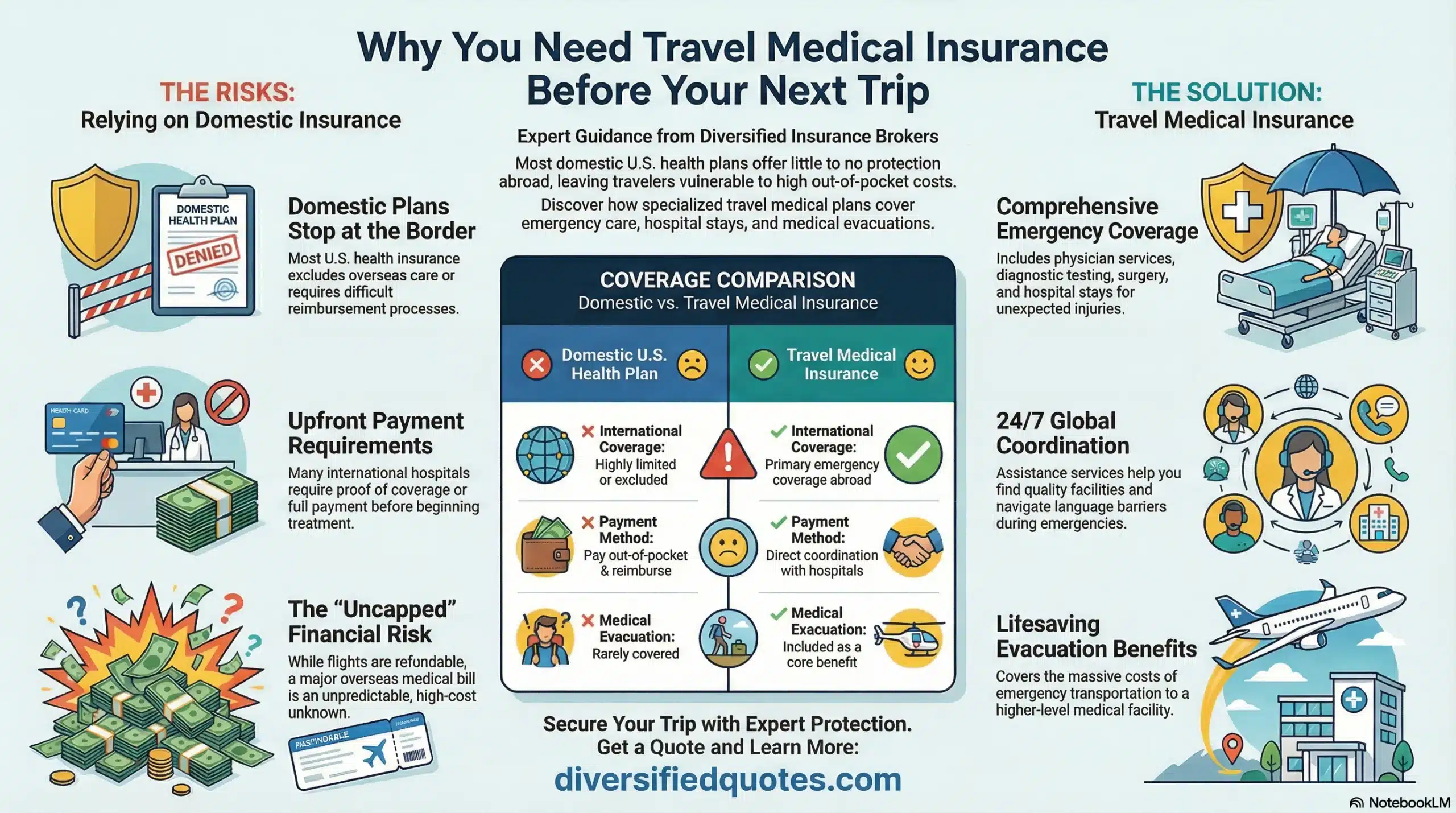
Talk With an Advisor Today
Choose how you’d like to connect—call or message us, then book a time that works for you.
Schedule here:
calendly.com/jason-dibcompanies/diversified-quotes
Licensed in all 50 states • Fiduciary, family-owned since 1980
FAQs: Travel Medical and Evacuation from Vietnam
Do I really need travel medical insurance for Vietnam if I’m healthy?
Even healthy travelers can get hit with unexpected issues—food-related illness, dehydration, infections, falls, or minor injuries that turn into bigger problems. Travel medical coverage is primarily about avoiding out-of-pocket exposure and having support if you need care quickly.
What’s the difference between travel medical coverage and medical evacuation coverage?
Travel medical coverage helps pay for eligible treatment costs like doctor visits, testing, prescriptions, ER care, and hospitalization. Medical evacuation coverage focuses on transportation to an appropriate facility (or back home) when medically necessary, which can be one of the most expensive travel-related risks.
Is evacuation coverage important if I’m mostly staying in big cities like Hanoi or Ho Chi Minh City?
It can still matter. Even in major cities, the best facility for a specific situation may not be the closest one. Evacuation benefits are most valuable when you need a higher level of care, need transport between facilities, or require supervised return travel.
Does a plan cover me if I’m traveling to more remote areas like Ha Giang, Sapa, Phu Quoc, or smaller coastal towns?
Coverage is usually territory-based, so it often applies throughout Vietnam. The bigger issue is how assistance services coordinate care and transport in remote areas. If you’re going far from major cities, prioritize strong assistance support and clear evacuation definitions.
What about motorbike or scooter accidents in Vietnam?
This is a common concern. Coverage can depend on the plan’s terms and the circumstances (for example, licensing requirements, helmet use, and whether the activity is considered higher-risk). If you’ll be riding, review the plan details carefully so you know how injuries are handled.
How do pre-existing conditions work for Vietnam travel medical plans?
Pre-existing condition rules vary widely. Some plans have specific eligibility windows, stability requirements, or limitations. If you have a known medical history, focus on the plan’s definition of a pre-existing condition and how it treats flare-ups or complications.
Will I have a “waiting period” before coverage starts?
Most travel medical plans start based on the effective dates you choose and the plan’s issuance/payment rules. Some benefits may have special timing provisions, so it’s smart to purchase coverage before you depart and confirm your effective date matches your itinerary.
What should I do if I need medical care while I’m in Vietnam?
If it’s an emergency, get care immediately. For non-emergencies, contact the plan’s assistance services when possible so you can be directed to an appropriate facility and understand what documentation you’ll need for reimbursement.
How do claims usually work if I pay out of pocket in Vietnam?
Keep itemized bills, proof of payment, and any clinical notes you can obtain. Claims decisions often depend on documentation, so collecting paperwork before leaving the facility can make reimbursement much smoother.
About the Author:
Jason Stolz, CLTC, CRPC and Chief Underwriter at Diversified Insurance Brokers (NPN 20471358), is a senior insurance and retirement professional with more than two decades of real-world experience helping individuals, families, and business owners protect their income, assets, and long-term financial stability. As a long-time partner of the nationally licensed independent agency Diversified Insurance Brokers, Jason provides trusted guidance across multiple specialties—including fixed and indexed annuities, long-term care planning, personal and business disability insurance, life insurance solutions, Group Health, and short-term health coverage. Diversified Insurance Brokers maintains active contracts with over 100 highly rated insurance carriers, ensuring clients have access to a broad and competitive marketplace.
His practical, education-first approach has earned recognition in publications such as VoyageATL, highlighting his commitment to financial clarity and client-focused planning. Drawing on deep product knowledge and years of hands-on field experience, Jason helps clients evaluate carriers, compare strategies, and build retirement and protection plans that are both secure and cost-efficient. Visitors who want to explore current annuity rates and compare options across multiple insurers can also use this annuity quote and comparison tool.
