
30-Year Term Life Insurance

Jason Stolz CLTC, CRPC
30-Year Term Life Insurance is one of the most popular ways to lock in long-term financial protection while keeping your monthly premium predictable. It’s designed for families who want a long runway of coverage during the years when their household is most dependent on income, most exposed to debt obligations, and still building retirement savings. If you have young children, a newer mortgage, or you’re the primary earner in the home, a 30-year term policy can create stability that lasts through decades of life changes. At Diversified Insurance Brokers, we help clients compare top carriers, underwriting paths, and contract features so your life insurance isn’t just “a policy,” but a reliable plan that fits your actual timeline.
One reason 30-year term life insurance is so widely chosen is that it covers the full “heavy responsibility” phase of life in one simple contract. Instead of guessing whether you’ll need coverage later, or planning to reapply years down the road when your health and pricing may change, you’re securing a defined protection window upfront. In many households, this term length lines up with a long mortgage payoff schedule, child-rearing years, and the decades when income is still required to keep the household operating smoothly. A 30-year term is not just about length—it’s about certainty.
Another advantage of a 30-year term is that it’s easy to understand and easy for beneficiaries to rely on. You pay a fixed premium, the death benefit stays in place, and if the unexpected happens the funds can be used to keep the family’s plan intact. That can mean paying off a mortgage, replacing income, covering childcare, preserving college funding plans, and avoiding the need to sell assets quickly. The goal isn’t to “win” with life insurance. The goal is to remove financial chaos from a situation that is already emotionally difficult.
Request a 30-Year Term Quote Review
We’ll compare carrier pricing, underwriting paths (no-exam vs. exam), and policy features so you can choose the best long-term coverage with confidence.
Prefer to talk? Call 800-533-5969
How 30-Year Term Life Insurance Works
A 30-year term life insurance policy provides a level premium and a fixed death benefit for 30 years. That means your premium is designed to stay the same during the level-term period, and the death benefit stays in force as long as premiums are paid. If the insured passes away while the policy is active, the life insurance company pays the death benefit to the named beneficiaries, most often income-tax-free. If the insured outlives the 30-year term, the level period ends and the policy typically expires unless it is renewed annually or converted to permanent coverage, depending on the carrier’s contract provisions.
The simplicity is what makes term insurance attractive. Unlike permanent life insurance, most term policies do not accumulate cash value. There’s no investment component, no changing crediting rates, and no complexity that requires ongoing management. It is designed to do one job well: provide meaningful protection for a defined period when financial risk is highest. For many families, that is exactly what they need, especially when budgets are already stretched by mortgages, childcare costs, and saving for retirement at the same time.
It’s important to understand that a 30-year term is a long commitment, and that’s the point. Over 30 years, your life will likely change—your income may increase, your kids will grow up, debts will be paid down, and assets will build. Term life insurance works best when it is aligned with those milestones, because the death benefit is meant to protect the years when your plan is still “fragile” and heavily dependent on the continued earning power of one or both spouses.
Why 30-Year Term Life Insurance Is So Popular
Most people don’t need life insurance forever, but they do need it during the years when losing an income would create the biggest shock. A 30-year term is popular because it covers that entire window for many households, especially for younger families who want to lock protection in early. It is also popular because it reduces the need to reapply later, which can be risky. When you apply later in life, premiums are usually higher because of age, and underwriting can become more complicated if your health history has expanded or changed.
For example, a 30-year term can protect a family through the years when children are financially dependent, when a mortgage is still large, and when retirement savings is still being built. Instead of hoping the plan will “be okay” if something happens, you have a defined financial backstop. And because term insurance is generally the most cost-efficient way to purchase a large death benefit, it can deliver meaningful protection without requiring a permanent-policy premium commitment.
At Diversified Insurance Brokers, we also see 30-year term chosen by clients who want simplicity. Many people do not want to manage multiple policies, or worry about their coverage expiring at an inconvenient time. They want one policy with one premium and one consistent coverage window. For those households, the clean structure of a 30-year term can feel like a “set it and forget it” solution, as long as it is set up correctly from the beginning.
Who a 30-Year Term Policy Is Best For
A 30-year term life insurance policy is typically best for people who have long-range responsibilities. That includes parents with young children, homeowners early in their mortgage payoff schedule, and primary earners whose family would face significant disruption if income stopped suddenly. It can also be a strong fit for couples who want to keep the surviving spouse from having to make rushed financial decisions, like selling a home or withdrawing from retirement accounts early, simply to stay afloat.
This type of policy can also be a smart fit for professionals and business owners who are still building financial independence. Even if income is strong, responsibilities can still be heavy. Many high earners have lifestyle and cash-flow commitments that rely on consistent income for decades. A long-term policy can help keep the plan intact while assets grow. In some cases, life insurance planning overlaps with business protection, where the loss of a key person could impact revenue or stability. This is also why some clients evaluate disability coverage as a parallel part of planning, because the risk of a long-term sickness or injury during working years can be just as disruptive as premature death.
If you have any complexity in your health history, it can still be possible to qualify for a long term, but carrier selection becomes more important. Some insurers are simply more competitive for certain profiles, and shopping the market through an independent broker can lead to better outcomes than applying blindly to one company and hoping for the best. The goal is not just “getting approved,” but securing the strongest possible rate class and contract features for a policy you plan to keep for decades.
What Impacts 30-Year Term Life Insurance Rates
Life insurance pricing is largely driven by underwriting. The carrier is estimating risk over the term length you select, and then pricing that risk based on a combination of factors. For most applicants, age is one of the biggest rate drivers because mortality risk increases over time and because the insurer is committing to level premiums for a long window. Health history is the next major category, including conditions, medications, any history of major diagnoses, and overall medical stability.
Tobacco and nicotine use can have a major impact on cost. Some people are surprised by how much pricing changes based on nicotine classification, even if overall health is strong. Build (height and weight) also matters because carriers have underwriting build charts that influence rate class. Blood pressure, cholesterol, and lab trends can affect outcomes as well. Family history sometimes plays a role, depending on the carrier’s guidelines and how close the family member’s diagnosis was to a younger age.
Driving record and lifestyle can matter too, especially if there are severe violations, recent DUIs, or risky patterns. Certain hobbies can create extra underwriting questions as well. The important takeaway is that underwriting is not identical across companies. Two carriers can evaluate the same applicant differently, and that can change pricing and approval outcomes. That is one reason comparing multiple carriers is so important for a 30-year term—because you want the best fit, not just the first quote you see.
No-Exam Underwriting vs. Traditional Underwriting for 30-Year Term Coverage
Many applicants qualify for accelerated underwriting, often called “no-exam life insurance,” where the carrier uses digital data sources, prescription history, and other records to make a decision without requiring a paramed exam. This can be a great option for people who want speed and simplicity, and it can still produce strong pricing outcomes in many cases. However, no-exam underwriting is not always the best answer for everyone.
Traditional underwriting involves an exam and labs, and while it may take slightly longer, it can sometimes secure a better rate class for people who have excellent vitals and strong lab results. It can also be helpful for applicants whose digital records may not tell the full story. Since you’re considering a long policy with decades of premium payments, it can be worth taking the approach that gives the strongest pricing and approval stability, not just the fastest decision. With long terms, small differences matter, and better underwriting outcomes can translate into meaningful long-term savings.
One of the biggest benefits of working with Diversified Insurance Brokers is being able to compare these underwriting paths intentionally. Instead of guessing, we evaluate your profile, then guide you toward carriers and approval styles that make sense. For some people, the right path is a no-exam approval with a strong carrier. For others, the right path is doing a traditional exam to secure top tier pricing. The goal is always to match the underwriting path to the outcome you want.
How Much 30-Year Term Coverage Do You Need?
The right coverage amount is about protecting the plan, not buying the biggest number possible. A good starting point is income replacement. If your income disappeared, how many years would your family need income support to remain stable? For many families, the answer is long enough for a spouse to maintain the home, cover childcare, avoid draining retirement savings too early, and keep kids on track.
Next, consider debts. A mortgage is usually the largest one, and many families want enough coverage to eliminate the mortgage entirely. Others want enough coverage to give the surviving spouse the option to keep the home without pressure. Beyond the mortgage, add any other meaningful debts, like auto loans or other obligations. Then consider future costs that people often forget, like childcare, household help, and the cost of keeping the family’s lifestyle stable during a difficult transition period.
Some households want coverage designed to fund education goals as well, especially if the plan includes private school or college funding. Others prefer to separate education funding from life insurance, but it’s still important to consider the overall picture: if you’re not here, what costs should be covered so your children still have opportunities and stability? The right number is different for every family. The correct approach is the one that matches your real-world responsibilities, without putting undue strain on monthly cash flow.
The premium has to be sustainable. A 30-year term only works if it stays in force. That means you want a policy that is affordable not just today, but through the many life changes that can happen over decades. It is often better to choose a coverage amount that comfortably fits the budget, rather than stretching into a premium that becomes difficult later. Stability is the goal.
Estimate Your 30-Year Term Life Pricing
Compare coverage amounts, underwriting paths, and pricing in real time.
What to Look for Beyond the Monthly Premium
Price matters, but it isn’t the whole story. With a long term policy, you also want to evaluate features that can protect flexibility later. One of the most important features is conversion. Conversion allows you to exchange a term policy for permanent coverage with the same carrier, often without additional medical underwriting, during a defined conversion window. That matters because health can change over time. Even healthy people can develop new medical conditions or begin taking medications that could affect future insurability. Conversion preserves options.
Renewability is another contract feature worth understanding. Many term policies allow annual renewal after the level period ends, but renewal premiums typically rise sharply. Most families do not plan to keep renewing at the end of 30 years because the pricing can become very expensive. Instead, good planning is selecting a term that covers the actual need, then reviewing options well before the end if coverage is still required. That allows you to make smart choices rather than rushed ones.
Administrative quality matters too. Over 30 years, you may change beneficiaries, update ownership structures, change premium payment modes, or need policy documentation for planning reasons. Working with a carrier that provides reliable service and clear policy administration can matter more than people expect. It’s not just about the policy being issued—it’s about the policy being manageable long-term.
Should You “Ladder” Coverage or Choose One 30-Year Term?
Laddering is a strategy where you use multiple policies with different term lengths so that your total coverage decreases as obligations decrease. For example, a family might buy a 30-year base policy for long-term protection and add a shorter policy for extra coverage during the highest debt and childcare years. Later, when that shorter policy expires, the family still has meaningful long-term protection in place, but the total premium outlay can be more efficient.
Some people love laddering because it matches insurance to real-world timelines. Others prefer the simplicity of one policy. There is no universally correct answer. The right structure is the one that fits your milestones and your comfort level. What matters is that the strategy supports the household plan without creating unnecessary complexity or risk.
For many families, the simplest and cleanest solution is a single 30-year term policy that covers the full primary obligation window. That approach is easy to manage and provides consistent protection. For households with very high early obligations, laddering can sometimes improve efficiency. The key is designing coverage deliberately, not accidentally.
What Happens When Your 30-Year Term Ends?
When a 30-year term life policy reaches the end of the level period, most people do one of three things: let it expire, renew it annually if renewal is available, or convert it to a permanent policy if conversion is still available and makes sense. The correct path depends on whether life insurance is still needed. Ideally, by the time the term ends, the household has built enough assets, reduced enough liabilities, and reached a point where income replacement is no longer critical.
However, sometimes life doesn’t go exactly as planned. Health changes, retirement takes a different shape than expected, or obligations remain longer. That’s why it’s smart to review the plan before the policy ends. Waiting until the final months can create pressure and reduce options. Reviewing 18–24 months in advance allows you to explore replacement coverage while underwriting options may still be favorable and while you have time to compare carriers and pricing.
Renewal is typically the least attractive option because renewal premiums can jump dramatically. But in some cases, renewal can serve as a temporary bridge while exploring conversion or replacement. Again, planning ahead keeps choices open. The best time to think about the end of the term is long before you get there.
Common Mistakes People Make With 30-Year Term Life Insurance
One common mistake is buying a long term policy without confirming what it is meant to protect. If you don’t know the primary goal—income replacement, mortgage protection, family stability—then it becomes easy to buy too little or too much. A good policy is one that is designed intentionally around your household responsibilities, not just selected because it is common or widely recommended.
Another mistake is focusing on price without evaluating contract features. Two quotes might look very similar, but conversion rules, renewal language, underwriting flexibility, and administrative experience can differ meaningfully. The result is that the “cheapest” policy may not be the best long-term fit. Over 30 years, flexibility can matter, and the right carrier can protect options later.
Another mistake is assuming you can “buy more later” if needed. Future premiums will typically be higher because of age, and future underwriting is unpredictable. Buying coverage when you are younger and healthier is often more efficient, and it reduces the risk of being forced into a decision later when options may be limited. In life insurance, timing matters.
Finally, many people underestimate how important it is to keep the policy in force. A long term policy should be affordable and sustainable. If the premium is too high, there’s a greater chance it will lapse during a difficult year. It is better to design a policy that fits the budget comfortably, because long-term consistency is what makes term insurance effective.
Why Work With Diversified Insurance Brokers?
Since 1980, Diversified Insurance Brokers has helped families protect what matters most using smart, straightforward coverage strategies. Our advisors work with clients nationwide, comparing rates and underwriting paths across 75+ carriers so you can select a 30-year term policy that fits your goals, not just your age. We focus on getting the right term length, the right coverage amount, and the right carrier for your underwriting profile so you can lock in protection with confidence.
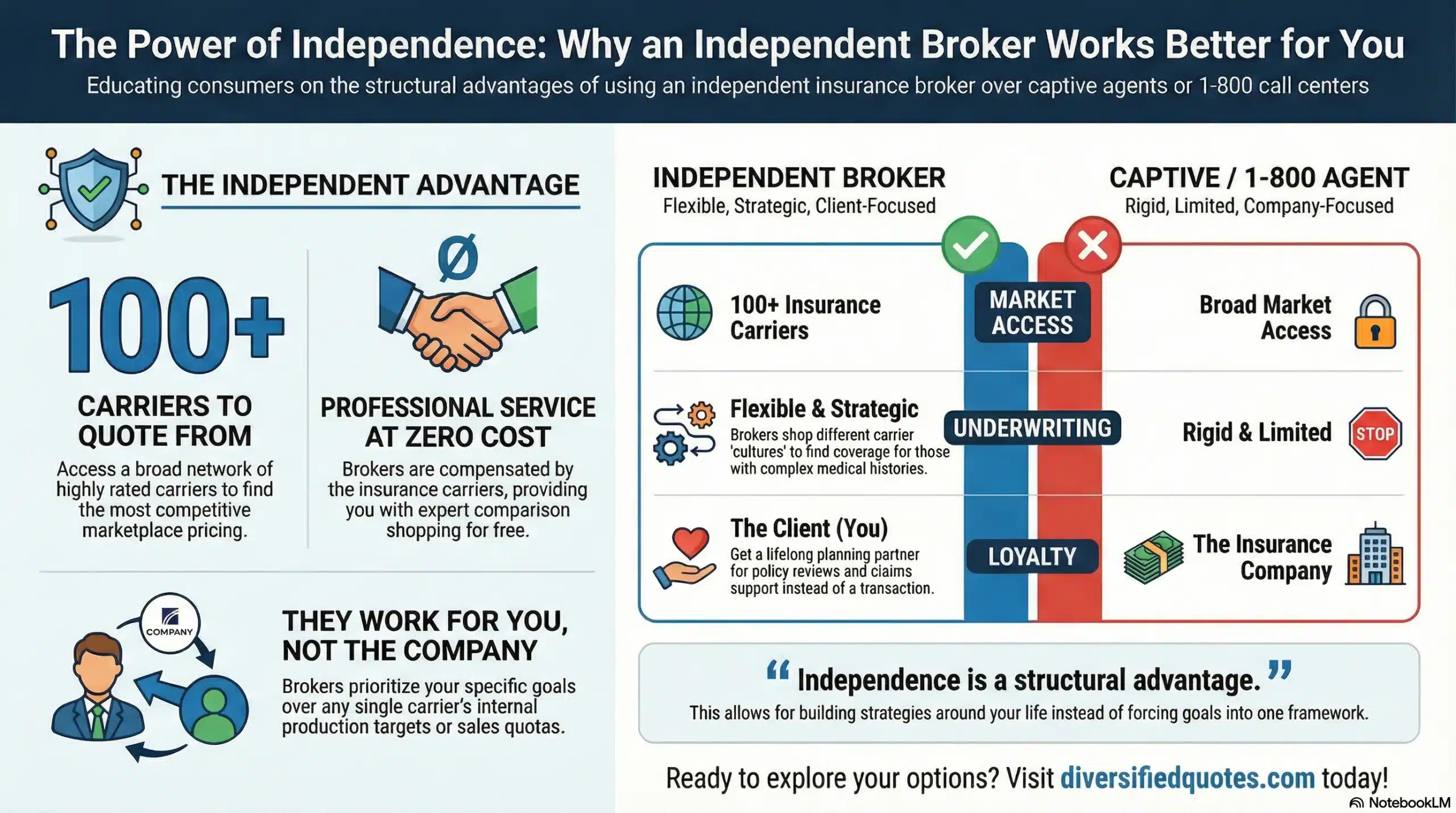
When you work with Diversified Insurance Brokers, you’re not limited to one company or one product lineup. Instead, we shop the market, identify the most competitive options for your situation, and help you understand the trade-offs that matter over the life of the policy. That includes conversion options, underwriting paths, premium stability, and long-term policy flexibility. The result is a better experience upfront and fewer surprises later.
If you’re ready to explore coverage, you can learn more about our process here: Life Insurance Services. If you want to request a quote review, you can also use the form above, and our team will help you compare options side by side.
Get Your Best 30-Year Term Options
We’ll compare carriers, confirm underwriting approach, and help you lock in long-term coverage that matches your family’s timeline.
Request My 30-Year Quote Review
Prefer to talk? Call 800-533-5969
Related Pages
If you’re building a complete life insurance strategy or you want to understand underwriting and policy structure more deeply, these related resources may help:
Financial Protection Essentials
Retirement income options, critical illness protection, group long-term care strategies, and specialized life insurance planning.
Compare Term Life Insurance Lengths
Explore different term periods to find coverage that best matches your timeline and budget.
Talk With an Advisor Today
Choose how you’d like to connect—call or message us, then book a time that works for you.
Schedule here:
calendly.com/jason-dibcompanies/diversified-quotes
Licensed in all 50 states • Fiduciary, family-owned since 1980
FAQs: 30-Year Term Life Insurance
Who is a 30-year term policy best for?
A 30-year term fits buyers who want long-run protection—such as new homeowners or growing families. Comparing financially strong carriers, like reviewing whether Prudential is a good insurance company, can help ensure long-term reliability.
How much coverage should I choose for 30 years?
Most families calculate income replacement plus debts and future goals. Some align long-term planning with strategies such as using an irrevocable life insurance trust (ILIT) when estate protection is part of the objective.
Can I convert a 30-year term to permanent insurance later?
Most carriers offer a defined conversion window that allows you to switch to permanent coverage without a new medical exam. Evaluating options like indexed universal life insurance can help determine which permanent structure may fit long-term goals.
What happens if I outlive the 30-year term?
The level term ends. Some policies allow annual renewal at higher rates. Retirement coordination—such as reviewing required minimum distribution (RMD) rules—can help determine whether permanent coverage is needed beyond the term.
Is 30-year term much more expensive than shorter terms?
It typically costs more than 20- or 25-year terms because coverage lasts longer. Reviewing comparative pricing resources like term vs whole life insurance comparisons can help clarify value differences.
Are no-exam 30-year term options available?
Often yes. Many carriers use accelerated underwriting. Applicants managing certain conditions may find it helpful to review topics like life insurance for diabetes to understand underwriting flexibility.
Which riders should I consider with a 30-year term?
Common riders include accelerated death benefit, waiver of premium, and child coverage. Business owners sometimes coordinate protection alongside tools such as business overhead expense insurance for comprehensive risk management.
Do I need a medical exam for a 30-year policy?
Not always. Some applicants qualify for no-exam underwriting, while others may receive better pricing through traditional underwriting. Evaluating carriers such as Banner Life can help identify underwriting strengths.
About the Author:
Jason Stolz, CLTC, CRPC and Chief Underwriter at Diversified Insurance Brokers (NPN 20471358), is a senior insurance and retirement professional with more than two decades of real-world experience helping individuals, families, and business owners protect their income, assets, and long-term financial stability. As a long-time partner of the nationally licensed independent agency Diversified Insurance Brokers, Jason provides trusted guidance across multiple specialties—including fixed and indexed annuities, long-term care planning, personal and business disability insurance, life insurance solutions, and short-term health coverage. Diversified Insurance Brokers maintains active contracts with over 100 highly rated insurance carriers, ensuring clients have access to a broad and competitive marketplace.
His practical, education-first approach has earned recognition in publications such as VoyageATL, highlighting his commitment to financial clarity and client-focused planning. Drawing on deep product knowledge and years of hands-on field experience, Jason helps clients evaluate carriers, compare strategies, and build retirement and protection plans that are both secure and cost-efficient. Visitors who want to explore current annuity rates and compare options across multiple insurers can also use this annuity quote and comparison tool.
