
Best Annuity for a 65-Year-Old in Georgia
As an Independent Annuity Broker, we compare rates across 100+ carriers and 1,000 different annuities— not just one company’s product offerings — to find the best fit for your goals.
Best Annuity for a 65-Year-Old in Georgia

Jason Stolz CLTC, CRPC, DIA, CAA
Turning 65 is a major milestone. For many Georgia retirees, it’s also the exact moment the “retirement math” becomes real: Social Security starts (or is about to), Medicare begins, paychecks slow down, and the question shifts from “How do I grow my money?” to “How do I turn savings into reliable income without taking unnecessary risk?” That’s why so many people search for the best annuity for a 65-year-old in Georgia — not because they want a complicated product, but because they want a plan that’s easier to live with. Here’s the truth: there isn’t one single “best” annuity for every 65-year-old. The best annuity is the one that matches your timeline, risk tolerance, liquidity needs, and income goals — while avoiding the most common mistakes. At Diversified Insurance Brokers, we help retirees compare options across a broad market of top-rated carriers so the annuity you choose fits your real life. To make this page useful, we’ll focus on what typically matters most at age 65 in Georgia: building reliable income, protecting principal, keeping smart access to funds for the “life stuff” that happens in your late 60s and 70s, and keeping taxes and required withdrawals from dictating your decisions. For the dedicated resource specifically designed around guaranteed income at age 65 — including what income amounts are realistically available from different annuity structures at this exact age — our resource on guaranteed income at age 65 covers that directly.
Compare the Best Annuity Options for a 65-Year-Old in Georgia
Current Fixed Annuity Rates
Compare today’s best fixed annuity rates from top carriers available in Georgia.
Current Bonus Annuity Rates
See which annuities offer the highest upfront bonus for 65-year-olds today.
Request a Georgia Annuity Comparison
We’ll match your goals to the right annuity type and compare real carrier illustrations for age 65 in Georgia.
Lifetime Income Calculator — See What Your Money Could Generate
Use the calculator to see how much guaranteed monthly income different annuity structures can provide starting at age 65. Inputs you control: deposit amount, income start date, single or joint life. Use it as a planning starting point, then request a carrier comparison for the specific numbers in Georgia.
Annuity Options for a 65-Year-Old in Georgia — Path Comparison
Every 65-year-old asking about annuities is really asking one of five questions: Should I start income now? Should I lock in future income with flexibility today? Should I grow safely first and decide later? Should I insure against living a very long time? Or should I combine growth potential with principal protection? The table below maps each of those goals to the annuity structure that addresses it most directly.
General reference only. Specific product terms, payout rates, surrender schedules, and features vary significantly by carrier and product form. Review full contract documents before any purchase decision. Availability of specific products may vary by state.
| Annuity Path | Best For a 65-Year-Old Who… | Income Timing | Liquidity | Primary Risk Addressed | Key Tradeoff |
|---|---|---|---|---|---|
| Single Premium Immediate Annuity (SPIA) | Is already retired, needs income to start right now, and values maximum simplicity — convert a lump sum into an immediate, defined paycheck | Income begins within 1-12 months of purchase; highest per-dollar income payout of all income structures | Very low — premium is irrevocably exchanged for the income stream; no lump-sum access in most designs after annuitization | Longevity risk — income continues for life regardless of how long the annuitant survives; cannot outlive the benefit | Surrenders flexibility entirely for the highest guaranteed income per dollar; less appropriate if significant reserves may be needed |
| Fixed Indexed Annuity with GLWB Income Rider | Wants guaranteed lifetime income but prefers to keep an account value; comfortable deferring income 1-5 years to increase the payout rate; values control and optionality | Flexible — income can begin immediately or be deferred; income base typically grows at a guaranteed roll-up rate (6-8%) during the deferral period | Moderate — typically 10% free withdrawal annually; income withdrawals within GLWB rules don’t trigger surrender; account value remains accessible subject to surrender schedule | Sequence-of-returns risk and longevity risk simultaneously — principal protected from market losses and income cannot be outlived | Income rider fee (typically 0.75-1.5% annually) reduces accumulation value; most valuable when income is actually activated |
| Multi-Year Guaranteed Annuity (MYGA) | Doesn’t need income immediately; wants a safe, guaranteed-rate alternative to CDs or bonds; prefers complete certainty about the credited rate for a defined term | Primarily accumulation — income is through systematic withdrawals at maturity or rollover to an income annuity when ready | Moderate — typically 10% free withdrawal annually during term; no penalty after the surrender period ends; shorter terms (3-5 years) provide faster access | Reinvestment risk and market volatility — the declared rate is locked for the full term; no market-related loss possible | Does not automatically provide lifetime income — requires a subsequent decision at maturity; inflation exposure over longer terms |
| Fixed Indexed Annuity (Accumulation Focus, No Income Rider) | Wants more growth potential than a MYGA while maintaining principal protection; not ready for income; prefers index-linked credits with no downside years | Accumulation phase — income through systematic withdrawals or future conversion; no guaranteed lifetime income without a rider | Moderate — same free withdrawal provision as MYGA; 7-10 year surrender schedules common for FIA accumulation products | Sequence-of-returns risk — zero floor means no negative credits in down market years; previously credited gains are locked in annually | Participation rates and caps limit upside; not appropriate if income is the immediate goal; no lifetime income guarantee without adding a rider |
| Deferred Income Annuity / Longevity Annuity (DIA) | Is concerned specifically about outliving money in advanced old age; wants to “insure” against needing income at 80, 85, or 90 without dedicating a large sum today | Income begins at a chosen future date (often 10-20 years out); very high income per dollar due to long deferral; best used as longevity insurance alongside other income sources | Very low — premium committed to future income; limited or no access during the deferral period in most designs; death benefits vary by design | Advanced longevity risk specifically — protecting against the financial consequences of living to age 85-100 when other savings may be exhausted | No income during the deferral period; premium is committed; most appropriate as a smaller allocation within a broader income plan rather than the primary strategy |
What “Best” Usually Means at Age 65
At 65, you’re often balancing two competing needs: you want better income certainty, and you still want flexibility. The “best annuity” for a 65-year-old is usually the one that creates dependable cash flow while keeping enough liquidity for emergencies, home repairs, travel, healthcare surprises, and helping family. Most retirees aren’t trying to maximize a number on paper — they’re trying to reduce stress and make retirement feel stable. That’s why the evaluation at 65 is less about chasing the highest hypothetical return and more about fitting the annuity into a retirement income system. If you already have Social Security and perhaps a pension, an annuity may be used to fill the “income gap.” If you don’t have a pension, an annuity may be the closest thing to creating a personal pension — an income stream you can budget around. Our resource on pension alternatives covers exactly this use case: how annuities replicate the predictable monthly income function that defined-benefit pensions provided for the previous generation. For the specific coordination of Social Security timing with annuity income strategy — which determines whether the annuity bridges a gap, supplements a delayed claim, or complements an active benefit — our resource on how Social Security and annuities work together covers the sequencing strategies that most practitioners recommend at this age.
Three Core Annuity Paths for 65-Year-Olds
Most 65-year-olds in Georgia end up choosing one of three broad annuity paths. Each path can be “best” in the right situation, and each can be a mistake in the wrong situation. The goal is to choose the path that matches how you’ll actually use the money in retirement. The first path is immediate income now — the SPIA-style approach where you exchange a lump sum for a guaranteed income stream that starts right away. This is a strong fit if you are already retired, you want the annuity to replace a paycheck immediately, and you value simplicity. The tradeoff is that once you annuitize, the money is generally less flexible. The second path is income soon but not immediately, using an income rider strategy. The reason many retirees prefer this approach is control: you can usually keep an account value, have withdrawal provisions, and still build a guaranteed income base that can be turned on when you choose. For someone age 65, even deferring income for 1-5 years can sometimes increase the lifetime payout rate meaningfully. The third path is safe growth and flexibility first, using a MYGA or conservative FIA. Some 65-year-olds aren’t ready to turn on lifetime income yet. In those situations, a fixed-rate annuity (often a MYGA) can be used like a “principal-protected bond alternative.” For the specific details of how MYGA structures work — including how the declared rate is set and what the renewal process looks like at the end of the guarantee period — our resource on what is a MYGA covers those mechanics. For the shorter-term FIA structure specifically designed for 2-5 year accumulation windows before income conversion — which is increasingly popular for 65-year-olds who want flexibility before committing — our resource on short-term fixed indexed annuity options covers that structure directly.
Georgia-Specific Considerations for 65-Year-Old Retirees
Georgia retirees benefit from a specific regulatory environment that affects annuity purchasing. The Georgia Office of Insurance and Safety Fire Commissioner licenses all insurance carriers operating in Georgia and enforces the Georgia Insurance Code, which includes suitability and best-interest standards for annuity sales. All licensed Georgia annuity carriers participate in the Georgia Life and Health Insurance Guaranty Association, which provides coverage for annuity policy values up to statutory limits if a licensed carrier becomes insolvent. Georgia is also one of the states where Social Security benefits are not subject to state income tax, which affects how income planning strategies — including annuity income — interact with the overall Georgia tax picture. For Georgia retirees age 65, there is a significant state income tax exclusion for retirement income (though the specifics can change with Georgia tax law, and a CPA should confirm current rules). Understanding how annuity distributions interact with Georgia’s retirement income tax treatment is a meaningful planning dimension that distinguishes Georgia-specific annuity planning from the generic national framework. For the resource on how annuity income is taxed federally — covering the exclusion ratio, ordinary income treatment of gains, and qualified vs. non-qualified annuity differences — our resource on whether best annuity rates across carriers is a useful starting point for comparing what’s available in the current rate environment before narrowing down product type.
Why Product Type Matters More Than Product Name
Many shoppers start by asking for “the best annuity product.” But annuities don’t behave like a single category. The product type determines how risk is managed, how income is calculated, how liquidity works, how fees may apply, and what the contract is really optimizing for. At age 65, that difference is huge because small changes in income design, surrender schedules, and rider mechanics can materially affect your retirement budget. For example, two fixed indexed annuities can look similar on the surface, but one might be designed for accumulation (higher potential account value growth, more flexible access features) while the other is designed for income (stronger guaranteed income base roll-ups, different payout factors, different rider structures). The “best” one depends on whether you care more about building a bigger account value or creating a bigger future paycheck. The mechanics of how a guaranteed lifetime withdrawal benefit rider grows the income base — and how that growth rate translates into monthly income at different activation ages — are covered in our resource on guaranteed lifetime withdrawal benefits explained. For the most common misconceptions that lead 65-year-olds to make poor annuity decisions — including myths about fees, surrender charges, and what happens to money at death — our resource on what most people get wrong about annuities addresses those directly.
Sequence-of-Returns Risk at 65 — Why It Matters for Annuity Decisions
One of the most compelling reasons a 65-year-old considers an annuity is protection against sequence-of-returns risk — the danger that a major market downturn in the early years of retirement permanently damages portfolio sustainability in a way that the same downturn occurring later would not. At 65, many retirees are moving from accumulation to distribution. If a 30% market loss occurs in year one of a portfolio-based withdrawal strategy, the combination of losses and ongoing withdrawals creates a depletion trajectory that may never fully recover. An annuity income floor that covers essential expenses breaks this dynamic: when guaranteed income covers basic living costs, the retiree is not forced to sell stocks at depressed values to fund monthly expenses during a market correction. Our dedicated resource on sequence-of-returns risk covers both the mathematics and the planning strategies for addressing it — with annuity income as the primary solution for most retirees who want to eliminate the vulnerability entirely for a defined portion of their budget.
How to Compare Annuities at 65 Without Getting Lost
Most retirees don’t want a finance lecture — they want clarity. A clean way to compare annuities at 65 is to use a short checklist that forces the important questions to the surface. When we compare options for Georgia clients, we typically focus on five practical areas that directly affect retirement outcomes. First, what problem are we solving? Are we solving for immediate income, future income, safe growth, or a combination? If the goal is lifetime income, then the “best” annuity is the one that creates the strongest income system for your timeline — not the one with the most attractive marketing pitch. Second, how much liquidity do you need? At age 65, locking up too much can create stress. Many retirees build a “two-bucket” approach: keep a liquid reserve outside the annuity for short-term needs, then place a portion into an annuity for stability and income. Understanding free withdrawal provisions matters here — see annuity free withdrawal rules for how these work in plain English. Third, how is income actually calculated? If income is the goal, you want to know whether income is based on account value or a separate income base, whether payouts change based on deferral time, and how joint income works for spouses. Understanding spread-rate mechanics when comparing indexed strategies is covered in our resource on what an annuity spread rate is. Fourth, what happens when you die? Review annuity beneficiary death benefits so you understand what is typical and what is optional. Fifth, how does this fit with your other accounts? For many 65-year-olds, annuity decisions involve rollover dollars from IRAs or 401(k)s. If you’re coordinating a rollover strategy, start with the broader framework here: what should I do with my 401(k) after I retire.
What a “Best Annuity” Often Looks Like in Georgia at 65
While every case is different, there are a few patterns we commonly see for 65-year-olds in Georgia who want stability and clearer income planning. Pattern A is the income floor first approach: a retiree wants to make sure baseline expenses are covered no matter what the market does. The “best” annuity here is often the one that creates a dependable lifetime paycheck sized to cover the gap between essential expenses and Social Security. This may be done with immediate income or with an income rider strategy that begins in the near term. For the complete resource on structuring annuity income as a monthly paycheck in retirement — including how to size the benefit to household budget needs — our resource on annuities for monthly retirement income covers those practical sizing decisions. Pattern B is principal protection while keeping options open: a retiree is cautious, wants to reduce market exposure, but isn’t sure when they want to start guaranteed income. In this case, the “best” annuity is often a fixed-rate strategy designed for stable accumulation with the option to reposition later. Pattern C is a blend of growth and income in a single plan: some retirees want a plan that can grow without market losses and still provide an income option later. This is where fixed indexed annuities with income riders show up most commonly — especially when the client values downside protection and wants a path to stronger payouts later. For the complete resource on how to use an annuity strategically within a retirement income plan — including how different annuity types coordinate with Social Security, RMDs, and other income sources — our resource on how to use an annuity in retirement covers that framework in full. For the coordination strategy specifically involving annuity payments alongside life insurance premium obligations — a financial integration approach that some retirees use to maintain protection while funding it from guaranteed annuity income — our resource on whether annuity payments can fund life insurance premiums covers that approach.
Common Mistakes 65-Year-Olds Make When Buying an Annuity
If you want the best annuity outcome, it helps to avoid the mistakes that quietly sabotage results. These are real-world issues that create buyer’s remorse later. Buying based on a single number is the most common: annuity decisions shouldn’t hinge on one metric (a bonus, a cap, a payout factor). The best annuity is the one with the best overall fit. Locking up too much is the second: at 65, flexibility matters. A strong plan usually keeps a meaningful liquid reserve outside the annuity. Misunderstanding what’s guaranteed is the third: some elements are contractually guaranteed, others can renew. The best purchase happens when you clearly understand which parts can change, which cannot, and what you would do if a renewal term becomes less attractive later. Ignoring beneficiary design and death benefits: even if income is your primary goal, it’s smart to understand what happens to remaining value and how your choices affect beneficiaries. Not coordinating with taxes and retirement accounts: rollovers, RMD timing, Social Security taxation, and Medicare premium brackets can all interact with income planning. If you’re weighing whether annuities make sense at all in your specific situation, our resource on whether annuities are worth it frames when they tend to help and when they don’t.
Compare “Income Now” vs. “Income Later” Options for Georgia Retirees at 65
A 65-year-old can often improve lifetime income by choosing the right annuity type and timing — without taking market risk. Request a personalized Georgia carrier comparison.
View Fixed MYGA Rates
See today’s strongest guaranteed yield options available for Georgia retirees.
View Bonus FIA Rates
Compare top-rated bonus FIA options and income rider structures for age 65.
Request a Personalized Comparison
Get a customized annuity comparison for a 65-year-old in Georgia based on your income and liquidity goals.
Annuity Education, Retirement Income, and Rollover Planning
Use these guides to compare annuity strategy value, retirement income positioning, and rollover decision frameworks.
Financial Protection Essentials
Core strategies to protect retirement income, prepare for healthcare costs, and build long-term financial stability.
Talk With an Advisor Today
Choose how you’d like to connect—call or message us, then book a time that works for you.
Schedule here:
calendly.com/jason-dibcompanies/diversified-quotes
Licensed in all 50 states • Fiduciary, family-owned since 1980
FAQs: Best Annuity for a 65-Year-Old in Georgia
What is the best annuity for a 65-year-old in Georgia?
The best annuity depends on your goal: immediate income, income starting in a year or two, safe growth with flexibility, or a blend of growth and lifetime income. For most 65-year-olds in Georgia, the right fit is determined by three practical questions: Do I need income now or can I wait? How much of my assets can I commit to a defined structure? Do I want a guaranteed lifetime paycheck or flexibility to adjust my approach later? The most common structures at age 65 are fixed indexed annuities with income riders (for guaranteed lifetime income with some account access), multi-year guaranteed annuities (for safe accumulation before deciding on income), and single premium immediate annuities (for maximum immediate income from a lump sum). The “best” is the one that addresses your specific retirement problem with the structure that will actually serve you throughout your 70s and 80s.
Should I choose income that starts now or defer income?
If you need income to cover expenses now — because Social Security alone doesn’t cover monthly costs or you are fully retired — an “income now” approach can make sense. A single premium immediate annuity or a FIA with an income rider activated immediately addresses that need. If you can wait even 1-5 years, many income designs can increase lifetime payout potential meaningfully. For a 65-year-old, deferring income start to age 68 or 70 — while covering expenses from savings or part-time work — often results in a meaningfully higher monthly benefit for the rest of your life. The best approach is the one that matches your spending plan and comfort level with the deferral period, not the one that looks best in abstract.
How much of my retirement savings should go into an annuity?
There isn’t a universal percentage that works for everyone. Many retirees at 65 use annuities to build an “income floor” while keeping a liquid reserve and other investments for flexibility and long-term growth. A common approach is to size the annuity to cover the gap between guaranteed income (Social Security, pension) and essential monthly expenses — then keep remaining assets in investments for discretionary spending, healthcare reserves, and long-term growth. If your essential expenses exceed your guaranteed income by $1,500 per month, sizing an annuity to cover that gap is a clearer framework than picking a percentage of assets. The right amount depends on expenses, Social Security timing, risk tolerance, and the size of your emergency fund.
Do fixed indexed annuity rates change?
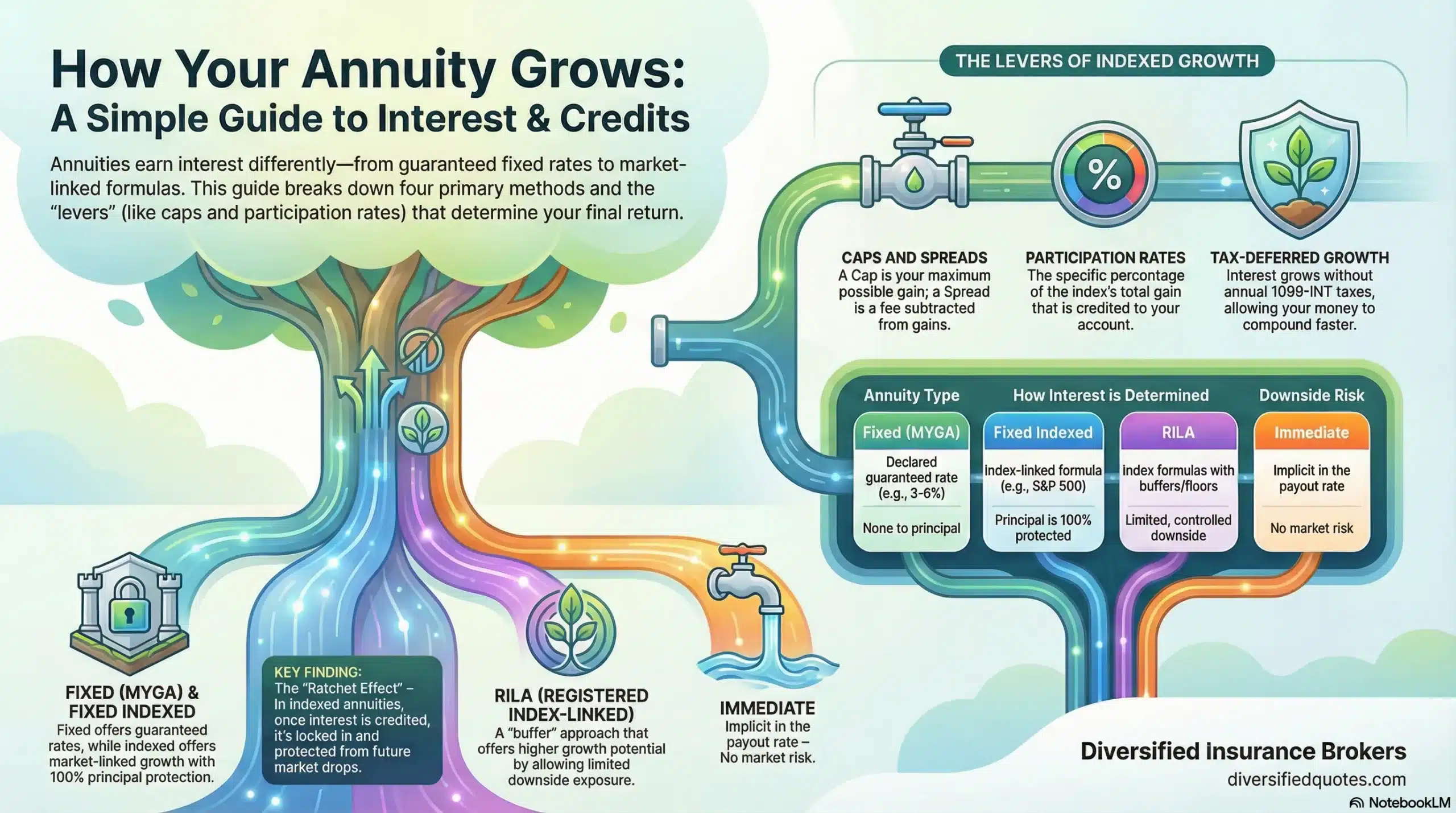
Some renewal terms in fixed indexed annuities can change over time within the contract rules — including caps (the maximum credited rate in a given period), participation rates (the percentage of index gain credited), and spreads. These elements are not permanent guarantees beyond the initial declaration period. However, “terms can change” does not automatically mean “the annuity is unpredictable.” What matters is understanding which elements are contractually guaranteed (the zero floor, the income base roll-up rate in a rider, the minimum guaranteed crediting rate) and which elements can renew within stated minimums. Some products are structured so that key terms are guaranteed not to change during the surrender charge period. At age 65, if you value consistency and predictability, that design distinction can be more important than chasing the highest headline rates.
Are annuity payouts guaranteed?
Income payouts from annuities with lifetime income provisions are contractually guaranteed by the issuing insurance company — not by the government or FDIC. For a guaranteed lifetime withdrawal benefit (GLWB) rider, the income amount is guaranteed to continue for life even if the account value depletes to zero. For a single premium immediate annuity, the payment stream is contractually defined from day one. Guarantees are backed by the claims-paying ability and financial strength of the issuing insurance company, which is why comparing carriers using AM Best financial strength ratings is a critical step in selecting the best annuity. State guaranty associations provide a backstop up to statutory limits in the unlikely event of insurer insolvency.
What happens if I need money after I buy an annuity?
Most fixed and indexed annuities include some form of annual free-withdrawal provision — typically 10% of the account value per year — that can be accessed without triggering surrender charges. Some annuities also include additional waiver features that allow larger withdrawals or surrender-charge waivers in qualifying circumstances such as terminal illness, nursing home confinement, or death. The key is to match the annuity’s liquidity structure to your realistic cash flow needs before purchasing. Keeping a separate liquid emergency reserve outside the annuity — three to six months of living expenses at minimum — is the most effective way to avoid needing to access annuity funds during the surrender period.
Can I use IRA or 401(k) money to buy an annuity?
Yes. Many retirees use qualified retirement funds in annuities through a direct rollover process to preserve tax deferral. Withdrawals from annuities funded with pre-tax qualified money (traditional IRAs, 401(k)s, 403(b)s) are typically taxed as ordinary income based on the rules for qualified accounts. Required minimum distributions continue to apply based on your age and IRA balance. For non-qualified money (after-tax savings outside of retirement accounts), annuity income is taxed using an exclusion ratio that separates the taxable gain from the return of principal. Coordinating which dollars go into which annuity structure — qualified versus non-qualified — has meaningful tax implications that should be evaluated with a tax advisor alongside the annuity purchase decision.
How does adding a spouse affect income planning?
Joint lifetime income extends the income guarantee to the surviving spouse — meaning payments continue for as long as either spouse is alive, regardless of which one dies first. For married couples at 65, joint income options are one of the most important planning decisions in any income annuity structure. The tradeoff is that joint income payout rates are lower than single-life rates (because the carrier is insuring two lifetimes instead of one). The “right” choice between single-life and joint-life structures depends on the age gap between spouses, each spouse’s health, the presence of other income sources that would survive the first death, and the relative priority of maximizing lifetime income versus survivor protection.
What should I compare when reviewing annuity illustrations?
When comparing annuity illustrations for a 65-year-old in Georgia, focus on these specific elements: the income start age and the payout rate at that age; the surrender schedule length and free withdrawal provision; whether income is calculated from the account value or a separate income base; the guaranteed roll-up rate on the income base and what it produces at different start ages; what happens at death — how much passes to beneficiaries and under what conditions; and the income rider fee if applicable. The “best annuity” decision almost always comes from comparing the full structure across two to three options side by side — not from comparing a single headline rate in isolation.
Is an annuity better than leaving money invested at 65?
Annuities and investments serve different functions in a retirement portfolio, and most financial planners recommend both rather than choosing one exclusively. Investments offer long-term growth potential with market volatility; annuities offer income certainty and principal protection with limited upside. At 65, the sequence-of-returns risk — the danger that an early market downturn permanently damages portfolio sustainability — is at its highest. An annuity income floor that covers essential expenses breaks that vulnerability by ensuring core monthly costs don’t depend on market performance. The portion of your portfolio that can tolerate volatility and doesn’t need to be accessed for 10+ years is better positioned in investments. The portion that needs to produce reliable, predictable income is the natural fit for an annuity.
How does sequence-of-returns risk affect a 65-year-old’s annuity decision?
Sequence-of-returns risk is the single most compelling reason a 65-year-old considers an annuity as part of their retirement income plan. The mathematics are stark: if a portfolio loses 30% in year one of retirement while the retiree is taking 4-5% withdrawals, the compounding depletion can exhaust the portfolio 10-15 years earlier than the same loss occurring in year fifteen. An annuity income floor that covers essential expenses eliminates the need to sell stocks at depressed values during market corrections — allowing growth assets to recover while the annuity provides stability. Even a relatively modest annuity income floor of $1,500-$2,000 per month can change the mathematical sustainability of a retirement portfolio by reducing the withdrawal burden on invested assets during down markets.
What makes Georgia a favorable state for annuity planning?
Georgia has several features that make it a favorable environment for retirement income planning with annuities. The state does not tax Social Security benefits, reducing the overall income tax burden on Georgia retirees. Georgia provides a retirement income exclusion for residents age 62 and older (confirm current amounts with a Georgia CPA as the rules can change), which may partially offset the ordinary income tax on annuity distributions depending on the structure and amounts involved. The Georgia Office of Insurance and Safety Fire Commissioner actively regulates insurance carriers and enforces suitability standards for annuity sales, providing consumer protection. The Georgia Life and Health Insurance Guaranty Association provides the standard state-level backstop for annuity contract values up to applicable limits. The company behind Diversified Insurance Brokers is headquartered in Suwanee, Georgia — meaning Georgia retirees have access to locally knowledgeable advisors with deep familiarity with how Georgia’s regulatory and tax environment intersects with annuity planning.
About the Author:
Jason Stolz, CLTC, CRPC, DIA, CAA and Chief Underwriter at Diversified Insurance Brokers (NPN 20471358), is a senior insurance and retirement professional with more than 25 years of real-world experience helping individuals, families, and business owners protect their income, assets, and long-term financial stability. As a long-time partner of the nationally licensed independent agency Diversified Insurance Brokers, Jason provides trusted guidance across multiple specialties—including fixed and indexed annuities, long-term care planning, personal and business disability insurance, life insurance solutions, Group Health, Travel Medical and Evacuation Insurance, and short-term health coverage. Diversified Insurance Brokers maintains active contracts with over 100 highly rated insurance carriers, ensuring clients have access to a broad and competitive marketplace.
His practical, education-first approach has earned recognition in publications such as VoyageATL, and contributions from his agency featured in Kiplinger and GoBankingRates— highlighting his commitment to financial clarity and client-focused planning. Drawing on deep product knowledge and years of hands-on field experience, Jason helps clients evaluate carriers, compare strategies, and build retirement and protection plans that are both secure and cost-efficient. Visitors who want to explore current annuity rates and compare options across multiple insurers can also use this annuity quote and comparison tool.
Explore More Annuity Options: Browse our complete guide to Annuity Strategies & Retirement Income — covering tax strategies, retirement income planning, lifetime income & annuity comparisons from 100+ carriers.
Last Reviewed: May 31, 2026 |
Reviewed by: Jason Stolz, CLTC, CRPC, DIA, CAA
Chief Underwriter, Diversified Insurance Brokers, Inc. | NPN: 20471358 | Diversified Insurance Brokers, Inc. — Licensed in all 50 states
Fact Checked by: Tonia Pettitt, CMIP©
Medicare Specialist, Diversified Insurance Brokers, Inc. | NPN: 14374308 | Diversified Insurance Brokers, Inc. — Licensed in all 50 states
Did you find this content helpful? Leave us a Google review — it helps others find trustworthy guidance too.
Editorial Standards: Diversified Insurance Brokers maintains rigorous editorial standards to ensure accuracy, clarity, and independence in all content. Learn more about our editorial standards and commitment to transparency.
