
Group Health Insurance for 10 Employees

Jason Stolz CLTC, CRPC
Group health insurance for 10 employees is often the first point where healthcare costs become a true financial planning decision rather than simply a benefit offering. At this size, employers begin to see how healthcare expenses directly influence profit margins, hiring strategy, retention, and long-term business sustainability. Many growing businesses discover that once they reach around 10 employees, healthcare costs move from a secondary concern to one of the top operating expenses.
For many companies, the challenge is not just finding coverage — it is finding coverage that remains affordable as the company grows. Premium increases of a few hundred dollars per employee can quickly compound into thousands of dollars annually. Because revenue growth is rarely perfectly linear in small businesses, sudden renewal increases can create serious budgeting pressure.
At Diversified Insurance Brokers, we work with 10-employee organizations to build group health strategies focused on cost predictability, transparency, and long-term sustainability. Rather than defaulting to whatever plan is easiest to install, we help employers evaluate structures designed to perform well financially over multiple renewal cycles.
Group Health Review for 10 Employees
We review your current plan and show cost-control strategies without sacrificing coverage quality.
Request a Group Health Review—
Why Group Health Costs Often Spike at 10 Employees
At roughly 10 employees, most companies are placed into traditional fully insured small-group health plans. These plans are designed to be simple and easy to administer. The employer pays a fixed monthly premium, and the insurance carrier assumes the claims risk.
The issue is not simplicity — it is pricing methodology. Fully insured premiums are built using conservative assumptions designed to protect carriers against large unpredictable claims across their entire risk pool. This means even if your specific employees are healthy, pricing still reflects worst-case pooled market scenarios.
This is why many employers feel stuck. Costs rise annually, explanations feel vague, and control seems limited. Understanding the structure of group medical insurance pricing models helps explain why renewals behave this way for smaller groups.
—
What Options Exist for Group Health Insurance at 10 Employees
Fully insured coverage is still common at 10 employees, but it is no longer the only viable option. Many carriers now offer alternative funding models designed specifically for small but stable employer groups.
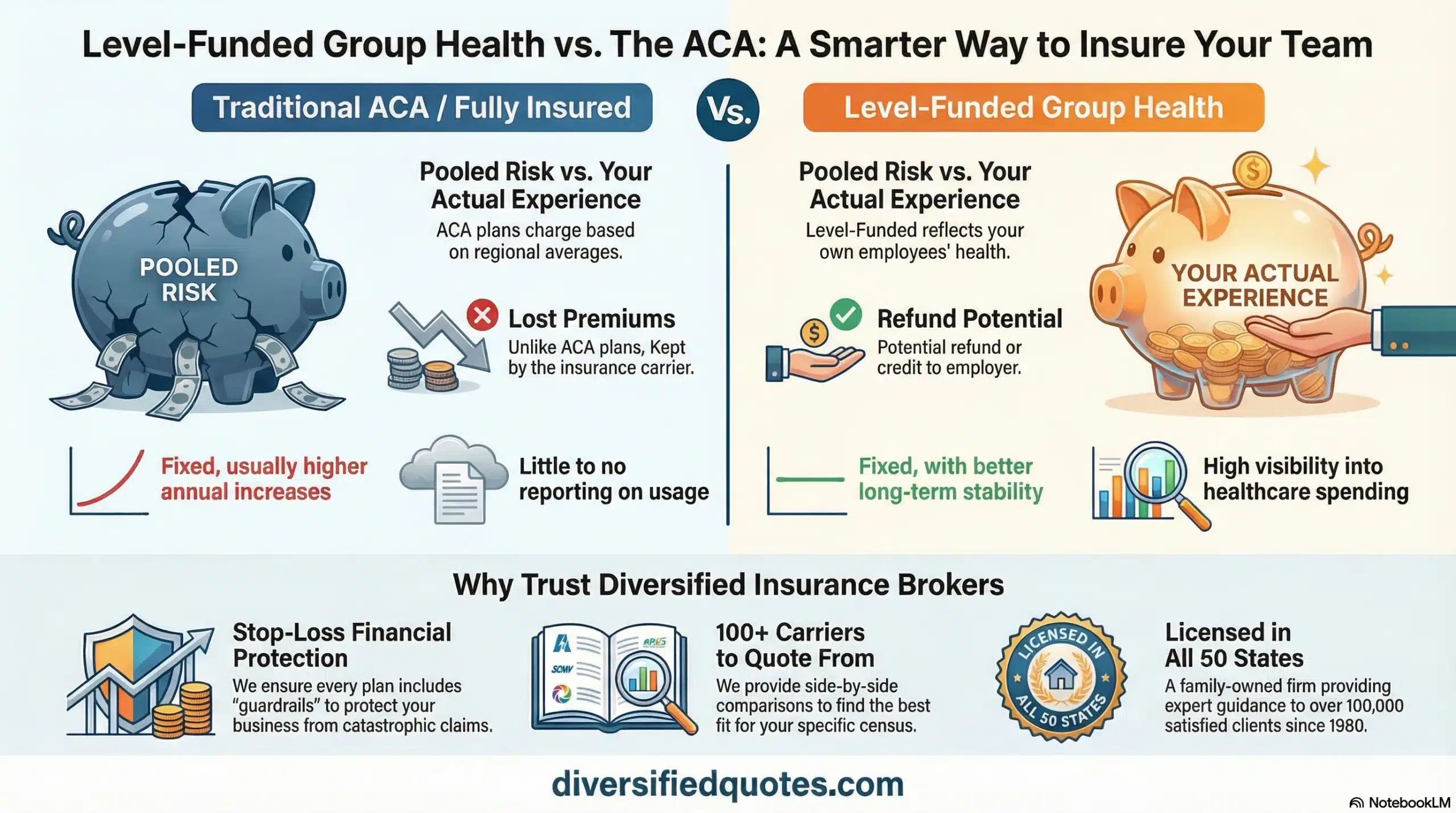
One of the fastest growing alternatives is level-funded group health insurance. This model maintains predictable monthly billing but aligns total cost more closely with actual claims performance.
Eligibility depends on workforce stability, employee demographics, and underwriting guidelines. Many employers begin by reviewing minimum group size requirements for employer health insurance before exploring advanced funding options.
—
How Level-Funded Health Insurance Works for 10 Employees
Level-funded group health is designed to feel familiar to employers used to fully insured coverage. Employers still pay one predictable monthly payment. This payment includes expected claims funding, administrative costs, and stop-loss protection.
From a cash-flow standpoint, this means there are no fluctuating invoices or unpredictable mid-year billing spikes. The difference appears at the end of the plan year. If claims run lower than expected, unused claim funding may be eligible to be returned to the employer depending on contract terms.
Even when refunds are minimal, level-funded plans often create smoother renewals because pricing reflects your group’s experience rather than broad pooled market assumptions.
—
Why Transparency Changes Long-Term Healthcare Costs
One of the biggest frustrations small employers face is lack of visibility into what actually drives healthcare spending. Fully insured plans typically provide limited claims insight, which makes strategic cost control difficult.
Level-funded arrangements typically provide more detailed reporting showing utilization trends, claim category distribution, and cost drivers. This allows employers to make informed plan design adjustments over time.
Employers exploring deeper cost transparency often benefit from understanding self-funded group health plan mechanics, even if they ultimately select a level-funded structure.
—
Reducing Group Health Costs Without Reducing Benefits
For 10-employee businesses, cost reduction rarely requires reducing benefits. Instead, savings often come from better plan architecture. Network selection alone can dramatically influence claim costs. Aligning deductibles and copays with real utilization patterns can eliminate unnecessary spending. Pharmacy benefit structure plays a major role, as prescription spending often represents a large share of total claims.
When plans are structured around how employees actually access care, cost stability improves and employee satisfaction often increases.
—
Lower Group Health Costs at 10 Employees
Compare fully insured and level-funded strategies to find the most efficient structure.
Compare Group Health Options—
Participation and Contribution Strategy at 10 Employees
Participation requirements matter more at smaller employee counts. If several employees waive coverage due to spouse coverage or other insurance, underwriting flexibility can narrow. Employer contribution strategy also influences participation and long-term plan stability.
This is why planning matters early. The goal is selecting a plan that remains sustainable as the business grows.
—
Planning Ahead for Growth Beyond 10 Employees
The health insurance decisions made at 10 employees often influence future cost trends. Employers who introduce transparency and cost accountability early typically experience smoother transitions as they grow to 15, 20, or 30 employees.
Waiting until costs become unmanageable often limits available options. Many business owners treat this stage as the foundation for a long-term healthcare cost strategy.
—
Build a Long-Term Group Health Strategy
See multi-year cost modeling across funding strategies.
Start My Strategy Review—
Related Group Health Planning Pages
Explore additional small business health insurance strategies and employer planning guides.
Pick Your Company Size
Not the right headcount? Use the buttons below to jump to the group health page that matches your workforce.
Group Health Insurance for 10 Employees
Small-team pricing, participation strategy, and easy rollout.
Group Health Insurance for 20 Employees
Plan design choices that improve cost control and retention.
Group Health Insurance for 30 Employees
Reduce renewal spikes and address pharmacy cost drivers.
Group Health Insurance for 40 Employees
Better plan efficiency as your claims credibility improves.
Group Health Insurance for 50 Employees
Cost containment strategies and scalable benefit design.
Group Health Insurance for 60 Employees
Improve predictability and reduce waste without cutting benefits.
Group Health Insurance for 70 Employees
Funding choices that reduce renewal volatility as you grow.
Group Health Insurance for 80 Employees
Plan design and vendor strategy to control cost trends.
Group Health Insurance for 90 Employees
Prepare for 100+ pricing leverage and stabilize renewals.
Group Health Insurance for 100 Employees
A major transition point: funding options expand and plan design matters more.
Group Health Insurance for 150 Employees
More claims credibility means more leverage—optimize funding and reduce overpaying.
Group Health Insurance for 250 Employees
Advanced funding and transparency strategies for stronger cost control.
Group Health Insurance for 500 Employees
Enterprise approach: analytics, vendor oversight, and smarter funding strategy.
Group Health Insurance for 750 Employees
Scaled cost-control with deeper data visibility and targeted interventions.
Group Health Insurance for Over 1,000 Employees
Enterprise governance, advanced funding, and high-impact cost management.
Talk With an Advisor Today
Choose how you’d like to connect—call or message us, then book a time that works for you.
Schedule here:
calendly.com/jason-dibcompanies/diversified-quotes
Licensed in all 50 states • Fiduciary, family-owned since 1980
Can a business with 10 employees qualify for group health insurance?
Yes. Most carriers offer small-group coverage at 10 employees, and many employers may also qualify for level-funded options depending on underwriting.
Is group health insurance expensive with only 10 employees?
It can be, because fully insured plans often bake in conservative pricing for risk. Many 10-employee groups lower costs by comparing funding types, not just carriers.
What is a level-funded plan and can it work for 10 employees?
A level-funded plan uses predictable monthly payments but is structured so unused claims dollars may be returned at year-end. Some 10-employee groups qualify depending on health and industry.
Can we get a refund if claims are low?
Refund potential is usually tied to level-funded or partially self-funded designs. Traditional fully insured plans typically do not return unused premium.
Do we need 100% employee participation?
Not always, but participation rules vary by carrier and state. Having multiple employees on waivers due to other coverage can affect eligibility.
How can a 10-employee company reduce healthcare costs without cutting benefits?
Often by improving plan design, network fit, pharmacy strategy, and funding approach—rather than reducing coverage.
What’s the difference between fully insured and self-funded plans?
Fully insured plans charge fixed premiums and the carrier assumes claims risk. Self-funded designs pay claims as they occur, typically with stop-loss protection to cap exposure.
How long does it take to set up a group plan for 10 employees?
Timing depends on documentation and effective date needs, but many groups can be implemented within a few weeks once enrollment and underwriting requirements are satisfied.
About the Author:
Jason Stolz, CLTC, CRPC and Chief Underwriter at Diversified Insurance Brokers, is a senior insurance and retirement professional with more than two decades of real-world experience helping individuals, families, and business owners protect their income, assets, and long-term financial stability. As a long-time partner of the nationally licensed independent agency Diversified Insurance Brokers, Jason provides trusted guidance across multiple specialties—including fixed and indexed annuities, long-term care planning, personal and business disability insurance, life insurance solutions, and short-term health coverage. Diversified Insurance Brokers maintains active contracts with over 100 highly rated insurance carriers, ensuring clients have access to a broad and competitive marketplace.
His practical, education-first approach has earned recognition in publications such as VoyageATL, highlighting his commitment to financial clarity and client-focused planning. Drawing on deep product knowledge and years of hands-on field experience, Jason helps clients evaluate carriers, compare strategies, and build retirement and protection plans that are both secure and cost-efficient.
