
Why Average Investors Lose Money in Volatile Markets
Concierge Wealth Services
Why Average Investors Lose Money in Volatile Markets
Many investors assume that because markets tend to recover over long horizons, timing decisions do not matter. In reality, the average experience is often far different from the market’s headline return. Emotional reactions, inconsistent rebalancing, withdrawals during drawdowns, and forced selling can quietly erode capital in volatile environments — even when markets eventually move higher. The result is a common pattern: investors participate in a portion of the upside, absorb most of the downside, and then repeat the cycle. This page explains why that cycle happens and how volatility interacts with human behavior, liquidity needs, and decision-making under stress. The focus is not on predicting markets — it is on understanding why the “average outcome” is often driven by actions taken during the worst moments, and why disciplined, rules-based frameworks tend to be more durable than emotional trading.
Request a Confidential Conversation
If you want a clearer framework for staying disciplined during volatility — especially when liquidity needs and emotions are involved — request a qualification review to learn how process-first planning is typically evaluated.
Important: Diversified Insurance Brokers does not provide securities or investment advice. If appropriate, qualified clients may be introduced to an independent SEC-registered investment adviser for evaluation under their regulatory framework.
Volatility Doesn’t Just Move Markets — It Exposes Decision-Making
Volatility is often described as “noise,” but for real people it is more than a statistical concept. Volatility creates uncertainty, and uncertainty creates pressure. When prices fall quickly, investors feel an urgent need to do something. When prices rise quickly, investors feel pressure not to miss out. Volatility is therefore not just a market condition — it is a stress test of an investor’s decision process. The most common reason average investors lose money in volatile markets is not that they chose the “wrong” assets. It is that volatility triggers actions that work against long-term compounding: selling after declines, re-entering after rebounds, abandoning disciplined rebalancing, and overconcentrating into whatever feels safest in the moment. Over time, these decisions create a return gap between the market’s performance and the investor’s actual experience. That return gap is often invisible until it compounds — one poorly timed decision might not seem catastrophic, but the combination of repeated emotional decisions, small timing errors, and inconsistent exposure management can meaningfully reduce long-term outcomes, especially when volatility clusters and fear becomes persistent.
The Behavioral Drivers That Quietly Destroy Results
Most investors recognize that panic selling is harmful. Fewer recognize how many other behaviors create the same damage over time. Overtrading, performance chasing, abandoning a plan during stress, and shifting allocations without a clear framework are all forms of volatility-induced decision errors. In volatile markets, investors often move from “long-term thinking” to “short-term survival thinking” — and that shift is where the damage begins. One of the most common patterns looks like this: an investor holds through an initial decline, then sells after additional declines to “stop the bleeding.” After markets rebound, they re-enter at higher prices because they fear missing the recovery. This pattern transforms temporary drawdowns into realized losses and reduces the investor’s participation in the recovery.
Another frequent issue is overconfidence during calm periods. When volatility is low, investors may take more risk than intended because the environment feels safe. Then when volatility spikes, their exposure is suddenly much higher than they can tolerate — increasing the probability of panic selling. This is a form of “risk drift” — a gradual movement away from the investor’s true tolerance without noticing it. Risk drift is one reason disciplined frameworks emphasize constraints and monitoring rather than relying on feelings. If you want a deeper explanation of how biases operate quietly, this topic is explored directly in Behavioral Biases That Quietly Destroy Wealth. The key insight is that investors rarely sabotage themselves intentionally — they sabotage themselves by making “reasonable” decisions in the moment that become harmful in sequence.
The Missing Ingredient: A Documented Framework
In volatile markets, the best decision is often not “do nothing.” It is “follow the framework.” The difference matters. Doing nothing without a plan can be avoidance. Following a framework is governance. A documented framework defines what will be done in advance: how exposure is set, how rebalancing is handled, what triggers a review, and what actions are permitted during stress. Average investors often lack this framework. They may have general intentions — “I’m a long-term investor” or “I don’t want to panic sell” — but intentions are not decision rules. When volatility rises, the human brain seeks relief, and relief often comes from action. Without a framework, action becomes improvisation. Improvisation is typically expensive in markets because it is driven by emotion rather than constraints.
A process-first lens is one reason institutional approaches emphasize repeatable disciplines rather than narratives. This is closely related to the philosophy in Institutional-Grade Portfolio Construction, where portfolios are structured to behave differently across environments and decisions are guided by policy rather than sentiment. The documented framework approach is also what separates institutional investing from retail investing at the behavioral level — not access to better information, but access to a better decision process that functions under pressure. For context on how the behavioral gaps between average and institutional investors translate into documented return differences across populations, our resource on behavioral biases that quietly destroy wealth covers the specific bias categories and how each one creates repeated, compounding damage.
Get the Framework, Not the Headlines
If volatile markets create uncertainty, the goal is not prediction — it’s constraints. Request a qualification review to learn how disciplined frameworks are typically structured for planning clarity.
Important: Diversified Insurance Brokers does not provide securities or investment advice. If appropriate, qualified clients may be introduced to an independent SEC-registered investment adviser partner.
Liquidity Needs Turn Volatility Into Permanent Loss
Volatility becomes far more damaging when an investor needs cash during a downturn. If liquidity is required and there is no dedicated reserve, the investor may be forced to sell assets at depressed prices — locking in losses and reducing the portfolio’s ability to recover. This is one of the most consistent ways volatility creates underperformance: withdrawals during drawdowns. This is why sophisticated investors treat liquidity as a design feature rather than an afterthought. Liquidity buffers can reduce the probability of selling during weakness and can provide time for markets to normalize. When liquidity is planned in advance — through layered reserves and clear spending policies — volatility becomes easier to endure because the plan does not depend on perfect market timing to fund near-term needs. The withdrawal problem is closely tied to sequence-of-returns risk. In any scenario where distributions occur while markets are down, the order of returns becomes critical: two portfolios with the same “average” return can have dramatically different outcomes depending on when declines occur relative to withdrawals.
Volatility Drag and Path Dependence: The Math Most Investors Ignore
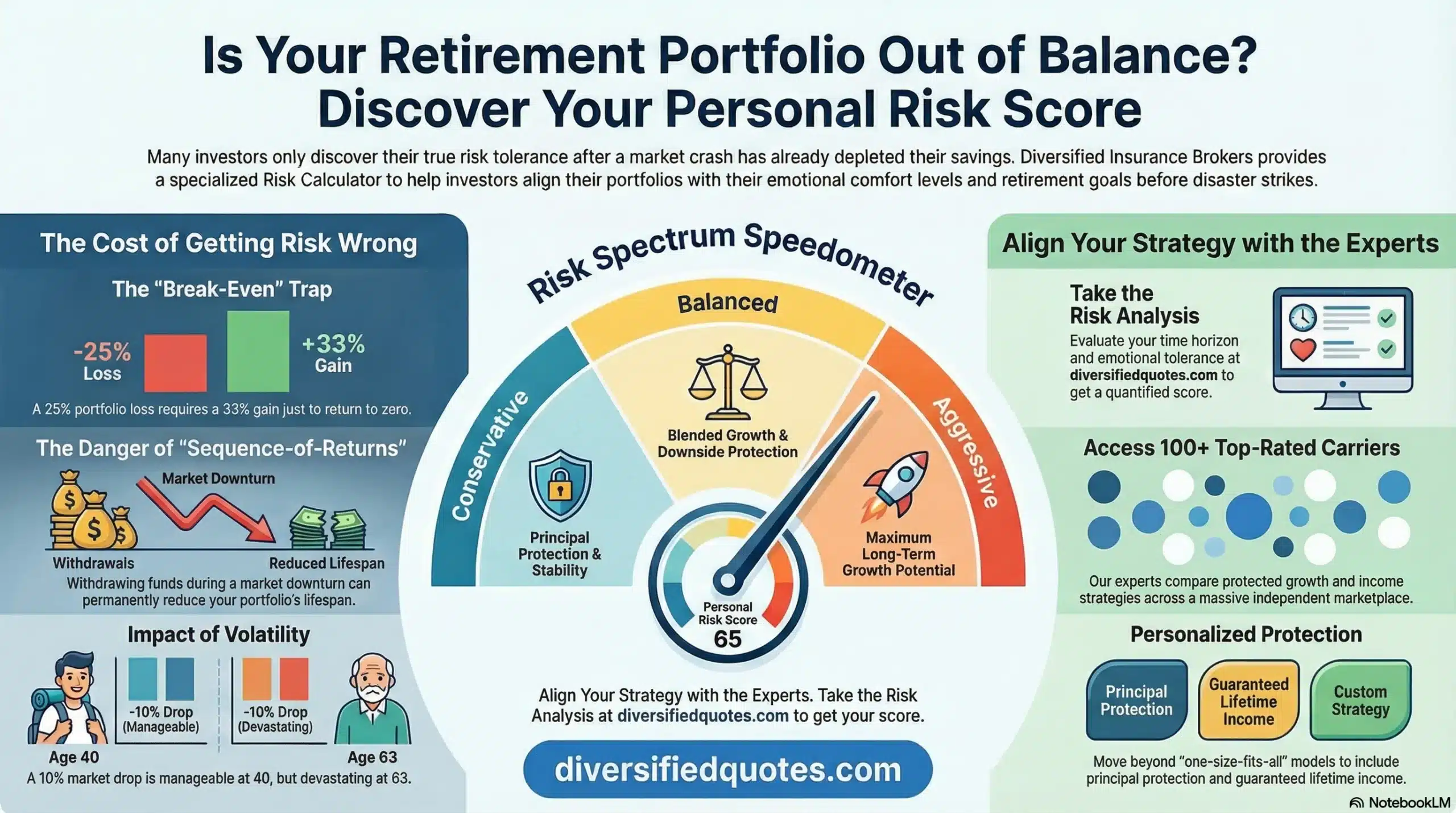
Volatility drag is the compounding penalty that occurs when returns fluctuate. A portfolio that alternates between gains and losses can end up with less growth than a portfolio with the same average return but a smoother path — because losses require larger gains to recover. A 20% decline requires a 25% gain to get back to even. A 30% decline requires about 43%. A 50% decline requires a 100% gain. The deeper the drawdown, the more compounding must work just to recover lost ground. Average investors often underestimate how quickly volatility drag accumulates. They assume that because markets can recover, their portfolio will naturally “come back.” But the path matters. If large losses occur early in a timeline, the portfolio has less capital available to participate in the recovery. If the investor sells during that period, the recovery participation may be reduced even further. This combination is why investors can live through a market cycle and still end up behind where they expected to be.
In planning terms, this is one reason “downside control” is not a luxury — it is a method for protecting compounding. Concepts around downside controls are explored further in Downside Protection Strategies in Bear Markets and the broader “preservation-first” mindset discussed in Why Capital Preservation Is the New Goal for Retirees. For investors specifically evaluating how volatility targeting reduces path dependence risk as a portfolio management discipline, our resource on Quantitative Risk Management covers the mechanisms that constrain exposure and reduce the probability of deep drawdowns that compound into lasting impairment.
Emotional Trading vs. Rules-Based Discipline
Emotional trading typically follows predictable phases. It begins with uncertainty, becomes fear during declines, turns into regret after selling, shifts into hesitation during the early rebound, and then ends with re-entry after prices have already moved higher. This cycle repeats because the investor is seeking emotional relief, not executing a framework. Rules-based frameworks are different. They do not guarantee outcomes, but they can reduce the probability of catastrophic decision errors. Rules-based systems typically define exposure limits, rebalancing rules, and review triggers. When volatility rises, the framework controls what is permitted and what is not — reducing overreaction and improving the likelihood that the investor remains aligned with a long-term plan.
Many institutional systems incorporate quantitative risk controls — constraints that aim to keep risk within a defined range rather than letting exposure drift with emotions. This is closely related to the discipline outlined in Quantitative Risk Management and the broader theme of managing volatility as a measurable variable, not an emotional event. The behavioral advantage of rules-based discipline is not that it eliminates discomfort — it is that it prevents discomfort from overriding a sound long-term plan at exactly the moment when the stakes are highest. For investors who want to understand how this framework applies across different portfolio structures, our resource on how smart investors manage risk without sacrificing growth connects the risk management discipline to the growth objective that makes long-term investing worthwhile in the first place.
Why Volatility Discipline Matters Even More as Wealth Increases
It is easy to assume that “average investor mistakes” only apply to smaller accounts. In reality, larger portfolios can amplify the emotional and strategic stakes. A 10% drawdown on a large portfolio is not just a number — it can influence lifestyle decisions, charitable planning, tax strategy, and long-term legacy considerations. Larger portfolios also tend to have more moving parts: business interests, real estate timing, taxes, and family dynamics. That complexity increases the value of disciplined frameworks. This is one reason affluent investors often focus on governance: documented decision rules, risk constraints, and a process-first lens that reduces the probability of reactive, regime-driven decisions.
Many of these themes are discussed within Beyond Insurance: Exclusive Wealth Strategies and the broader idea of exploring what sophisticated households often do beyond basic stock-and-bond thinking, as introduced in What Do the Wealthy Invest in Beyond the Stock Market?. The institutional-style governance that large family offices and endowments use to manage behavioral risk at scale is increasingly accessible to individual high-net-worth investors through disciplined advisory relationships focused on framework and process rather than narrative and prediction.
Where Concierge Wealth Services Fits
Through Concierge Wealth Services, qualified clients may request introductions to independent fiduciary advisers who implement disciplined, process-driven frameworks rather than speculative tactics. The intent is to help investors move from improvisation to structure: clear constraints, documented processes, and a planning lens that emphasizes durable decision-making. If you are just getting familiar with how the introduction process works and what to expect, begin with An Invitation to Explore More. The most important takeaway is that the goal is not to “beat the market” — it is to build a decision process that can survive volatility without self-sabotage.
Turn Volatility Into a Managed Variable
If you want a disciplined way to stay aligned during stress — especially around liquidity needs and emotional pressure — request a confidential conversation.
Important: Diversified Insurance Brokers does not provide securities or investment advice. If appropriate, qualified clients may be introduced to an independent SEC-registered investment adviser partner.
Related Topics to Explore
Explore adjacent concepts on discipline, volatility control, and institutional-style risk frameworks.
Important Notice: Diversified Insurance Brokers does not provide securities advice, investment advice, or individualized investment recommendations. Content on this page is provided for educational and informational purposes only and is intended to explain common behavioral and risk-management concepts used by sophisticated investors. All wealth management and investment advisory services, if any, are provided exclusively through independent SEC-registered investment adviser partners. Any advisory relationship is governed solely by the adviser’s disclosures, agreements, fees, and regulatory framework. Clients who engage in advisory relationships will be subject to the adviser’s terms and fiduciary responsibilities.
Why Average Investors Lose Money in Volatile Markets — FAQs
Because volatility triggers emotional decisions — selling after declines, chasing rebounds, overtrading, and abandoning rebalancing rules — that individually seem reasonable but collectively create a pattern that systematically reduces participation in recoveries while fully realizing drawdown losses. The mechanism is straightforward: when prices fall, fear intensifies. The emotional pressure to “stop the bleeding” often overwhelms the long-term plan, leading to sales at depressed prices. When prices recover, the fear of missing out pulls investors back in at higher prices. The combination of selling low and buying high — even occasionally — creates a persistent return gap between what the market delivered and what the investor actually captured. This gap compounds invisibly across cycles. Research consistently documents that the average dollar invested in equity funds earns meaningfully less than the funds themselves return over full cycles, precisely because investors flow money in and out at emotionally driven moments rather than systematic ones. The solution is not willpower — it is governance. A documented framework with pre-committed decision rules, rebalancing protocols, and defined review triggers removes the emotional improvisation from the most important moments. For a detailed examination of the specific biases that create these patterns, our resource on behavioral biases that quietly destroy wealth covers each mechanism and its practical consequence.
Volatility drag is the mathematical compounding penalty created by fluctuating returns — specifically, the fact that percentage losses require larger percentage gains to recover. A portfolio that loses 20% requires a 25% gain to return to its starting value. A 30% loss requires approximately a 43% gain. A 50% loss requires a 100% gain. This asymmetry means that a portfolio experiencing high volatility can end up with lower long-term wealth than a portfolio with the same arithmetic average return but a smoother path — because the larger losses consume more compounding capacity than the equivalent-sized gains restore. In practical terms, volatility drag explains why two portfolios with the same 10-year average annual return can end up at very different ending values if one experienced its returns smoothly and the other experienced them with large up-and-down swings. The portfolio with the volatile path spent proportionally more compounding time recovering from losses rather than building on gains. This is one of the foundational reasons institutional investors place significant emphasis on downside control — not because they are trying to “beat the market” by avoiding losses, but because reducing drawdown depth directly protects compounding efficiency regardless of future return. Understanding volatility drag is also essential to understanding why the timing of losses matters so much for investors who are simultaneously making withdrawals, which is the sequence-of-returns problem addressed in our resource on sequence of returns risk.
Withdrawals during market downturns can force the sale of assets at depressed prices, converting what would have been a temporary paper loss into a permanent realized loss — and permanently reducing the number of units or shares available to participate in the subsequent recovery. The mechanism is what makes this so damaging: a portfolio experiencing a 30% drawdown has temporarily lost 30% of its value, but if forced to sell assets at those depressed prices to fund withdrawals, it permanently crystallizes that loss and is now working from a smaller base when prices recover. The practical consequence is that two identical portfolios can diverge significantly in ending value if one is forced to sell during the drawdown and the other is not — even if both ultimately experience the same market recovery. This is why liquidity planning is not a secondary consideration for retirees and anyone making regular distributions from a portfolio — it is a primary design requirement. Having a dedicated liquidity reserve that covers near-term cash needs means market drawdowns do not force asset sales at the worst possible moment. The liquidity layer absorbs the immediate cash need while the portfolio’s invested assets have time to recover. For the full framework on why this matters most in the retirement distribution phase, our resource on sequence of returns risk explains the mechanics in detail and why addressing this through plan design is more reliable than trying to time withdrawals around market conditions.
Sequence-of-returns risk is the risk that the order in which investment returns occur — not just their average — significantly affects wealth outcomes when ongoing withdrawals or contributions are involved. Two portfolios can have the identical average annual return over a 20-year period and arrive at dramatically different ending values if one experienced its poor returns early in the period while withdrawals were occurring, and the other experienced its poor returns later when the portfolio had grown. The early-poor-returns portfolio is forced to sell more shares at depressed prices to fund the same dollar withdrawals, permanently reducing the share count available to participate in subsequent recoveries. The late-poor-returns portfolio has had years of growth and lower withdrawal impact, leaving it in a much more resilient position when the difficult period arrives. Sequence-of-returns risk matters because it is invisible in most standard long-term return illustrations, which typically use average returns without accounting for the order of those returns. A financial plan that looks adequate based on average expected returns may fail not because the average return was wrong but because poor timing of early losses — combined with ongoing withdrawals — permanently impaired the portfolio before recovery could occur. Managing sequence risk requires proactive planning: dedicated liquidity reserves, structured withdrawal policies, and income sources that do not depend on selling market assets at potentially depressed prices to fund near-term needs.
A written framework is helpful because it moves decision-making from the emotional present — where volatility creates urgency, fear, and pressure to act — to the rational past, when the investor had the clarity and distance to design a sound long-term approach. When a framework is documented, decisions during volatile periods are governed by rules that were established under calmer conditions rather than improvised under stress. The framework defines in advance: what exposure levels are appropriate, what triggers a rebalancing event, what constitutes a review rather than a reaction, and what actions are permitted and prohibited during various market conditions. Without a framework, each volatile period becomes a fresh decision problem — and the human brain, under stress, tends to solve those problems with emotional heuristics rather than analytical rigor. The framework removes the need to re-solve the problem from scratch during each episode of market turbulence. It also creates accountability: when decisions are documented in a policy, deviations from that policy require explicit justification, which creates a natural friction against purely emotional decision-making. Institutional investors use investment policy statements (IPS) for exactly this purpose — not because they are bureaucratic, but because the IPS ensures that governance, not emotion, drives decisions when pressure is highest. For individual investors, even a simple written statement of exposure limits, rebalancing triggers, and review cadence can meaningfully reduce the probability of behavior-driven investment errors during volatile periods.
For many frameworks, yes — and for a counterintuitive reason. Rebalancing during periods of market decline systematically forces buying of assets that have fallen in price and selling of assets that have held up better, which is the opposite of the emotional impulse that volatility creates. By mechanically buying what has fallen and selling what has held, a disciplined rebalancing process can improve long-term outcomes by enforcing a form of buy-low/sell-high discipline that most investors fail to execute emotionally. Rebalancing also prevents “risk drift” — the gradual movement of a portfolio’s actual risk level away from its target as different assets appreciate and depreciate at different rates. A portfolio that started with a 60% equity / 40% fixed income allocation can drift to 75%/25% during a strong equity rally, leaving the investor with much more equity risk than they intended just before a period of equity weakness. Rebalancing restores the target allocation and prevents the portfolio from carrying more risk than the investor has actually decided is appropriate. The challenge is that rebalancing during a decline feels wrong — adding to positions that are falling generates immediate discomfort. That is precisely why a documented rebalancing policy, defined in advance and executed systematically, tends to produce better outcomes than rebalancing “when it feels right,” which in practice often means not rebalancing during exactly the periods when rebalancing would be most beneficial.
No. Diversified Insurance Brokers does not provide securities or investment advice, does not make investment recommendations, and does not manage investment portfolios. Content on this page is educational and intended to explain common behavioral and risk-management concepts that sophisticated investors and institutional allocators use to improve decision-making under volatility. It is not financial advice, investment advice, or a solicitation to purchase any security or investment product. If a qualified client expresses interest and there is a potential fit, Diversified Insurance Brokers may facilitate a confidential introduction to an independent SEC-registered investment adviser partner. All investment advisory services, disclosures, recommendations, agreements, fees, and fiduciary responsibilities occur exclusively within that adviser relationship — under the adviser’s regulatory framework and oversight — and not through Diversified Insurance Brokers. Any introductory conversation with Diversified Insurance Brokers is solely to assess general fit and qualifications, not to provide investment guidance.
Sophisticated investors typically use a combination of governance tools that convert emotion-prone decisions into repeatable, rules-based processes — reducing the probability that fear, overconfidence, or urgency drives expensive choices at critical moments. The foundational tool is a documented investment policy statement that defines permissible exposures, rebalancing triggers, liquidity requirements, review cadence, and the process for evaluating exceptions. This policy creates accountability and removes the need to re-solve allocation and risk decisions from scratch during volatile periods. Liquidity layering — maintaining explicit reserves for near-term cash needs separate from longer-duration invested assets — reduces the probability of forced selling during market weakness. Objective risk monitoring systems track portfolio risk exposure and flag when drift from intended targets occurs, creating a systematic trigger for review that does not depend on market timing intuition. Pre-committed drawdown protocols define in advance what will be done if the portfolio experiences specific loss levels — this is more effective than improvising a response after the fact when emotions are running high. Periodic review cadence with explicit agendas ensures decisions are evaluated regularly and on schedule, not only after markets move. For the full framework on how institutional governance structures reduce behavioral risk at scale, our resource on Institutional-Grade Portfolio Construction explains how these disciplines translate to individual and family wealth management contexts.
About the Author:
Jason Stolz, CLTC, CRPC, DIA, CAA and Chief Underwriter at Diversified Insurance Brokers (NPN 20471358), is a senior insurance and retirement professional with more than 25 years of real-world experience helping individuals, families, and business owners protect their income, assets, and long-term financial stability. As a long-time partner of the nationally licensed independent agency Diversified Insurance Brokers, Jason provides trusted guidance across multiple specialties—including fixed and indexed annuities, long-term care planning, personal and business disability insurance, life insurance solutions, Group Health, Travel Medical and Evacuation Insurance, and short-term health coverage. Diversified Insurance Brokers maintains active contracts with over 100 highly rated insurance carriers, ensuring clients have access to a broad and competitive marketplace.
His practical, education-first approach has earned recognition in publications such as VoyageATL, and contributions from his agency featured in Kiplinger and GoBankingRates— highlighting his commitment to financial clarity and client-focused planning. Drawing on deep product knowledge and years of hands-on field experience, Jason helps clients evaluate carriers, compare strategies, and build retirement and protection plans that are both secure and cost-efficient. Visitors who want to explore current annuity rates and compare options across multiple insurers can also use this annuity quote and comparison tool.
Explore More Annuity Options: Browse our complete guide to Annuity Strategies & Retirement Income — covering tax strategies, retirement income planning, lifetime income & annuity comparisons from 100+ carriers.
Last Reviewed: May 12, 2026 |
Reviewed by: Jason Stolz, CLTC, CRPC, DIA, CAA
Chief Underwriter, Diversified Insurance Brokers, Inc. | NPN: 20471358 | Diversified Insurance Brokers, Inc. — Licensed in all 50 states
Fact Checked by: Tonia Pettitt, CMIP©
Medicare Specialist, Diversified Insurance Brokers, Inc. | NPN: 14374308 | Diversified Insurance Brokers, Inc. — Licensed in all 50 states
Did you find this content helpful? Leave us a Google review — it helps others find trustworthy guidance too.
Editorial Standards: Diversified Insurance Brokers maintains rigorous editorial standards to ensure accuracy, clarity, and independence in all content. Learn more about our editorial standards and commitment to transparency.
