
19-Year Term Life Insurance

Jason Stolz CLTC, CRPC
19-Year Term Life Insurance is a less common but highly strategic option for people whose financial obligations don’t line up perfectly with standard term lengths. It offers guaranteed protection for nearly two decades—often matching a remaining mortgage term, an income replacement window, or a family dependency timeline more precisely than a traditional longer-term policy. For many households, the difference between “coverage that fits” and “coverage that’s a little too long” is only a year, and that’s exactly where a 19-year term can make sense.
At Diversified Insurance Brokers, we help clients match coverage duration to real-world planning, not assumptions. That includes evaluating how long your household would truly be financially exposed without your income, what policy features matter if life changes, and whether a custom duration is actually available and competitively priced for your age and underwriting profile.
If you want to see how very long durations are structured and why term length should be tied to a timeline (not a default), you can review can you get a 50-year term life insurance policy for broader context on how carriers think about length, pricing, and planning.
Get a Term Life Insurance Quote
Explore how a 19-year term compares with standard and extended options.
How a 19-Year Term Life Insurance Policy Works
A 19-year term life policy provides a fixed death benefit for a defined 19-year period. In most cases, both the premium and the death benefit are guaranteed level for the entire term. If the insured dies during that window, the policy pays the benefit to the named beneficiaries—commonly income-tax-free in many situations. If the insured outlives the term, the level-premium period ends and the policy either terminates or enters a renewable phase depending on the contract.
Like other term policies, 19-year term life insurance is designed for protection, not accumulation. There is typically no cash value component and no exposure to market performance. You are paying for coverage during the years your household would be most financially vulnerable to a loss of income.
Term insurance works best when it prevents forced decisions. When the death benefit is sized correctly and the term matches the timeline, it can help a family keep the home, protect retirement savings from being drained too early, and maintain stability while adjusting to a major life event.
Why Some Families Choose 19-Year Term Life Insurance
While longer standard term policies are more common, a 19-year term can be a better fit when financial obligations don’t extend cleanly into an additional year. Many mortgages are refinanced midstream, leaving an 18–19 year payoff horizon. Some people have a planned retirement or career transition that falls just short of the next major planning milestone. Others know that a spouse’s income or a growing investment portfolio is likely to reduce the need for insurance before an extra year of coverage would matter.
In these cases, paying for extra coverage beyond the point where it’s realistically needed can feel inefficient. A 19-year term tightens the protection window while still offering long-term premium stability and predictable coverage through the years where risk is highest.
That said, pricing differences between a 19-year term and other nearby options can be modest, depending on the carrier. That’s why side-by-side comparison matters more than assumptions. Sometimes the custom duration is the cleanest fit. Other times the cost difference is small enough that broader flexibility may be worth considering. The key is making the decision intentionally instead of defaulting.
Is 19-Year Term Life Insurance the Right Length for You?
The right term length is the one that matches your longest major obligation. If your mortgage, income replacement need, or family dependency timeline ends in roughly 19 years, this term length may align well. If the need is shorter, a shorter design may be more efficient. If the need extends beyond 19 years—even slightly—choosing a policy that ends too soon can create a coverage gap later, when replacing coverage may be more expensive due to age or health changes.
A practical way to evaluate the timeline is to ask: if you were not here tomorrow, how long would your family need the death benefit to keep the plan intact without rushing into major changes? When you map that answer against real obligations (mortgage schedule, childcare years, education expenses, business commitments, retirement timeline), the ideal term length usually becomes clearer.
Who Should Consider a 19-Year Term Policy?
A 19-year term policy is often considered by homeowners, parents, and professionals who have a very clear financial timeline. It can also appeal to planners who want to avoid “over-insuring” beyond the point where savings, investments, pension income, or other resources are expected to replace the need for life insurance.
It may also be used as part of a layered strategy, where different policies cover different stages of financial risk so coverage declines as obligations shrink. This approach can be cost-effective, but only when it’s organized and intentionally built around the household’s timeline.
If you are also managing other risk exposures—such as disability or business income protection—your life insurance need may change based on what those policies cover. Reviewing related topics like disability income insurance for key person employees can help put life insurance decisions into broader context, especially for business owners and high-income professionals.
Estimate Your Term Life Premiums
Compare quotes for a 19-year term alongside other coverage lengths.
Life Insurance Quoter
19-Year Term Life Insurance Rates and Underwriting
Rates for 19-year term life insurance are driven primarily by underwriting. The insurer evaluates age, health history, tobacco use, build, family history, driving record, and lifestyle factors to determine pricing. Underwriting class often has a bigger impact on cost than the exact term length, which is why getting the carrier match right is so important.
Many applicants qualify for accelerated underwriting, where carriers use data sources instead of a medical exam. In other cases—especially for higher coverage amounts or certain medical profiles—a brief exam and labs may still produce better pricing. A good strategy doesn’t automatically avoid the exam or automatically require it. It chooses the approach most likely to deliver strong pricing and a smooth approval.
If you want a clearer picture of what carriers evaluate, reviewing what a life insurance exam is can make the process far more predictable.
Conversion and Renewability Features
Conversion allows you to exchange your term policy for a permanent policy with the same carrier, typically without new medical underwriting, as long as conversion occurs within the allowed window. This can be valuable if health changes during the term but long-term coverage is still needed. Even if you believe you’ll only need protection for 19 years, conversion can act like a backup plan if life doesn’t unfold exactly as expected.
Renewability applies after the 19-year level period ends. Some policies allow annual renewals at increasing rates. Because renewal premiums often rise sharply, most long-term plans are designed to avoid relying on renewal. The plan is usually to let coverage end because the need is reduced, replace coverage if the need remains, or convert if long-term protection becomes important.
For a deeper dive into this strategy, see convert term to permanent life insurance.
Riders to Consider on a 19-Year Term Policy
Most term policies include an accelerated death benefit for qualifying terminal illness at no additional cost. Optional riders may include child riders, waiver of premium, or other features depending on the carrier. Because term insurance is meant to stay simple, riders are most effective when they directly support a planning objective—rather than adding complexity for features you may never use.
In many cases, the most important “feature” is selecting a carrier that fits your profile well and offers clean contract language, strong conversion rules, and a policy design that matches your goals.
Laddering vs. One 19-Year Term Policy
Laddering involves owning multiple policies with different durations so coverage decreases as obligations decline. Some families prefer this because it concentrates the most coverage in the early, high-expense years and then reduces later, when the household is stronger financially.
A single 19-year policy is simpler—one premium, one policy, one expiration date. Laddering can be more precise, but it also introduces complexity and requires periodic review. The right approach depends on how predictable your milestones are and how much simplicity you want in your plan.
Comparison: Custom Term Coverage vs Permanent Coverage
| Feature | Custom Term Coverage | Permanent Life |
|---|---|---|
| Coverage Length | Fixed timeline | Lifelong |
| Premium Cost | Lower to moderate | Highest |
| Best For | Income and debt protection window | Legacy needs and lifelong protection |
Availability of custom term lengths varies by carrier and state. We’ll compare all viable options.
How Much 19-Year Term Life Insurance Coverage Do You Need?
Coverage amounts typically start with income replacement and debt payoff, then expand to future goals and ongoing household expenses. The goal is to protect the family’s plan—keeping the home, maintaining stability, and avoiding forced financial decisions.
From there, subtract resources that would realistically be used—such as savings, existing insurance, and potential survivor income. The objective isn’t to buy the largest policy possible. It’s to buy a policy you can keep for the full term, because consistency is what makes term life insurance effective.
Common Mistakes to Avoid
The most common mistake is choosing a term that ends before the need ends. Another is assuming all carriers price and underwrite the same way. Carrier selection matters—especially if you have a medical history, a complex build profile, or any lifestyle factors that can affect underwriting.
If that applies to you, reviewing life insurance with pre-existing conditions can clarify why working with an independent broker is critical. Often, the difference between a frustrating outcome and a clean approval comes down to matching the applicant to the right carrier strategy.
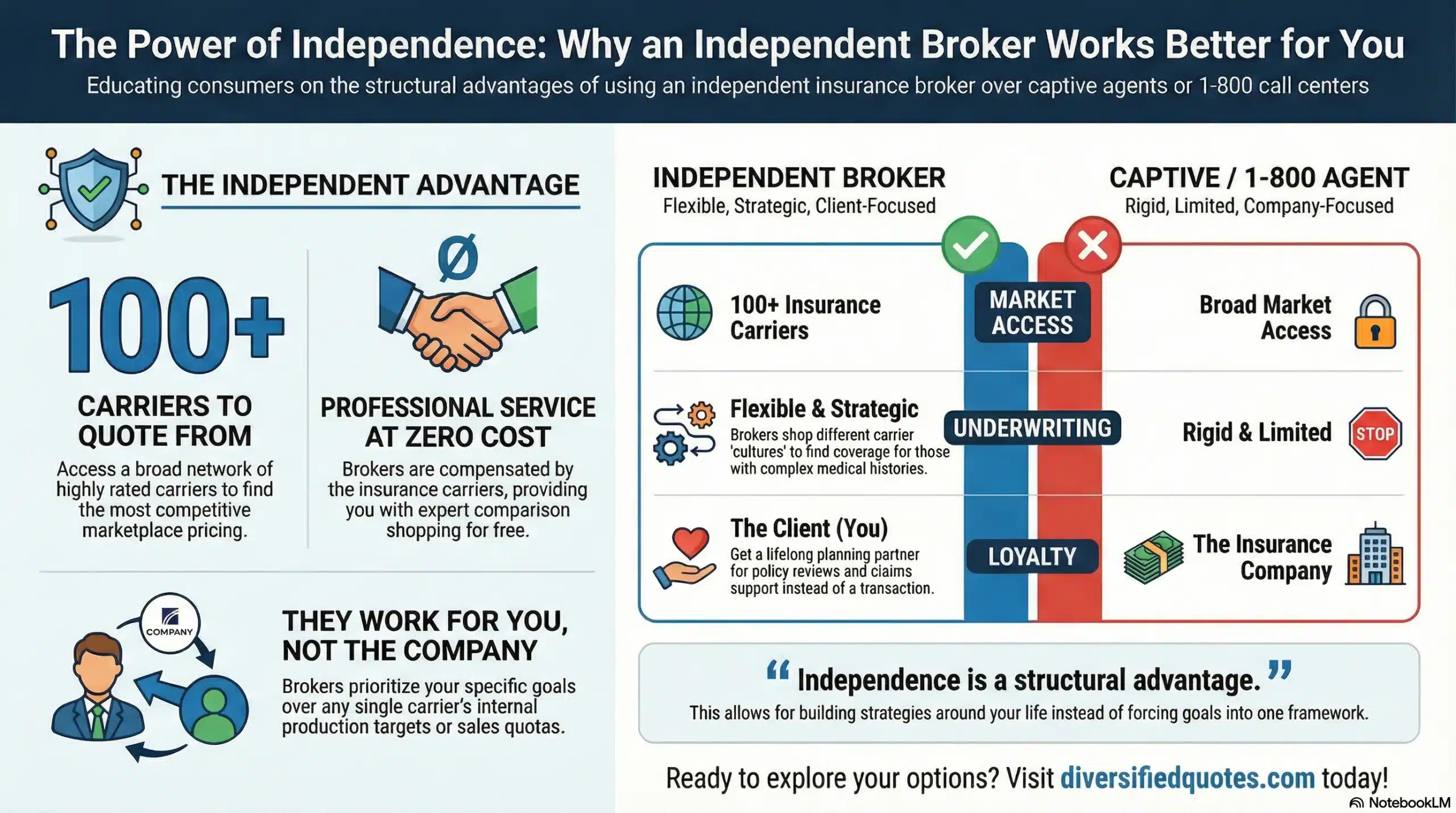
Why Work With Diversified Insurance Brokers?
Since 1980, Diversified Insurance Brokers has helped families align life insurance with real financial timelines. We compare standard and custom term lengths, underwriting approaches, and carrier pricing so you can make an informed decision without guessing. Our advisors focus on building a policy that fits your plan today while keeping flexibility in mind for tomorrow.
You can learn more about our life insurance services, and if you’re also reviewing end-of-life planning, our burial insurance resources may be helpful.
Related Pages
Here are a few helpful pages to explore next:
Financial Protection Essentials
Carrier evaluations, senior burial planning, and guaranteed issue life insurance strategies to strengthen financial protection.
Compare Term Life Insurance Lengths
Explore different term periods to find coverage that best matches your timeline and budget.
Talk With an Advisor Today
Choose how you’d like to connect—call or message us, then book a time that works for you.
Schedule here:
calendly.com/jason-dibcompanies/diversified-quotes
Licensed in all 50 states • Fiduciary, family-owned since 1980
FAQs: 19-Year Term Life Insurance
What is a 19-year term life insurance policy?
A 19-year term life insurance policy provides level premiums and a guaranteed death benefit for 19 years. If the insured passes away during the term, beneficiaries receive the payout. Comparing broader life insurance rate structures can help determine how this term fits within your overall coverage plan.
Why would someone choose a 19-year term instead of 20 years?
A 19-year term may better match a specific financial timeline, such as a projected retirement date. Individuals coordinating protection with long-term planning often review strategies like life insurance for single parents when aligning coverage periods with family milestones.
Is 19-year term life insurance cheaper than 20-year term?
Because the coverage window is slightly shorter, premiums can sometimes be lower than a 20-year term. However, understanding what impacts life insurance pricing can clarify whether the savings are meaningful.
Do insurance companies offer 19-year term policies?
Not all carriers provide custom term lengths like 19 years. Availability varies by insurer and state. Working with an independent advisor—similar to choosing the best independent life insurance broker—can help identify niche term options.
Can a 19-year term policy be converted to permanent life insurance?
Many term contracts allow conversion to permanent life insurance without a new medical exam, provided conversion occurs within the specified timeframe. Reviewing how guaranteed universal life insurance works can help determine if conversion aligns with long-term needs.
Is a medical exam required for 19-year term life insurance?
Some applicants qualify for accelerated underwriting, while others may require a traditional exam. If health history is a concern, understanding why obtaining life insurance can be challenging may provide helpful insight.
What happens when a 19-year term life policy ends?
At the end of the level period, coverage typically expires unless renewed annually at higher rates or converted beforehand. Planning ahead by reviewing when to stop buying term life insurance can prevent unexpected coverage gaps.
Who is a good candidate for 19-year term life insurance?
This term length may suit homeowners nearing mortgage payoff or individuals targeting a specific retirement milestone. Those coordinating coverage with broader financial goals sometimes explore how to choose the right life insurance policy to ensure term length aligns with long-term objectives.
About the Author:
Jason Stolz, CLTC, CRPC and Chief Underwriter at Diversified Insurance Brokers (NPN 20471358), is a senior insurance and retirement professional with more than two decades of real-world experience helping individuals, families, and business owners protect their income, assets, and long-term financial stability. As a long-time partner of the nationally licensed independent agency Diversified Insurance Brokers, Jason provides trusted guidance across multiple specialties—including fixed and indexed annuities, long-term care planning, personal and business disability insurance, life insurance solutions, Group Health, and short-term health coverage. Diversified Insurance Brokers maintains active contracts with over 100 highly rated insurance carriers, ensuring clients have access to a broad and competitive marketplace.
His practical, education-first approach has earned recognition in publications such as VoyageATL, highlighting his commitment to financial clarity and client-focused planning. Drawing on deep product knowledge and years of hands-on field experience, Jason helps clients evaluate carriers, compare strategies, and build retirement and protection plans that are both secure and cost-efficient. Visitors who want to explore current annuity rates and compare options across multiple insurers can also use this annuity quote and comparison tool.
