
Aspida Synergy Choice Bonus Annuity – Market Growth, Premium Bonus, and Built-In Income Protection
Aspida Synergy Choice Bonus Annuity – Market Growth, Premium Bonus, and Built-In Income Protection
At Diversified Insurance Brokers, we work with individuals and families who want retirement solutions that adapt as their needs evolve. The Aspida Synergy Choice Bonus Annuity, issued by Aspida Life Insurance Company, is structured to provide a compelling blend of market-linked growth, premium bonus incentives, downside protection, and meaningful liquidity. In an environment where traditional fixed income options often struggle to keep pace with inflation and market-based investments introduce volatility risk, this annuity offers a middle ground — participation in index growth without exposing principal to market losses. Whether your goal is retirement income, legacy transfer, or repositioning underperforming conservative assets, Synergy Choice Bonus is designed to create long-term value with guardrails in place.

Ensure you are receiving the absolute top rates
Current Fixed Annuity Rates
Compare today’s best fixed annuity rates from top carriers.
Current Bonus Annuity Rates
See which annuities offer the highest upfront bonus today.
Request an Annuity Quote
Submit our annuity request form to get personalized rate options.
Lifetime Income Calculator
Use our calculator to see how much guaranteed income your annuity can provide.
Aspida Synergy Choice Bonus: Key Product Features at a Glance
| Product Feature | Details |
|---|---|
| Issuing Carrier | Aspida Life Insurance Company, Durham, North Carolina. Founded 2021; Ares Management Corporation backing. AM Best: A- (Excellent), affirmed August 29, 2025, Stable. KBRA: A- (Excellent), July 2025. $30 billion total assets. NAIC Complaint Index effectively zero. Not FDIC insured. Not available in New York. Guarantees backed by claims-paying ability of Aspida Life Insurance Company. The Synergy Choice Bonus is a different product from the income-focused Synergy Choice Income — no GLWB rider or income mechanics apply to this product. |
| Product Type | Single-premium deferred fixed indexed annuity (FIA). Accumulation-focused. Two surrender period options: 5-year or 10-year. No optional riders available on either version. Principal protected from negative index performance. Tax-deferred growth. Not a direct market investment. Not FDIC insured. Available in most states excluding New York. |
| Minimum / Maximum Premium | Minimum: $25,000. Maximum: $2,000,000 (amounts above $2,000,000 may be accepted with prior company approval). Single premium only — no subsequent premium payments. Eligible fund types: Non-Qualified, Traditional IRA, IRA Rollover, IRA Transfer, TSA 403(b), SEP IRA, Roth IRA, SIMPLE IRA, 457 Plan, TSP. |
| Surrender Charge Period | 5-year or 10-year surrender period selected at contract issue. Surrender charges and MVA apply to withdrawals above the free withdrawal amount during the period. No surrender charges at death or under qualifying waiver events. Verify current surrender charge schedule with carrier documentation at time of application. |
| Premium Bonus and Vesting Schedule | 10-year version: ages 18–75 = 15% bonus; ages 76–80 = 12% bonus. 5-year version: ages 18–75 = 7% bonus; ages 76–80 = 4% bonus. Bonus is applied to the contract value at issue. Bonus is subject to a vesting schedule — 10% of the bonus vests each year through the surrender period. Early surrender or excess withdrawals may forfeit unvested bonus. Products with premium bonuses typically offer lower cap rates, lower participation rates, or lower overall crediting terms than non-bonus alternatives from the same carrier. Always weigh the bonus against the crediting trade-off in a side-by-side comparison. |
| Free Withdrawal Provision | Up to 10% of the contract value may be withdrawn annually after the first contract year without surrender charges or MVA. Year 1: no standard penalty-free withdrawal. Excess withdrawals above 10% are subject to surrender charges and MVA. Withdrawals reduce the contract value and may affect future credited interest calculations. |
| Health Event Waivers | Nursing Home Waiver: 100% of the contract value accessible without surrender charges if confined to an eligible nursing home for at least 90 consecutive days after the first contract anniversary. Terminal Illness Waiver: 100% of the contract value accessible upon qualifying terminal illness. Owner cannot be confined at time of contract issue. Waiver terms and availability may vary by state. |
| Bailout Provision | Available specifically on the S&P 500 1-year point-to-point strategy with a cap. If Aspida lowers the cap rate on that strategy below the contractually defined Bailout Cap rate, the contract owner has full access to withdraw the full accumulated value without surrender charges or MVA. This provision protects against a scenario where the S&P 500 cap rate is reduced to a level that makes continued accumulation in that strategy uncompetitive. It applies to this specific strategy only and is not a general surrender waiver. |
| Index Crediting Options | S&P 500; Invesco QQQ Growth Index; Nasdaq-100 Index; Goldman Sachs Grand Prix Index (balances U.S. tech equity futures and U.S. Treasury futures with 4.5% volatility target); Goldman Sachs Lexicon Long Short Index; Citi Aria Index (ESG-focused, dynamically allocates between Citi Global ESG Index and Citi US Tech ESG Index); BlackRock U.S. Equity Bitcoin Balanced Risk 10% Index. Fixed account available. 17 total strategy options. Note on Goldman Sachs Grand Prix Index: 0.50% annual fee deducted from index performance — reduces net credited interest. Multiple crediting methods including 1-year point-to-point with cap and participation rate strategies. Annual reset locks in credited interest. Negative index performance credits 0% — no loss of principal due to market performance alone. |
| No Optional Riders | Neither the 5-year nor the 10-year Synergy Choice Bonus has optional riders. No income rider, no enhanced death benefit rider, no LTC-style multiplier. This is an accumulation-only product. For the income-focused version of the Synergy Choice family with a built-in GLWB rider, see the Synergy Choice Income. |
| Death Benefit | Full contract value paid to beneficiaries without surrender charges or MVA. Transfers outside of probate in most states when beneficiary designations are properly completed. The contract value — not a separate income base — is the death benefit. |
| Tax Treatment | Interest grows tax-deferred until withdrawal. Non-qualified: LIFO taxation. Qualified accounts: full distributions taxed as ordinary income. Withdrawals before age 59½ subject to 10% IRS early withdrawal penalty. An annuity inside a qualified plan provides no additional tax deferral. Not FDIC insured. |
About Aspida Life Insurance Company
The Synergy Choice Bonus is issued by Aspida Life Insurance Company — the same carrier as the Synergy Choice Income. Aspida holds an AM Best A- (Excellent) rating affirmed August 29, 2025 with a Stable outlook, and a KBRA A- (Excellent) assigned July 2025 — dual-agency A- confirmation meeting the minimum financial strength threshold most experienced advisors specify for new annuity purchases. Backed by Ares Management Corporation with $30 billion in total assets and an effectively zero NAIC Complaint Index since founding, Aspida is a growth-stage carrier with institutional-grade financial infrastructure. For a full carrier evaluation, the carrier context is covered in detail on the Synergy Choice Income page already linked above.
How a Fixed Indexed Annuity Protects Principal While Pursuing Growth
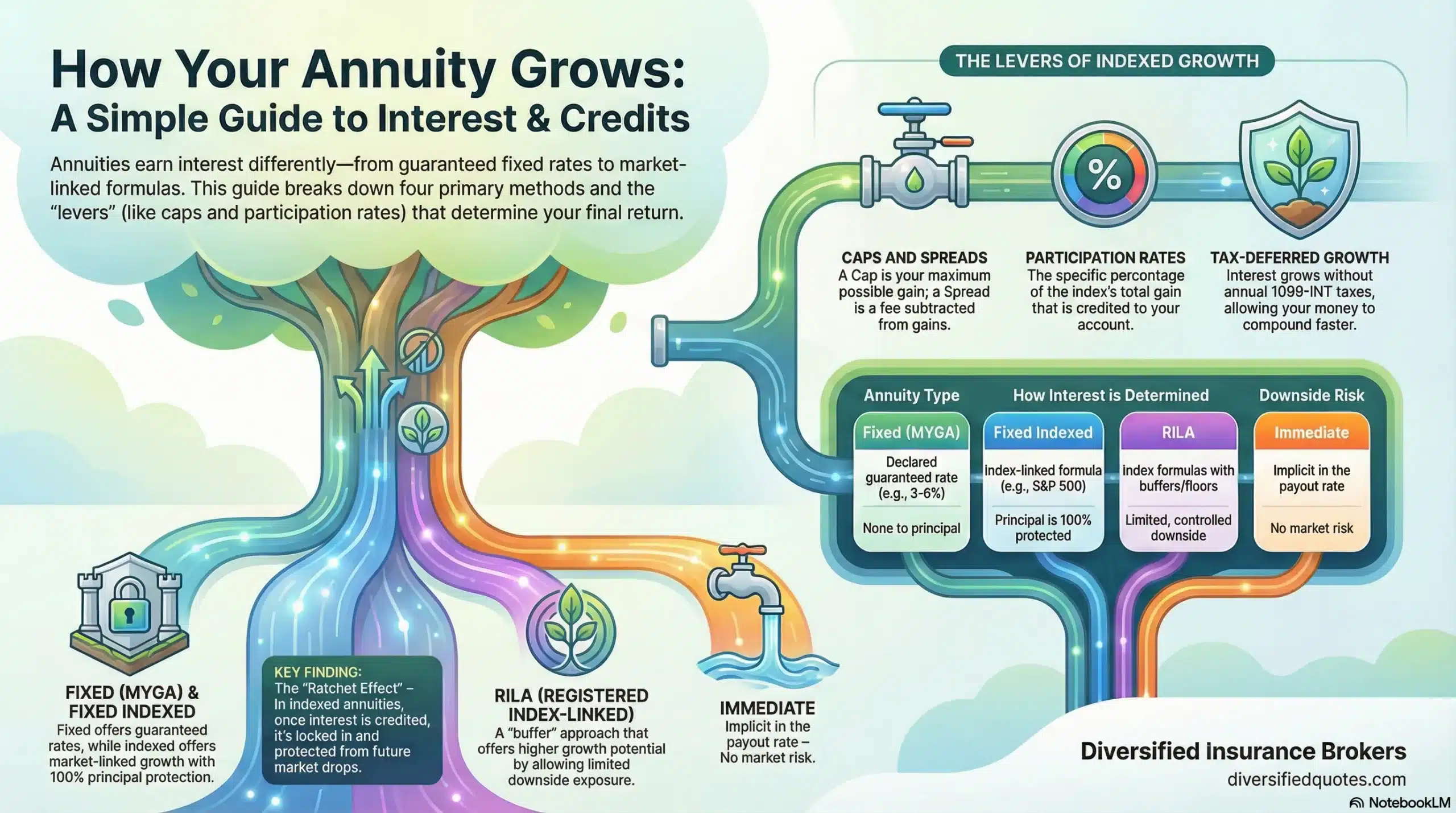
Understanding how a fixed indexed annuity functions is essential before evaluating specific features. Your premium is not directly invested in the stock market. Instead, Aspida credits interest based on the performance of selected indices — subject to caps, participation rates, or spreads — while guaranteeing that market downturns will not reduce your principal. If the index posts a negative return during a crediting period, your contract receives a 0% credit for that term rather than a loss. Gains, once credited, lock in and cannot be taken away due to subsequent market declines. If you would like a full breakdown of index methodologies and crediting mechanics, our guide explaining how a fixed indexed annuity works walks through each component in detail.
The Premium Bonus: What It Does and What to Watch
One of the defining features of the Synergy Choice Bonus Annuity is its premium bonus structure. On the 10-year version, eligible buyers ages 18–75 receive a 15% premium bonus applied to the contract value at issue; buyers ages 76–80 receive 12%. On the 5-year version, the bonus is 7% (ages 18–75) and 4% (ages 76–80). This bonus is applied at issue and increases the accumulation base from day one. When paired with tax-deferred growth, that upfront accumulation increase can meaningfully amplify long-term results. For savers transitioning funds from CDs, money markets, or conservative bond positions, the impact of an immediate accumulation boost combined with principal protection can be substantial.
Two important disclosures about the bonus structure that are essential for accurate planning. First, the bonus is subject to a vesting schedule — 10% of the bonus vests each year over the surrender period. Early surrender or excess withdrawals may forfeit the unvested portion. Second, as with all bonus annuities, the premium bonus comes with trade-offs in the crediting economics: products with premium bonuses typically offer lower cap rates, lower participation rates, or lower overall crediting terms than comparable non-bonus products from the same carrier. Aspida’s own product comparison guide notes this explicitly. The appropriate evaluation framework is a side-by-side comparison of total projected accumulation value — bonus annuity with its actual crediting terms versus a non-bonus alternative with higher crediting terms — at the specific surrender period end. For competitive bonus positioning across carriers, visit our Current Bonus Annuity Rates page already linked in the 3-card CTA above.
The Index Menu, the Bailout Provision, and No Optional Riders
The index lineup within Synergy Choice Bonus is diversified. Available strategies include the S&P 500, Invesco QQQ Growth Index, Nasdaq-100 Index, Goldman Sachs Grand Prix Index (a dynamic allocation between U.S. tech equity futures and U.S. Treasury futures targeting 4.5% volatility), Goldman Sachs Lexicon Long Short Index, Citi Aria Index (ESG-focused, dynamically allocating between U.S. and global ESG indices), and the BlackRock U.S. Equity Bitcoin Balanced Risk 10% Index. A fixed interest account and 17 total strategy options are available. These indices incorporate combinations of equities, volatility controls, sector allocation, and tactical rebalancing models. If you would like to understand the different methodologies, our overview of index annuity crediting methods explains caps, participation rates, spreads, and volatility control strategies in depth.
A distinctive liquidity feature is the Bailout Provision, specific to the S&P 500 1-year point-to-point strategy with a cap. If Aspida reduces the cap rate on that strategy below the contractually defined Bailout Cap rate, the contract owner may withdraw the full accumulated value without surrender charges or MVA. This provision protects against a scenario where declining cap rates make continued accumulation in the S&P 500 cap strategy uncompetitive. It applies to this specific strategy only and should not be read as a general escape from surrender charges. Neither the 5-year nor the 10-year Synergy Choice Bonus has optional riders — no income rider, no enhanced death benefit, no LTC multiplier. For buyers who specifically want an income rider on an Aspida product, the Synergy Choice Income is the appropriate product.
Liquidity, Tax Deferral, and Who This Product Is Best For
After the first contract year, policyholders may withdraw up to 10% of the contract value annually without surrender penalties. Nursing Home and Terminal Illness Waivers provide full contract value access if qualifying health events occur after year one. For a complete understanding of declining surrender schedules and how they apply, see our explanation of annuity surrender charges. For those seeking income stability, the Synergy Choice Bonus can serve as the growth layer in a blended strategy — with a separate income-dedicated vehicle handling the guaranteed withdrawal function. If income guarantees are your primary objective, you may also compare structured income-focused contracts through our overview of annuity options for retirees without pensions.
Tax deferral remains one of the most powerful advantages of fixed indexed annuities. Earnings compound without annual taxation, potentially accelerating growth relative to taxable accounts. When withdrawals occur, taxation follows established IRS guidelines based on qualified or non-qualified status. For clarity on tax treatment and withdrawal sequencing, see our guide on how annuities are taxed. Upon death, beneficiaries receive the full contract value without surrender charges, allowing for efficient wealth transfer outside probate in most states. For those evaluating whether indexed annuities align with broader retirement objectives, our article on whether annuities are a good investment in retirement provides balanced context.
The Synergy Choice Bonus is best suited for accumulation-focused buyers who want a meaningful upfront bonus, a diversified index menu with access to the Aspida carrier’s A- rated financial strength, and a simplified no-rider product structure. It is particularly relevant for buyers repositioning CDs, money market funds, or conservative bond allocations who want indexed growth potential with the 15% bonus (10-year) acting as an immediate accumulation accelerant. It is less appropriate for buyers whose primary objective is guaranteed lifetime income during the surrender period, buyers who need year-1 liquidity, or buyers in New York.
Related Pages
Explore additional annuity and retirement planning resources.
Financial Protection Essentials
Insurance planning resources covering post-surgery underwriting, retirement income planning, and conservative annuity strategies.
Talk to an Advisor or Request Your Annuity Quote
Ready to explore this annuity in more detail—or compare it with other carriers to see if even higher rates are available? With guaranteed income, principal protection, and long-term growth potential on the line, making the right choice is essential. The experienced advisors at Diversified Insurance Brokers will guide you through the options and design a strategy tailored to your retirement goals.
Schedule here:
calendly.com/jason-dibcompanies/diversified-quotes
Licensed in all 50 states • Fiduciary, family-owned since 1980
FAQs: Aspida Synergy Choice Bonus Fixed Indexed Annuity
How does the Synergy Choice Bonus differ from the Synergy Choice Income?
The Synergy Choice Bonus and the Synergy Choice Income are two distinct products from the same Aspida carrier with fundamentally different purposes. The Synergy Choice Bonus is an accumulation-focused FIA — no income rider is available, no Guaranteed Lifetime Withdrawal Benefit exists, and the product does not have a separate income base calculation. Its value proposition is a premium bonus applied to the contract value at issue, a diversified index menu, and tax-deferred accumulation over 5 or 10 years with no ongoing rider charges. The Synergy Choice Income is an income-focused FIA — it includes a built-in GLWB rider with a 25% benefit base bonus at issue, a 10% simple interest roll-up for up to 10 years, and a lifetime withdrawal guarantee. The Synergy Choice Income also includes an Enhanced Nursing Home Multiplier that doubles GLWB income for qualifying care events, and it carries a 10-year surrender period only. The two products serve different planning objectives: the Bonus is for accumulation and CD/bond repositioning; the Income is for guaranteed lifetime income planning. They cannot be compared on the same metrics because they solve different problems. Buyers who are unclear about whether their primary objective is accumulation or guaranteed income should clarify that distinction before evaluating either product — because the right answer leads to different products with materially different features.
The 15% bonus sounds significant — what are the real trade-offs?
The 15% premium bonus on the 10-year Synergy Choice Bonus (for buyers ages 18–75) is genuinely one of the highest upfront accumulation bonuses available in the current A–rated FIA market. For a $100,000 single premium, the contract value starts at $115,000 on day one rather than $100,000. That $15,000 head start then earns index credits on the larger base, creating a compounding advantage throughout the 10-year period. However, there are two material trade-offs that must be modeled honestly before concluding the 15% bonus makes the product superior to alternatives. First, the vesting schedule: the bonus vests at 10% per year over the 10-year surrender period. If the contract is surrendered in year 3 — for any reason — only 30% of the bonus ($4,500 on a $100,000 premium) has vested; the remaining 70% ($10,500) is forfeited along with the surrender charge on the total withdrawal. The bonus only fully belongs to the owner after the full 10 years. Second, the crediting rate trade-off: Aspida’s own product documentation acknowledges that bonus products typically offer lower cap rates, lower participation rates, or lower overall crediting terms than comparable non-bonus products. A $100,000 in a non-bonus FIA with higher cap rates might produce more total accumulation over 10 years than the same $100,000 in the Synergy Choice Bonus with the 15% head start, depending on market performance. The appropriate comparison is always total projected accumulation value — not just the bonus percentage. Diversified Insurance Brokers can model this comparison explicitly so you can see whether the bonus or the higher crediting rate produces the better 10-year outcome at your specific premium level and in your state.
How does the Bailout Provision work, and when would I actually use it?
The Bailout Provision on the Synergy Choice Bonus applies specifically to the S&P 500 1-year point-to-point strategy with a cap rate. At contract issue, there is a Bailout Cap rate defined in the contract — a minimum cap rate level below which Aspida is not supposed to reduce the cap on that specific strategy without triggering the bailout right. If Aspida declares a new cap rate on the S&P 500 1-year point-to-point strategy that is below the Bailout Cap rate, the contract owner has the right to withdraw the full accumulated value — including any vested bonus — without surrender charges or MVA. This provision addresses one of the most common concerns with FIA buyers during the surrender period: being “trapped” in a product where cap rates have been reduced so significantly that the accumulation opportunity no longer justifies the illiquidity. The Bailout Provision provides a contractual exit right specifically in that scenario. Two important limitations: first, the bailout only applies to the S&P 500 1-year point-to-point strategy — it is not a general cap rate floor that applies to all indexed strategies, and it would not be triggered by cap reductions on the Nasdaq-100, Goldman Sachs, or Citi Aria strategies. Second, the bailout is a right, not an automatic event — the owner must elect to exercise it. If the bailout right is not exercised, the contract continues in force under the new (lower) cap rate. Buyers who allocate entirely or primarily to the S&P 500 1-year point-to-point cap strategy benefit most from this protection; buyers who allocate primarily to other strategies should not rely on the bailout as a general escape mechanism.
Should I choose the 5-year or 10-year surrender period?
The choice between the 5-year and 10-year Synergy Choice Bonus involves a direct trade-off between the bonus size and the length of the liquidity commitment. The 10-year version provides a 15% bonus (ages 18–75) but requires a 10-year surrender commitment. The 5-year version provides a 7% bonus (ages 18–75) with only a 5-year surrender period. The decision framework should be driven by two primary factors. First, how much of the bonus difference is actually worth the extra 5 years of surrender commitment. At $200,000 premium: 10-year version starts at $230,000 (15% bonus); 5-year version starts at $214,000 (7% bonus). That $16,000 difference in starting value compounds through crediting over the respective periods — but the 10-year version’s crediting rates may be lower than the 5-year version’s rates, partially or fully offsetting the bonus advantage. Second, your actual liquidity planning: do you anticipate needing more than 10% annual access within the next 5 years? If yes, neither version is appropriate. Do you expect your needs to change materially between years 5 and 10 in a way that would make the 10-year surrender period problematic? If yes, the 5-year version may be more appropriate even with the lower bonus. For buyers with longer time horizons who genuinely will not need the funds for 10 years and who want to maximize the upfront accumulation boost, the 10-year version is typically the better economic choice. For buyers who want the bonus concept but have reasonable uncertainty about liquidity needs in the 5–10 year window, the 5-year version provides a meaningful bonus with a manageable commitment. Side-by-side illustrations comparing total projected surrender values at years 5 and 10 under both designs — at your specific premium and state — are the most reliable decision tool.
What are the Goldman Sachs and Citi index options, and are there any hidden costs?
The Goldman Sachs Grand Prix Index and Citi Aria Index are proprietary volatility-controlled indices with specific mechanics that differ from the S&P 500 and Nasdaq-100. The Goldman Sachs Grand Prix Index dynamically allocates between U.S. tech equity futures and U.S. Treasury futures, using calendar-based signals and market anomaly detection to balance between growth and defensive positioning while targeting 4.5% volatility. A 0.50% annual fee (accruing daily) is deducted from the index level before credited interest is calculated — similar to the fee structure on the Goldman Sachs Voyager and other Goldman Sachs indices used in FIAs from other carriers. This means a participation rate of 100% on the Goldman Sachs Grand Prix Index earns 100% of the return after the 0.50% daily-accruing fee is already deducted. The Goldman Sachs Lexicon Long Short Index is a separate strategy involving long and short positioning in factor-based equity strategies. The Citi Aria Index is ESG-focused, dynamically allocating monthly between two underlying ESG portfolios — the Citi Global ESG Index and the Citi US Tech ESG Index — based on the relative performance and risk of each. The Citi Aria Index also incorporates internal cost structures that reduce the net credited return compared to a simple equity index. None of these additional fees appear as explicit charges to the annuity contract; they are embedded in the index level itself. The practical evaluation approach is to look at historical index performance net of these embedded costs — not at the participation rate or index structure in isolation — to assess whether the strategy delivers competitive credits relative to simpler alternatives. Diversified Insurance Brokers can provide historical performance context for these indices alongside the current rate sheet when building your comparison.
How does the Synergy Choice Bonus compare to other accumulation-focused bonus FIAs?
The Synergy Choice Bonus competes in the accumulation bonus FIA category alongside products including the Delaware Life PrimeStart Bonus 10 (14% bonus on 10-year, A- carrier, Flex-Lock rate guarantee, Lowest Starting Index Value feature) and various carrier offerings from Athene, American Equity, and others. Key structural comparisons: the Synergy Choice Bonus 10-year offers 15% versus the Delaware Life PrimeStart Bonus 10’s 14% — a 1 percentage point bonus advantage, though the Delaware Life product offers the Flex-Lock 10-year rate certainty guarantee that Aspida does not. The PrimeStart Bonus 10’s Lowest Starting Index Value feature (using the lowest index value in the first 90 days) is also a structural differentiator that the Synergy Choice Bonus does not have. The Synergy Choice Bonus’s index menu is broader — 17 strategies including Goldman Sachs Grand Prix, Goldman Sachs Lexicon Long Short, Citi Aria, Invesco QQQ, BlackRock Bitcoin-linked, and others — versus the PrimeStart’s Goldman Sachs Canopy, First Trust Capital Strength Barclays, Franklin SG Select, and S&P 500. Both carriers hold AM Best A- with Aspida’s Positive KBRA confirmation and Delaware Life’s Positive AM Best outlook providing different forward-looking signals. The right choice between these products depends on which combination of bonus size, rate certainty (Flex-Lock vs. standard), index menu breadth, and carrier features best serves the specific buyer’s accumulation objectives and timeline.
Who is the Synergy Choice Bonus best suited for, and who should consider alternatives?
The Synergy Choice Bonus is most appropriate for: accumulation-focused buyers who want an upfront bonus (15% on the 10-year for ages 18–75) to accelerate the starting contract value; buyers repositioning CDs, money markets, or conservative bond positions who want indexed growth potential within an A–rated carrier; buyers who prefer a simple no-rider product structure without the complexity and cost of income rider elections; buyers who want a diversified index menu including ESG (Citi Aria), growth-focused tech (Invesco QQQ, Nasdaq-100), and volatility-managed strategies (Goldman Sachs Grand Prix); and buyers with genuine 5- or 10-year liquidity commitments who will not need more than the 10% annual free withdrawal during the surrender period. The Synergy Choice Bonus is less appropriate for: buyers whose primary objective is guaranteed lifetime income — the Synergy Choice Income, F&G Safe Income Advantage, or other income FIAs are more appropriate; buyers who need year 1 liquidity; buyers in New York (not available); buyers who want rate certainty through the full surrender period — the Delaware Life PrimeStart Bonus 10 Flex-Lock feature provides that guarantee, which the Synergy Choice Bonus does not; and buyers who require A or A+-rated minimum carrier strength — Aspida’s A- meets the standard threshold but buyers requiring A or A+ should evaluate Athene (A+) or other higher-rated accumulation FIA alternatives.
About the Author:
Jason Stolz, CLTC, CRPC, DIA, CAA and Chief Underwriter at Diversified Insurance Brokers (NPN 20471358), is a senior insurance and retirement professional with more than 25 years of real-world experience helping individuals, families, and business owners protect their income, assets, and long-term financial stability. As a long-time partner of the nationally licensed independent agency Diversified Insurance Brokers, Jason provides trusted guidance across multiple specialties—including fixed and indexed annuities, long-term care planning, personal and business disability insurance, life insurance solutions, Group Health, Travel Medical and Evacuation Insurance, and short-term health coverage. Diversified Insurance Brokers maintains active contracts with over 100 highly rated insurance carriers, ensuring clients have access to a broad and competitive marketplace.
His practical, education-first approach has earned recognition in publications such as VoyageATL, and contributions from his agency featured in Kiplinger and GoBankingRates— highlighting his commitment to financial clarity and client-focused planning. Drawing on deep product knowledge and years of hands-on field experience, Jason helps clients evaluate carriers, compare strategies, and build retirement and protection plans that are both secure and cost-efficient. Visitors who want to explore current annuity rates and compare options across multiple insurers can also use this annuity quote and comparison tool.
Explore More Annuity Options: Browse our complete guide to Best Fixed Indexed Annuity Products — covering individual fixed indexed annuity product reviews from top-rated carriers from 100+ carriers.
Last Reviewed: June 22, 2026 |
Reviewed by: Jason Stolz, CLTC, CRPC, DIA, CAA
Chief Underwriter, Diversified Insurance Brokers, Inc. | NPN: 20471358 | Diversified Insurance Brokers, Inc. — Licensed in all 50 states
Fact Checked by: Tonia Pettitt, CMIP©
Medicare Specialist, Diversified Insurance Brokers, Inc. | NPN: 14374308 | Diversified Insurance Brokers, Inc. — Licensed in all 50 states
Did you find this content helpful? Leave us a Google review — it helps others find trustworthy guidance too.
Editorial Standards: Diversified Insurance Brokers maintains rigorous editorial standards to ensure accuracy, clarity, and independence in all content. Learn more about our editorial standards and commitment to transparency.
