
Disability Insurance for College Professors
As an Independent Disability Insurance Broker, we have access to exclusive discounts and negotiated pricing most captive agents can’t offer — see the full breakdown near the end of this page.
Disability Insurance for College Professors

Jason Stolz CLTC, CRPC, DIA, CAA
College and university professors — across the full spectrum of tenure-track faculty, tenured professors, clinical faculty, adjunct instructors, and visiting scholars — represent one of the most educationally credentialed and professionally specialized workforces in America. The path to a faculty position typically requires four or more years of undergraduate education, five to seven years of doctoral study, one or more postdoctoral research positions, and then a highly competitive faculty appointment process that places successful candidates in their positions after a decade or more of preparation. That accumulated human capital investment generates income in a range that varies enormously by institution, discipline, and career stage — from adjunct instructors earning $3,000 per course to full professors at major research universities earning $200,000 or more annually. It also generates a disability risk profile shaped by the specific demands of academic work that most standard disability insurance analysis never fully addresses.
A 2024 systematic review of burnout among university faculty — covering data from approximately 43,639 academic staff across peer-reviewed studies — identified excessive workload, lack of institutional support, and workplace conflict as the key risk factors for burnout among university professors, while finding that variables such as age, gender, academic rank, and employment stability significantly influenced burnout vulnerability. The study confirmed what faculty across institutions experience: academic work demands are genuine, sustained, and intensifying — with publication pressure, teaching loads, administrative service requirements, grant competition, and the emotional demands of student mentorship creating a work profile that produces clinically significant burnout at rates that have been rising for years.
At Diversified Insurance Brokers, we help college and university professors across every employment structure — tenure-track, tenured, non-tenure-track, adjunct, and clinical faculty — build disability income protection that addresses the real-world coverage gaps in their university group plans, state pension systems, and the specific occupational demands of academic work. Our resource on disability income insurance for teachers provides the K-12 context, and our resource on own-occupation disability insurance explains the definitional provisions most important for academic professionals.
Disability Insurance for College Professors
Income protection for tenure-track and tenured faculty, clinical professors, adjunct instructors, and academic professionals across all disciplines and institution types.
Request a Disability Insurance QuoteCall 800-533-5969
The Real Disability Risks in Academic Careers
Academic work is not the low-risk office environment that naive occupational classification might suggest. The disability risks facing university professors are genuine, well-documented, and specific to the demands of academic professional life in ways that standard disability analysis rarely captures.
Burnout progressing to clinical depression and anxiety disorders is among the most significant and most likely disability pathways for faculty. Research consistently confirms that academic burnout is driven by a combination of high and expanding workload demands, publication and grant pressure that extends well beyond formal work hours, the emotional labor of student mentorship and advising, the administrative service obligations that come with tenure, and the institutional pressures of evaluation cycles, reappointment reviews, and promotion processes. When burnout progresses to clinical depression requiring treatment, or when anxiety disorders produce the kind of functional impairment that prevents the sustained cognitive engagement that research and teaching demand, the result is a genuine disabling condition — and one whose recovery timeline frequently extends well beyond the 24-month mental health benefit period cap that many standard disability policies apply.
Musculoskeletal disorders represent the second disability pathway — less prominent in discussions of academic risk but genuinely significant for professors whose work involves extended periods of writing, typing, reading, and computer work at sustained intensity. Repetitive strain injuries, carpal tunnel syndrome, cervical spine conditions from sustained seated work, and back conditions from the sedentary demands of long writing and research sessions all produce functional limitations that can impair a professor’s ability to perform the sustained intellectual work that their position demands. For laboratory scientists in academic faculty positions — chemists, biologists, physicists, engineers — the laboratory-specific injury risks add to this baseline musculoskeletal profile.
The University Group LTD Gap
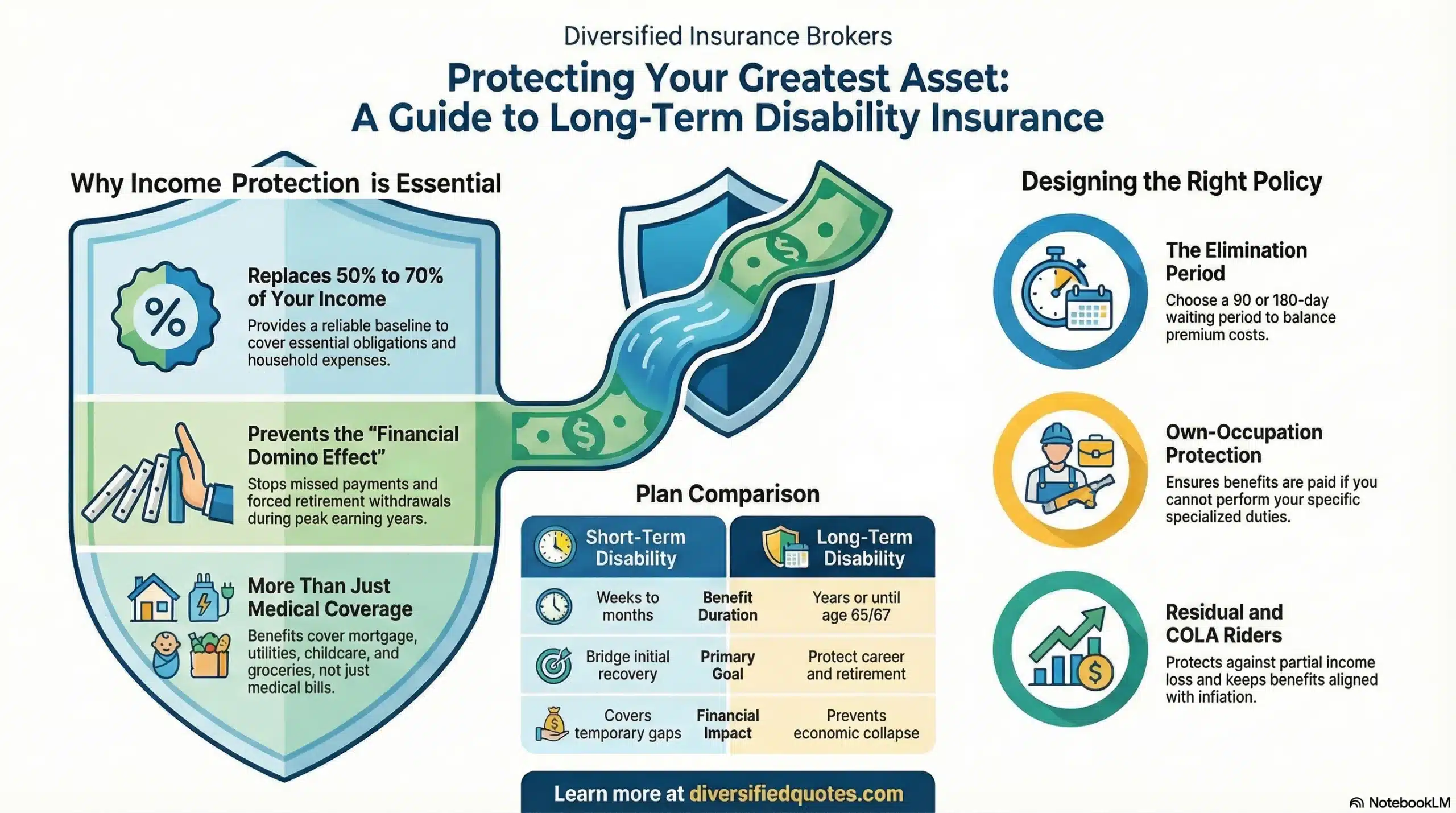
Most tenure-track and tenured faculty at major universities have access to employer-sponsored group long-term disability coverage through their university benefits program, often administered through TIAA or comparable group carriers. These plans provide a meaningful base layer of income protection that many faculty appropriately rely on as a first line of defense. However, several structural features of university group LTD plans create gaps that individual disability insurance should fill.
The most significant gap is the definition shift. Many university group LTD plans apply an own-occupation definition for the first 24 months of disability — paying benefits if the faculty member cannot perform their specific academic duties. After 24 months, most plans shift to an any-occupation standard — paying benefits only if the faculty member cannot perform any gainful occupation for which they are reasonably suited. For a professor with decades of education and general professional competence, this any-occupation standard after year two can result in benefit termination despite continued inability to perform the specific research, teaching, and scholarly production functions that constitute academic faculty work. Individual disability insurance with true own-occupation language for the full benefit period prevents this definitional shift from eliminating benefits at the two-year mark of a long-duration disability.
The benefit cap is the second significant gap. University group LTD plans typically cap monthly benefits at levels that may not achieve full income replacement for higher-earning senior faculty. A full professor at a major research university earning $180,000 annually faces a target monthly benefit of approximately $9,000 (at 60% income replacement) — which may approach or exceed many group plan caps. Individual supplemental coverage closes this gap.
The Adjunct and Non-Tenure-Track Crisis
The dramatic growth of adjunct and non-tenure-track faculty in American higher education has created a large and largely underprotected academic workforce. Tenured and tenure-track faculty account for only one-third of all faculty, with full-time non-tenure-track faculty accounting for approximately 19% of the remainder. Adjunct faculty — part-time, non-salaried, paid per course with average pay around $3,000 per course — typically receive no group disability coverage from the institutions where they teach. They are not employees in the traditional sense; they receive no benefits; and their income depends entirely on each institution’s decision to offer them courses each semester.
For adjunct faculty who depend on their teaching income — whether as their primary income or as a significant supplement — individual disability insurance is the only protection mechanism available. The documentation challenge is significant: adjunct income is typically low per individual course and may come from multiple institutions, making income documentation and the insurable income calculation complex. However, adjunct faculty who teach full loads across multiple institutions and earn meaningful aggregate annual income have a genuine insurable income base, and individual disability insurance products are available to address their specific situation.
Occupational Classification for Academic Faculty
| Faculty Role | Typical Duties | Occupational Class | Coverage Outlook |
|---|---|---|---|
| Tenured / Tenure-Track Professor (humanities, social sciences, professional schools) | Teaching, research, writing, service — office-based | Class 4–5 | Most favorable; full own-occupation; to-age-65 benefit period available |
| Laboratory Sciences Faculty (chemistry, biology, physics, engineering) | Teaching plus lab research; direct chemical/biological specimen handling | Class 3–4 depending on lab exposure | Still favorable; slight premium difference for lab component; full provisions available |
| Clinical Faculty (nursing, medicine, PT, OT, pharmacy) | Teaching plus clinical practice duties; patient contact | Class 3–4 depending on clinical duty percentage | Strong provisions; clinical own-occupation language important for clinical duties |
| Adjunct / Part-Time Faculty | Teaching only; office hours; course-specific duties | Class 3–5 depending on discipline and duties | No group coverage typically; individual insurance the only option; income documentation challenge |
The Mental Health Benefit Period: A Faculty-Specific Priority
The 24-month mental health benefit cap that many standard disability policies apply is particularly significant for faculty disability planning, because burnout, depression, anxiety, and related conditions are among the most prevalent disabling conditions in academic careers and frequently require treatment timelines that extend well beyond 24 months. A professor who enters a disabling depressive episode following years of accumulated academic burnout is unlikely to recover to full professional function within 24 months — and a policy that terminates benefits at the two-year mark regardless of recovery status leaves the most financially and professionally damaging period of the disability without income protection.
Selecting policies that provide the full standard benefit period for mental health conditions — without the 24-month limitation — should be an explicit priority for any faculty member evaluating disability insurance. The peer-reviewed research on faculty burnout consistently documents multi-year recovery trajectories for clinically significant burnout conditions, making the 24-month cap structurally inadequate for this specific workforce’s disability risk profile. Our resources on disability insurance for teachers and disability insurance for white-collar professionals cover this provision priority in the context of related knowledge-intensive professional groups.
The State Public University Pension Dimension
Faculty at public universities in many states participate in state-administered pension systems that include disability benefit provisions. The same structural limitations that affect government pension disability provisions for other public sector workers apply to faculty pension systems: duty-related versus non-duty disability distinctions, any-occupation standards that apply after initial periods, and pension fund fiscal health that affects benefit security over multi-decade career timelines. Faculty at public universities who rely solely on their pension system’s disability provisions for income protection face the same coverage gaps that other public sector professionals face — gaps that individual disability insurance addresses by providing own-occupation coverage for the full benefit period without the definitional shifts and pension system fiscal dependencies that government provisions carry.
The Social Security Fairness Act of 2025 eliminated the Windfall Elimination Provision and Government Pension Offset that had reduced Social Security benefits for many public sector employees including faculty at non-Social Security-participating institutions — improving the Social Security picture for some faculty. However, Social Security disability benefits remain difficult to qualify for, based on an extremely strict any-occupation standard, and provide benefit amounts that represent a small fraction of professional faculty income. They remain an inadequate substitute for properly structured individual disability insurance. Our resource on 403(b) retirement planning for educators addresses the retirement income planning context within which disability protection fits for university faculty.
Build Complete Income Protection for Your Academic Career
We compare own-occupation policies for faculty at every stage — junior faculty establishing coverage, senior faculty closing gaps in group plans, and adjunct instructors with no institutional coverage at all.
Compare Disability Options for College ProfessorsCall 800-533-5969
Related Disability Insurance Pages
Financial Protection Essentials
Retirement planning, annuity income tools, life insurance resources, and financial protection guides for university faculty and academic professionals.
Talk With an Advisor Today
Choose how you’d like to connect—call or message us, then book a time that works for you.
Schedule here:
calendly.com/jason-dibcompanies/diversified-quotes
Licensed in all 50 states • Fiduciary, family-owned since 1980
FAQs: Disability Insurance for College Professors
What are the most common disabling conditions for college professors?
Burnout progressing to clinical depression, anxiety disorders, and related mental health conditions represents the most prevalent disability pathway for faculty — driven by excessive workload, publication and grant pressure, administrative service obligations, student mentorship demands, and the sustained high-pressure professional environment of academic careers. A 2024 systematic review covering approximately 43,639 academic staff confirmed excessive workload, lack of institutional support, and workplace conflict as the primary burnout risk factors for university faculty. Musculoskeletal conditions from sustained computer work and writing are a second significant disability pathway. For laboratory science faculty, chemical and biological laboratory exposures add an occupational health dimension not present for humanities and social science faculty. The disability insurance policy’s mental health benefit period provision is particularly important for faculty given the dominance of burnout-related conditions in the academic disability profile.
Does university group LTD coverage provide adequate disability protection for faculty?
For many faculty, particularly at senior levels and at major research universities, university group LTD coverage has two structural gaps that individual disability insurance should fill. First, most group plans apply a definition shift: own-occupation for the first 24 months, then any-occupation for subsequent benefit payments. A faculty member unable to perform academic work after 24 months but capable of some other employment may lose benefits under the any-occupation standard despite continuing inability to return to academic duties. Second, group plan benefit caps may be set below full income replacement for higher-earning senior faculty. Individual disability insurance with true own-occupation language for the full benefit period and no benefit cap limitations closes both gaps. Individual coverage is also portable through career changes, which group coverage is not.
Do adjunct professors need individual disability insurance?
Yes — adjunct faculty typically have no employer-provided disability benefits at all. Adjunct positions are generally contract-based, per-course arrangements without the benefits package that full-time faculty receive, meaning there is no group LTD, no sick leave accrual, and no institutional income protection when a disability occurs. Individual disability insurance is the only available protection mechanism for adjuncts whose teaching income represents a meaningful portion of household financial stability. The documentation challenge for multi-institution adjunct income is real — carriers require documentation of earned income, which for adjuncts earning $3,000 per course across several institutions requires careful income record-keeping. Working with an independent broker who understands how to document and present multi-source adjunct income for underwriting purposes produces the best available outcome.
Why is the mental health benefit period especially important for faculty disability policies?
Because burnout, depression, and anxiety disorders are among the most statistically prevalent disabling conditions in academic careers — and their treatment and recovery timelines frequently extend well beyond the 24-month mental health benefit period cap that many standard policies apply. A faculty member entering a disabling depressive episode following years of accumulated academic burnout is unlikely to recover to full professional function within 24 months, and a policy that terminates mental health benefits at the two-year mark regardless of recovery status creates a coverage gap precisely when the disability is most financially damaging. Selecting policies that provide the full standard benefit period for mental health conditions — treating a disabling depression the same as a disabling back injury for benefit duration purposes — should be an explicit, confirmed policy provision for any faculty member’s disability coverage.
What occupational class do college professors receive?
Tenure-track and tenured faculty in humanities, social sciences, and professional schools — whose work is primarily office-based teaching, research, and writing — typically receive Class 4 or Class 5 occupational ratings, among the most favorable available. This produces lower premiums and access to the strongest available policy provisions. Laboratory sciences faculty whose work includes direct laboratory research receive Class 3 or Class 4 ratings reflecting the laboratory exposure component. Clinical faculty with patient care duties receive Class 3 or Class 4 depending on the clinical duty percentage. Adjunct faculty typically fall into Class 3 to Class 5 depending on discipline and specific duties. The favorable occupational classification that most academic faculty receive makes the premium cost of comprehensive individual disability insurance, including own-occupation language and full benefit periods, relatively accessible.
About the Author:
Jason Stolz, CLTC, CRPC, DIA, CAA and Chief Underwriter at Diversified Insurance Brokers (NPN 20471358), is a senior insurance and retirement professional with more than 25 years of real-world experience helping individuals, families, and business owners protect their income, assets, and long-term financial stability. As a long-time partner of the nationally licensed independent agency Diversified Insurance Brokers, Jason provides trusted guidance across multiple specialties—including fixed and indexed annuities, long-term care planning, personal and business disability insurance, life insurance solutions, Group Health, Travel Medical and Evacuation Insurance, and short-term health coverage. Diversified Insurance Brokers maintains active contracts with over 100 highly rated insurance carriers, ensuring clients have access to a broad and competitive marketplace.
His practical, education-first approach has earned recognition in publications such as VoyageATL, and contributions from his agency featured in Kiplinger and GoBankingRates— highlighting his commitment to financial clarity and client-focused planning. Drawing on deep product knowledge and years of hands-on field experience, Jason helps clients evaluate carriers, compare strategies, and build retirement and protection plans that are both secure and cost-efficient. Visitors who want to explore current annuity rates and compare options across multiple insurers can also use this annuity quote and comparison tool.
Explore More Disability Insurance Options: Browse our complete guide to Disability Insurance for Legal, Finance & White Collar Professionals — covering attorneys, accountants, bankers, executives, financial planners & business professionals from 100+ carriers.
Last Reviewed: May 18, 2026 |
Reviewed by: Jason Stolz, CLTC, CRPC, DIA, CAA
Chief Underwriter, Diversified Insurance Brokers, Inc. | NPN: 20471358 | Diversified Insurance Brokers, Inc. — Licensed in all 50 states
Fact Checked by: Tonia Pettitt, CMIP©
Medicare Specialist, Diversified Insurance Brokers, Inc. | NPN: 14374308 | Diversified Insurance Brokers, Inc. — Licensed in all 50 states
Did you find this content helpful? Leave us a Google review — it helps others find trustworthy guidance too.
Editorial Standards: Diversified Insurance Brokers maintains rigorous editorial standards to ensure accuracy, clarity, and independence in all content. Learn more about our editorial standards and commitment to transparency.
