
Disability Insurance for Sanitation and Septic Services
As an Independent Disability Insurance Broker, we have access to exclusive discounts and negotiated pricing most captive agents can’t offer — see the full breakdown near the end of this page.
Disability Insurance for Sanitation and Septic Services

Jason Stolz CLTC, CRPC, DIA, CAA
Sanitation and septic services workers — including waste collection drivers, septic tank technicians, sewer maintenance workers, hazardous waste handlers, street sweepers, and portable sanitation operators — perform essential infrastructure work that keeps American communities functional and healthy. It is also some of the most dangerous work available, by the numbers. According to data from the Bureau of Labor Statistics, refuse and recyclable material collectors are exposed to some of the highest job-related risks in the American workforce, with fatality rates that consistently place sanitation workers among the top five most dangerous occupations in the country. A 2024 systematic review and meta-analysis published in Frontiers in Public Health documented a global pooled prevalence of occupational injuries among sanitation workers of 36.49% — meaning more than one in three sanitation workers worldwide experiences an occupational injury, with musculoskeletal disorders accounting for 59.7% of injuries among waste collectors specifically.
For the workers who empty American trash cans, pump American septic tanks, and maintain American sewer infrastructure, the disability risk is not an abstract statistical concern. It is an occupational reality that arrives in the form of back injuries from repeated heavy lifting, traffic accidents during route operations, equipment crush injuries, biological hazard exposures in confined-space sewer work, and the cumulative health toll of physically demanding outdoor work conducted in all weather conditions across careers that span decades. Disability insurance for sanitation and septic services workers must address this elevated risk profile directly, while also being accessible and affordable for workers whose wages and savings may not permit the premium levels available to higher-income professionals.
At Diversified Insurance Brokers, we help sanitation workers, septic service professionals, and environmental services business owners find disability income protection that reflects the real-world risk of their occupation. Our independent disability insurance brokerage gives us access to more than 100 carriers to identify which products and programs offer the most favorable terms for this occupational category.
Disability Insurance for Sanitation and Septic Services Workers
Income protection for waste collection, septic services, sewer maintenance, and environmental services professionals facing some of the highest occupational risks in the workforce.
Request a Disability Insurance Quote
Call 800-533-5969
The Injury and Health Risk Profile — By the Numbers
The disability risk for sanitation workers is documented across multiple hazard categories that together create one of the more complex occupational risk profiles in the service sector. Sanitation workers lift heavy loads repeatedly throughout their shifts and are prone to sustaining lifting injuries like hernias, muscular strains and sprains, overexertion injuries, and shoulder injuries. Crushing accidents from using trash and recycling compactors and front-end loader systems can lead to catastrophic injuries including the amputation of a limb. Sanitation workers are constantly jumping in and out of their vehicles to collect material, rendering them vulnerable to fall injuries on slippery roads and sidewalks. These falls can cause various head injuries, such as concussions and other traumatic brain injuries (TBIs), contusions, bone fractures, and spinal injuries.
Traffic risk is the most acutely dangerous dimension of waste collection work. Sanitation workers operate in active traffic — backing large vehicles in residential streets and commercial areas, working alongside moving traffic during collection, and operating in the same road environments where driver inattention, road conditions, and vehicle blind spots combine to create serious injury potential. The Solid Waste Association of North America (SWANA) documented seven sanitation worker deaths in just the first 10 days of 2018, illustrating how concentrated the mortality risk is in this occupation.
For septic tank technicians and sewer maintenance workers, the hazard profile adds biological exposure and confined-space risk. Sewer and septic work involves contact with pathogen-containing human waste, exposure to hydrogen sulfide and other toxic gases in enclosed spaces, and the serious injury and fatality potential of confined-space entry — an OSHA-identified high-risk activity that produces some of the most severe occupational accidents in any industry. Workers who enter manholes, septic tank chambers, and sewer infrastructure without adequate gas monitoring and atmospheric testing face genuine life-threatening risk that workers in most other occupations never encounter. A 2024 systematic review documented that cardiovascular diseases, musculoskeletal disorders, infections, skin problems, and respiratory conditions are all elevated among sanitary workers, reflecting the multi-pathway health exposure that characterizes work in close contact with waste streams.
Occupational Classification and Coverage Options by Role
| Sanitation Role | Primary Risk Factors | Occupational Class | Coverage Notes |
|---|---|---|---|
| Waste Collection Driver / Loader | Traffic risk, heavy lifting, fall injuries, compactor equipment | Class 1–2 | Limited individual market; group GI programs are primary access point |
| Septic Tank Technician | Biological hazard, toxic gas exposure, confined-space risk, heavy equipment | Class 1 | Most restrictive; independent broker essential to find favorable carriers |
| Sewer Maintenance Worker | Confined space, toxic gas, biological hazards, structural risk | Class 1 | Highest-risk classification; layered group + individual approach recommended |
| Route Supervisor / Field Manager | Field oversight; limited manual work; vehicle operation | Class 2–3 | Meaningfully better options; broader carrier access at supervisor level |
| Office / Administrative | Standard office environment; no field exposure | Class 4–5 | Full provisions available; most favorable terms; own-occupation to age 65/67 |
Independent Owner-Operators: Personal and Business Exposure
A significant portion of the septic tank service and portable sanitation market is operated by independent owner-operators — individuals who own their service vehicles and equipment, operate their own client routes, and contract directly with residential and commercial customers. These business owners face the same two-layer disability risk as all owner-operated businesses: personal income loss and business fixed cost obligations that continue regardless of whether the owner can work.
Personal disability insurance covers the owner’s household income during a disability. Business overhead expense (BOE) disability insurance reimburses the fixed costs of keeping the business operational — truck payments, equipment leases, liability insurance, licensing fees, and any employee wages for helpers or administrative support. For a septic contractor who has built client relationships over years of reliable service in a geographic area, maintaining the business’s presence and service continuity during a disability preserves the route equity and client relationships that represent the business’s long-term value. Without BOE coverage, a disabled owner-operator who cannot service clients for several months may find those clients have established relationships with competing services that are difficult or impossible to recapture after recovery. Our resource on disability business overhead expense coverage explains the BOE structure and eligible expense categories in detail.
The Workers’ Compensation Gap for Sanitation Workers
Workers’ compensation provides baseline protection for on-the-job injuries in sanitation work, and the documented injury rates in this occupation make that protection genuinely valuable. However, workers’ compensation has the same fundamental limitation for sanitation workers that it has for every other occupation: it covers only work-related conditions. The cardiovascular disease, cancer, diabetes, and non-occupational musculoskeletal conditions that statistically account for a large share of long-duration disability events are entirely outside workers’ compensation coverage for sanitation workers — regardless of the physical demands of their job.
Individual disability insurance fills this non-occupational disability gap, covering any disabling condition from any cause. For sanitation workers who experience a heart attack, a cancer diagnosis, or a serious non-work injury, individual disability insurance provides the income protection that workers’ compensation cannot. The two programs address different risks and should both be part of a complete financial protection plan for sanitation industry workers — workers’ compensation for the workplace injury coverage it provides, individual disability insurance for everything else. Our resource on disability insurance for truck drivers addresses a closely parallel occupational risk and income protection profile for route-based vehicle operators with similar classification and coverage considerations.
Accessible Coverage Pathways for High-Risk Occupational Classes
For Class 1 sanitation workers whose individual market options are most constrained, multiple coverage access strategies can build a meaningful total protection structure even when the standard individual market is limited. Guaranteed issue disability insurance through employer or association group programs provides coverage without individual medical underwriting — accessible regardless of accumulated occupational health conditions — and can provide a meaningful base benefit amount through the group framework. Workers who want to supplement group coverage with individual policies should work with an independent broker who knows which carriers write Class 1 sanitation occupations most favorably, because the variation in premium and available provisions across carriers at this occupational level is significant.
No-exam disability insurance through accelerated underwriting programs may provide an accessible individual market pathway for qualifying sanitation workers who want to avoid a full paramedical exam process. The availability of no-exam options for Class 1 occupational workers is more limited than for higher-class professionals, but specific carriers’ accelerated underwriting programs do accommodate some Class 1 sanitation occupational categories — an independent broker who knows which programs apply can identify these pathways before a formal application is submitted. For workers concerned about premium affordability, our resource on best disability insurance rates provides market context for how the full cost picture compares across different product types and coverage levels.
Find the Right Disability Coverage for Your Sanitation Role
We identify the strongest available individual and group options for every sanitation and environmental services role — from route workers to owner-operators.
Get Your Disability Insurance Quote
Call 800-533-5969
Related Disability Insurance Pages
Financial Protection Essentials
Life insurance, burial insurance, income protection tools, and retirement planning resources for environmental services workers and owner-operators.
Talk With an Advisor Today
Choose how you’d like to connect—call or message us, then book a time that works for you.
Schedule here:
calendly.com/jason-dibcompanies/diversified-quotes
Licensed in all 50 states • Fiduciary, family-owned since 1980
FAQs: Disability Insurance for Sanitation and Septic Services
How dangerous is sanitation work compared to other occupations?
Extremely dangerous by documented metrics. BLS data consistently places refuse and recyclable material collectors among the occupations with the highest job-related fatality risks in the United States, with sanitation workers having the fifth-highest fatality rate among all occupations. A 2024 global systematic review and meta-analysis documented a 36.49% pooled prevalence of occupational injuries among sanitation workers, with musculoskeletal disorders accounting for 59.7% of injuries among waste collectors specifically. The hazard profile spans traffic accidents from route operations, heavy lifting injuries, equipment crush accidents from compactors and front-end loaders, fall injuries from vehicle entry and exit, and biological and chemical hazard exposures for sewer and septic workers. The occupational risk profile fully justifies prioritizing disability income protection for any worker in this sector.
What occupational class do sanitation workers receive?
Most hands-on sanitation workers — waste collection drivers, septic technicians, sewer maintenance workers — receive Class 1 occupational ratings from disability insurance carriers, reflecting manual duties, biological and chemical hazard exposure, heavy equipment operation, traffic risk, and elevated injury rates. Route supervisors and field managers with primarily oversight duties typically receive Class 2 or Class 3. Office and administrative staff receive Class 4 or Class 5. The classification directly affects both available premium rates and policy provisions — Class 1 workers face higher premiums and more limited individual market options, making group guaranteed issue programs particularly valuable as the primary coverage access point.
Can septic tank owner-operators get both personal disability and BOE coverage?
Yes, and for owner-operators, both policies serve essential and distinct purposes. Personal disability insurance replaces the owner’s household income — the funds covering mortgage, living expenses, and personal obligations — when disability prevents them from working. Business overhead expense (BOE) disability insurance reimburses the fixed costs of keeping the business operational: truck payments, equipment leases, liability insurance, licensing fees, and any employee wages. For a septic contractor who has built client relationships over years of reliable service, BOE coverage keeps the business viable during recovery and prevents the client relationships from eroding to competitors. Without both, a disabled owner-operator must choose between funding personal bills or preserving the business — a choice with no good outcome. Our resource on business overhead disability insurance explains the BOE structure in detail.
What elimination period should sanitation workers choose?
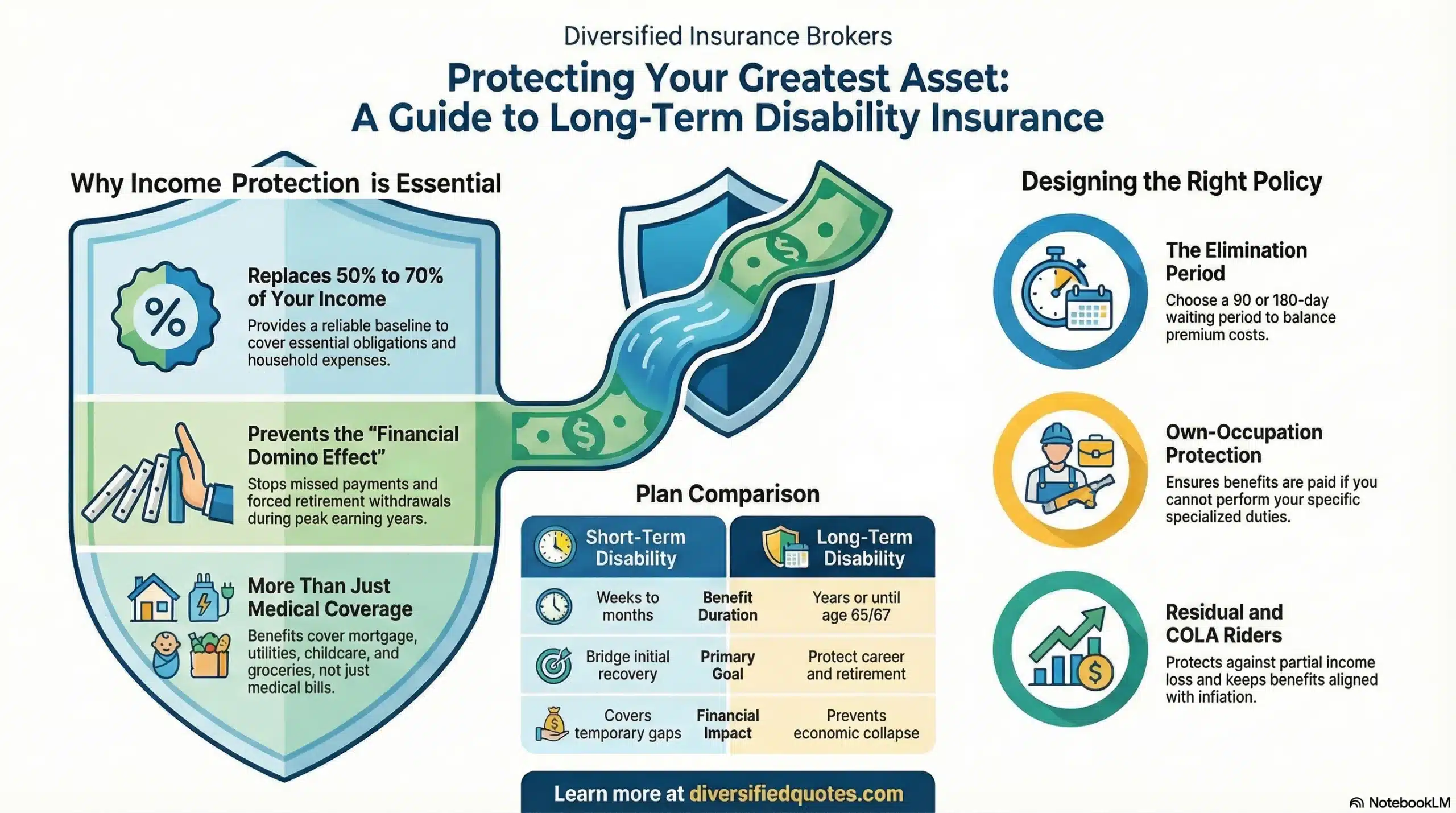
The right elimination period for sanitation workers depends on actual cash reserves rather than default assumptions. The standard 90-day elimination period assumes the worker can fund approximately three months of living expenses before benefits begin. For hourly wage workers with limited emergency savings, this waiting period may create genuine financial hardship before disability income arrives. A 60-day elimination period provides earlier protection at higher premium cost and may be worth the additional monthly payment when the alternative is a three-month financial crisis at the start of a disability. Short-term disability coverage through the employer plan — if available — can bridge the elimination period gap regardless of which long-term elimination period is selected, making the combination of short-term coverage plus a 90-day long-term elimination period a cost-effective total structure for workers who have both options. Our resource on disability insurance elimination periods explained provides the full decision framework.
About the Author:
Jason Stolz, CLTC, CRPC, DIA, CAA and Chief Underwriter at Diversified Insurance Brokers (NPN 20471358), is a senior insurance and retirement professional with more than 25 years of real-world experience helping individuals, families, and business owners protect their income, assets, and long-term financial stability. As a long-time partner of the nationally licensed independent agency Diversified Insurance Brokers, Jason provides trusted guidance across multiple specialties—including fixed and indexed annuities, long-term care planning, personal and business disability insurance, life insurance solutions, Group Health, Travel Medical and Evacuation Insurance, and short-term health coverage. Diversified Insurance Brokers maintains active contracts with over 100 highly rated insurance carriers, ensuring clients have access to a broad and competitive marketplace.
His practical, education-first approach has earned recognition in publications such as VoyageATL, and contributions from his agency featured in Kiplinger and GoBankingRates— highlighting his commitment to financial clarity and client-focused planning. Drawing on deep product knowledge and years of hands-on field experience, Jason helps clients evaluate carriers, compare strategies, and build retirement and protection plans that are both secure and cost-efficient. Visitors who want to explore current annuity rates and compare options across multiple insurers can also use this annuity quote and comparison tool.
Explore More Disability Insurance Options: Browse our complete guide to Disability Insurance for Transportation, Maritime & Hazardous Occupations — covering truck drivers, flight attendants, merchant marines, divers, chauffeurs & drivers from 100+ carriers.
Last Reviewed: May 18, 2026 |
Reviewed by: Jason Stolz, CLTC, CRPC, DIA, CAA
Chief Underwriter, Diversified Insurance Brokers, Inc. | NPN: 20471358 | Diversified Insurance Brokers, Inc. — Licensed in all 50 states
Fact Checked by: Tonia Pettitt, CMIP©
Medicare Specialist, Diversified Insurance Brokers, Inc. | NPN: 14374308 | Diversified Insurance Brokers, Inc. — Licensed in all 50 states
Did you find this content helpful? Leave us a Google review — it helps others find trustworthy guidance too.
Editorial Standards: Diversified Insurance Brokers maintains rigorous editorial standards to ensure accuracy, clarity, and independence in all content. Learn more about our editorial standards and commitment to transparency.
