
GBU Asset Guard Fixed Index Annuity – Growth Potential with Downside Protection
As an Independent Annuity Broker, we compare rates across 100+ carriers and 1,000 different annuities— not just one company’s product offerings — to find the best fit for your goals.
GBU Asset Guard Fixed Index Annuity – Growth Potential with Downside Protection
At Diversified Insurance Brokers, we focus on annuity strategies that combine safety, competitive growth potential, and structural clarity — because retirement dollars deserve more than guesswork. The GBU Asset Guard Fixed Indexed Annuity, issued by GBU Life (AM Best: A- Excellent), is designed for conservative investors who want principal protection with the opportunity to earn interest tied to market index performance. In a retirement environment defined by volatility, inflation pressure, and longevity risk, many pre-retirees are uncomfortable keeping large balances fully exposed to equities — yet they also recognize that traditional savings vehicles may not keep pace with long-term purchasing power needs. The Asset Guard FIA bridges that gap by offering indexed growth potential without direct market exposure, contractual downside protection, tax-deferred accumulation, and optional income planning flexibility.

Ensure you are receiving the absolute top rates
Current Fixed Annuity Rates
Compare today’s best fixed annuity rates from top carriers.
Current Bonus Annuity Rates
See which annuities offer the highest upfront bonus today.
Request an Annuity Quote
Submit our annuity request form to get personalized rate options.
Lifetime Income Calculator
Use our calculator to see how much guaranteed income your annuity can provide.
GBU Asset Guard FIA — How It Compares to Other Conservative Options
| Feature | GBU Asset Guard FIA | Fixed Annuity (MYGA) | CD / Taxable Bond |
|---|---|---|---|
| Principal Protection | Full — 0% floor prevents index-related losses. Account value cannot decline due to negative index performance. Previously credited interest is locked in and cannot be reversed by future negative index years. | Full — principal and declared interest guaranteed contractually for the full term. No market exposure of any kind. Simpler than FIA but no upside potential beyond the declared rate. | CDs are FDIC-insured; taxable bonds are mark-to-market and lose value when rates rise. Neither provides the upside participation of an FIA with the same principal protection structure. |
| Growth Mechanism | Index-linked — credited interest tied to index performance (S&P 500 or other indexes) subject to cap, participation rate, or spread. In strong market years, FIA may credit significantly more than a MYGA’s declared rate. | Declared rate — known on day one, locked for the full term. No upside beyond the stated rate regardless of market performance. Maximum certainty; zero market participation. | CD: fixed rate, FDIC-insured. Taxable bond: interest rate and price dependent. Both generate taxable income annually — no tax deferral on growth. |
| Tax Treatment | Full tax deferral — no annual 1099 on credited interest. Full rate compounds without annual tax reduction. Gains taxable as ordinary income at distribution; basis returned tax-free for non-qualified contracts. | Full tax deferral — same tax-deferred compounding advantage. For investors in higher brackets, the net after-tax return advantage of annuity structures versus taxable alternatives is meaningful over multi-year horizons. | Fully taxable annually — CD interest and bond coupon payments generate a 1099 each year regardless of whether income is withdrawn. Tax drag reduces effective compound return versus annuity alternatives at the same nominal rate. |
| Liquidity | 10% annual free withdrawal after year one, without surrender charges. Health-related waivers (nursing home, terminal illness) typically available. Full access at contract maturity with no charge. | 10% annual free withdrawal on most MYGA contracts — same general liquidity structure as the FIA. Surrender charges apply on excess withdrawals during the guarantee period. Full access at maturity. | CDs: penalty for early withdrawal before maturity. Taxable bonds: fully liquid but at market price, which may be below purchase price if rates have risen. Full liquidity comes with mark-to-market loss risk. |
| Rate Certainty | Cap rates and participation rates can adjust at each crediting period renewal — initial rates are not locked for the full surrender period. Minimum guaranteed cap specified in contract. Carrier history of renewal rate consistency matters. | Declared rate locked for the full term — maximum rate certainty. No renewal rate uncertainty during the guarantee period. The primary advantage of the MYGA over the FIA for buyers who want absolute predictability. | CD: rate locked for the term, then reinvested at prevailing rates. Bond: coupon fixed; price fluctuates. Neither offers the upside participation or tax deferral of annuity structures. |
How the Asset Guard FIA Works — Crediting Strategies and Principal Protection
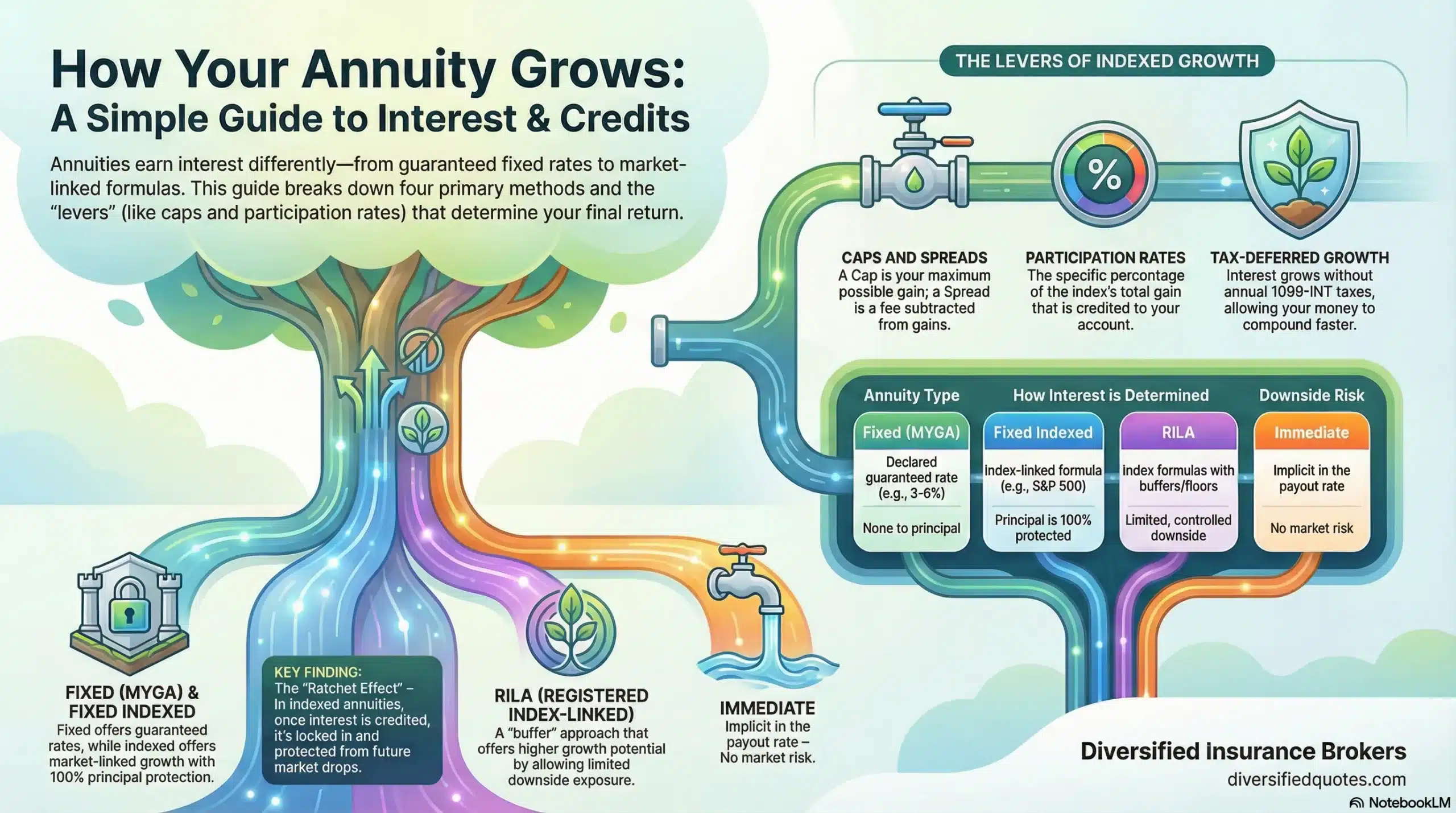
The GBU Asset Guard FIA offers multiple crediting strategies, typically including annual point-to-point options with cap rates, spread strategies, or participation rate structures. Each method calculates credited interest differently. A cap strategy sets a maximum rate that can be credited in a given term; a participation rate credits a defined percentage of the index gain; and a spread subtracts a predetermined percentage from the index return before crediting interest. Choosing among these options requires more than simply selecting the highest advertised number — it involves evaluating historical volatility, long-term averages, renewal rate expectations, and your personal timeline. Because index crediting terms reset periodically, understanding renewal mechanics is essential. For investors who want a clear foundation before evaluating specific crediting options, reviewing how index annuity crediting methods work provides the analytical framework for comparing cap strategies, participation rates, and spreads across different market environments. For investors who want foundational context on the broader product structure, reviewing how a fixed indexed annuity works clarifies the distinction between accumulation value, the crediting mechanism, and how principal protection functions at the contract level.
Liquidity, Tax Deferral, and the Case for FIA in Conservative Allocations
Liquidity is a critical planning element. Most versions of the Asset Guard FIA allow annual free withdrawals — commonly up to 10% of the account value after the first contract year — without surrender penalties. Additionally, many fixed indexed annuities include waivers of surrender charges in cases of qualifying health events such as nursing home confinement or terminal illness. Understanding the structure of annuity free withdrawal rules helps ensure the contract aligns with anticipated liquidity needs. While annuities are not designed for short-term money, strategic planning allows them to serve as long-term growth and income tools without sacrificing essential flexibility.
Tax deferral remains one of the most overlooked advantages of indexed annuities. Interest credited inside the Asset Guard FIA compounds without annual taxation until distributions occur — no 1099 for growth each year unless funds are withdrawn. Over long horizons, tax-deferred compounding creates a measurable difference compared to taxable alternatives. For clients who have already maxed out IRAs or qualified plans, or who are repositioning non-qualified assets such as CDs or brokerage cash, this structure provides both stability and efficiency. Understanding the difference between simple vs compound interest in annuities clarifies how credited gains build upon prior growth inside the contract, and why tax-deferred compounding amplifies the effective net return advantage over taxable fixed-income alternatives across multi-year accumulation periods.
The Asset Guard FIA is particularly suitable for conservative savers, rollover IRA holders seeking downside mitigation, and pre-retirees concerned about sequence-of-returns risk during the early years of retirement. By carving out a portion of assets into a principal-protected vehicle, investors gain confidence to keep remaining funds allocated for growth elsewhere. Proper diversification is not about placing everything into one strategy — it is about assigning the right dollars to the right purpose. For many clients, an FIA serves as the stability anchor within a broader allocation that allows other assets to remain invested more confidently through market cycles.
Income Planning Considerations and the Asset Guard in Retirement Context
Beyond accumulation, many pre-retirees are evaluating income guarantees. While the Asset Guard FIA may offer optional riders that create a lifetime withdrawal benefit base, it is important to distinguish between account value and income base calculations. The income base is typically used solely to determine guaranteed withdrawal amounts and is not a cash value available for lump-sum surrender. When lifetime income is the primary objective, comparing this product to other lifetime income annuity strategies ensures you are optimizing payout rates, deferral bonuses, and rider costs. How the Asset Guard compares to an FIA with a dedicated GLWB income rider — or to a MYGA in the same accumulation role while a separate income annuity is purchased at retirement — is part of the side-by-side analysis that Diversified Insurance Brokers provides before any recommendation. The comparison between the fixed annuity and fixed indexed annuity structures helps identify whether the FIA’s index-linked crediting upside is worth the cap and renewal rate variability compared to a MYGA’s locked declared rate for the specific holding period and objective.
GBU Life Carrier Context
Backed by the financial strength of GBU Life — AM Best A- (Excellent), stable outlook affirmed August 2025 — the Asset Guard FIA reflects a long-standing fraternal benefit society structure focused on policyholder alignment. GBU Life has maintained the A- AM Best rating since 2017, when it was upgraded from B++, and holds over $4.7 billion in assets with a $314 million surplus built through 130+ years of continuous operation. Reviewing the full GBU Life carrier profile provides the complete due diligence context — financial strength history, NAIC complaint ratios, and product lineup — alongside the Asset Guard product evaluation. At Diversified Insurance Brokers, we compare over 75 top-rated carriers to determine whether the Asset Guard is the right fit — or whether another contract offers stronger crediting terms, bonus structures, or income features based on your objectives. Choosing an annuity should never be about chasing a single rate or promotional feature. It requires clarity on timeline, liquidity needs, tax considerations, income objectives, and risk tolerance, which is why we provide side-by-side comparisons, personalized projections, and suitability analysis before any recommendation is made.
Ready to see how the GBU Asset Guard FIA fits your retirement allocation?
Request Your Personalized Annuity Comparison
Financial Protection Essentials
Explore annuity interest examples, disability income protection for key professions, and insurance planning strategies across multiple coverage types.
Talk to an Advisor or Request Your Annuity Quote
Ready to explore this annuity in more detail—or compare it with other carriers to see if even higher rates are available? With guaranteed income, principal protection, and long-term growth potential on the line, making the right choice is essential. The experienced advisors at Diversified Insurance Brokers will guide you through the options and design a strategy tailored to your retirement goals.
Schedule here:
calendly.com/jason-dibcompanies/diversified-quotes
Licensed in all 50 states • Fiduciary, family-owned since 1980
What happens to my Asset Guard FIA account value if the index has a bad year?
In a year when the linked index declines — whether the S&P 500 falls 10%, 25%, or 40% — the Asset Guard FIA credits zero interest for that crediting period rather than reflecting a negative return. The account value does not decline due to index performance. This is the fundamental distinction between owning an FIA and owning the index directly: a direct investor who experiences a 30% drawdown has lost 30% of principal. The FIA owner experiences no principal loss and simply receives no interest credit for the negative year, while previously credited interest from prior positive years remains locked in and cannot be clawed back. This “zero is your floor” mechanism is the primary reason FIAs are used as a sequence-of-returns risk mitigation tool in retirement portfolios — it eliminates the mechanism by which early market losses during the withdrawal phase permanently impair the conservative allocation. If an optional income rider is in place, the rider fee (typically assessed as a percentage of the income base or account value annually) would still be deducted even in zero-credit years, creating a small actual decline in the account value but not in the income base. Buyers selecting the Asset Guard primarily for accumulation without an income rider experience the 0% floor as a true floor — the account value is unchanged in negative index years. Understanding the full range of index annuity crediting methods and how the floor interacts with different crediting strategy structures — cap rate versus participation rate versus spread — provides the analytical foundation for evaluating realistic accumulation outcomes across mixed market environments.
How do cap rates, participation rates, and spreads compare — and which is best?
All three crediting methods achieve the same fundamental result — they define how much of the index’s positive return you receive as credited interest for that period — but they structure the calculation differently, which produces meaningfully different outcomes depending on how the index performs in any given year. A cap rate sets an absolute ceiling: if the index returns 12% and the cap is 8%, you receive 8%. If the index returns 5%, you receive 5% (because it is below the cap). A participation rate credits a defined percentage of the index gain: a 50% participation rate on a 10% index return credits 5%; the same participation rate on a 20% index return credits 10%. There is no ceiling in the standard participation rate structure — in an exceptionally strong index year, the participation rate can produce a higher credit than a cap strategy’s maximum. A spread subtracts a fixed percentage from the index return before crediting: a 3% spread on a 10% index return credits 7%; on a 5% return, the spread produces only 2%; if the index returns less than 3%, the credit is zero. The “best” crediting method depends on your return expectation for the index over the crediting period and your preference between ceiling-capped certainty and percentage-based participation. Understanding how annuity cap rates are set and adjusted — including the minimum guaranteed cap specified in the contract — is particularly important because caps can adjust at renewal, and a high initial cap that declines significantly at renewal may underperform a lower-initial-cap contract with a higher guaranteed minimum. Comparing the Asset Guard’s crediting options alongside alternative FIA structures for conservative investors in the current marketplace ensures the crediting method selection is made in a fully competitive context rather than in isolation.
Should I choose the Asset Guard FIA or a MYGA for my conservative allocation?
The choice between the Asset Guard FIA and a MYGA for the conservative allocation comes down to two primary questions: how much do you value certainty of return versus upside potential, and how does the comparison look when actual competing rates are placed side by side? The MYGA provides a declared rate known on day one, locked for the full guarantee period — if a 5-year MYGA credits 5.25%, you know from the first day exactly what the $200,000 deposit will grow to at maturity. The Asset Guard FIA provides a 0% floor and index-linked upside potential — in strong market years, the FIA may credit meaningfully more than 5.25%; in flat or down years, it credits less or zero. Over a 5 or 7-year period that includes both strong and weak market years, the FIA’s average annual effective yield may be higher or lower than the MYGA’s declared rate depending on the sequence of index returns during the holding period. Our full resource on fixed annuities vs fixed indexed annuities covers this comparison in detail across different market scenarios. The practical framework: if you are highly motivated by simplicity and absolute certainty of return, the MYGA is the more appropriate vehicle for the conservative allocation. If you are comfortable with the index crediting structure and want the potential for above-MYGA accumulation in favorable market periods while maintaining the 0% downside floor, the FIA is the appropriate choice. Both preserve principal; only the growth mechanism differs. Reviewing both options side by side with the same premium amount and the same holding period — comparing the MYGA’s projected maturity value against the FIA’s historical average effective yield range — is the most honest basis for the selection.
Can I use the Asset Guard FIA for an IRA rollover?
Yes — the Asset Guard FIA can be purchased as a qualified annuity funded by a direct IRA rollover or a 401(k) rollover, and this is one of the most common funding sources for FIAs in the retirement market. The direct rollover from a former employer 401(k) or from an existing IRA at a bank or brokerage moves funds directly from the custodian to GBU Life without triggering a taxable distribution — as long as the rollover is handled as a direct trustee-to-trustee transfer rather than a 60-day rollover (which requires the funds to be redeposited within 60 days). For a rollover from an existing traditional IRA at a bank currently holding CDs or money market funds, the repositioning into the Asset Guard FIA adds the FIA’s tax-deferred accumulation advantage — but since IRA funds are already tax-deferred, the marginal tax deferral advantage of the annuity is less significant than it would be for non-qualified assets. The primary reasons an IRA rollover into the Asset Guard FIA makes sense are the 0% floor protection, the index-linked growth potential during the accumulation phase, and the optional income rider structure if guaranteed lifetime income is part of the retirement plan. Understanding annuity free withdrawal rules in the qualified IRA context is particularly important because IRA Required Minimum Distributions (RMDs) must still be taken from IRA-qualified annuities beginning at the required beginning date, and the 10% annual free withdrawal provision must be sufficient to accommodate the RMD amount — or the RMD must be aggregated across multiple IRA accounts so that the annuity account’s RMD can be taken from another IRA while the annuity’s free withdrawal provision remains intact. Coordinating the RMD planning with the annuity’s surrender schedule and free withdrawal provision before any rollover ensures the liquidity structure is fully compatible with the IRA distribution requirements over the full retirement horizon.
How does GBU Life’s A- AM Best rating compare to other FIA carriers in the marketplace?
GBU Life’s A- (Excellent) AM Best rating, affirmed August 2025 with a stable outlook, places it solidly above the B++ carriers that frequently appear in rate tables at smaller specialty annuity companies — and makes it fully competitive with many of the major FIA carriers in the marketplace from a financial strength standpoint. The AM Best scale runs from A++ (Superior) through B++ (Good) and lower tiers, with A- representing the third-highest category out of 15. For context, the largest FIA carriers in the market — companies like North American Company (A+) and Nationwide (A+) — carry the highest rating tiers. GBU Life at A- sits one tier below the A rating tier and two tiers below the A+ tier, which reflects a strong but not elite financial strength position. For most individual retirement investors, the practical significance: an A- carrier has demonstrated AM Best’s assessment of “Excellent” ability to meet ongoing insurance obligations, with strong balance sheet strength and appropriate enterprise risk management. The upgrade from B++ to A- in 2017 — and the seven-year maintenance of the A- rating through various market cycles — reflects the structural improvement in GBU Life’s capitalization, operating performance, and business profile over that period. Reviewing the complete GBU Life carrier profile provides the full context of the financial strength trajectory, surplus levels, and product lineup that supports the A- rating. Additionally, state guaranty associations provide a secondary backstop for annuity policyholders — typically up to $250,000 per policyholder per insurer, with limits varying by state — as a supplementary protection layer independent of the carrier’s AM Best rating.
About the Author:
Jason Stolz, CLTC, CRPC, DIA, CAA and Chief Underwriter at Diversified Insurance Brokers (NPN 20471358), is a senior insurance and retirement professional with more than 25 years of real-world experience helping individuals, families, and business owners protect their income, assets, and long-term financial stability. As a long-time partner of the nationally licensed independent agency Diversified Insurance Brokers, Jason provides trusted guidance across multiple specialties—including fixed and indexed annuities, long-term care planning, personal and business disability insurance, life insurance solutions, Group Health, Travel Medical and Evacuation Insurance, and short-term health coverage. Diversified Insurance Brokers maintains active contracts with over 100 highly rated insurance carriers, ensuring clients have access to a broad and competitive marketplace.
His practical, education-first approach has earned recognition in publications such as VoyageATL, and contributions from his agency featured in Kiplinger and GoBankingRates— highlighting his commitment to financial clarity and client-focused planning. Drawing on deep product knowledge and years of hands-on field experience, Jason helps clients evaluate carriers, compare strategies, and build retirement and protection plans that are both secure and cost-efficient. Visitors who want to explore current annuity rates and compare options across multiple insurers can also use this annuity quote and comparison tool.
Browse More Resources: Return to our complete Fixed Indexed Annuity Products & Education guide — covering FIA products and education from top carriers.
Last Reviewed: June 26, 2026 |
Reviewed by: Jason Stolz, CLTC, CRPC, DIA, CAA
Chief Underwriter, Diversified Insurance Brokers, Inc. | NPN: 20471358 | Diversified Insurance Brokers, Inc. — Licensed in all 50 states
Fact Checked by: Tonia Pettitt, CMIP©
Medicare Specialist, Diversified Insurance Brokers, Inc. | NPN: 14374308 | Diversified Insurance Brokers, Inc. — Licensed in all 50 states
Did you find this content helpful? Leave us a Google review — it helps others find trustworthy guidance too.
Editorial Standards: Diversified Insurance Brokers maintains rigorous editorial standards to ensure accuracy, clarity, and independence in all content. Learn more about our editorial standards and commitment to transparency.
