
Group Health Insurance for 100 Employees

Jason Stolz CLTC, CRPC
Group health insurance for 100 employees marks a major milestone for any organization. At this size, healthcare benefits stop being a “nice HR perk” and become a core operating system that affects cash flow, recruiting, retention, productivity, and long-term scalability. A 100-employee workforce typically has enough stability and claims credibility to move beyond many of the limitations that smaller groups face, which means you can often access more sophisticated plan designs, deeper cost controls, and better long-run renewal management.
Many companies reaching 100 employees discover that healthcare costs can accelerate faster than revenue if the plan structure stays on autopilot. Fully insured renewals often bring double-digit increases, limited transparency, and very little clarity about what is actually driving cost. The good news is that once you hit 100 employees, scale can start working in your favor—if the plan is built intentionally.
At Diversified Insurance Brokers, we help employers with 100 employees redesign group health insurance to improve cost control, increase transparency, and create predictable long-term outcomes—without reducing benefit quality or disrupting employees. This page walks through what is different at 100 employees, the funding options typically available, how to think about stop-loss and renewal exposure, and what strategies can meaningfully lower spend without “cutting benefits.”
Group Health Strategy Review for 100 Employees
We’ll review your current plan, claims efficiency, and renewal exposure to identify ways to lower costs and stabilize future increases.
Why Group Health Insurance for 100 Employees Is Fundamentally Different
Group health insurance for 100 employees operates in a different underwriting environment than plans designed for smaller organizations. At this level, insurers typically place greater weight on your company’s own claims history, utilization patterns, and risk profile instead of relying primarily on broad market pooling. That shift creates both risk and opportunity.
The opportunity is that you can often escape “worst-case pooled pricing” that penalizes healthy groups in the fully insured small-group world. The risk is that a poorly designed plan can magnify inefficiencies because a larger group produces more claim activity and more dollars flowing through the plan—meaning small design flaws can become expensive over time.
At 100 employees, you also usually have more leverage. More carriers and more administrators tend to take your case seriously. More plan designs become quoteable. More stop-loss structures are viable. And because there are more covered lives, you can often make better use of data to identify cost drivers and implement targeted improvements.
Understanding how group medical insurance is priced helps explain why proactive planning becomes essential once you reach this threshold. If you keep the same structure you used at 10 or 20 employees, you might be paying for inefficiencies that only become visible when the group is large enough to reveal claim patterns.
What’s Actually Driving Cost in a 100-Employee Health Plan
Most leadership teams think of healthcare cost as “premium increases,” but premium is just the outer shell. The underlying drivers usually fall into a few recurring buckets. Pharmacy spend—especially specialty meds—can quietly grow faster than medical. Network unit costs can vary widely depending on contracting, even when employees use the same doctors and hospitals. Chronic condition management can determine whether routine care stays routine or turns into high-cost events. And plan design incentives strongly shape how employees use the system.
At 100 employees, you have enough claims volume to evaluate these drivers more meaningfully. That matters because the best cost control is often not “cutting benefits,” it’s removing waste: reducing avoidable ER use, steering toward high-value sites of care, improving generic adoption when clinically appropriate, and getting better leverage on unit costs and network strategy.
If you’re stuck in a fully insured plan with limited visibility, you often can’t see these drivers clearly. If you move into a structure that provides de-identified reporting, you can make decisions based on real utilization instead of guesswork.
Group Health Insurance Options Available at 100 Employees
Employers with 100 employees typically qualify for the full spectrum of group health insurance funding options. Fully insured plans remain available, but they are often the most expensive long-term choice because carrier margins and conservative pricing assumptions are built into the premium. Fully insured is still a fit for some organizations—especially those that prioritize administrative simplicity above all else—but it is rarely the best structure for employers seeking cost control and transparency.
At 100 employees, level-funded and partially self-funded plans are commonly accessible. These structures are designed to align healthcare spending more closely with the group’s actual claim experience while protecting the employer from catastrophic volatility through stop-loss coverage. The right path depends on your risk tolerance, cash flow preferences, claims history, and how much transparency you want.
Some employers begin by reviewing minimum employees for group health insurance just to confirm structural eligibility, but at 100 employees you’re usually in the range where more carriers and funding structures become quoteable and competitive. The bigger decision becomes which model best supports your long-term budget goals.
Fully Insured at 100 Employees: When It Still Makes Sense
Even at 100 employees, fully insured group health can still be appropriate in specific situations. If your organization wants the cleanest administrative experience possible and prefers transferring nearly all claim risk to the carrier, fully insured can provide simplicity. Premiums are predictable each month, and the carrier assumes claim responsibility.
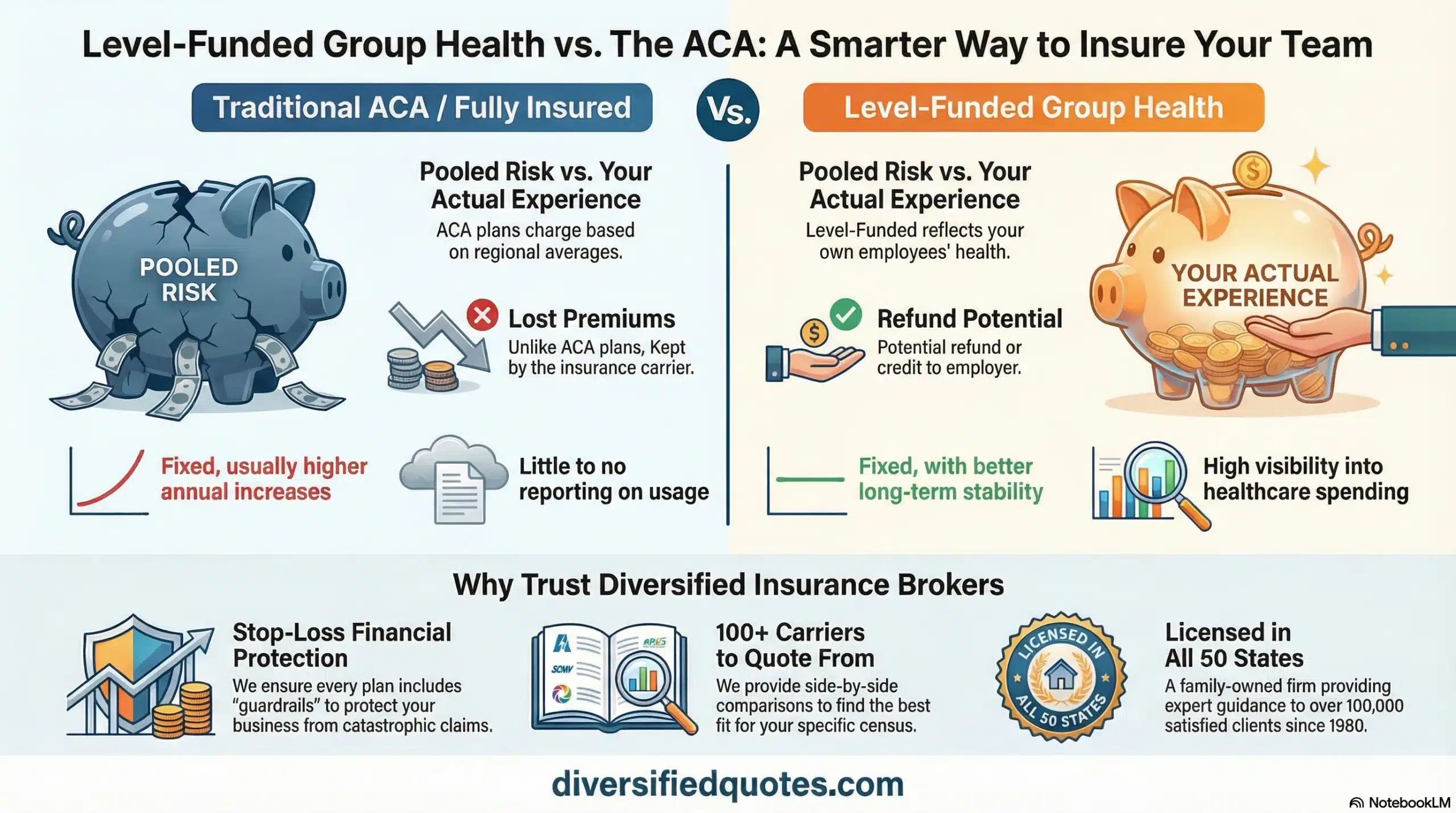
The tradeoff is that you typically give up two things: meaningful transparency and upside participation. In fully insured plans, you generally do not receive a refund for good claims performance. If the carrier’s risk pool trends upward—even if your group had a favorable year—renewals can rise. That dynamic is why many employers feel like they are paying for market conditions they can’t control.
For a 100-employee employer, the question is often not “can we do fully insured?” but “are we paying extra for simplicity that we no longer need to pay extra for?” Many companies at this size can maintain predictable cash flow with alternative funding while gaining tools that reduce waste and improve renewal stability.
Level-Funded Group Health Insurance for 100 Employees
Level-funded group health insurance is a common transition strategy for organizations reaching 100 employees, especially those coming out of fully insured small-group coverage and wanting a “familiar feel” with better financial alignment. Under a level-funded arrangement, the employer pays a fixed monthly amount that includes estimated claims funding, administrative expenses, and stop-loss protection. From a budgeting standpoint, this still feels like fully insured coverage.
The key difference is accountability. Because a portion of the monthly cost funds projected claims, the plan can reconcile at year end. If claims are lower than projected, unused claim dollars may be returned to the employer (as a refund or credit) depending on contract terms. That means your group can benefit directly from favorable performance instead of subsidizing a wider pool.
Employers also tend to get improved reporting in level-funded structures. That visibility can help you identify cost drivers, adjust plan design, refine contributions, and strengthen long-term outcomes. Even if refund potential is modest in a given year, many employers still experience better renewal dynamics because the pricing is closer to the group’s reality.
Level-funded isn’t “risk-free,” but it usually introduces a controlled, capped form of risk. Stop-loss protection is built into the structure, which helps stabilize exposure and prevent catastrophic claim spikes from becoming business-threatening events.
Partially Self-Funded Plans at 100 Employees
Partially self-funded group health plans are often especially well suited for organizations with 100 employees because the group size tends to be large enough to generate meaningful data but still small enough to benefit from flexible plan design and tighter cost controls. In this model, the employer typically pays claims as they occur rather than prepaying a fixed premium that includes carrier margins and pooled risk load.
Stop-loss insurance remains the safety net. Specific stop-loss caps exposure for large individual claims, and aggregate stop-loss limits total plan-year claim exposure beyond defined thresholds. This is a critical point: self-funding does not mean “unlimited risk.” When designed correctly, stop-loss creates a predictable maximum exposure range.
The biggest advantage for many employers is transparency. Employers gain clearer visibility into where healthcare dollars are actually spent. That allows leadership to address cost drivers more directly: pharmacy utilization, high-cost claimants, chronic conditions, site-of-care choices, network unit costs, and plan incentive alignment.
If your organization is new to this approach, understanding what self-funded group health insurance is can help clarify how risk is controlled. Reviewing the pros and cons of self-funded group health can also help determine whether this structure aligns with your company’s financial goals and governance preferences.
Stop-Loss: The Real Risk-Control Lever at 100 Employees
Stop-loss is the backbone of risk management in level-funded and self-funded structures. The attachment points you choose—both specific and aggregate—shape the financial behavior of the plan. More conservative stop-loss structures reduce volatility but can raise fixed cost. Less conservative structures can reduce fixed cost but increase variance.
At 100 employees, stop-loss design becomes a strategic choice rather than a checkbox. The right structure depends on cash reserves, risk tolerance, historical claimant patterns, and leadership preferences. Some employers prefer a tighter “guardrail” approach with stronger protections. Others prefer a more performance-participation approach that can reduce fixed cost in exchange for wider variance.
Either way, stop-loss should be coordinated with plan design. For example, if a plan is built to steer utilization away from high-cost settings, you can often reduce volatility without relying solely on stop-loss. Conversely, if utilization is unmanaged and employees frequently use high-cost settings, stop-loss becomes more expensive over time.
Reducing Group Health Insurance Costs for 100 Employees Without Cutting Benefits
At 100 employees, sustainable savings rarely come from reducing benefits or shifting excessive costs to employees. That approach can damage retention and recruitment, and it often creates unintended consequences like deferred care and higher downstream claims. The better path is usually smarter plan architecture that reduces waste while keeping benefits competitive.
Network strategy is often one of the most powerful levers. In many markets, there are major differences in unit costs between networks even when the provider list looks similar. Employers sometimes pay more simply because their network contracts are more expensive. Evaluating network options can reduce cost while preserving employee access.
Pharmacy management is another major driver. Specialty medications can produce a disproportionate share of total spend. Strong PBM strategy, formulary management, site-of-care optimization, and clinical programs can all materially influence trend. For many employers, pharmacy is where “hidden inflation” lives.
Plan design incentives also matter. When employees have clear pathways to urgent care, telemedicine, primary care, and nurse lines, avoidable ER use tends to drop. When plan design supports preventive engagement and chronic management, high-cost episodes can decline over time.
At 100 employees, these improvements aren’t just theoretical. The volume is large enough that changes can produce meaningful financial impact, but the organization is still small enough to communicate effectively and drive behavior change with a well-designed engagement strategy.
Refund Potential and Renewal Stability at 100 Employees
Fully insured plans provide no direct reward for good claims performance. Alternative funding models change this dynamic. Level-funded plans may return unused claim dollars. Partially self-funded plans avoid paying fixed premiums for risk that never materializes. Both structures can improve renewal predictability, because pricing becomes more connected to the group’s actual experience rather than generalized assumptions.
That doesn’t mean renewals disappear. Healthcare inflation is real. But when you have visibility and the ability to address drivers, renewals often become more explainable and manageable. Leadership can forecast better because cost outcomes aren’t purely a black box.
A practical approach is to model multiple scenarios each year: expected, favorable, and adverse. That approach builds confidence because leadership understands both the possible upside and the worst-case range—especially when stop-loss defines the ceiling.
Claims Reporting and What You Can Actually Do With It
Reporting is only valuable if it leads to action. At 100 employees, de-identified claims reporting can guide meaningful decisions. If pharmacy is driving trend, you can address PBM strategy. If ER utilization is high, you can implement navigation tools and plan design adjustments that steer to lower-cost sites of care. If certain chronic conditions are generating repeated high-cost events, you can implement coaching programs and preventive interventions.
Employers also use reporting to improve communication. Many employees do not realize how choices like site-of-care and generic adoption affect premiums over time. When communication is respectful and practical, employee engagement often improves and frustration declines. Transparency can actually strengthen culture when it is used to build shared understanding rather than blame.
Participation and Employer Contribution Strategy at 100 Employees
Participation requirements are generally less restrictive at 100 employees than they are for very small groups, but contribution strategy still influences pricing and long-term stability. High participation tends to produce more credible underwriting and broader plan design options. Employer contribution levels influence employee satisfaction and retention, and they also shape how employees perceive the value of benefits.
At this size, many employers also begin offering multiple plan options. That flexibility can improve satisfaction but must be designed carefully to avoid unintended selection effects (for example, if one plan design attracts higher utilizers disproportionately). Good design balances choice with risk stability.
Implementation: What the Transition Process Typically Looks Like
One of the biggest concerns employers have is disruption. A funding transition—especially toward level-funded or partially self-funded—should not feel chaotic for employees. When executed properly, the employee experience can remain familiar: same networks, similar ID card experience, and clear enrollment communication.
Most implementations start with a clean census review and baseline plan analysis. Then we evaluate funding options, stop-loss designs, network strategies, and plan designs. Once a preferred approach is selected, we coordinate enrollment, onboarding communication, and administrative setup to avoid surprises.
Done well, the process feels like a controlled upgrade rather than a dramatic shift. The biggest difference for leadership is improved visibility and better long-term financial control.
Planning Beyond 100 Employees
The group health insurance strategy selected at 100 employees often becomes the foundation for the next decade of growth. Employers that introduce transparency, accountability, and cost control at this stage typically scale more efficiently as they move into larger group categories. Those that delay often find themselves reacting to renewal increases instead of managing them.
Reaching 100 employees creates leverage. The question is whether your plan design captures that leverage or leaves it on the table. When healthcare becomes one of the largest operating expenses, proactive strategy is not optional—it’s part of responsible business management.
Compare Group Health Options for 100 Employees
See how fully insured, level-funded, and partially self-funded plans compare for a 100-employee workforce.
Stress-Test Your Renewal Exposure
We’ll model expected, favorable, and adverse claim-year outcomes so leadership can plan confidently.
Related Group Health Pages
Explore additional guides for employers evaluating plan structures and cost control strategies.
Pick Your Company Size
Not the right headcount? Use the buttons below to jump to the group health page that matches your workforce.
Group Health Insurance for 10 Employees
Small-team pricing, participation strategy, and easy rollout.
Group Health Insurance for 20 Employees
Plan design choices that improve cost control and retention.
Group Health Insurance for 30 Employees
Reduce renewal spikes and address pharmacy cost drivers.
Group Health Insurance for 40 Employees
Better plan efficiency as your claims credibility improves.
Group Health Insurance for 50 Employees
Cost containment strategies and scalable benefit design.
Group Health Insurance for 60 Employees
Improve predictability and reduce waste without cutting benefits.
Group Health Insurance for 70 Employees
Funding choices that reduce renewal volatility as you grow.
Group Health Insurance for 80 Employees
Plan design and vendor strategy to control cost trends.
Group Health Insurance for 90 Employees
Prepare for 100+ pricing leverage and stabilize renewals.
Group Health Insurance for 100 Employees
A major transition point: funding options expand and plan design matters more.
Group Health Insurance for 150 Employees
More claims credibility means more leverage—optimize funding and reduce overpaying.
Group Health Insurance for 250 Employees
Advanced funding and transparency strategies for stronger cost control.
Group Health Insurance for 500 Employees
Enterprise approach: analytics, vendor oversight, and smarter funding strategy.
Group Health Insurance for 750 Employees
Scaled cost-control with deeper data visibility and targeted interventions.
Group Health Insurance for Over 1,000 Employees
Enterprise governance, advanced funding, and high-impact cost management.
Talk With an Advisor Today
Choose how you’d like to connect—call or message us, then book a time that works for you.
Schedule here:
calendly.com/jason-dibcompanies/diversified-quotes
Licensed in all 50 states • Fiduciary, family-owned since 1980
FAQ for Group Health Insurance for 100 Employees
Can a company with 100 employees get group health insurance?
Yes. Employers with 100 employees typically qualify for fully insured, level-funded, and partially self-funded group health plans.
Are refunds possible with group health insurance at 100 employees?
Refunds may be available under level-funded plans or through reduced net costs in partially self-funded arrangements.
Is self-funding risky for a 100-employee company?
Stop-loss insurance caps exposure for large claims and total annual costs, helping manage financial risk.
How long does implementation usually take?
Most group health plans can be implemented within a few weeks once underwriting and enrollment are completed.
Can this plan scale as the company grows?
Yes. Plans designed with transparency and cost control scale more effectively as employee count increases.
About the Author:
Jason Stolz, CLTC, CRPC and Chief Underwriter at Diversified Insurance Brokers, is a senior insurance and retirement professional with more than two decades of real-world experience helping individuals, families, and business owners protect their income, assets, and long-term financial stability. As a long-time partner of the nationally licensed independent agency Diversified Insurance Brokers, Jason provides trusted guidance across multiple specialties—including fixed and indexed annuities, long-term care planning, personal and business disability insurance, life insurance solutions, and short-term health coverage. Diversified Insurance Brokers maintains active contracts with over 100 highly rated insurance carriers, ensuring clients have access to a broad and competitive marketplace.
His practical, education-first approach has earned recognition in publications such as VoyageATL, highlighting his commitment to financial clarity and client-focused planning. Drawing on deep product knowledge and years of hands-on field experience, Jason helps clients evaluate carriers, compare strategies, and build retirement and protection plans that are both secure and cost-efficient.
