
Group Health Insurance for 20 Employees

Jason Stolz CLTC, CRPC
Group health insurance for 20 employees is where many growing companies start to feel the difference between “having a plan” and having a real healthcare strategy. At this size, even a modest renewal increase can materially affect cash flow, and the wrong plan structure can cause you to overpay year after year—without improving coverage or employee satisfaction.
For many employers, 20 employees is also a sweet spot where more advanced funding options become realistic. Instead of accepting fully insured pricing that’s built for worst-case assumptions, many businesses can explore alternatives that improve cost control, increase transparency, and introduce refund potential when claims run favorably. The goal is not complexity for its own sake. The goal is a better long-term outcome: a plan that fits how your employees actually use healthcare and a renewal process that feels explainable instead of random.
At Diversified Insurance Brokers, we help employers with 20 employees compare traditional and alternative funding approaches side by side, focusing on practical ways to reduce healthcare costs without cutting benefits or shifting excessive expenses onto employees. On this page, you’ll learn what typically drives cost increases at 20 employees, which plan structures are commonly available, how level-funded and partially self-funded designs work, and how to evaluate these options using a clear “total cost of ownership” approach rather than only looking at premium.
Group Health Review for 20 Employees
We’ll review your current plan, renewal pressure, and cost drivers to identify options that can lower spend and improve predictability.
Request a Group Health ReviewWhy Healthcare Costs Often Jump at 20 Employees
Many 20-employee companies are still placed into a fully insured small-group plan by default. Fully insured coverage is straightforward: you pay a set premium every month, the carrier pays claims, and renewals are recalculated each year. The simplicity is appealing, especially when a business is busy growing and leadership wants healthcare to be “handled.”
The challenge is that fully insured premiums typically include conservative risk pricing, administrative load, and carrier profit—regardless of whether your team actually generates that level of claims. Fully insured pricing is built to protect the carrier from variability across the market. That means your premiums may reflect assumptions that are not aligned with your specific group’s reality, especially if your workforce is stable and your utilization patterns are relatively efficient.
If your group has a healthy year, you generally do not benefit. If claims spike anywhere in the carrier’s broader pool, renewals can rise even if your own group did not change. If your group has a high-cost year, renewals can jump sharply with little clarity about which components drove the increase. That is why many employers describe fully insured renewals as a “black box.” Costs rise, explanations are vague, and it’s difficult to know what changes will actually improve outcomes.
If you want a broader overview of the building blocks of employer coverage, this guide on group medical insurance is a helpful foundation for comparing plan types and funding approaches. Understanding the building blocks makes it easier to evaluate whether you’re paying for “risk padding” you may not need.
What Changes at 20 Employees: Stability, Credibility, and Leverage
Even though 20 employees still qualifies as a small group, it is often large enough to be more stable than early-stage companies and small enough that each plan decision still matters. The group is typically past the “two-person” or “five-person” volatility stage where one employee’s decision to enroll or waive can dramatically change participation and pricing. With 20 employees, you often have a more credible enrollment base, which opens additional plan designs and sometimes more competitive quoting.
At 20 employees, employers also start to feel the pain of inefficiency more clearly. If premiums increase $150 per employee per month, that’s a meaningful annual cost. If out-of-pocket exposure is misaligned and employees avoid care, productivity can suffer. If the network is too narrow and people can’t access care efficiently, claims often show up later in more expensive settings. This is where “strategy” begins to matter because small improvements can create meaningful financial impact.
The practical takeaway is that 20 employees can be the right time to stop buying plans like a commodity and start evaluating how the plan behaves in real life.
Funding Strategies That Become More Viable at 20 Employees
Group Health Insurance for 20 employees, at this size, employers often have enough enrollment stability to consider alternatives to traditional fully insured coverage. The biggest shift is moving from “premium-first” pricing to a structure where costs are tied more closely to actual claims, with protections built in to limit risk. This creates accountability. It also creates a pathway for the employer to benefit when claims are favorable, rather than always paying as though the worst will happen.
These strategies typically fall into two categories: level-funded plans and partially self-funded plans. Both can be designed with stop-loss protection so a single large claim doesn’t derail the plan. Both can also provide better reporting than a standard fully insured small-group plan, which helps leadership identify what actually drives trend and where the most valuable changes are.
Employers exploring alternative funding often benefit from understanding minimum employees for group health insurance and how participation and contribution rules affect eligibility and pricing at this size. Some programs have more flexible guidelines than others. The best fit depends on your state, industry, enrollment, and how the carrier views your risk profile.
Level-Funded Plans for 20 Employees: Predictability With Performance Alignment
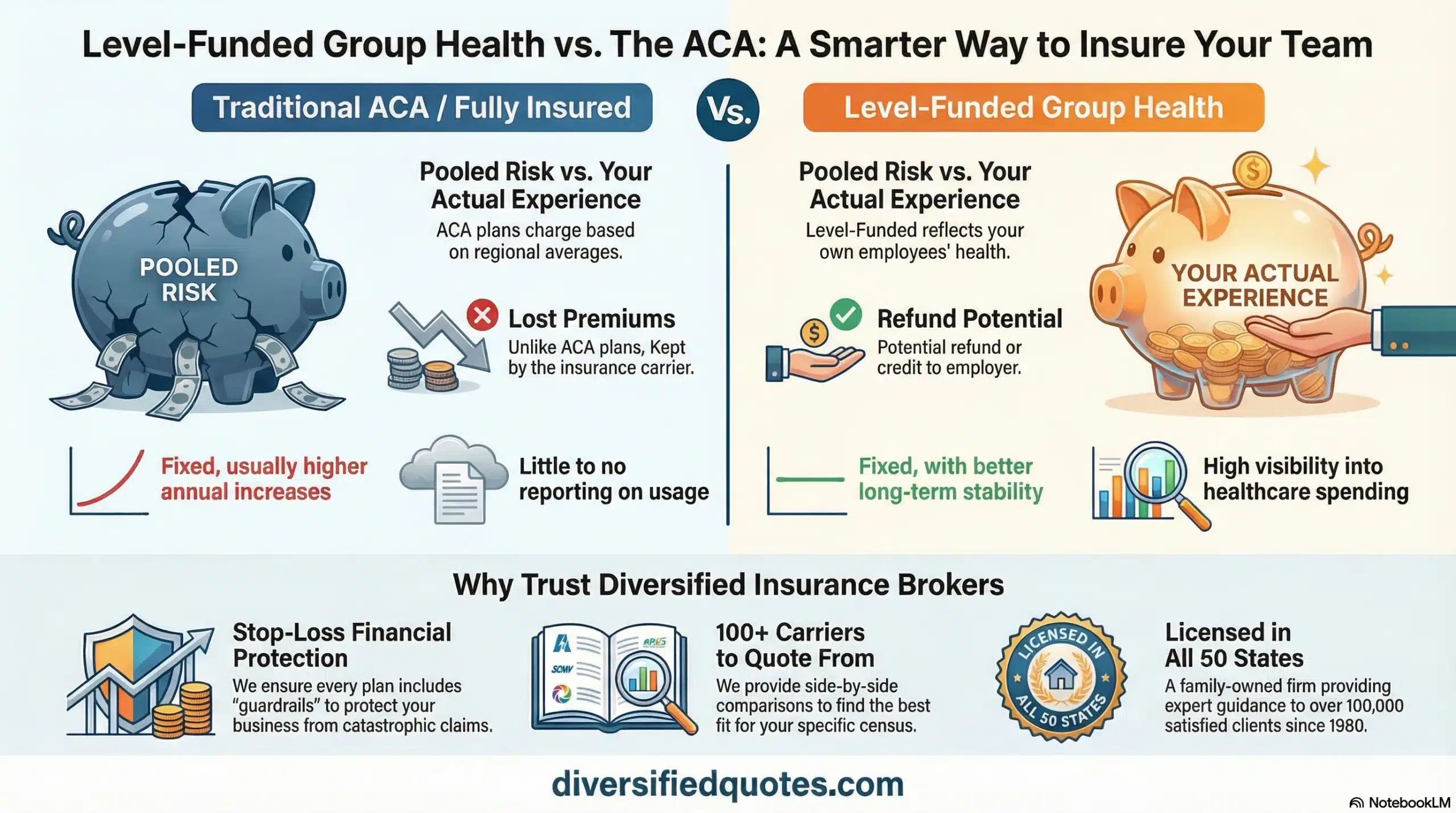
Level-funded plans are a common stepping stone for 20-employee groups because they preserve predictable monthly budgeting while improving how the plan is priced and reconciled. Employers like them because they still feel “clean” from a cash flow standpoint. You have a fixed monthly cost and an employee experience that typically feels like a traditional plan.
In a typical level-funded design, your monthly cost includes three components: estimated claims funding, administrative costs, and stop-loss protection. The claims component is essentially a budgeted amount that is intended to cover expected utilization. Stop-loss protects against high-cost claims beyond the plan’s thresholds. Administration includes the mechanics of the plan: processing claims, managing enrollment, providing ID cards, and maintaining plan operations.
The key difference is what happens when the plan year ends. If claims are lower than expected, there may be unused claim dollars that can be returned to the employer, usually as a refund or premium credit depending on the carrier’s rules and the contract language. This refund potential is one of the main reasons level-funded plans can reduce net cost for groups with favorable claims experience.
Even when refunds are modest, level funding can improve renewals because pricing is more connected to the group’s actual experience rather than broad pooled assumptions. That can reduce the feeling that renewals are arbitrary. In many cases, employers also appreciate the reporting because it helps them understand trend drivers instead of only reacting to rate increases.
Partially Self-Funded Plans: Transparency and Cost Control
Some 20-employee companies may qualify for partially self-funded arrangements, especially when the group’s demographics and industry profile align well with carrier underwriting. With partial self-funding, the employer pays claims as they occur, while stop-loss insurance caps exposure for large individual claims and total annual plan spend.
This approach can increase transparency because employers gain visibility into claims patterns. Instead of receiving a renewal increase with limited explanation, you can often see what’s driving costs and make targeted changes—such as adjusting plan design, improving the network fit, or addressing pharmacy spend more strategically. The goal is not to “micro-manage” healthcare; it is to have the information necessary to make high-impact decisions instead of guessing.
For many employers, the first step is understanding what self-funded group health insurance is and how stop-loss protection works to limit risk. It also helps to understand tradeoffs. This overview of the pros and cons of self-funded group health is useful for employers who want cost control but don’t want unpredictable exposure.
At 20 employees, the decision is not “self-funded or not.” The decision is “how much variability are we comfortable with, and how do we structure stop-loss and plan design to keep outcomes within a range leadership can tolerate?” A well-structured partially self-funded plan can still behave predictably when designed correctly.
How 20-Employee Employers Reduce Costs Without Cutting Benefits
When employers say they want to “lower healthcare costs,” they often assume the only lever is raising deductibles or shifting more premium to employees. That approach can backfire by reducing participation, lowering morale, and causing employees to delay needed care, which frequently leads to higher costs later. At 20 employees, you want cost control that employees can live with, not cost shifting that creates resentment and poorer health outcomes.
Meaningful savings often come from plan architecture rather than benefit reduction. A better network fit can reduce claims cost without changing the employee experience. A smarter prescription approach can lower spend significantly, especially when specialty medications are involved. Deductibles and copays can be structured to encourage appropriate utilization rather than simply shifting costs. When the plan encourages primary care, telemedicine, and urgent care for non-emergency needs, avoidable high-cost utilization often declines over time.
Cost control also improves when the plan aligns with how employees actually use healthcare. If the workforce primarily uses primary care and urgent care, a plan that makes those services predictable can reduce expensive downstream claims. If chronic conditions are present, improving medication adherence and preventive care often costs less than allowing conditions to escalate into high-cost episodes. The goal is a plan that supports good decisions by default rather than a plan that creates friction.
Refunds, Surplus, and “Getting Credit” for a Good Claims Year
One of the most frustrating parts of fully insured plans is that an employer can have a low-claims year and still see a renewal increase—sometimes with no meaningful explanation. Employers often ask, “If we had a good year, why did our rates go up?” The answer is that fully insured pricing often reflects pooled trend, carrier assumptions, and risk loads that aren’t directly tied to your group’s performance in a way you can capture financially.
Alternative funding changes that dynamic. In many level-funded arrangements, when claims are lower than expected, the unused claim portion may be returned based on the program’s reconciliation rules. In partially self-funded designs, when claims are favorable, the employer simply isn’t paying a padded premium for risk they didn’t generate. That is one reason many employers explore these structures: they create a pathway to benefit financially from efficient claims experience rather than always paying as though the worst will happen.
The important practical step is to evaluate refund potential realistically. Refunds are not guaranteed. They depend on claims performance and the contract language. The right way to compare plans is to model multiple scenarios and focus on “expected” outcomes rather than only best-case outcomes.
Participation, Waivers, and Eligibility at 20 Employees
At 20 employees, eligibility and participation usually aren’t a problem, but they still matter. If several employees waive coverage because they are on a spouse’s plan, some carriers may view participation as weaker, which can influence rates or plan availability. Employer contribution also matters because it affects participation and the perceived stability of the plan.
Strong participation is often viewed favorably at underwriting because it suggests the plan is stable and the group isn’t only enrolling the people who need the most care. Strong employer contribution can support better participation, but the contribution strategy should still be aligned with payroll realities and the company’s compensation philosophy. At 20 employees, one of the most common mistakes is forcing a contribution approach that looks good “on paper” but creates dissatisfaction in practice.
These details matter because the “best” plan on paper is not helpful if underwriting declines it or if it can’t be implemented cleanly. The right plan is one that is not only competitive but also installable and sustainable.
Why Independent Plan Comparison Matters More at 20 Employees
Many small employers are shown one carrier and one plan design, then told the renewal is the renewal. That approach removes leverage and hides alternatives that may be a better fit. At 20 employees, the differences between carriers and funding designs can be meaningful. One carrier may price aggressively for your industry while another is conservative. One level-funded program may offer stronger stop-loss terms, while another may provide more useful reporting that helps improve plan performance over time.
Independent comparison across carriers and funding structures is often what unlocks savings because it allows the plan to be designed intentionally rather than accepted passively. Even when the “best” plan is still fully insured, the act of comparing can improve outcomes because it ensures the plan choice is based on fit and competitiveness rather than defaulting into the status quo.
Employers who treat benefits as part of a recruiting and retention system tend to benefit most from independent comparison. The goal is not simply to buy a plan—it is to create a benefit that employees value and that the company can afford long term.
Compare Funding Options Side by Side
See how fully insured, level-funded, and partially self-funded plans compare for a 20-employee group.
Get a ComparisonWhen a 20-Employee Group Should Stay Fully Insured
Not every 20-employee employer should move away from fully insured coverage. If the group has very high expected claims, significant enrollment instability, heavy seasonal shifts, or underwriting concerns that make alternative models unattractive, a fully insured plan can still be the most practical fit. In those situations, the best strategy may be selecting the right carrier and plan design, then improving renewal positioning through clean enrollment and smart contribution planning.
The goal is not to force a funding model. The goal is to evaluate whether the company is overpaying for pooled assumptions when more transparent options are available. In many cases, employers find that a blended approach works best: keep stability and simplicity while improving cost accountability and renewal predictability over time through better carrier selection, network fit, and plan design.
If your organization is growing, it’s also wise to think about what the next stage will look like. A plan strategy that works well at 20 employees can become the foundation for smoother growth at 30, 40, and 50 employees. The earlier you build a system that produces predictable renewals, the less disruptive benefits become as the business expands.
What to Do Next
If you want to reduce costs at 20 employees without cutting benefits, the best next step is a side-by-side comparison that includes the plan mechanics, not just premium. That means reviewing the network, prescription strategy, plan design, and renewal behavior under each funding model. When you can see how each option behaves in good, average, and bad claim years, decision-making becomes much simpler.
We typically start with your current plan and a basic census, then show comparable plan designs so you’re not comparing apples to oranges. From there, we identify which structure best matches your priorities: maximum simplicity, higher transparency, improved renewal predictability, or potential performance-based savings.
Request a Quote for a 20-Employee Group
Tell us your goals and we’ll build options that balance cost, coverage, and renewal stability.
Request Group Health OptionsRelated Group Health Pages
Explore additional small employer resources and plan-structure guides.
Pick Your Company Size
Not the right headcount? Use the buttons below to jump to the group health page that matches your workforce.
Group Health Insurance for 10 Employees
Small-team pricing, participation strategy, and easy rollout.
Group Health Insurance for 20 Employees
Plan design choices that improve cost control and retention.
Group Health Insurance for 30 Employees
Reduce renewal spikes and address pharmacy cost drivers.
Group Health Insurance for 40 Employees
Better plan efficiency as your claims credibility improves.
Group Health Insurance for 50 Employees
Cost containment strategies and scalable benefit design.
Group Health Insurance for 60 Employees
Improve predictability and reduce waste without cutting benefits.
Group Health Insurance for 70 Employees
Funding choices that reduce renewal volatility as you grow.
Group Health Insurance for 80 Employees
Plan design and vendor strategy to control cost trends.
Group Health Insurance for 90 Employees
Prepare for 100+ pricing leverage and stabilize renewals.
Group Health Insurance for 100 Employees
A major transition point: funding options expand and plan design matters more.
Group Health Insurance for 150 Employees
More claims credibility means more leverage—optimize funding and reduce overpaying.
Group Health Insurance for 250 Employees
Advanced funding and transparency strategies for stronger cost control.
Group Health Insurance for 500 Employees
Enterprise approach: analytics, vendor oversight, and smarter funding strategy.
Group Health Insurance for 750 Employees
Scaled cost-control with deeper data visibility and targeted interventions.
Group Health Insurance for Over 1,000 Employees
Enterprise governance, advanced funding, and high-impact cost management.
Talk With an Advisor Today
Choose how you’d like to connect—call or message us, then book a time that works for you.
Schedule here:
calendly.com/jason-dibcompanies/diversified-quotes
Licensed in all 50 states • Fiduciary, family-owned since 1980
FAQ for Group Health Insurance for 20 Employees
Can a company with 20 employees get group health insurance?
Yes. Most carriers offer group health plans at 20 employees, including fully insured and alternative funding options.
Are level-funded plans available for 20 employees?
In many cases, yes. Eligibility depends on industry, claims history, and underwriting guidelines.
Can a 20-employee group receive refunds?
Refunds are possible under level-funded or partially self-funded plans when claims are lower than expected.
Do healthcare costs usually increase as a company reaches 20 employees?
Costs can increase if plans are not restructured. Many employers reduce per-employee costs by changing funding approaches.
What participation requirements apply at 20 employees?
Participation rules vary by carrier, but 20-employee groups often meet requirements more easily than very small groups.
Is self-funding risky for a 20-employee company?
Risk is managed through stop-loss insurance, which caps exposure and protects against large claims.
How long does implementation take?
Most group plans can be implemented within a few weeks once underwriting and enrollment requirements are met.
About the Author:
Jason Stolz, CLTC, CRPC and Chief Underwriter at Diversified Insurance Brokers, is a senior insurance and retirement professional with more than two decades of real-world experience helping individuals, families, and business owners protect their income, assets, and long-term financial stability. As a long-time partner of the nationally licensed independent agency Diversified Insurance Brokers, Jason provides trusted guidance across multiple specialties—including fixed and indexed annuities, long-term care planning, personal and business disability insurance, life insurance solutions, and short-term health coverage. Diversified Insurance Brokers maintains active contracts with over 100 highly rated insurance carriers, ensuring clients have access to a broad and competitive marketplace.
His practical, education-first approach has earned recognition in publications such as VoyageATL, highlighting his commitment to financial clarity and client-focused planning. Drawing on deep product knowledge and years of hands-on field experience, Jason helps clients evaluate carriers, compare strategies, and build retirement and protection plans that are both secure and cost-efficient.
