
Group Health Insurance for 500 Employees

Jason Stolz CLTC, CRPC
Group health insurance for 500 employees operates at an enterprise level where healthcare benefits are no longer just an HR expense—they are a core financial system that can materially affect profitability, cash flow, and long-term corporate strategy. At this size, insurers price coverage almost entirely on your organization’s own claims data, utilization trends, and risk management practices rather than market averages.
Employers with 500 employees often find that legacy plan structures—especially fully insured models—become increasingly inefficient. Premiums rise regardless of actual performance, transparency is limited, and leadership lacks actionable insight into what is driving costs. The advantage at 500 employees is scale: you now have the leverage, data, and stability to design a group health strategy that actively controls costs instead of reacting to annual renewals.
At Diversified Insurance Brokers, we help organizations with 500 employees restructure group health insurance to improve cost predictability, increase transparency, and support sustainable enterprise growth without compromising benefit quality or employee experience. This page breaks down how enterprise underwriting works, what funding models are typically available, where large employers tend to overpay, and how to build a system that stays stable as the workforce grows.
Enterprise Group Health Strategy Review (500 Employees)
We’ll evaluate your current group health plan, claims performance, funding structure, and renewal exposure to identify opportunities for cost control and long-term stability.
Why Group Health Insurance for 500 Employees Is an Enterprise Decision
Group health insurance for 500 employees is fully experience-rated in most practical ways, even when the plan is structured to feel “simple.” Underwriters and carrier partners examine multiple years of claims data, pharmacy utilization, chronic condition prevalence, specialty drug exposure, and trend patterns with precision. A handful of plan design assumptions—how the network is built, how pharmacy is managed, and how care is navigated—can create or eliminate seven figures of excess spend at this scale.
That is why enterprise group health becomes a governance issue as much as a benefits issue. When healthcare spend is large enough to move margins, leadership teams need a structure that produces reliable data and measurable outcomes. Organizations that continue using reactive or legacy plan designs often see healthcare costs grow faster than revenue. By contrast, employers that adopt intentional funding strategies and data-driven plan management frequently outperform market benchmarks.
Understanding how group medical insurance pricing works helps explain why strategic oversight becomes essential. At 500 employees, the plan stops behaving like a generic “product” and starts behaving like an operating system with inputs, outputs, and levers that can be adjusted.
What Changes at 500 Employees Compared to Mid-Size Groups
At 50 or 100 employees, a plan can still feel unpredictable because single claims can swing the year. At 500 employees, the plan develops a usable pattern. There will always be outliers—high-cost claimants and unpredictable events—but the overall distribution becomes steady enough to manage intentionally. That stability is what makes advanced funding, analytics, and vendor accountability work.
It also means “hidden” inefficiencies are no longer small. If the plan is overpaying due to network pricing, pharmacy spread, lack of care navigation, or misaligned plan design, the organization can experience excess spending that compounds annually. At 500 employees, the most expensive plan is often the one that seems easiest to maintain because the organization never sees where dollars are going.
Group Health Insurance Funding Options at 500 Employees
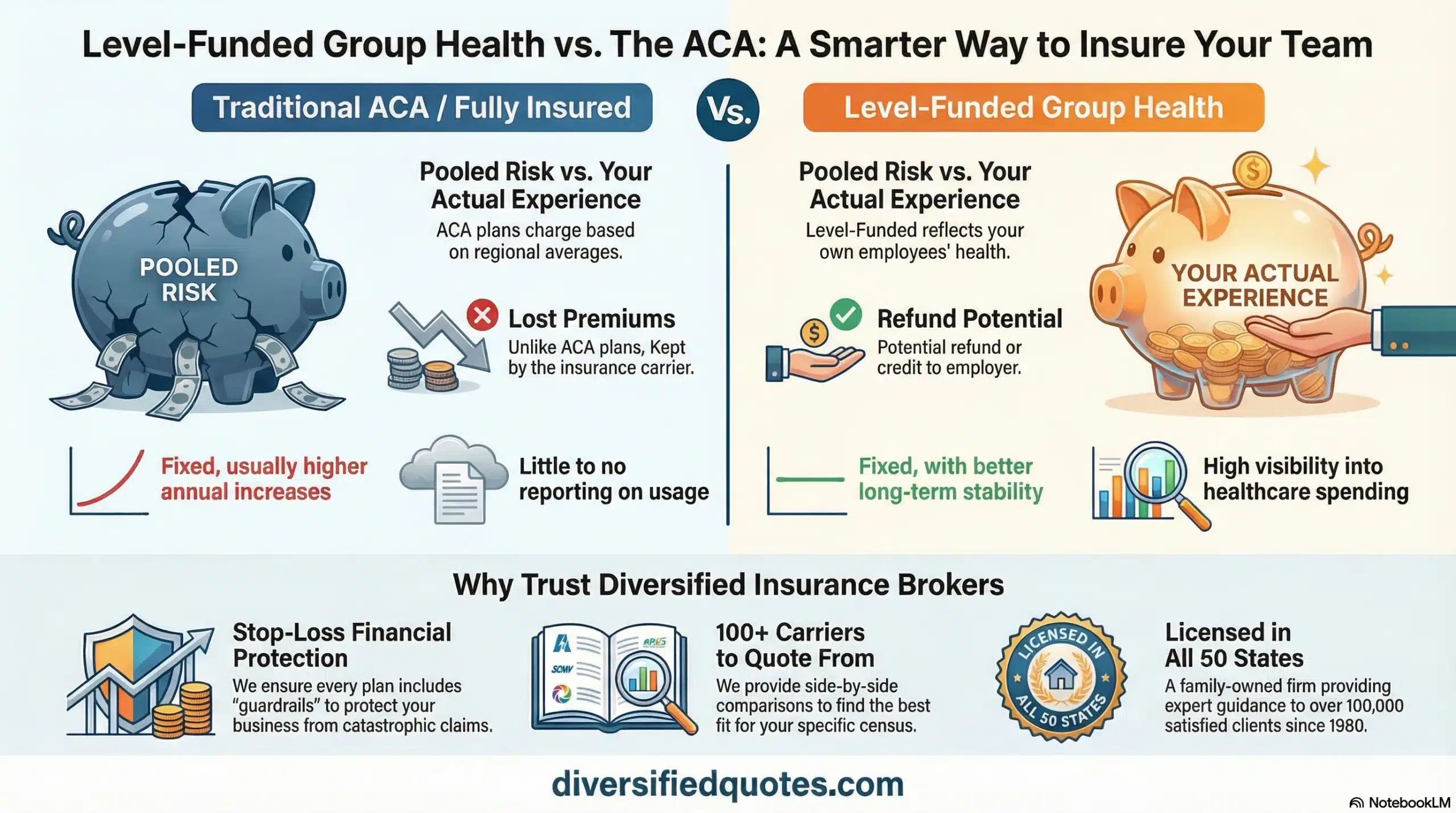
Employers with 500 employees typically qualify for every major group health funding model. Fully insured plans remain available, but they are rarely the most efficient choice due to carrier margins, embedded risk loads, and limited transparency. Many fully insured plans also make it difficult to measure vendor performance because reporting tends to be limited or delayed.
Self-funded and partially self-funded plans are the dominant structures at this size. These models align healthcare spending directly with actual claims while using stop-loss insurance to cap catastrophic exposure. Many organizations begin by reviewing minimum employees for group health insurance simply to understand why self-funding becomes more viable as employee count increases and claims volume becomes more predictable.
The better question at 500 employees is not “Can we self-fund?” but “What funding structure creates the right balance of control, transparency, and budgeting consistency for our leadership team?”
Self-Funded Group Health Insurance for 500 Employees
Self-funded group health insurance is often the most efficient structure for employers with 500 employees because it replaces prepaid premium pricing with a system that reflects real plan performance. In a self-funded arrangement, the employer pays medical claims as they occur rather than prepaying fixed premiums. Stop-loss insurance protects against large individual claims and excessive aggregate exposure, providing financial guardrails.
The primary advantage of self-funding at this scale is control. Employers gain visibility into claims drivers, allowing leadership to address pharmacy costs, chronic conditions, network utilization, and care management proactively. Instead of waiting for renewal and hoping for the best, the organization can monitor performance and adjust strategy continuously.
For organizations evaluating this approach, understanding what self-funded group health insurance is provides clarity around risk management and governance. It is also important to weigh considerations carefully. Reviewing the pros and cons of self-funded group health helps align strategy with organizational risk tolerance and budgeting preferences.
Stop-Loss Strategy at 500 Employees: Building Predictable Guardrails
Stop-loss is not just a “safety net” at enterprise size—it is part of the plan’s operating design. The organization typically selects attachment points based on risk tolerance, cash flow preferences, and the plan’s claims distribution. Specific stop-loss limits exposure to a high-cost individual claimant. Aggregate stop-loss caps total annual claims beyond the expected range.
At 500 employees, stop-loss strategy should support stability. Many organizations prefer guardrails that keep year-to-year volatility within a predictable band. That lets finance teams plan while still allowing the plan to benefit from efficient performance. If attachment points are set too conservatively, the plan can behave like fully insured pricing without delivering transparency benefits. If they are set too aggressively, leadership may perceive self-funding as “volatile” even when the long-term economics are superior.
The right stop-loss approach is usually the one leadership can commit to for multiple years while making incremental improvements to plan performance.
Partially Self-Funded and Hybrid Structures
Some organizations with 500 employees prefer partially self-funded or hybrid structures that blend predictability with transparency. These arrangements preserve smoother cash flow while still allowing employers to benefit from favorable claims performance. They can also serve as transitional models for organizations moving from fully insured coverage toward full self-funding.
Hybrid strategies are often paired with stronger reporting, pharmacy carve-outs, and care navigation programs to maximize efficiency. The organization may keep certain elements more predictable while gaining the measurement needed to manage the biggest drivers of spend.
At enterprise size, hybrid is often less about “easing into” self-funding and more about tailoring the funding approach to how leadership wants to budget and govern healthcare spend.
Reducing Group Health Insurance Costs for 500 Employees
At this size, sustainable healthcare savings rarely come from reducing benefits or shifting costs to employees. Those approaches can erode participation, reduce satisfaction, and cause employees to delay care, which frequently increases high-cost claims later. Instead, cost reduction is typically driven by structural improvements that reduce waste while preserving access.
Network optimization can significantly affect claims costs without reducing provider access. Many employers pay more than necessary due to network configuration and unit-cost differences that aren’t visible on a premium invoice. Pharmacy benefit strategy is often the largest cost driver, particularly with specialty medications. Aligning plan design—matching deductibles, copays, and out-of-pocket limits to actual utilization—reduces waste while preserving access to care.
At 500 employees, small “percentage” improvements are large dollar outcomes. That is why enterprise planning focuses on repeatable levers rather than one-time changes.
Pharmacy Strategy at 500 Employees: Where Enterprise Plans Win or Lose
Pharmacy is often the biggest controllable driver of long-term trend. Specialty drugs can represent a small number of claimants and a large share of total spend. Brand utilization when generics are available, lack of prior authorization effectiveness, and limited visibility into rebate structures can all inflate costs without improving outcomes.
Enterprise-level pharmacy management is not about restricting necessary medication. It is about designing the system so the organization pays a fair net cost and employees have a predictable experience. When pharmacy reporting is strong, leadership can identify emerging spend early and address it through plan design, vendor performance requirements, and care management strategy.
For many 500-employee employers, pharmacy management is the largest reason self-funding and transparency outperform fully insured renewals over time.
Claims Analytics, Transparency, and Accountability
One of the greatest advantages of enterprise-scale group health insurance is access to meaningful data—if the plan is structured to capture and use it. With proper reporting, employers can identify cost trends early, evaluate vendor performance, and implement targeted interventions. Transparency creates accountability and supports continuous improvement rather than reactive renewals.
Enterprise governance typically benefits from consistent dashboards that track high-level trend, category-level spend, pharmacy drivers, and utilization patterns. The point is not to micromanage claims, but to manage the system that produces them. When leadership sees performance in time to act, renewals become the result of decisions instead of surprises.
Renewal Stability and Long-Term Financial Planning
Fully insured plans provide limited reward for favorable claims experience because premium is priced as a fixed product with embedded margin. Self-funded and advanced funding models change this dynamic. Employers avoid paying premiums for unused risk and gain greater renewal stability over time because the plan’s cost reflects what actually occurred, plus the guardrails selected via stop-loss.
This improves forecasting. When the organization has visibility into trend and can see the drivers of spend, finance teams can model healthcare costs with more accuracy. That also supports more confident decisions about compensation strategy, hiring, and benefit expansion.
At 500 employees, the “best” plan is often the one that produces consistent governance outcomes: predictable budgeting, measurable improvement levers, and stable employee experience.
Participation and Employer Contribution Strategy at 500 Employees
Participation requirements are generally flexible at this size, but contribution strategy still plays a critical role in plan performance. Strong participation supports risk stability and improves the effectiveness of self-funded structures by reducing adverse selection. Contribution levels also influence employee engagement, recruitment, and retention.
At enterprise scale, contribution strategy is often best viewed as part of the overall talent system. The goal is to maintain a strong benefits offering while aligning the plan design so employees use care efficiently and predictably. When plan design is simple and navigable, satisfaction improves and waste declines.
Planning Beyond 500 Employees
The group health insurance strategy selected at 500 employees often becomes the foundation for long-term enterprise benefits planning. Organizations that establish transparency, accountability, and cost controls at this stage are better positioned to scale efficiently, manage risk, and maintain competitive benefits over time.
The biggest advantage of enterprise scale is the ability to build an operating system that improves each year. Rather than switching carriers constantly, organizations can keep a stable structure and refine performance drivers—network strategy, pharmacy, care navigation, and plan design—incrementally. That approach typically produces better long-term results than chasing short-term premium relief.
When group health becomes a managed financial system, leadership gains something more valuable than a one-year savings: predictability, control, and a benefit plan that supports growth instead of threatening it.
Compare Enterprise Group Health Options
Compare fully insured, partially self-funded, and self-funded strategies for a 500-employee organization.
Request an Enterprise Side-by-Side Analysis
We’ll review your current structure and show plan designs built for enterprise-scale cost control and transparency.
Related Group Health Pages
Explore additional group health and small employer coverage resources.
Financial Protection Essentials
International travel protection, critical illness education, group coverage strategies, and carrier reviews.
Pick Your Company Size
Not the right headcount? Use the buttons below to jump to the group health page that matches your workforce.
Group Health Insurance for 10 Employees
Small-team pricing, participation strategy, and easy rollout.
Group Health Insurance for 20 Employees
Plan design choices that improve cost control and retention.
Group Health Insurance for 30 Employees
Reduce renewal spikes and address pharmacy cost drivers.
Group Health Insurance for 40 Employees
Better plan efficiency as your claims credibility improves.
Group Health Insurance for 50 Employees
Cost containment strategies and scalable benefit design.
Group Health Insurance for 60 Employees
Improve predictability and reduce waste without cutting benefits.
Group Health Insurance for 70 Employees
Funding choices that reduce renewal volatility as you grow.
Group Health Insurance for 80 Employees
Plan design and vendor strategy to control cost trends.
Group Health Insurance for 90 Employees
Prepare for 100+ pricing leverage and stabilize renewals.
Group Health Insurance for 100 Employees
A major transition point: funding options expand and plan design matters more.
Group Health Insurance for 150 Employees
More claims credibility means more leverage—optimize funding and reduce overpaying.
Group Health Insurance for 250 Employees
Advanced funding and transparency strategies for stronger cost control.
Group Health Insurance for 500 Employees
Enterprise approach: analytics, vendor oversight, and smarter funding strategy.
Group Health Insurance for 750 Employees
Scaled cost-control with deeper data visibility and targeted interventions.
Group Health Insurance for Over 1,000 Employees
Enterprise governance, advanced funding, and high-impact cost management.
Talk With an Advisor Today
Choose how you’d like to connect—call or message us, then book a time that works for you.
Schedule here:
calendly.com/jason-dibcompanies/diversified-quotes
Licensed in all 50 states • Fiduciary, family-owned since 1980
FAQ for Group Health Insurance for 500 Employees
Can a company with 500 employees get group health insurance?
Yes. Employers with 500 employees typically qualify for fully insured, partially self-funded, and fully self-funded group health plans.
Is self-funding common for organizations with 500 employees?
Yes. Most organizations at this size use self-funded or hybrid structures due to improved cost control and transparency.
How is financial risk managed in a self-funded plan?
Stop-loss insurance caps exposure for large individual claims and total annual costs.
How long does it take to implement an enterprise group health plan?
Implementation timelines vary, but most plans can be transitioned within a few months with proper planning.
Can group health insurance scale beyond 500 employees?
Yes. Enterprise-level plans are designed to scale efficiently as employee count increases.
About the Author:
Jason Stolz, CLTC, CRPC and Chief Underwriter at Diversified Insurance Brokers (NPN 20471358), is a senior insurance and retirement professional with more than two decades of real-world experience helping individuals, families, and business owners protect their income, assets, and long-term financial stability. As a long-time partner of the nationally licensed independent agency Diversified Insurance Brokers, Jason provides trusted guidance across multiple specialties—including fixed and indexed annuities, long-term care planning, personal and business disability insurance, life insurance solutions, Group Health, and short-term health coverage. Diversified Insurance Brokers maintains active contracts with over 100 highly rated insurance carriers, ensuring clients have access to a broad and competitive marketplace.
His practical, education-first approach has earned recognition in publications such as VoyageATL, highlighting his commitment to financial clarity and client-focused planning. Drawing on deep product knowledge and years of hands-on field experience, Jason helps clients evaluate carriers, compare strategies, and build retirement and protection plans that are both secure and cost-efficient. Visitors who want to explore current annuity rates and compare options across multiple insurers can also use this annuity quote and comparison tool.
