
Group Health Insurance for 60 Employees

Jason Stolz CLTC, CRPC
Group health insurance for 60 employees places many organizations firmly into the mid-size employer category, where healthcare decisions begin to look very different than they did at 20, 30, or even 40 employees. At this size, claims patterns are more established, renewal increases can swing budgets materially, and employers often realize that treating healthcare as a static expense is no longer sustainable.
For companies with 60 employees, the goal typically shifts from simply offering coverage to actively managing healthcare costs, improving predictability, and building a plan that can scale as the workforce grows. This is where funding strategy, transparency, and plan architecture matter far more than carrier branding or default renewals.
At Diversified Insurance Brokers, we help employers with 60 employees redesign group health insurance strategies around long-term cost control, smarter risk management, and employee stability—without sacrificing benefit quality. This page explains how pricing works at this size, why renewals can feel volatile, which funding models tend to be available, and how to build a repeatable system that improves each year instead of resetting every renewal.
Group Health Review for 60 Employees
We’ll evaluate your current plan, renewal exposure, and claims efficiency to identify smarter ways to control healthcare costs.
Why Group Health Insurance Changes at 60 Employees
Group health insurance for 60 employees is driven far more by the employer’s own experience than by generalized small-group assumptions. Claims volume is typically sufficient for underwriters and plan partners to analyze trends, utilization patterns, and risk factors with greater confidence. That doesn’t mean your plan is “predictable” by default—but it does mean you have enough volume to manage it intentionally.
Many employers remain on fully insured plans simply because that is what they have always used. While fully insured coverage offers administrative simplicity, it often embeds conservative pricing, carrier profit margins, and pooled risk assumptions that inflate premiums regardless of how efficiently the workforce actually uses healthcare. When renewals increase, leadership often receives a vague explanation that doesn’t translate into a clear action plan.
This is why organizations at this size frequently experience volatile renewals—even in years where claims feel “average.” Understanding how group medical insurance is priced helps explain why cost control becomes harder when plans are not actively managed. At 60 employees, the plan needs to operate more like a managed financial system—one that produces usable data and improves outcomes year after year.
What Employers Usually Feel at 60 Employees
At 60 employees, healthcare costs are large enough to matter, but often not large enough for employers to feel they have “enterprise” tools. That gap is exactly where many organizations overpay. They get the cost pressure of a mid-size plan, but they remain stuck in an approach that feels like small group: limited options, limited transparency, and a renewal process that happens to them rather than being managed by them.
Common signals include: renewals that swing year to year without a clear driver, frustration with carrier service levels, employees who feel confused about networks and prescriptions, and leadership that has to make contribution decisions without knowing whether the plan is actually efficient. Even when benefits are “fine,” employers often feel like they are paying more each year for the same experience.
The solution is not to chase the lowest premium. The solution is to structure the plan so the employer can measure what is happening, understand the drivers of spend, and apply repeatable levers to reduce waste while protecting employees.
Group Health Insurance Options for 60 Employees
At 60 employees, most organizations have access to a broader range of funding strategies. Fully insured plans remain available, but many employers begin to evaluate alternatives that align costs more closely with actual claims. The most common mid-market options are level-funded and partially self-funded plans, typically paired with stop-loss insurance to cap downside exposure.
Eligibility depends on workforce demographics, industry classification, and claims history. Employers often start by reviewing minimum employees for group health insurance to confirm which plan types are available. At 60 employees, you usually have meaningful flexibility—but it still matters how the group is structured, how participation is managed, and how underwriting is presented.
What matters most is matching the funding model to leadership’s priorities. Some organizations want maximum transparency and control. Others want smoother cash flow while still reducing inefficiencies. The “right” choice is the one that leadership can commit to for multiple years while improving performance drivers over time.
Fully Insured at 60 Employees: When It Works and When It Doesn’t
Fully insured can still be appropriate at 60 employees in certain situations. If a group has unstable enrollment, significant expected claims, or limited administrative bandwidth, fully insured may offer simplicity that matters. The challenge is that many employers remain fully insured by default—not because it is best, but because it is familiar.
Fully insured pricing is typically built with conservative assumptions. The carrier must protect itself against adverse selection and volatility, and it prices accordingly. That can be expensive for groups that are stable and reasonably healthy. Fully insured also tends to limit the employer’s ability to see what is driving costs. When premiums rise, the employer usually gets a number, not a system.
If leadership chooses to stay fully insured, it becomes even more important to shop renewals aggressively, compare multiple carriers, and ensure the plan design is not quietly drifting into inefficiency. At 60 employees, the difference between “good enough” and “efficient” can be substantial.
Level-Funded Group Health Insurance for 60 Employees
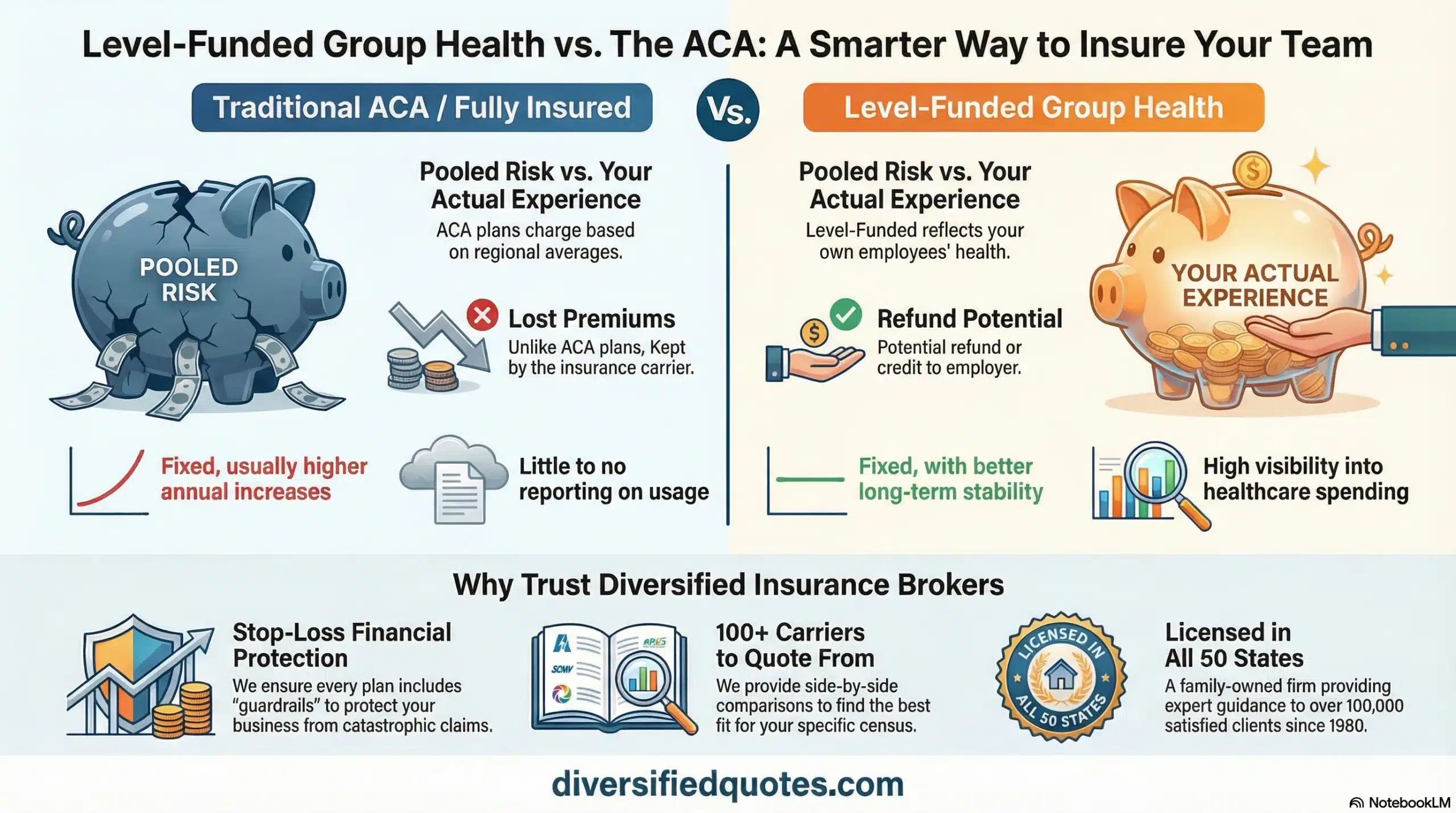
Level-funded group health insurance is often the first alternative employers consider at 60 employees because it balances predictability with improved efficiency. In a level-funded structure, the employer pays a consistent monthly amount that typically includes estimated claims, administrative expenses, and stop-loss protection. From a budgeting standpoint, it feels similar to fully insured coverage, which helps leadership stay comfortable with cash flow.
The key difference appears at year-end. If claims run lower than projected, unused claim dollars may be returned to the employer (carrier rules and contract terms apply). This refund potential allows companies to benefit from favorable claims experience rather than subsidizing pooled risk. Even when refunds are modest, level-funded can reduce renewal volatility because pricing tends to reflect the group’s own performance more directly than a broad pooled market.
Level funding also changes how employers think about plan performance. When leadership can see that efficient utilization has the potential to reduce net cost, the plan becomes something the organization can manage rather than merely pay for.
Partially Self-Funded Plans and Transparency at 60 Employees
Some organizations with 60 employees qualify for partially self-funded group health plans. In a partially self-funded arrangement, the employer pays claims as they occur instead of prepaying a fixed premium to cover unknown risk. Stop-loss insurance caps exposure for individual high-cost claims and total annual spend, creating guardrails that keep the plan financially manageable.
The primary advantage is transparency. Employers gain insight into where healthcare dollars are being spent, which makes it easier to address cost drivers over time. Instead of being surprised at renewal, leadership can identify trends earlier and implement targeted changes—network strategy, plan design adjustments, pharmacy management, and care navigation improvements.
For employers unfamiliar with this model, understanding what self-funded group health insurance is helps clarify how risk is managed and why this approach becomes more practical as employee count increases. It’s also important to weigh tradeoffs carefully. This overview of the pros and cons of self-funded group health can help determine whether added transparency aligns with organizational goals and governance preferences.
At 60 employees, partially self-funded is often less about “taking big risk” and more about replacing inefficient premium pricing with a structure that reflects real plan performance—while still protecting the organization against severe outliers.
Compare Funding Options for 60 Employees
See how fully insured, level-funded, and partially self-funded plans compare for your workforce.
Reducing Group Health Insurance Costs for 60 Employees
At 60 employees, sustainable cost reduction rarely comes from cutting benefits or shifting large premium increases to employees. Those tactics can reduce participation, damage morale, and cause employees to delay care, which often increases catastrophic claims later. Instead, the strongest savings typically come from plan architecture and utilization management—building a structure that reduces waste while preserving a strong employee experience.
Network selection can significantly affect claim costs without altering how employees “feel” the plan day to day. Many employers overpay due to network unit-cost differences that are invisible inside a premium invoice. Pharmacy strategy is often one of the largest opportunities for savings, particularly when specialty medications are involved. Plan design—how deductibles, copays, and out-of-pocket limits are structured—can reduce waste when aligned with how the workforce actually uses care.
The best cost reductions are usually the ones employees barely notice: fewer billing surprises, better navigation to the right site of care, stronger preventive access, and prescription management that lowers net cost while keeping medications accessible.
Why Pharmacy Often Becomes the Biggest Driver
For many mid-size employers, pharmacy is where trend accelerates the fastest. Specialty drugs can represent a small number of members and a large share of total spend. Without strong pharmacy oversight, employers can pay inflated net costs due to pricing structure, utilization patterns, or a lack of effective clinical management.
At 60 employees, pharmacy strategy matters even more because a handful of prescriptions can swing plan results. Effective management is not about restricting necessary medication. It is about building a system that pays a fair net cost, encourages appropriate utilization, and creates visibility into emerging spend. Even modest improvement in pharmacy net costs can translate into meaningful renewal stability.
When evaluating level-funded or partially self-funded plans, pharmacy reporting and transparency should be viewed as foundational, not optional. A plan that looks “cheaper” but hides pharmacy drivers often becomes more expensive over time.
Network Strategy: Controlling Unit Cost Without Disrupting Employees
Employers often assume network decisions are binary: keep the current network or change everything. In reality, network strategy can be more nuanced. Some structures preserve broad access while improving unit costs. Others focus on steering care to higher-value providers without limiting choice. The goal is to align provider pricing and utilization patterns with the organization’s budget and employee expectations.
At 60 employees, a plan can often improve financial performance by addressing “site of care” behavior. When employees have easy access to primary care, telehealth, and urgent care, they are less likely to use expensive emergency settings for routine issues. That reduces downstream high-cost claims without reducing benefits. When the plan makes the right choice easy, employees do not feel “cut”—they feel supported.
Network optimization is one of the most underused levers because it doesn’t feel like a typical renewal decision. But over time, it can be one of the most consistent drivers of savings.
Plan Design at 60 Employees: Aligning Incentives With Real Utilization
At mid-size employee counts, the best plan designs usually balance three goals: predictable experience for employees, protection against catastrophic spend, and alignment with how the workforce actually uses healthcare. Plans fail when they are designed generically—too rich in low-value areas, too punitive in high-value areas, or structured in a way that encourages waste.
Good plan design tends to make high-value care accessible and predictable. Primary care and preventive care should be easy to use. Chronic conditions should be managed through predictable medication access and navigation support. When employees can access the right care early, the plan avoids expensive escalation later. A plan that “saves money” by making everything hard often spends more in the long run.
At 60 employees, plan design should also reflect leadership’s contribution strategy. If the employer is increasing employee share, the plan must remain understandable and navigable. Confusion creates dissatisfaction and can lead to worse utilization patterns. Clear design reduces friction and improves outcomes.
Refund Potential and Renewal Stability
One of the most frustrating aspects of fully insured plans is the lack of reward for favorable claims experience. Employers can have a strong year and still see an increase driven by market pooling, carrier assumptions, or non-transparent rating factors. This is where alternative funding models change the employer’s experience.
In level-funded plans, efficient claims may generate refunds or credits (subject to contract rules). In partially self-funded plans, employers avoid paying inflated premiums for risk that never materializes. In both structures, the plan becomes more connected to what actually happened. That connection tends to improve renewal predictability because leadership can see drivers sooner and make adjustments earlier.
Renewal stability is not just a financial advantage. It also reduces disruption. When renewals are less volatile, leadership can avoid reactive contribution changes, avoid constant carrier switching, and provide employees a more consistent benefits experience.
Participation and Contribution Considerations at 60 Employees
Participation requirements generally loosen as employee count grows, but they still matter. Employer contribution levels influence participation, underwriting perception, and employee satisfaction. Strong participation often leads to better pricing and broader plan availability, while low participation can increase adverse selection risk and reduce carrier competitiveness.
At 60 employees, waivers become a strategic factor. If many employees waive due to spousal coverage, the enrolled population may skew toward higher utilizers, which can affect pricing and plan performance. Employers do not need to “force” enrollment, but they should understand how contributions and plan design influence who enrolls and why.
Contribution strategy is also part of talent strategy. At 60 employees, benefits are typically a meaningful recruiting lever. The best approach balances budget constraints with a competitive offering, while structuring the plan to encourage efficient utilization rather than confusion or avoidance of care.
Compliance and Governance Realities at 60 Employees
At this size, benefits decisions are rarely just an HR issue. They touch finance, recruiting, and operations. That is why governance matters. Employers benefit from a consistent decision process: establish goals, measure plan performance, identify drivers, choose levers, implement changes, and then measure results again. Without governance, organizations often bounce from plan to plan, never improving the underlying drivers.
Documentation also matters. Carriers and administrators commonly require clean census information, effective-date planning, and consistent employee eligibility rules. When the plan is redesigned, implementation quality becomes part of plan performance. A well-designed plan can fail if enrollment is messy, communications are unclear, or employees don’t understand how to use the plan.
That’s why the best employers treat group health as a repeatable operating process rather than a one-time annual negotiation.
Implementation: How a 60-Employee Plan Change Actually Rolls Out
Most plan changes involve a predictable sequence: confirm eligibility and participation, gather census information, evaluate plan structures, compare carrier terms and pricing, select a design, complete underwriting (if required), coordinate enrollment, and then manage the first months carefully to ensure employees understand the plan. At 60 employees, the difference between a smooth rollout and a disruptive rollout is usually communication and clarity, not complexity.
Employees don’t need a textbook. They need simple guidance: what plan options exist, how the network works, how prescriptions are handled, how to find care, and what to do when something doesn’t make sense. When a plan includes improved navigation, employees often feel supported rather than “changed.” That perception matters for retention and satisfaction.
Strong implementation also improves financial performance because employees are more likely to use care appropriately when they understand how the plan is built.
Planning Beyond 60 Employees
The group health insurance strategy chosen at 60 employees often sets the foundation for future growth. Employers that introduce transparency and cost accountability at this stage typically scale more efficiently as they grow into larger group categories. Those that delay often find options narrowing as costs rise and the renewal cycle becomes more reactive.
Proactive planning now reduces disruption later and positions the organization for sustainable growth. Instead of reinventing the plan each year, leadership can refine a stable structure. That creates compounding benefits: better utilization patterns, better vendor accountability, more predictable budgeting, and a more consistent employee experience.
At 60 employees, the goal is not perfection in year one. The goal is building a structure that improves over time—and that leadership can manage with confidence.
Build a Long-Term Group Health Strategy
If your renewals feel volatile or your plan feels like a “black box,” we’ll map funding options and a clear path to better predictability.
Related Group Health Pages
Explore additional group health resources for small and growing employers.
Pick Your Company Size
Not the right headcount? Use the buttons below to jump to the group health page that matches your workforce.
Group Health Insurance for 10 Employees
Small-team pricing, participation strategy, and easy rollout.
Group Health Insurance for 20 Employees
Plan design choices that improve cost control and retention.
Group Health Insurance for 30 Employees
Reduce renewal spikes and address pharmacy cost drivers.
Group Health Insurance for 40 Employees
Better plan efficiency as your claims credibility improves.
Group Health Insurance for 50 Employees
Cost containment strategies and scalable benefit design.
Group Health Insurance for 60 Employees
Improve predictability and reduce waste without cutting benefits.
Group Health Insurance for 70 Employees
Funding choices that reduce renewal volatility as you grow.
Group Health Insurance for 80 Employees
Plan design and vendor strategy to control cost trends.
Group Health Insurance for 90 Employees
Prepare for 100+ pricing leverage and stabilize renewals.
Group Health Insurance for 100 Employees
A major transition point: funding options expand and plan design matters more.
Group Health Insurance for 150 Employees
More claims credibility means more leverage—optimize funding and reduce overpaying.
Group Health Insurance for 250 Employees
Advanced funding and transparency strategies for stronger cost control.
Group Health Insurance for 500 Employees
Enterprise approach: analytics, vendor oversight, and smarter funding strategy.
Group Health Insurance for 750 Employees
Scaled cost-control with deeper data visibility and targeted interventions.
Group Health Insurance for Over 1,000 Employees
Enterprise governance, advanced funding, and high-impact cost management.
Talk With an Advisor Today
Choose how you’d like to connect—call or message us, then book a time that works for you.
Schedule here:
calendly.com/jason-dibcompanies/diversified-quotes
Licensed in all 50 states • Fiduciary, family-owned since 1980
FAQ for Group Health Insurance for 60 Employees
Can a company with 60 employees get group health insurance?
Yes. Employers with 60 employees typically qualify for fully insured, level-funded, and partially self-funded group health plans.
Are refunds possible with group health insurance at 60 employees?
Refunds may be available under level-funded plans or through reduced net costs in partially self-funded arrangements.
Is self-funding risky at this employee size?
Risk is managed through stop-loss insurance that caps exposure for large claims and total annual spend.
How long does it take to implement a group plan for 60 employees?
Implementation typically takes a few weeks once underwriting, enrollment, and documentation are completed.
Can group health insurance scale as we grow beyond 60 employees?
Yes. Plans built around transparency and cost control typically scale more smoothly as employee count increases.
About the Author:
Jason Stolz, CLTC, CRPC and Chief Underwriter at Diversified Insurance Brokers, is a senior insurance and retirement professional with more than two decades of real-world experience helping individuals, families, and business owners protect their income, assets, and long-term financial stability. As a long-time partner of the nationally licensed independent agency Diversified Insurance Brokers, Jason provides trusted guidance across multiple specialties—including fixed and indexed annuities, long-term care planning, personal and business disability insurance, life insurance solutions, and short-term health coverage. Diversified Insurance Brokers maintains active contracts with over 100 highly rated insurance carriers, ensuring clients have access to a broad and competitive marketplace.
His practical, education-first approach has earned recognition in publications such as VoyageATL, highlighting his commitment to financial clarity and client-focused planning. Drawing on deep product knowledge and years of hands-on field experience, Jason helps clients evaluate carriers, compare strategies, and build retirement and protection plans that are both secure and cost-efficient.
