
Group Health Insurance for 70 Employees

Jason Stolz CLTC, CRPC
Group health insurance for 70 employees places an organization firmly into the mid-market category, where healthcare costs, claims patterns, and renewal outcomes are driven far more by the company’s own experience than by generalized small-group assumptions. At this size, healthcare decisions are no longer tactical—they are strategic, with real implications for budgeting, employee retention, and long-term growth.
Many employers with 70 employees discover that the group health insurance approach that “worked well enough” at 20 or 30 employees starts to show cracks. Premium increases become larger in dollar terms, claims volatility has more impact, and a passive renewal strategy can quietly drain cash flow year after year. The upside is that scale now works in your favor: you typically have enough enrollment stability and claims credibility to access better funding options, demand stronger reporting, and build a plan that improves over time instead of resetting at every renewal.
At Diversified Insurance Brokers, we help employers with 70 employees transition from reactive renewals to intentional group health insurance strategies focused on cost control, transparency, and scalability. This page walks through how pricing works at this size, what plan structures are commonly available, and what levers actually reduce costs without cutting benefits or pushing too much burden onto employees.
Group Health Review for 70 Employees
We’ll review your current group health plan, renewal exposure, and claims efficiency to identify opportunities to reduce costs and improve predictability.
Why Group Health Insurance for 70 Employees Is Different
Group health insurance for 70 employees behaves differently than coverage for smaller teams. Claims volume is typically high enough for underwriters and plan partners to identify trends, utilization patterns, and risk concentrations with more confidence. As a result, pricing becomes more experience-based and less dependent on broad market pooling. That shift can be a disadvantage if a plan is inefficient, but it becomes a major advantage when an employer builds a plan with the right architecture and management tools.
At 70 employees, a few high-cost claims can still influence results, but you usually have enough data to see patterns—pharmacy spend, site-of-care behavior, chronic condition management, and network utilization. Instead of guessing why costs increased, an employer can start treating the plan like an operating system: measure, adjust, and improve.
Many employers at this size remain on fully insured plans because they are familiar and administratively simple. However, fully insured premiums typically include conservative pricing assumptions, carrier profit margins, and limited transparency. Over time, this often leads to paying more than necessary—especially for groups with relatively stable or improving claims experience.
Understanding how group medical insurance is structured helps explain why costs can escalate quickly when plans are not actively managed. The most important shift at 70 employees is moving from “renewal shopping” to “plan management,” where renewals become a predictable outcome of good design and good governance.
What Usually Drives Mid-Market Renewal Volatility
Renewals feel volatile at 70 employees for a few reasons that are easy to overlook. First, the dollar impact of trend is simply larger. Even if the percentage increase is “normal,” the budget hit can feel sharp because the total premium base is higher than it was at 20 or 30 employees.
Second, claims credibility becomes more relevant. Insurers and program partners can see enough history to react more directly to what happened in your group. If there was a spike in high-cost claims, specialty prescriptions, or unexpected inpatient utilization, the renewal may incorporate that experience more aggressively than a smaller-group pool would.
Third, plan drift is real. Many employers keep the same structure for years—same copays, same network, same pharmacy approach—while medical costs and utilization patterns change. Over time, the plan becomes misaligned with employee behavior, and the misalignment shows up as higher claims and weaker renewals.
The goal is not to eliminate volatility entirely. The goal is to reduce avoidable volatility by building a plan that makes cost drivers visible and manageable before renewal season.
Group Health Insurance Options Available at 70 Employees
At 70 employees, employers usually have access to a wider range of group health insurance funding strategies. Fully insured plans remain available, but they are no longer the default or most efficient option for many organizations. Most carriers and program administrators have mid-market solutions designed specifically for groups in the 50–150 range.
Level-funded and partially self-funded plans are commonly available at this size. These approaches shift the focus from fixed premiums to claims-aligned pricing while still using stop-loss insurance to cap downside risk. Depending on industry and demographics, some organizations may also see early access to more customized self-funded approaches, though many prefer to start with a structure that preserves predictable monthly budgeting.
Eligibility depends on factors such as workforce demographics, industry classification, and historical claims experience. Employers often start by reviewing minimum employees for group health insurance to understand which plan structures are realistically available. At 70 employees, most groups have options—but the quality of those options depends on how the group is presented and how participation and contribution strategy are structured.
Fully Insured at 70 Employees: When It Still Makes Sense
Fully insured coverage can still be a practical fit for some 70-employee employers, particularly when leadership prioritizes simplicity over visibility. If the group has enrollment instability, ongoing acquisitions or restructuring, or a claims pattern that makes alternative funding unattractive, fully insured may provide a clean, predictable administrative approach.
The tradeoff is that fully insured often limits transparency. Employers typically do not receive the same level of actionable reporting, and pricing may include risk loads and margins that do not reflect the group’s actual utilization efficiency. For stable groups, this can result in paying for worst-case assumptions year after year.
If an employer stays fully insured, the plan must be shopped intentionally. That means comparing multiple carriers, evaluating network fit, and ensuring the plan design is not drifting into inefficiency. At 70 employees, small design choices can translate into meaningful dollars over time.
Level-Funded Group Health Insurance for 70 Employees
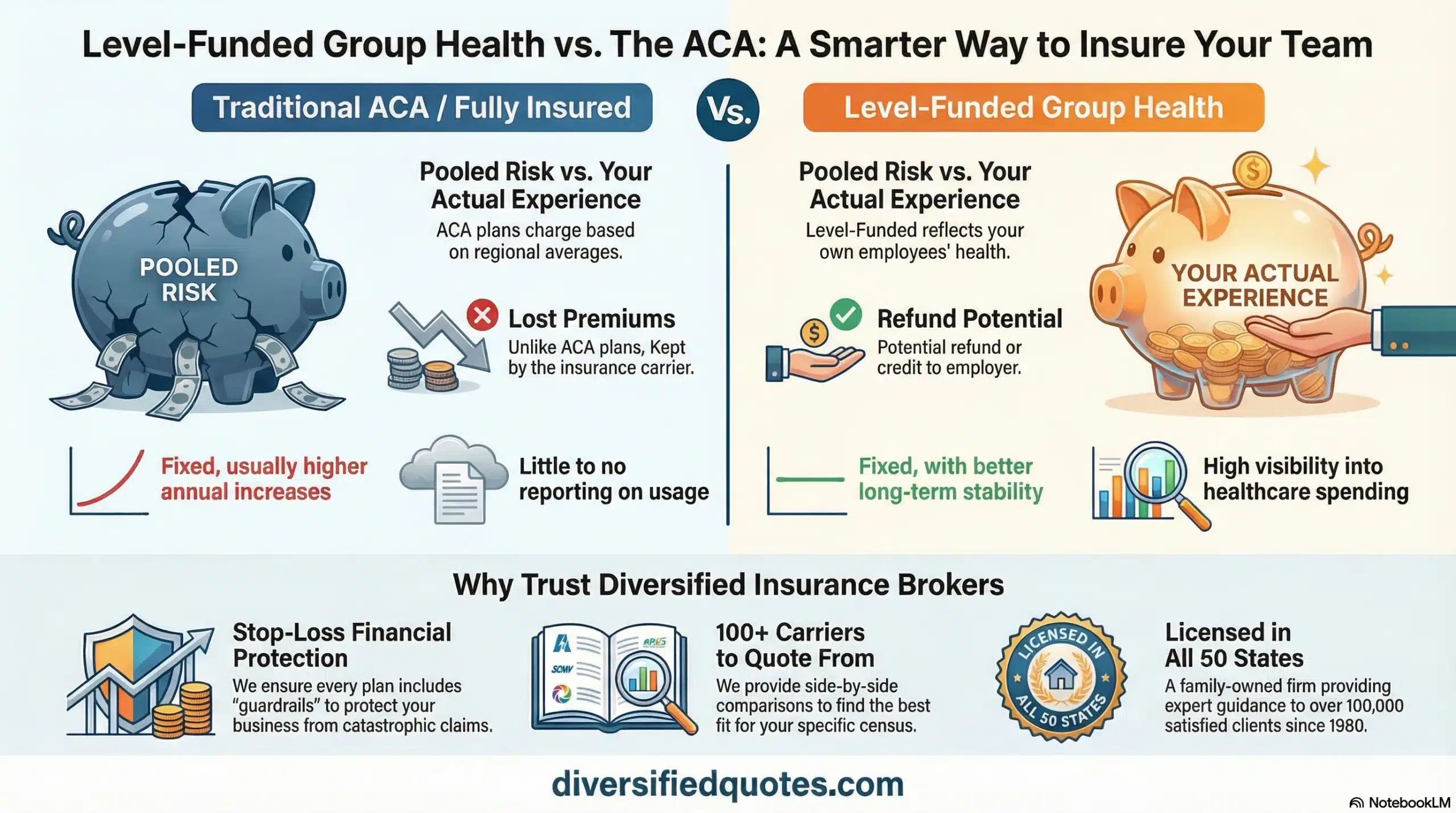
Level-funded group health insurance is a popular option for companies with 70 employees that want improved efficiency without sacrificing budgeting predictability. Level-funded programs are often designed to feel familiar: the employer pays a consistent monthly amount, the plan is administered like a traditional group plan, and employees typically experience the coverage without feeling like they are part of something radically different.
With a level-funded plan, the employer’s monthly payment is generally built from three components: an estimated claims amount, administrative costs, and stop-loss protection. That structure preserves cash-flow stability while changing how costs are reconciled behind the scenes.
If claims are lower than expected, unused claim dollars may be returned to the employer at the end of the plan year (subject to contract terms and program rules). This refund potential allows companies to benefit directly from favorable claims experience—something fully insured plans do not offer. Even when refunds are modest, level funding can still improve renewals because pricing is more directly connected to your group’s own performance.
Level funding also creates a helpful mindset shift. When the employer can benefit from efficient utilization, plan design becomes an investment rather than a sunk cost. Employers become more willing to implement navigation tools, pharmacy improvements, and smarter networks because the upside is tangible.
Partially Self-Funded Plans and Transparency at 70 Employees
Many organizations with 70 employees also qualify for partially self-funded group health plans. In a partially self-funded arrangement, the employer pays claims as they occur rather than prepaying premiums. Stop-loss insurance limits exposure to large individual claims and total annual costs, helping manage financial risk.
The primary advantage of partial self-funding is transparency. Employers gain visibility into where healthcare dollars are actually being spent, which makes it easier to identify cost drivers and adjust plan design over time. Instead of receiving a renewal number with minimal explanation, leadership can see trends earlier and take action before the renewal is set.
For employers new to this approach, understanding what self-funded group health insurance is helps clarify how risk is controlled and why this model becomes more viable as employee count increases. It’s also important to weigh tradeoffs carefully. Reviewing the pros and cons of self-funded group health can help determine whether increased transparency aligns with your organization’s risk tolerance and goals.
At 70 employees, “self-funded” should not be confused with “unprotected.” Stop-loss coverage is designed to create guardrails, and good plan governance focuses on controlling known cost drivers while limiting exposure to outliers. The combination of transparency plus guardrails is what makes partial self-funding attractive for many mid-market organizations.
Compare Group Health Options for 70 Employees
See how fully insured, level-funded, and partially self-funded plans compare for a 70-employee workforce.
Reducing Group Health Insurance Costs for 70 Employees
At 70 employees, sustainable cost reduction rarely comes from cutting benefits or shifting excessive costs onto employees. Those approaches can reduce participation, lower morale, and cause employees to delay needed care—often increasing long-term claims. Instead, the strongest savings typically come from smarter plan architecture and better utilization management.
Network selection can materially affect claim costs without changing how employees access care. Many employers overpay because the network is priced at a higher unit cost than necessary for the geography and provider patterns of the workforce. When the network is a better match, the employee experience may remain similar while claim costs decline in the background.
Pharmacy benefit design often represents one of the largest opportunities for savings, particularly when specialty medications are involved. At 70 employees, a small number of specialty prescriptions can swing plan results materially. That’s why pharmacy strategy is not a detail—it’s a core lever of cost control.
Aligning deductibles, copays, and out-of-pocket limits with actual utilization patterns helps reduce waste while preserving access to necessary care. The goal is not to make employees pay more. The goal is to steer utilization toward high-value settings and encourage early, appropriate care that prevents expensive escalation later.
Why Pharmacy Spend Can Dominate at Mid-Market Sizes
Many employers think medical claims are the main driver, but pharmacy often becomes the most volatile category—especially as specialty drugs continue to expand. At 70 employees, you may have only a handful of members using high-cost medications, but those medications can represent a large percentage of total spend.
Effective pharmacy management is not about denying needed treatment. It’s about controlling net cost and improving predictability. That can involve stronger clinical management, better alignment of formulary incentives, transparency into rebate structures, and strategies that reduce avoidable waste. Even small improvements in pharmacy efficiency can translate into meaningful renewal stability.
When comparing funding models, employers should ask: will we have visibility into pharmacy trends, and will we be able to take action if a cost driver emerges? The ability to answer those questions confidently is often the difference between a plan that improves over time and a plan that keeps surprising leadership at renewal.
Network Strategy: Lower Unit Costs Without Employee Disruption
Network strategy is often misunderstood. Employers worry that changing the network means employees lose doctors. In practice, network strategy can be designed to preserve broad access while improving unit costs. Some approaches emphasize steering employees to higher-value providers, while others focus on improving how care is accessed through navigation and site-of-care tools.
At 70 employees, site-of-care behavior matters. When employees default to the emergency room for non-emergency issues, plan costs increase quickly. When employees have easy access to primary care, telehealth, and urgent care, total cost often declines without reducing benefits. The plan should make the right choice easy, not confusing.
Network optimization is one of the most consistent long-term levers because it influences the unit cost of care every day. A plan can be “good” and still be overpriced if it’s paying higher unit costs than necessary for common services.
Plan Design That Matches How Employees Actually Use Care
At 70 employees, plan design should be intentional. Many plans are built around generic templates rather than actual utilization. That creates misalignment: employees avoid preventive care because it’s inconvenient or costly, then the plan pays more for downstream complications. Or employees overuse expensive settings because the plan doesn’t guide them toward better alternatives.
Good plan design focuses on what reduces total cost over time. It encourages appropriate primary care and preventive access, supports chronic condition management, and structures cost-sharing in a way that reduces low-value utilization while protecting employees against catastrophic exposure.
Employers also benefit from designing around employee behavior. If the workforce uses urgent care frequently, make urgent care predictable and easy. If chronic conditions are present, create better medication adherence incentives and navigation support. These changes do not feel like “cuts” to employees; they feel like improvements, and they often reduce total claims.
Refund Potential and Renewal Stability
One of the most common frustrations with fully insured plans is the lack of reward for good claims experience. Employers can have a relatively favorable year and still see a sizable renewal increase. That disconnect fuels the feeling that the plan is a “black box.”
Alternative funding models change this dynamic. In level-funded plans, efficient claims may result in refunds or credits (subject to the program’s terms). In partially self-funded plans, employers avoid paying inflated premiums for risk that never materializes. In both cases, the employer’s experience is more connected to what actually happened.
This connection improves renewal predictability. Not because claims never fluctuate, but because leadership has more visibility and more levers. When cost drivers are visible earlier, adjustments can be made before renewal is finalized. That is what turns renewals from an annual surprise into a manageable outcome.
Participation and Contribution Considerations at 70 Employees
Participation requirements generally become less restrictive as employee count grows, but they still influence underwriting and pricing. Employer contribution levels affect participation, employee satisfaction, and perceived plan stability. Strong participation typically leads to better pricing and broader plan options because the risk pool is more stable.
Waivers matter as well. If many employees waive coverage because they are on a spouse’s plan, the enrolled group can skew toward higher utilizers. That can influence claims performance and pricing. Employers don’t need to eliminate waivers, but they should understand how contribution strategy and plan design influence who enrolls and why.
At 70 employees, a strong plan often includes a clear contribution strategy that supports participation while remaining sustainable for the business. When contribution decisions are made intentionally, plan stability improves and the organization is less likely to face disruptive changes later.
Governance: The Mid-Market Advantage Most Employers Miss
At 70 employees, one of the biggest advantages is that you can build a repeatable process. You are large enough to benefit from data and plan management, but small enough to implement changes quickly without heavy bureaucracy. This is where governance becomes a competitive advantage.
Good governance doesn’t mean endless meetings. It means a simple cycle: establish goals, measure performance, identify cost drivers, apply specific levers, communicate changes clearly, and measure results again. Without governance, employers often bounce between carriers, adjust contributions reactively, and never improve the underlying drivers of spend.
When governance is in place, the plan tends to improve each year. Renewals become more stable, employees experience fewer disruptions, and leadership can forecast costs with more confidence.
Implementation: What Changing Plans Looks Like for Employees
Employers often delay changes because they fear disruption. In reality, most disruption comes from unclear communication, not from better plan design. Employees need simple guidance: what changed, how to use the plan, how the network works, how prescriptions are handled, and where to go for help. When that communication is clear, employees typically adapt quickly.
At 70 employees, plan improvements can actually reduce friction. Better navigation, clearer cost-sharing, and improved pharmacy management often lead to fewer billing surprises and a more predictable experience. Employees judge the plan by how it feels when they need care, not by how it’s funded behind the scenes.
That’s why implementation should include a clean enrollment process, straightforward decision support, and a simple “how to use your plan” message. When employees feel supported, plan utilization improves—and improved utilization is often what drives better long-term claims results.
Planning Beyond 70 Employees
The group health insurance strategy chosen at 70 employees often sets the trajectory for future growth. Employers that introduce transparency and cost accountability at this stage tend to scale more efficiently as they move into larger group categories. Those that delay often find their options narrowing as costs increase and renewals become more disruptive.
Proactive planning now reduces disruption later and positions the organization for sustainable growth. Instead of rebuilding the plan each year, leadership can refine a stable structure over time—improving outcomes, controlling waste, and keeping benefits competitive.
At 70 employees, the right plan is not the one with the lowest sticker price. It is the plan that produces visibility, rewards efficient claims, and gives leadership levers to improve performance year after year.
Stabilize Renewals for a 70-Employee Group
If renewals feel unpredictable, we’ll help you evaluate funding models and build a plan designed for long-term stability.
Related Group Health Pages
Explore additional group health resources for small and growing employers.
Pick Your Company Size
Not the right headcount? Use the buttons below to jump to the group health page that matches your workforce.
Group Health Insurance for 10 Employees
Small-team pricing, participation strategy, and easy rollout.
Group Health Insurance for 20 Employees
Plan design choices that improve cost control and retention.
Group Health Insurance for 30 Employees
Reduce renewal spikes and address pharmacy cost drivers.
Group Health Insurance for 40 Employees
Better plan efficiency as your claims credibility improves.
Group Health Insurance for 50 Employees
Cost containment strategies and scalable benefit design.
Group Health Insurance for 60 Employees
Improve predictability and reduce waste without cutting benefits.
Group Health Insurance for 70 Employees
Funding choices that reduce renewal volatility as you grow.
Group Health Insurance for 80 Employees
Plan design and vendor strategy to control cost trends.
Group Health Insurance for 90 Employees
Prepare for 100+ pricing leverage and stabilize renewals.
Group Health Insurance for 100 Employees
A major transition point: funding options expand and plan design matters more.
Group Health Insurance for 150 Employees
More claims credibility means more leverage—optimize funding and reduce overpaying.
Group Health Insurance for 250 Employees
Advanced funding and transparency strategies for stronger cost control.
Group Health Insurance for 500 Employees
Enterprise approach: analytics, vendor oversight, and smarter funding strategy.
Group Health Insurance for 750 Employees
Scaled cost-control with deeper data visibility and targeted interventions.
Group Health Insurance for Over 1,000 Employees
Enterprise governance, advanced funding, and high-impact cost management.
Talk With an Advisor Today
Choose how you’d like to connect—call or message us, then book a time that works for you.
Schedule here:
calendly.com/jason-dibcompanies/diversified-quotes
Licensed in all 50 states • Fiduciary, family-owned since 1980
FAQ for Group Health Insurance for 70 Employees
Can a company with 70 employees get group health insurance?
Yes. Employers with 70 employees typically qualify for fully insured, level-funded, and partially self-funded group health plans.
Are refunds possible with group health insurance at 70 employees?
Refunds may be available under level-funded plans or through reduced net costs in partially self-funded arrangements.
Is self-funding risky for a 70-employee company?
Stop-loss insurance is used to cap exposure for large claims and total annual spend, helping manage risk.
How long does it take to implement a group plan for 70 employees?
Most group health plans can be implemented within a few weeks once underwriting and enrollment are completed.
Can group health insurance scale as we grow beyond 70 employees?
Yes. Plans designed around transparency and cost control typically scale more smoothly as employee count increases.
About the Author:
Jason Stolz, CLTC, CRPC and Chief Underwriter at Diversified Insurance Brokers, is a senior insurance and retirement professional with more than two decades of real-world experience helping individuals, families, and business owners protect their income, assets, and long-term financial stability. As a long-time partner of the nationally licensed independent agency Diversified Insurance Brokers, Jason provides trusted guidance across multiple specialties—including fixed and indexed annuities, long-term care planning, personal and business disability insurance, life insurance solutions, and short-term health coverage. Diversified Insurance Brokers maintains active contracts with over 100 highly rated insurance carriers, ensuring clients have access to a broad and competitive marketplace.
His practical, education-first approach has earned recognition in publications such as VoyageATL, highlighting his commitment to financial clarity and client-focused planning. Drawing on deep product knowledge and years of hands-on field experience, Jason helps clients evaluate carriers, compare strategies, and build retirement and protection plans that are both secure and cost-efficient.
