
Group Health Insurance for over 1,000 Employees

Jason Stolz CLTC, CRPC
Enterprise Group Health Strategy Review (1,000+ Employees)
We’ll evaluate your plan design, claims performance, funding structure, and renewal exposure to identify opportunities for long-term cost control and stability.
Group health insurance for over 1,000 employees is an enterprise-scale system that directly impacts operating margins, talent strategy, and long-term financial planning. At this size, healthcare is no longer a line item—it is a managed financial ecosystem. Pricing is fully experience-based, driven by multi-year claims, pharmacy utilization, specialty drug exposure, and care patterns. Plan structure, funding strategy, and governance matter as much as the carrier itself.
Organizations with more than 1,000 employees often discover that legacy approaches—especially fully insured models—become inefficient. Premiums can rise regardless of performance, transparency is limited, and leadership lacks actionable insight into cost drivers. The advantage at this scale is leverage: sufficient data, stability, and buying power to design a program that actively controls costs instead of reacting to renewals.
At Diversified Insurance Brokers, we help large employers redesign enterprise health benefits to improve predictability, increase transparency, and support sustainable growth—without reducing benefit quality or disrupting the employee experience.
Why Group Health Insurance for Over 1,000 Employees Is an Enterprise System
Group health insurance for over 1,000 employees behaves differently than coverage for smaller employer groups because the plan is no longer priced on broad market assumptions. It is priced on your organization’s measurable reality. Insurers and administrators can evaluate multi-year utilization trends, chronic condition prevalence, high-cost claimant patterns, pharmacy dynamics, and network usage with far more confidence than they can in a small group.
At this size, small inefficiencies that might be invisible at 50 or 100 employees can become material. A few plan design misalignments, weak pharmacy controls, or network leakage can easily translate into seven-figure overspend. The plan becomes a financial system that requires governance, reporting, and decision cadence—not just renewal shopping.
This is also why employers that move beyond reactive renewals and into intentional plan management often outperform market benchmarks. When leadership treats the plan like a controllable ecosystem—rather than a fixed expense—cost trend typically becomes more predictable and the renewal process becomes far less disruptive.
If you want the baseline framing for employer plans, start with group medical insurance. It’s a useful foundation because it outlines how employer plan structures work before you layer in enterprise-level levers.
How Enterprise Pricing Is Built (and Why It Moves)
At 1,000+ employees, pricing is fully experience-based. That means your expected cost is heavily influenced by your own historical claims and projected utilization. The plan is still impacted by broader market inflation, but the biggest swing factors are often internal: how claims are trending, how well the network is being used, and whether pharmacy costs are controlled effectively.
Because the population is large, underwriters are more confident in trend assumptions and can identify emerging risk drivers earlier. That creates both risk and opportunity. If there is unmanaged specialty pharmacy spend, the plan can drift upward quickly. If there is strong care navigation, network discipline, and better plan alignment with utilization patterns, the plan can stabilize and improve.
Enterprise leaders often become frustrated because renewal increases feel “inevitable.” In reality, many renewals reflect a lack of levers. When the plan has limited transparency, leadership cannot identify what is driving cost early enough to adjust. When reporting improves, renewals become a result of decisions rather than a surprise.
Funding Options for Group Health Insurance at 1,000+ Employees
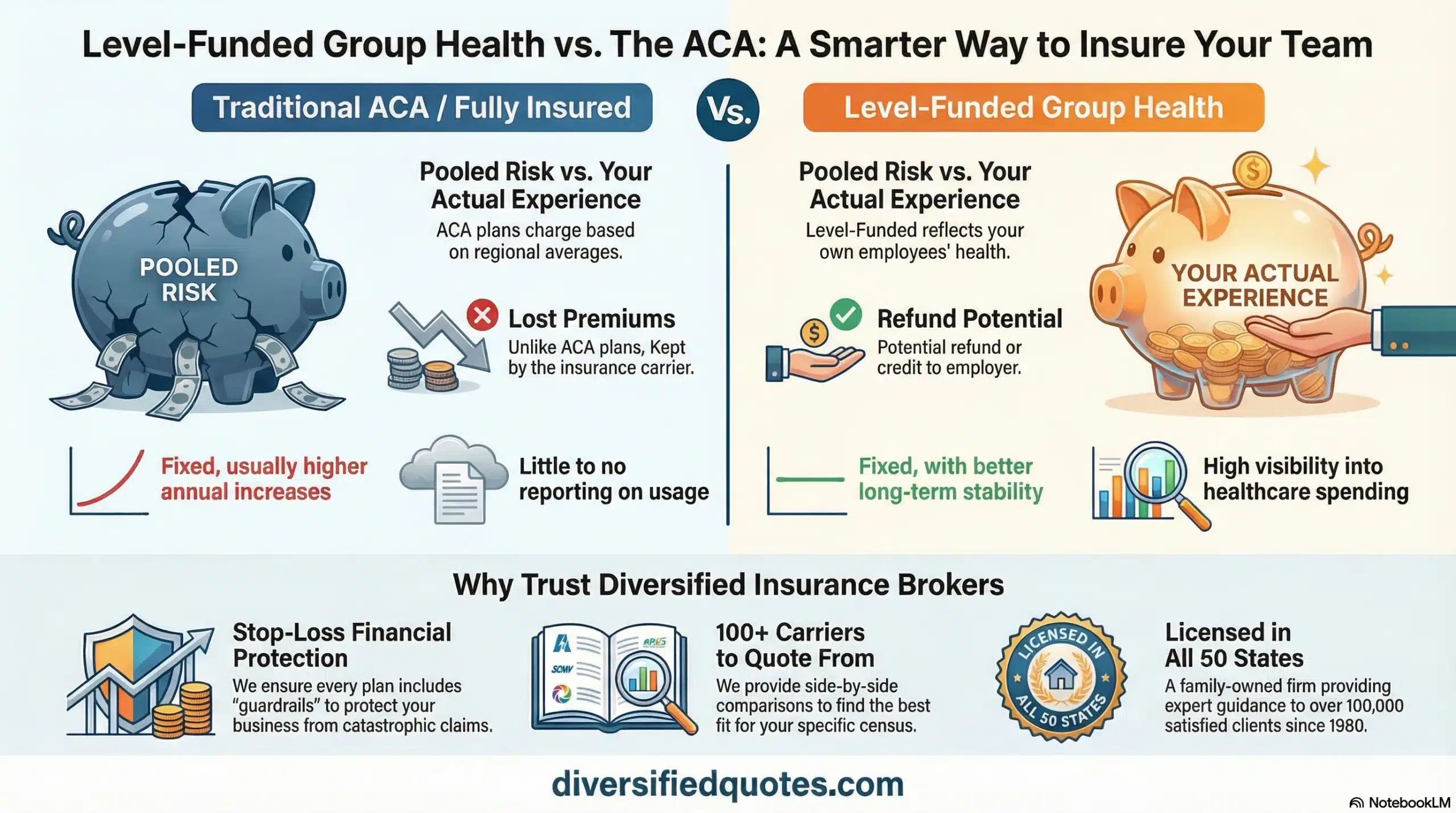
Organizations with more than 1,000 employees typically qualify for every major funding model. Fully insured plans may still be available, but they are rarely the most efficient structure at this size because they include carrier margins, conservative pricing cushions, and less direct control over the claims engine.
Self-funded and partially self-funded plans dominate at this level because they align cost with actual claims while allowing leadership to use reporting and vendor management to influence future outcomes. Many employers review minimum employees for group health insurance to understand why self-funding becomes increasingly standard as scale increases.
Hybrid approaches can also be effective when leadership wants smoother cash flow, guardrails, or transitional steps from insured arrangements. The best fit depends on organizational risk tolerance, financial discipline, and how much customization is desired.
Self-Funded Group Health Insurance for Over 1,000 Employees
Self-funding is commonly the most efficient structure for employers with over 1,000 employees because it removes the “prepaid premium” model and replaces it with claims-aligned spend. Claims are paid as they occur (usually through a third-party administrator), while stop-loss protection limits exposure to catastrophic claims and aggregate volatility.
The advantage is control. Instead of hoping the carrier prices you favorably, leadership can see what is driving cost and implement targeted changes. That often includes pharmacy strategy improvements, network optimization, plan design realignment, and care navigation programs that reduce unnecessary high-cost utilization.
For organizations evaluating this approach, understanding what self-funded group health insurance is clarifies how risk is managed and why reporting is a major part of the value.
Leadership teams also weigh tradeoffs carefully. Reviewing the pros and cons of self-funded group health helps align plan strategy with risk tolerance and financial objectives.
Stop-Loss Strategy and Catastrophic Risk Controls
Stop-loss is the enterprise safety net that keeps self-funding predictable. At scale, the goal is not to “avoid claims”—claims will happen. The goal is to structure risk so that high-cost events do not destabilize budgeting. A well-designed stop-loss strategy defines the right attachment points, protects against shock claims, and supports stable cash flow even in volatile years.
Large employers often implement layered protection that separates predictable claims from catastrophic exposure. The best structure depends on cash reserves, risk tolerance, historical claimant patterns, and how leadership prefers to manage variability. When designed correctly, stop-loss acts as a guardrail that allows the organization to benefit from strong plan performance without taking on unbounded downside.
For many employers, this becomes the bridge between “self-funding sounds risky” and “self-funding is a controlled system.” The risk exists either way—self-funding simply makes the risk measurable and manageable.
Pharmacy and Specialty Drug Management at Enterprise Scale
For many 1,000+ employee plans, pharmacy is the largest controllable cost driver. Specialty medications, biologics, and emerging therapies can create rapid cost acceleration even when the rest of the plan looks stable. Enterprise plans that do not manage pharmacy strategically often see renewals spike with little warning because pharmacy trends can move faster than medical trends.
Effective pharmacy management is not about restricting access to necessary medications. It is about using the plan’s buying power and governance to reduce waste, confirm clinical appropriateness, avoid inflated pricing, and ensure specialty drugs are managed intentionally. When paired with clean reporting, leadership can identify which categories are driving spend and implement improvements proactively.
Enterprise employers often implement pharmacy strategies that align formularies with cost efficiency, improve specialty oversight, and ensure employees have support navigating complex therapies. The result is often improved member experience and improved cost predictability at the same time.
Network Strategy and Workforce Geography
Network decisions become more strategic as the workforce becomes geographically diverse. A national employer may have employees in multiple states, multiple metro areas, and multiple provider ecosystems. The “best” network is not the one with the biggest logo—it’s the one employees can actually use without network leakage.
Network leakage is expensive. When employees unintentionally go out of network due to poor access, claim costs rise and member satisfaction falls. Enterprise plans often improve performance by selecting networks that align with where employees live and work, then reinforcing smart utilization through education and navigation.
For multi-state employers, the plan must also consider local provider availability, regional cost variation, and how networks perform across different markets. This is where enterprise leverage matters. Large employers can often structure network choices more intentionally than smaller groups, but the strategy must be designed and monitored, not assumed.
Plan Design Levers That Control Cost Without Cutting Benefits
At 1,000+ employees, sustainable savings rarely come from reducing benefits or shifting massive costs onto employees. Those moves often reduce participation, harm engagement, and create turnover pressure. Instead, cost control typically comes from aligning plan design to utilization patterns and removing structural waste.
Plan design is about incentives. When deductibles, copays, and out-of-pocket limits are aligned with how employees actually use care, utilization becomes more efficient without creating friction. Many enterprise employers offer multiple plan options so employees can choose the tradeoff that fits their situation, while leadership maintains predictable cost structure.
Plan design is also where “small changes” can create large outcomes at scale. A modest improvement in ER avoidance, network utilization, or preventive care engagement can meaningfully change the plan’s trend when applied across a large population.
The most effective plan designs are clear, repeatable, and stable enough that employees learn how to use them. Frequent disruption creates confusion. Stability with intentional tuning usually performs better.
Vendor Governance: TPA, PBM, and Reporting Accountability
Enterprise plans are not run by a single entity. Even when a carrier is involved, the ecosystem often includes administrators, pharmacy benefit managers, network partners, wellness vendors, and clinical programs. Governance is how leadership ensures these vendors are accountable and aligned with plan goals.
Without governance, vendors operate in silos, reporting is inconsistent, and leadership is forced into reactive decisions. With governance, the plan has a rhythm: regular reporting, measurable goals, vendor evaluation, and continuous improvement. This is where the plan becomes a managed system rather than a recurring budget shock.
Strong governance also improves negotiation leverage. When vendors know performance is being tracked, cost drivers are being analyzed, and alternatives are being benchmarked, the employer is positioned to demand clarity and better terms.
Analytics, Transparency, and Continuous Improvement
Enterprise group health insurance unlocks actionable data, but only if it is organized into useful reporting. The goal is not to drown leadership in dashboards. The goal is to identify key drivers early enough to act. That includes pharmacy categories, high-cost care patterns, network utilization, and recurring utilization that can be influenced by better navigation and plan design.
Transparency creates accountability. It also creates focus. When leadership can see what is driving spend, decisions shift from “we need a cheaper plan” to “we need to fix the cost engine.” That change in mindset is often what produces long-term stability.
Continuous improvement does not require constant disruption. The best enterprise plans make modest adjustments, monitor outcomes, and keep employees informed. Over time, those incremental improvements often outperform dramatic plan changes that create confusion and dissatisfaction.
Renewal Stability and Long-Term Financial Planning
Fully insured plans often offer limited reward for favorable claims experience because pricing includes carrier risk loads and margin, and because transparency is restricted. In contrast, self-funded and advanced funding models are designed to avoid paying for unused risk and to create a clearer connection between plan performance and cost.
At enterprise scale, renewal stability is not only about next year’s premium. It is about budgeting confidence and long-term planning. When leadership can forecast healthcare expenses with more accuracy, it improves decision-making across the organization. That includes workforce planning, compensation strategy, and overall financial management.
Stable renewals also reduce employee disruption. When a plan does not need major changes every year, employees become more confident using benefits and HR administration becomes simpler. That stability supports retention and improves the perceived quality of the benefit.
Implementation and Change Management
Enterprise plan improvement is as much an execution project as it is a strategy decision. Even the best plan design will fail if the rollout is unclear or if employees do not understand how to use the plan. Implementation should be structured to protect continuity of care, minimize disruption, and provide clear guidance for enrollment.
Most large employers do best with a clean implementation sequence: confirm workforce demographics and geography, align vendor reporting, finalize network strategy, finalize plan options and contributions, then build an enrollment communication plan that explains the changes in plain language. The goal is to make decisions feel intentional and stable, not confusing or rushed.
After implementation, the best practice is a “first 90 days” review. Verify that employees have access, that payroll deductions match elections, and that key vendors are producing the reporting cadence promised. Early fixes prevent small administrative problems from turning into employee confidence problems.
Compare Enterprise Group Health Options
Compare self-funded, partially self-funded, and hybrid strategies for organizations with over 1,000 employees.
Related Pages
Explore additional group health resources and plan-structure guides.
Pick Your Company Size
Not the right headcount? Use the buttons below to jump to the group health page that matches your workforce.
Group Health Insurance for 10 Employees
Small-team pricing, participation strategy, and easy rollout.
Group Health Insurance for 20 Employees
Plan design choices that improve cost control and retention.
Group Health Insurance for 30 Employees
Reduce renewal spikes and address pharmacy cost drivers.
Group Health Insurance for 40 Employees
Better plan efficiency as your claims credibility improves.
Group Health Insurance for 50 Employees
Cost containment strategies and scalable benefit design.
Group Health Insurance for 60 Employees
Improve predictability and reduce waste without cutting benefits.
Group Health Insurance for 70 Employees
Funding choices that reduce renewal volatility as you grow.
Group Health Insurance for 80 Employees
Plan design and vendor strategy to control cost trends.
Group Health Insurance for 90 Employees
Prepare for 100+ pricing leverage and stabilize renewals.
Group Health Insurance for 100 Employees
A major transition point: funding options expand and plan design matters more.
Group Health Insurance for 150 Employees
More claims credibility means more leverage—optimize funding and reduce overpaying.
Group Health Insurance for 250 Employees
Advanced funding and transparency strategies for stronger cost control.
Group Health Insurance for 500 Employees
Enterprise approach: analytics, vendor oversight, and smarter funding strategy.
Group Health Insurance for 750 Employees
Scaled cost-control with deeper data visibility and targeted interventions.
Group Health Insurance for Over 1,000 Employees
Enterprise governance, advanced funding, and high-impact cost management.
Talk With an Advisor Today
Choose how you’d like to connect—call or message us, then book a time that works for you.
Schedule here:
calendly.com/jason-dibcompanies/diversified-quotes
Licensed in all 50 states • Fiduciary, family-owned since 1980
FAQ for Group Health Insurance for Over 1,000 Employees
Can a company with over 1,000 employees get group health insurance?
Yes. Employers with over 1,000 employees typically use self-funded or hybrid group health plans designed for enterprise-level risk management.
Is self-funding standard at this size?
Yes. Most organizations with more than 1,000 employees adopt self-funded or advanced hybrid structures due to improved cost control and transparency.
How is financial risk controlled?
Stop-loss insurance caps exposure for large individual claims and total annual costs, providing financial guardrails.
How long does it take to implement an enterprise plan?
Implementation timelines vary, but most enterprise transitions occur over several months with proper planning and data analysis.
Can the plan scale as the organization grows?
Yes. Enterprise group health plans are designed to scale efficiently as employee count and geographic reach increase.
About the Author:
Jason Stolz, CLTC, CRPC and Chief Underwriter at Diversified Insurance Brokers, is a senior insurance and retirement professional with more than two decades of real-world experience helping individuals, families, and business owners protect their income, assets, and long-term financial stability. As a long-time partner of the nationally licensed independent agency Diversified Insurance Brokers, Jason provides trusted guidance across multiple specialties—including fixed and indexed annuities, long-term care planning, personal and business disability insurance, life insurance solutions, and short-term health coverage. Diversified Insurance Brokers maintains active contracts with over 100 highly rated insurance carriers, ensuring clients have access to a broad and competitive marketplace.
His practical, education-first approach has earned recognition in publications such as VoyageATL, highlighting his commitment to financial clarity and client-focused planning. Drawing on deep product knowledge and years of hands-on field experience, Jason helps clients evaluate carriers, compare strategies, and build retirement and protection plans that are both secure and cost-efficient.
