
Disability Insurance for Insurance Investigators and Adjustors
As an Independent Disability Insurance Broker, we have access to exclusive discounts and negotiated pricing most captive agents can’t offer — see the full breakdown near the end of this page.
Disability Insurance for Insurance Investigators and Adjustors

Jason Stolz CLTC, CRPC, DIA, CAA
Disability insurance for insurance investigators and adjusters is income protection built around a profession that spans two fundamentally different work profiles — and carries meaningful disability risk in both. Claims adjusters, examiners, and insurance investigators earn their income through a combination of field work, cognitive analysis, high-volume case management, and sustained interpersonal engagement that requires both physical presence and sharp mental performance. For field adjusters who personally inspect damaged properties, navigate post-disaster environments, and conduct surveillance operations, the physical disability risk is direct and documented. For desk-based examiners and analysts managing large caseloads of complex claims, the disability risk is primarily cognitive and stress-related — conditions that can be equally disabling and equally disruptive to income. When either profile of professional cannot work, income stops, and the financial consequences depend entirely on what individual protection has been arranged in advance.
At Diversified Insurance Brokers, we help insurance investigators and adjusters across every specialty — staff claims adjusters, independent adjusters, catastrophe field adjusters, SIU investigators, public adjusters, and insurance fraud examiners — structure disability insurance coverage that reflects the genuine professional risks of their work. A well-structured policy provides income replacement from any qualifying disability, whether it originates from a physical injury sustained in a field inspection, a cognitive or neurological condition that prevents the analytical demands of complex claims work, or a medical event entirely unrelated to the job itself.
Get Disability Insurance Quotes for Insurance Investigators and Adjusters
We compare carriers, explain occupational class ratings, and structure policies built for the real professional risks of claims and investigative work.
Request Disability Insurance OptionsWhat Insurance Investigators and Adjusters Actually Do — and Why It Creates Real Disability Risk
The occupational profile of insurance adjusting and investigation work is considerably more varied — and in many cases more physically and cognitively demanding — than the title suggests. Field claims adjusters travel directly to loss sites to inspect property damage: walking through fire-damaged structures with weakened floors and compromised ceilings, assessing flood-damaged properties with water-damaged subfloor and potential mold exposure, climbing onto damaged roofs to evaluate storm losses, and navigating active accident scenes and body shop environments to assess vehicle damage. Catastrophe adjusters deploy to large-scale disaster zones — hurricanes, wildfires, tornadoes, floods — where the physical environment is actively hazardous, hours are long and irregular, and the caseload volume can be extreme. According to the Bureau of Labor Statistics, workers who inspect damaged buildings must exercise care around collapsed roofs and floors and weakened structural elements — conditions that represent acute fall and injury risk that is present on every qualifying field inspection.
SIU investigators — the professionals assigned to detect and document insurance fraud — carry an additional set of occupational demands. Surveillance operations require extended periods of stationary vehicle occupation, often in variable weather conditions and irregular hours including evenings and weekends. Conducting field interviews with claimants, witnesses, and law enforcement personnel requires travel across wide geographic areas. SIU investigators frequently carry digital recording equipment, work independently in unfamiliar environments, and must maintain the mental acuity to build legally defensible investigative records while managing multiple open cases simultaneously. Desk-based examiners and analysts face a different but equally serious disability risk profile: high-volume cognitive work under deadline pressure, sustained computer use that produces hand, wrist, shoulder, and cervical spine conditions over time, and the cumulative psychological stress of high-stakes claims decisions and adversarial settlement environments. Across every specialty, the income depends on the adjuster or investigator’s sustained capacity to perform — physically, cognitively, and professionally.
The Most Common Disabling Conditions for Insurance Investigators and Adjusters
The disability risk profile for insurance investigators and adjusters divides along the field-versus-desk line that defines the profession. For field adjusters and SIU investigators, musculoskeletal injuries from falls represent the most acute physical risk. Falls in post-disaster environments — through weakened flooring, from unstable roof surfaces, on debris-covered ground, or on water-damaged structures where surface integrity is unpredictable — produce back injuries, knee and ankle injuries, fractures, and head injuries that can require months of recovery or produce permanent functional limitations. Back and spinal conditions are a particularly common outcome, developing from both acute fall events and the cumulative physical demands of sustained field inspection work across vehicles, structures, and terrain in varying conditions. Extended driving between claim sites contributes to lumbar loading and is itself a source of automobile accident risk that can produce disabling injuries entirely unrelated to the job site.
For desk-based examiners, analysts, and those who split their time between office and field, the dominant disability risk profile shifts toward repetitive strain and cognitive conditions. Hand and wrist conditions — including carpal tunnel syndrome and related repetitive strain injuries — develop from sustained high-volume keyboard and documentation work across large case inventories. Cervical spine and shoulder conditions develop from sustained desk posture and computer screen positioning. Anxiety disorders, depression, and stress-related conditions are documented occupational outcomes in high-pressure claims environments where financial exposure is large, adversarial settlement negotiations are routine, and caseload volume is heavy. A cognitive condition that prevents the analytical precision, detail orientation, and rapid case processing that complex claims adjusting requires can be as professionally disabling as a physical injury that prevents field access — making the own-occupation disability definition particularly valuable for this profession. For comparable disability risk profiles across professions with similarly mixed physical and cognitive demand structures, our resource on disability insurance for the entertainment industry provides useful context on how mixed-demand occupations are evaluated across carriers.
Why Many Insurance Investigators and Adjusters Have No Disability Safety Net
The disability vulnerability of insurance investigators and adjusters depends heavily on employment structure, and the profession contains meaningful numbers of professionals on both sides of that divide. Staff adjusters employed directly by insurance carriers often receive employer-provided benefits including group disability coverage — but group disability policies typically replace only 60 percent of base salary, exclude bonus and overtime income that may represent a significant share of total compensation, and carry any-occupation or modified any-occupation definitions that provide weaker protection than an individual own-occupation policy. For staff adjusters whose total compensation during catastrophe seasons or heavy claim periods significantly exceeds base salary, group coverage leaves a material income gap uninsured.
Independent adjusters — who work as contractors for multiple insurance carriers or third-party administration firms — typically receive no employer-provided benefits at all. As self-employed contractors, they bear the full responsibility for their own income protection, and when they cannot work, no income is generated. The independent adjuster market is particularly exposed because income is inherently variable: quiet periods, catastrophe surges, and the contractor relationship itself mean that the financial consequences of a disability extend beyond lost wages to lost claim assignments, lost carrier relationships, and the professional network damage that results from extended absence. Public adjusters, who represent policyholders rather than carriers and operate their own practices, face the same self-employment vulnerability as any independent professional with no institutional safety net. Our resource on what is the primary reason people buy disability insurance provides essential context on why individual coverage fills the gaps that employer plans and workers’ compensation consistently leave open for professionals in this field.
How Disability Insurance Carriers Classify Insurance Investigators and Adjusters
Disability insurance carriers assign occupational class ratings that reflect the estimated disability risk of each profession. For insurance adjusters and investigators, the classification an individual receives depends heavily on how their specific duties are described — because the field-versus-desk divide within this profession produces materially different risk profiles that carriers evaluate differently. A desk examiner or analyst who works primarily in an office environment reviewing documentation, managing case files, and conducting phone and email correspondence will typically receive a more favorable occupational classification than a field catastrophe adjuster who personally inspects damaged structures in post-disaster environments, or an SIU investigator who conducts extended surveillance operations and field interviews in variable conditions.
Presenting occupational duties accurately to underwriters — including the specific percentage of time spent in field versus office activity, the type of structures and environments accessed during inspections, and the nature of the investigative work performed — is an area where working with an experienced independent broker produces meaningfully better classification outcomes than applying to a single carrier directly. For independent adjusters and public adjusters who operate their own practices, the self-employment income documentation picture adds another layer of complexity that experienced broker guidance navigates effectively. Our guide on how disability insurance elimination periods work provides essential context on how waiting period selection affects the financial planning implications of a disability for both staff and independent adjusters who need to understand exactly when benefits begin relative to when income stops. For additional perspective on how occupational class ratings interact with premium structure across professions with mixed field and office exposure, our resources on disability insurance for golf club pros and disability income insurance for real estate agents provide useful cross-occupational context.
Case Study — Independent Field Adjuster, Back Injury
Consider an independent catastrophe adjuster with an established carrier network generating approximately $85,000 per year in claim assignment revenue during an active season. After sustaining a lumbar disc herniation during a field inspection — falling through weakened subfloor in a flood-damaged structure — this adjuster requires surgery and a minimum of three months of recovery during which sustained walking over uneven terrain, climbing into damaged structures, and extended driving between claim sites are medically contraindicated. The table below illustrates the financial difference disability insurance makes in this specific scenario.
| Scenario | Without Disability Insurance | With Disability Insurance |
|---|---|---|
| Monthly Income During Recovery | $0 | $3,500–$4,500 |
| 3-Month Income Total | $0 | $10,500–$13,500 |
| Carrier Relationships | Claim assignments routed to available adjusters; relationships deteriorate during absence | Financial stability allows managed communication and planned return to assignments |
| Overhead During Recovery | Adjuster license fees, E&O coverage, vehicle costs, and software subscriptions continue regardless | Monthly benefit offsets ongoing fixed professional costs |
| Return-to-Work Pressure | Forced early return to field inspections before full medical clearance; re-injury risk | Full recovery supported on medical timeline without financial desperation |
Back injuries from falls in structurally compromised properties are among the most documented acute occupational outcomes for field claims adjusters — the combination of post-disaster building conditions, variable surface integrity, and the physical demands of accessing damaged structures creates exactly the environment that produces serious spinal injuries. Disability insurance for insurance investigators and adjusters ensures that this predictable occupational health event does not simultaneously become a financial crisis that forces premature return to field work and risks permanent career-limiting re-injury. For additional disability context across professions with comparable field inspection exposure, our resources on disability insurance for the woodworking industry and disability insurance for the automobile industry provide useful perspective on how physically active service occupations are evaluated and structured.
Key Policy Features That Matter Most for Adjusters and Investigators
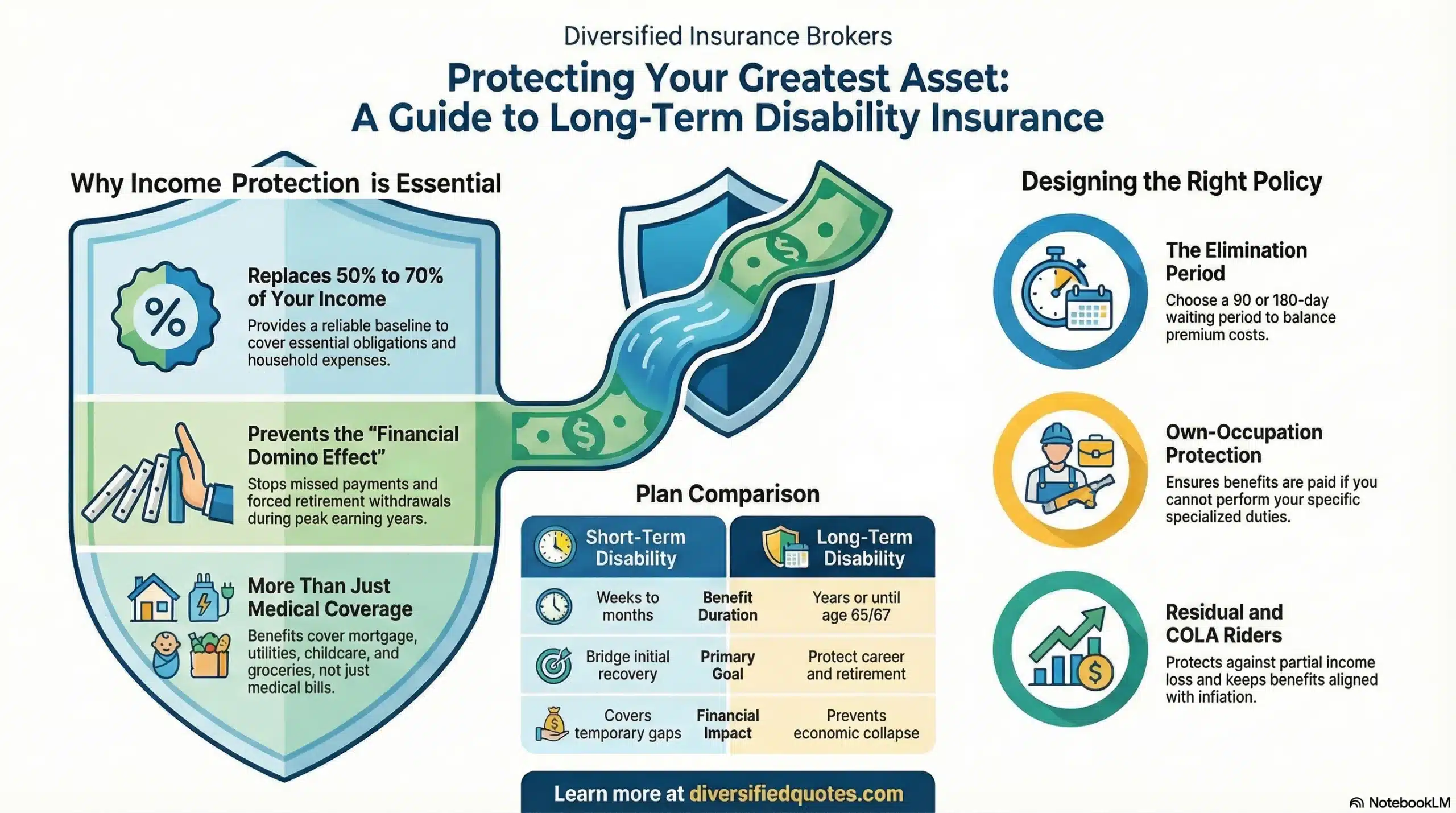
The own-occupation definition of disability is the most important policy feature for insurance investigators and adjusters, and it matters for reasons that span both the physical and cognitive dimensions of the profession. Under an own-occupation definition, the policy pays benefits when a condition prevents the insured from performing the specific duties of their own occupation — whether that means a field adjuster whose back injury prevents safe access to damaged structures, or a desk examiner whose cognitive condition prevents the analytical precision and high-volume case processing that complex claims work demands — regardless of whether they could theoretically perform some other type of unrelated work. Without an own-occupation definition, a policy would only pay benefits if the insured could not perform virtually any gainful employment at all — a standard that would deny benefits to an injured field adjuster who could hypothetically perform sedentary work, even though that work has no relationship to their professional income or career. Our dedicated resource on own-occupation disability insurance explained covers exactly how this definition protects professionals in real disability scenarios and why the precise policy language matters more than almost any other feature.
A residual disability rider is equally important for adjusters and investigators whose recovery may involve a gradual return to full caseload capacity. An independent adjuster recovering from a back injury or hand condition may be able to handle a reduced volume of desk-based review assignments while still unable to perform field inspections — earning substantially less than normal without being completely unable to work. A total-disability-only policy provides no benefits during this partial recovery period, even though income is far below normal and a genuinely disabling condition is still being managed. A residual disability rider pays proportional benefits based on the percentage reduction in earnings, providing continuous financial support through the entire recovery arc. Our resource on how residual disability benefits work covers exactly how proportional benefit calculations function in practice and why independent adjusters almost universally benefit from having this rider in place. A cost-of-living adjustment rider maintains the purchasing power of the monthly benefit over years of sustained claim payment for adjusters facing long-term or permanent disability. Our resource on disability income insurance with a COLA rider explains when inflation protection produces the most meaningful financial benefit.
Income Documentation and Business Overhead Coverage for Independent Adjusters
Because many insurance investigators and adjusters work as independent contractors, disability insurance underwriting involves income documentation requirements that differ from W-2 employee applications. Carriers base benefit amounts on verified earned income using federal tax returns — typically two to three years of Schedule C net profit or 1099 income for independent applicants. For independent adjusters whose gross claim revenue varies significantly between active catastrophe seasons and quieter periods, presenting income documentation accurately and in the most favorable light requires working with a broker who understands how adjusters are compensated and how to structure the application to reflect actual earning capacity rather than a single anomalous quiet-year tax return.
Independent adjusters and public adjusters should also consider business overhead expense coverage alongside personal income replacement disability insurance. Business overhead expense policies cover the fixed costs of maintaining professional operations during a disability: adjuster licensing renewal fees, state license maintenance across multiple jurisdictions, errors and omissions insurance premiums, claims management software subscriptions, vehicle costs, and continuing education requirements for maintaining CIFI, AIC, CPCU, or other professional designations. These fixed professional costs continue regardless of whether the adjuster can work, and allowing them to lapse during a disability risks losing the licensing standing and professional credentials that took years to build and that carrier relationships depend on. Our resource on income protection insurance provides additional perspective on how independent professionals structure comprehensive financial protection beyond the personal income replacement policy itself.
Why Independent Broker Access Matters for Adjusters and Investigators
Not every disability insurance carrier classifies insurance adjusting and investigative work equally, and the field-versus-desk distinction within the profession means that the classification outcome for an individual adjuster depends significantly on how their duties are presented. Some carriers approach field inspection work — particularly in post-disaster environments — with conservative restrictions that result in exclusion riders or reduced benefit limits that undermine the policy’s real protective value. Others write field adjusters more comprehensively when the income documentation and health profile support a clean underwriting outcome. Identifying the carriers whose underwriting guidelines are most favorable for the specific type of adjusting or investigative work an individual performs requires independent access to the full carrier marketplace.
At Diversified Insurance Brokers, we evaluate options across multiple carriers for every adjuster and investigator we serve. We understand how to present mixed field and office duty profiles accurately, how to document variable independent contractor income effectively, and how to structure policy provisions — own-occupation definitions, residual disability riders, elimination period selection, and benefit period choices — in ways that produce genuinely comprehensive income protection rather than a generic policy that underperforms at the moment of a claim. Our resource on why independent disability insurance brokers matter explains the full value of this approach for professionals who cannot afford to discover coverage gaps at the time of a disability claim.
When to Apply for Coverage
The best time for an insurance investigator or adjuster to apply for disability insurance is as early as possible in their career — before any occupational health conditions have accumulated in the medical record. Disability insurance premiums are based in part on age and health status at the time of application, and younger applicants in good health secure the most comprehensive coverage at the most favorable rates. Conditions that develop from the physical demands of field adjusting work over time — back conditions from falls and field inspection activity, hand and wrist conditions from sustained documentation and keyboard use, stress-related conditions from high-pressure claims environments — can result in exclusion riders that specifically eliminate coverage for those conditions if they are already documented when the application is submitted.
For staff adjusters who currently have employer-provided group disability coverage, applying for an individual supplement policy while still young and healthy is the most important timing decision available. Group coverage often follows the employee — if the adjuster changes employers, loses their position, or transitions to independent contracting, the group policy does not travel with them, and individual coverage applied for later in a career comes at higher premium and potentially with exclusions for conditions that have developed in the interim. The individual policy secured early is the comprehensive coverage available through every career transition — and that portability and comprehensiveness cannot be recaptured once conditions have been documented. Our resource on how to buy disability insurance online provides practical guidance on the application process for both employed and self-employed professionals in the claims and investigative field.
Request Disability Insurance Quotes for Insurance Investigators and Adjusters
We compare carriers, explain how adjusting and investigative work is classified, and structure policies that protect the income your claims career depends on.
Get Disability Insurance QuotesRelated Disability Insurance Pages
Talk With an Advisor Today
Choose how you’d like to connect—call or message us, then book a time that works for you.
Schedule here:
calendly.com/jason-dibcompanies/diversified-quotes
Licensed in all 50 states • Fiduciary, family-owned since 1980
Disability Insurance for Insurance Investigators and Adjusters — FAQs
Yes — insurance investigators and adjusters can obtain individual disability insurance, and the occupational class rating they receive depends significantly on the specific nature of their work. The profession spans a wide range of duty profiles — from predominantly desk-based examiners and analysts to field catastrophe adjusters who personally inspect structurally compromised properties in post-disaster environments, to SIU investigators conducting surveillance operations in the field. Carriers evaluate each profile differently, and how an individual adjuster’s or investigator’s duties are described to underwriters has a direct effect on the classification, premium, and policy features available. Working with an independent broker who understands how to accurately present mixed field and office duty profiles produces consistently better terms than applying to a single carrier directly.
The disability risk profile for adjusters and investigators divides along the field-versus-desk line that defines the profession. For field adjusters and SIU investigators, musculoskeletal injuries from falls in damaged or post-disaster structures represent the most acute physical risk — back injuries, knee and ankle injuries, and fractures resulting from weakened flooring, unstable roof surfaces, and debris-covered terrain that are routine features of field inspection environments. Extended driving between claim sites contributes to lumbar loading and automobile accident exposure. For desk-based examiners and analysts, hand and wrist conditions from sustained high-volume keyboard and documentation work, cervical spine and shoulder conditions from sustained desk posture, and stress-related cognitive and psychiatric conditions from high-pressure claims environments are the dominant disability risk categories. Cognitive conditions that prevent the analytical precision and case management demands of complex claims work can be as professionally disabling as physical injuries that prevent field access.
Own-occupation disability insurance pays benefits when a condition prevents the insured from performing the specific duties of their own occupation — regardless of whether they could theoretically perform different or lighter work. For a field claims adjuster, this means benefits are paid when conditions prevent safe access to damaged structures, extended driving between claim sites, and the physical demands of field inspection — even if the adjuster could hypothetically perform sedentary administrative work entirely unrelated to their profession. For a desk-based examiner, it means benefits are paid when a cognitive or neurological condition prevents the analytical precision and high-volume case processing that complex claims work demands. Without an own-occupation definition, a policy would only pay benefits if the insured could not perform virtually any gainful employment at all — which would deny benefits to an injured or ill professional who retains any capacity for unrelated light work, regardless of the income gap that creates.
Group disability coverage provides a foundation, but it leaves material gaps that individual coverage fills. Employer-provided group plans typically replace only 60 percent of base salary and exclude bonus income, overtime pay, and the surge earnings that catastrophe adjusters may generate during active claim seasons — which can represent a significant share of total annual compensation. Group policies often carry any-occupation or modified any-occupation disability definitions that provide weaker protection than an individual own-occupation policy, meaning benefits can be denied even when the adjuster cannot perform their specific professional duties. Critically, group coverage is not portable — if the adjuster changes employers, is laid off, or transitions to independent contractor status, the group policy does not travel with them. An individual own-occupation policy, secured while young and healthy, provides portable comprehensive protection that remains in force through every career transition regardless of employment status.
Residual disability coverage pays proportional benefits when a disability reduces earning capacity without eliminating the ability to work entirely. An independent adjuster recovering from a back injury may be able to handle a reduced volume of desk-based review assignments while still unable to perform field inspections — earning substantially less than normal without being completely unable to work. A total-disability-only policy provides no benefits during this period, even though income is far below normal and a genuinely disabling condition is still being managed. A residual disability rider pays a proportional benefit based on the percentage reduction in earnings, providing continuous income support from the onset of disability through to full return to normal assignment volume and professional activity. For independent adjusters who rebuild their carrier relationships and claim assignment volume gradually after a disability, this rider is essential protection across the entire recovery arc.
The appropriate benefit amount is generally 60 to 70 percent of gross monthly earned income — the standard underwriting guideline most disability insurance carriers apply. For independent adjusters and investigators, this is calculated based on net earned income from Schedule C or documented 1099 income after business deductions, which can understate actual financial need when significant professional expenses reduce net income below gross revenue. The practical question is whether the benefit amount would actually cover household obligations during a disability — housing, insurance, transportation, and loan payments do not decrease because claim assignments have stopped. For independent adjusters whose income varies between active catastrophe seasons and quieter periods, working with a broker who understands how to present variable income documentation in the most accurate and favorable light is an important step in securing a benefit amount that reflects genuine earning capacity rather than a single anomalous low-income year.
The elimination period — the waiting period between disability onset and when benefits begin — is a critical planning decision, and the right choice depends heavily on employment structure. Independent adjusters and public adjusters with no employer sick pay and limited cash reserves should strongly consider a 30- or 60-day elimination period, which minimizes the financial gap between disability onset and the arrival of monthly benefit payments. The shorter the elimination period, the higher the premium — but for an independent adjuster whose income stops immediately when they cannot work, the financial cost of a 90-day wait without income replacement can be severe. Staff adjusters with employer sick pay accrual or stronger household cash reserves may comfortably accept a 90-day elimination period to reduce the premium cost. The right choice depends entirely on how long the individual could realistically sustain household and professional expenses from existing reserves without income replacement beginning.
Yes — health history affects both eligibility and the specific terms of coverage offered. Disability insurance underwriting evaluates the full health picture alongside occupational risk: musculoskeletal history, chronic conditions, prior injuries, cardiovascular health, mental health history, and any documented history of conditions most likely to produce a disability claim. For field adjusters, existing back problems, knee conditions, or other musculoskeletal concerns already documented at the time of application can result in exclusion riders eliminating coverage for those conditions. For desk-based professionals, documented anxiety disorders, depression, or stress-related conditions may affect coverage terms for cognitive and psychiatric claims. Applying as early as possible in a career — before the physical and cognitive demands of adjusting and investigative work have produced documented conditions — is the most important timing decision available to any adjuster or investigator evaluating disability coverage.
Yes — for independent adjusters, public adjusters, and self-employed investigators with meaningful fixed professional costs, business overhead expense coverage is a valuable complement to personal income replacement disability insurance. Business overhead expense insurance covers the fixed operating costs of maintaining professional operations during a disability: adjuster licensing renewal fees across multiple state jurisdictions, errors and omissions insurance premiums, claims management software subscriptions, vehicle costs, and continuing education requirements for maintaining professional designations such as CIFI, AIC, or CPCU. These costs continue regardless of whether the adjuster can work, and allowing them to lapse during a disability risks losing the licensing standing and professional credentials that carrier relationships depend on. A personal disability income policy replaces income for household expenses. A business overhead expense policy preserves the professional infrastructure that makes a return to full practice possible after recovery.
The best time is as early as possible in a claims or investigative career — ideally before any occupational health conditions from the physical and cognitive demands of the work have appeared in the medical record. Premiums are based in part on age and health at application, and younger, healthier applicants secure the most comprehensive coverage at the most favorable rates. For staff adjusters currently covered by employer group plans, applying for an individual supplement policy while young and healthy is particularly important — group coverage is not portable, and individual coverage applied for later in a career after transitioning to independent contracting comes at higher premium and potentially with exclusions for conditions that have developed in the interim. The individual own-occupation policy secured early provides comprehensive, portable protection that travels through every career transition and remains in force precisely when it is needed most.
About the Author:
Jason Stolz, CLTC, CRPC, DIA, CAA and Chief Underwriter at Diversified Insurance Brokers (NPN 20471358), is a senior insurance and retirement professional with more than 25 years of real-world experience helping individuals, families, and business owners protect their income, assets, and long-term financial stability. As a long-time partner of the nationally licensed independent agency Diversified Insurance Brokers, Jason provides trusted guidance across multiple specialties—including fixed and indexed annuities, long-term care planning, personal and business disability insurance, life insurance solutions, Group Health, Travel Medical and Evacuation Insurance, and short-term health coverage. Diversified Insurance Brokers maintains active contracts with over 100 highly rated insurance carriers, ensuring clients have access to a broad and competitive marketplace.
His practical, education-first approach has earned recognition in publications such as VoyageATL, and contributions from his agency featured in Kiplinger and GoBankingRates— highlighting his commitment to financial clarity and client-focused planning. Drawing on deep product knowledge and years of hands-on field experience, Jason helps clients evaluate carriers, compare strategies, and build retirement and protection plans that are both secure and cost-efficient. Visitors who want to explore current annuity rates and compare options across multiple insurers can also use this annuity quote and comparison tool.
Explore More Disability Insurance Options: Browse our complete guide to Disability Insurance for Legal, Finance & White Collar Professionals — covering attorneys, accountants, bankers, executives, financial planners & business professionals from 100+ carriers.
Last Reviewed: June 8, 2026 |
Reviewed by: Jason Stolz, CLTC, CRPC, DIA, CAA
Chief Underwriter, Diversified Insurance Brokers, Inc. | NPN: 20471358 | Diversified Insurance Brokers, Inc. — Licensed in all 50 states
Fact Checked by: Tonia Pettitt, CMIP©
Medicare Specialist, Diversified Insurance Brokers, Inc. | NPN: 14374308 | Diversified Insurance Brokers, Inc. — Licensed in all 50 states
Did you find this content helpful? Leave us a Google review — it helps others find trustworthy guidance too.
Editorial Standards: Diversified Insurance Brokers maintains rigorous editorial standards to ensure accuracy, clarity, and independence in all content. Learn more about our editorial standards and commitment to transparency.
