
Disability Insurance for the Lumber Industry
As an Independent Disability Insurance Broker, we have access to exclusive discounts and negotiated pricing most captive agents can’t offer — see the full breakdown near the end of this page.
Disability Insurance for the Lumber Industry

Jason Stolz CLTC, CRPC, DIA, CAA
The lumber industry encompasses one of the most statistically dangerous occupational environments in the American workforce — a fact the Bureau of Labor Statistics documents with unmistakable specificity. CDC data places the fatal injury rate for logging workers at 98.9 per 100,000 full-time equivalent workers — approximately 28 times the all-worker rate of 3.5 per 100,000, making logging the deadliest civilian occupation in the United States by fatal injury rate. This is not a statistical anomaly: logging has held one of the highest fatal injury rates of any occupation in BLS records since tracking began, with the Southern Oregon Business Journal and other industry publications specifically noting that nonfatal injury rates in logging run approximately 40 percent higher than the private sector average. OSHA’s own documentation on sawmill operations is equally explicit — stating directly that working in a sawmill is one of the most dangerous occupations in the United States, and that wood sawing machine setters, operators, and tenders have one of the highest rates of injuries and illnesses of all occupations. The ILO Encyclopedia of Occupational Health and Safety documents that sawmill and lumber mill workers face a documented range of hazards spanning lacerations and amputations from machinery, strains and sprains from heavy material handling, respiratory diseases from wood dust exposure, and cancer-associated outcomes from formaldehyde exposure in plywood and particleboard operations — with a pooled analysis of two major US plywood mill worker cohorts specifically observing excesses for nasopharyngeal cancer, multiple myeloma, Hodgkin’s disease, and non-Hodgkin’s lymphoma. The lumber industry’s disability risk is not merely physical and acute — it is chemical, respiratory, and illness-based in ways that workers’ compensation’s incident attribution framework specifically fails to address, making individual disability insurance the critical income protection mechanism for workers across the full lumber sector spectrum. The majority of independent logging contractors and timber harvesting operators carry the complete self-employment coverage gap that eliminates every employer benefit baseline, and even employed sawmill and lumber mill workers have access to employer group disability plans that carry the standard structural limitations — 24-month definition transitions, benefit ceilings, mental health caps — that leave meaningful income unprotected. Understanding how disability insurance works for the most hazardous occupations in the American workforce begins with the lumber industry’s statistical record, because that record establishes not merely that the risk is elevated but that it is elevated at rates that make every working day without income protection a day of uninsured financial exposure. For self-employed logging contractors, timber operators, and independent lumber professionals, that exposure is complete — with no employer benefit, no workers’ comp for their own injuries, and no income floor of any kind when a disability event eliminates the ability to work.
At Diversified Insurance Brokers, Jason Stolz, CLTC, CRPC, DIA, CAA works with lumber industry workers across the full spectrum of the industry’s employment structure — independent logging contractors who operate skidders, feller-bunchers, and forwarders as self-employed equipment operators with the same two-layer disability exposure — personal income and equipment overhead — that any self-employed heavy equipment operator carries, employed sawmill workers whose employer group plan access is limited and whose wood dust respiratory and machinery injury exposures create specific disability pathways, log truck drivers whose combination of high-mileage driving and physical loading at landing sites creates a compound risk profile, timber foresters and cruisers who work in remote locations with all the same isolation and emergency response challenges as logging crews, and lumber yard workers whose heavy material handling and equipment operation creates the musculoskeletal risk profile documented for any heavy-material-handling industry. The coverage architecture for each requires specific attention to the occupational class implications of the specific lumber sector work, the income documentation for variable contract-based or fee-based timber income, and the business overhead dimension for operators with equipment financing as a fixed obligation that survives any disability period. The question is never whether the risk is real in the lumber industry — the BLS, OSHA, and ILO documentation answer that definitively. The question is whether the income protection in place matches the risk the daily work environment creates. Coverage for self-employed lumber industry professionals is available and meaningful — and the most consequential financial protection decision any lumber worker makes is establishing it before a disability event, not after.
Compare Disability Coverage for Lumber Industry Workers
We review coverage options across 100+ carriers and identify the policy structure, income documentation approach, and equipment overhead coverage that fits your specific role in the lumber industry.
Request Disability Insurance OptionsLumber Industry Disability Risk — The Statistical Record and the Coverage Architecture
| Sector / Role | Documented Hazard Profile | Primary Disability Pathways | Employment Structure | Income Protection Gap |
|---|---|---|---|---|
| Loggers — fallers, buckers, and equipment operators | BLS 2023: fatal injury rate 98.9 per 100,000 FTE — 28 times the all-worker rate; highest civilian occupational fatality rate; NIOSH research documents that being struck by falling objects (primarily falling trees) accounts for approximately 50% of logging deaths; chainsaw kickback, machinery-related incidents, and motor vehicle incidents account for remaining fatalities; nonfatal injury rate 40% above private sector average; remote locations where emergency medical response is delayed add severity to any injury | Struck-by fatalities and disabling injuries from falling trees and limbs; chainsaw lacerations and amputations; crush injuries from machinery and logs; vehicle accidents on logging roads; musculoskeletal conditions from equipment vibration and physical demands; illness-based disability (90% of long-term claims across all professions) | Mix of employed (corporate logging operations) and self-employed independent logging contractors; contract timber operators typically self-employed with equipment obligations | Complete gap for self-employed; group plan structural gaps for employed; individual DI is the primary or supplemental income protection for the most hazardous civilian occupation in America |
| Sawmill and lumber mill workers | OSHA specifically states sawmill work is “one of the most dangerous occupations in the United States”; BLS documents wood sawing machine operators have one of the highest injury/illness rates of all occupations; documented hazards: lacerations, amputations, severed fingers, and blindness from sawmill machinery; strains and sprains from heavy material handling; wood dust respiratory disease from sustained inhalation; ILO research documents excesses for nasopharyngeal cancer, multiple myeloma, and lymphoma in pooled plywood mill worker cohort studies | Acute machinery injuries (amputation, laceration) requiring extended recovery; noise-induced hearing loss from sustained high-decibel mill operations; respiratory conditions from wood dust accumulation; cancer-associated illness from formaldehyde and wood dust exposure; musculoskeletal disorders from heavy material handling | Primarily employed by lumber mills and wood products manufacturing companies; employer group plan access available but with standard structural limitations | Group plan ceiling, definition transition, and respiratory illness gaps; individual DI fills what employer plans leave unprotected; gradual chemical exposure conditions specifically require individual DI |
| Log truck drivers | NIOSH logging fatality research documents truck drivers as representing approximately 11 percent of logging industry deaths — a statistically significant share given relative workforce proportions; log truck driving combines the high-fatality-rate vehicle accident exposure of commercial trucking with the physical loading hazards of log yard and landing site operations; log load securing, log rolling risk during load management, and highway driving with heavy oversize loads create a compound accident risk profile | Vehicle accident injuries from log truck collisions on logging roads and highways; crush injuries during log loading and unloading at landing sites; musculoskeletal conditions from sustained commercial trucking vibration and physical load management | Mix of employed (company drivers) and owner-operators with their own trucks and equipment obligations | Full gap for owner-operators; group plan gaps for employed drivers; individual DI covers all qualifying disability from vehicle and loading accident causes |
| Timber foresters and cruisers | Timber cruisers, foresters, and land management professionals work in remote forested terrain — the same isolated environment as logging crews but without the same industry hazard recognition; hazards include falls on uneven terrain, wildlife encounters, remote location delays in emergency response, and the sustained physical demands of backcountry travel; government and corporate forestry employment provides more benefit access than contract timber consulting | Falls on rough terrain; vehicle accidents on forest roads; illness-based disability (dominant long-term probability for any professional); cognitive disability from neurological conditions affecting the technical analysis and report production functions of forestry professional work | Mix of government employment (USFS, state agencies), corporate forestry, and self-employed consulting foresters; government employment typically provides better benefit access than industry average | Variable by employment structure; self-employed consulting foresters carry complete gap; government-employed foresters may have public employee plan access with varying quality |
| Lumber yard and wood products workers | Lumber yard and building materials distribution work involves heavy material handling — lifting and stacking dimensional lumber, operating forklifts, and managing large wood product inventories — producing the same musculoskeletal loading documented for heavy material handling across the construction supply chain; wood dust exposure from cutting and handling in retail lumber operations; forklift and material handling equipment accident risk | Musculoskeletal conditions from heavy lumber handling; forklift accident injuries; wood dust respiratory exposure from retail cutting operations; back conditions from sustained heavy lifting across a lumber yard career | Primarily employed at building materials retailers, lumber distributors, and wood products dealers; employer group plan access at larger retail organizations | Group plan structural gaps; individual supplemental DI addresses definition transition, benefit ceiling, and respiratory illness coverage gaps for the full lumber supply chain workforce |
The table documents the full lumber industry disability risk landscape across the sector’s employment spectrum — from the 98.9 per 100,000 fatal injury rate that makes logging the deadliest civilian occupation, through the OSHA-documented dangerous conditions of sawmill work, to the compound risks of log truck driving and the physical demands of lumber yard operations. The consistent conclusion across every lumber sector role is that the documented disability risk substantially exceeds what any single employer benefit baseline adequately addresses — and for the independent logging contractors and equipment operators who make up a meaningful share of the industry’s workforce, individual disability insurance is the only income protection that exists at all. Why lumber industry workers prioritize disability income protection is answered by the BLS statistical record: this industry produces the highest documented rates of disabling and fatal injury in the American civilian workforce, and the financial consequences of a disabling event without income protection in place are immediate and severe across all income levels the industry supports.
The Logging Fatality Rate — Context for the Most Dangerous Occupation in America
The BLS fatal injury rate for logging workers — 98.9 per 100,000 FTE workers in 2023 — is a number that deserves specific contextual framing rather than mere citation. The all-worker fatal injury rate for comparison is 3.5 per 100,000 — meaning the logging fatality rate is approximately 28 times the average for all American workers. Industry analysis describes the mechanism precisely: logging combines massive trees weighing tons, chainsaws, steep terrain, heavy machinery, remote locations, and unpredictable weather — and when a tree falls wrong or a log shifts, workers get crushed, equipment fails, branches snap without warning, and help is miles away. NIOSH research spanning multiple decades documents that being struck by falling objects accounts for approximately 50 percent of logging fatalities, with falling trees accounting for 68 percent of those struck-by events — meaning the majority of fatal logging events arise from the foundational work task of the occupation itself, not from equipment failures or unusual circumstances.
The nonfatal injury rate tells a parallel story: nonfatal injury rates in logging run approximately 40 percent higher than the private sector average, meaning the daily probability of a serious but non-fatal disabling injury is also substantially elevated above any industry comparison. Chainsaws, skidders, forwarders, and feller-bunchers each present specific non-fatal injury mechanisms: chainsaw kickback producing severe lacerations; equipment rollovers on steep terrain; crush injuries from logs and machinery; and sustained whole-body vibration producing the cumulative musculoskeletal conditions documented across all heavy equipment operations. Long-term disability income coverage to age 65 is the only income protection mechanism that addresses the full disability consequence of any of these events for a self-employed logging contractor or an employed logger whose group plan is inadequate. Short-term disability coverage fills the immediate income gap from day one before long-term coverage activates — critical in an industry where most workers have no employer sick leave adequate for extended recovery. Accident-only disability income insurance provides a specifically targeted and accessible coverage layer for loggers who want protection for the acute physical injury and accident scenarios that dominate the industry’s documented fatality and injury profile, even when comprehensive illness-inclusive coverage is challenged by the occupation’s hazard classification. The broader construction and extraction sector disability framework provides context for how logging and lumber industry disability protection fits within the approach used across physically hazardous extraction and construction industries generally.
The Sawmill Chemical and Respiratory Dimension — Illness-Based Disability Beyond the Acute Injury
The acute physical injury risk of logging and sawmill work captures most of the industry’s public safety attention — but the illness-based disability pathway from chronic chemical and respiratory exposure in lumber processing operations deserves equal planning attention, both because it represents the dominant long-term disability probability for any worker regardless of occupation and because it is the pathway that workers’ compensation handles least effectively. OSHA specifically documents that wood dust and chemicals used for finishing products may cause skin and respiratory diseases in sawmill operations. ILO occupational health research on sawmill and lumber mill workers documents exposure to wood dust, volatile wood components, airborne molds and bacteria, and formaldehyde — with occupational exposure to wood dust associated with a broad range of upper and lower respiratory effects. A pooled analysis of two US plywood mill worker cohort studies observed statistically significant excesses for nasopharyngeal cancer, multiple myeloma, Hodgkin’s disease, and non-Hodgkin’s lymphoma — an illness profile that places wood products manufacturing workers in the category of documented occupational carcinogen exposure similar to other well-characterized chemical industries.
Peer-reviewed sawmill worker research documents respiratory symptoms including breathlessness, coughing, chest tightness, and pulmonary function abnormalities at rates substantially higher in wood dust-exposed sawmill workers than in control populations — reflecting the cumulative respiratory impact of sustained occupational wood dust exposure across a sawmill career. These respiratory conditions develop gradually across years of exposure rather than from a single identifiable incident — precisely the disability pathway that workers’ compensation’s incident attribution framework fails to cover and that individual disability insurance covers through its any-cause illness-based disability provisions. A sawmill worker who develops occupational asthma or a progressive respiratory condition from years of wood dust inhalation has a qualifying disability for individual disability insurance purposes regardless of whether a specific incident can be identified and attributed to a specific employer. Early purchase before any respiratory treatment history has been documented in medical records produces the most comprehensive available coverage without exclusion riders — the most characteristic illness-based disability pathway of the lumber processing sector is best protected before the occupation has had time to produce the health record that would limit it at underwriting. Specialty and modified options address sawmill workers whose documented respiratory or chemical exposure histories have already created standard underwriting complexity.
Self-Employed Logging Contractors — The Complete Two-Layer Exposure
Independent logging contractors who own and operate their own timber harvesting equipment — skidders, feller-bunchers, forwarders, chainsaws — carry the most complete disability exposure in the lumber industry: the highest documented fatal and nonfatal occupational injury rate of any civilian occupation, combined with the complete self-employment coverage gap that eliminates every employer benefit baseline, combined with equipment financing obligations that continue during any disability period regardless of operating revenue. A logging contractor who finances a $250,000 feller-buncher and generates revenue from operating it on timber contracts faces a disability that eliminates both the operating income and the revenue stream servicing the equipment debt simultaneously — with no automatic protection mechanism addressing either layer.
Business overhead expense disability coverage specifically addresses the contractor’s fixed equipment and business costs during a qualifying disability — equipment loan payments, equipment insurance premiums, storage costs, and maintenance contract obligations — preserving the logging operation’s viability during recovery rather than allowing accumulated debt to force equipment sale decisions during what may be a temporary and recoverable disability period. The BOE benefit is sized to actual documented monthly fixed overhead rather than to contract revenue, covering what the operation costs to maintain rather than what it generates. Personal disability income and BOE coverage together create the complete protection architecture for a self-employed logging contractor — the household income floor and the equipment overhead floor, each addressing the distinct financial layer that disability simultaneously threatens. Income documentation for self-employed logging contractors uses Schedule C net self-employment income averaged across two to three years, capturing all contract timber harvesting fees as the personal income basis alongside the separately documented BOE overhead obligations. 1099-earning timber contract operators document all contract timber harvesting fees as the benefit calculation basis using the same multi-year averaging approach.
For logging contractors whose operations have grown to include employed crew members — a sawyer, a skidder operator, a loader operator — the disability exposure expands further. A disability that sidelines the owner-operator eliminates the owner’s personal production while crew wages, equipment payments, and overhead obligations continue in full. The BOE policy addresses precisely this scenario — paying the fixed obligations that keep the crew employed and the equipment financed during a recovery period that would otherwise force the contractor into financially destructive decisions during what may be a temporary disability. The self-employed disability insurance framework applies fully to logging contractors regardless of whether they operate solo or with a small crew, and the multi-year Schedule C averaging approach specifically handles the seasonal and contract-volume variability that characterizes timber harvesting income across market cycles.
Coverage Options, Occupational Class, and Policy Design for Lumber Industry Workers
Lumber industry workers receive occupational class assignments reflecting the documented hazard profile of their specific role — loggers and sawmill operators in the Class B to Class C range given the industry’s documented injury statistics; log truck drivers similarly in the higher physical hazard classifications; timber foresters and consulting foresters in more favorable classifications reflecting the professional analytical character of their work alongside the field activity. These classifications produce higher premiums than white-collar occupations but do not prevent meaningful individual disability insurance coverage across the carrier market. The most consequential step any lumber industry worker takes is working with an independent broker with access to the full carrier market — carrier variation in how specific lumber sector occupations are classified is significant enough to materially affect both premium cost and coverage quality for the same worker doing the same job. Own-occupation disability coverage for a logging worker should encompass the specific machinery operation, chainsaw work, and timber harvesting functions that generate the contractor’s income — not merely generic inability to perform any physical work. An employed sawmill operator’s policy should encompass the specific mill operation functions that produce their wage income rather than a generic any-occupation standard that eliminates coverage the moment some theoretical sedentary alternative exists.
Residual disability coverage addresses the partial disability scenario realistic in lumber industry recovery — a logging contractor managing lighter operations during recovery from a physical injury while unable to perform full active timber harvesting, receiving proportional income replacement based on actual income reduction rather than requiring total disability as the only trigger. How short-term and long-term disability structures interact maps the coverage architecture from the first day of a qualifying disability through the full benefit period, filling the gap between disability onset and long-term benefit activation that most lumber industry workers have no employer sick leave to bridge. Guarantee issue disability insurance provides a last-resort access point when standard individual underwriting produces unacceptably limited terms for the most hazardous occupational classifications.
Policy design begins with income documentation. How much disability income a lumber industry worker actually needs reflects documented income — W-2 wages for employed mill and yard workers, Schedule C averaged across two to three years for self-employed contractors — and the household’s actual financial obligations during a disability period. The elimination period should reflect actual financial reserves: 90 days for workers with adequate savings, shorter for those with minimal reserves who cannot sustain the household through a long wait before benefits activate. The future increase option is particularly important for early-career workers whose income will grow with skill advancement and equipment investment — locking in the ability to increase coverage without new medical underwriting as career income develops, before any occupational health history has had time to narrow those options. Cost of living adjustment protects purchasing power across extended permanent disability periods, relevant given the industry’s documented carcinogen exposures that can produce long-duration illness-based disability requiring income replacement across decades rather than months.
The timing of purchase matters more in the lumber industry than in almost any other sector — because the occupational exposures documented by BLS, OSHA, and ILO research begin accumulating from the first day of logging or sawmill work. The window to purchase comprehensive coverage before any occupational health documentation has developed is early in the career — and every working year that passes without coverage is a year during which the health record potentially narrows the comprehensive terms available at the next application. No-exam disability coverage provides streamlined approval for healthy industry workers who want to avoid the paramedical exam process. Getting the best available rates means independent broker comparison across the full carrier market rather than a single direct application to one company. Whether disability benefits are taxable for a self-employed logging contractor: personally purchased individual policies paid with after-tax income generally produce tax-free benefits — the full monthly benefit reaches the household without income tax reduction during the disability period. A second opinion on any disability insurance proposal for a lumber industry worker confirms whether the occupational class assignment is competitive, the policy definition encompasses the specific work activities generating the income, and the equipment overhead dimension is appropriately addressed before any premium commitment is made.
Get Your Lumber Industry Coverage Review
We compare occupational class assignments, chemical exposure underwriting approaches, and equipment overhead structures across 100+ carriers to build the most comprehensive available income protection for your lumber industry career.
Request Disability Insurance Options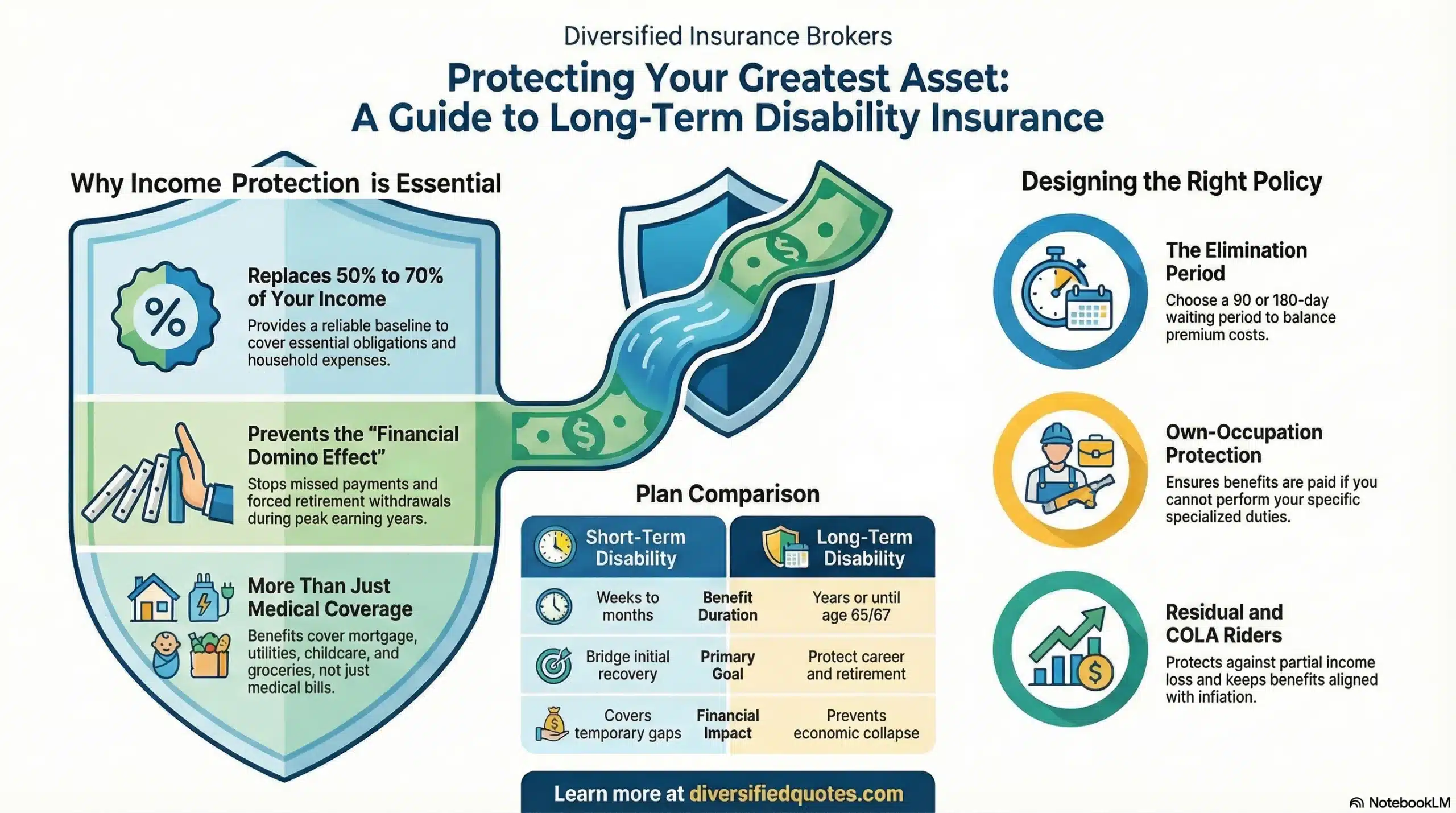
Talk With an Advisor Today
Choose how you’d like to connect—call or message us, then book a time that works for you.
Schedule here:
calendly.com/jason-dibcompanies/diversified-quotes
Licensed in all 50 states • Fiduciary, family-owned since 1980
FAQs: Disability Insurance for the Lumber Industry
Can loggers and sawmill workers actually get disability insurance given the hazard level of the work?
Yes — and the assumption that the lumber industry’s documented hazard level makes disability insurance inaccessible is the most consequential misconception any lumber worker can hold about their financial protection options. The disability insurance market uses an occupational class system that prices elevated risk appropriately rather than excluding it. Logging occupations and sawmill workers are classified in the higher physical hazard categories — Class B or Class C in most carrier systems — which produces higher premiums than white-collar professional occupations, but disability insurance coverage is available, meaningful, and genuinely provides the income floor that the industry’s documented risk profile makes urgent.
The most important factor for any lumber industry worker evaluating disability insurance is carrier selection through an independent broker who accesses the full carrier market. Carrier guidelines for high-physical-hazard occupational classifications vary meaningfully for lumber industry roles — what one carrier classifies as Class B with standard policy terms, another may classify as Class C with more restrictive benefit terms, for the same worker doing the same job. The difference produces real differences in premium cost and coverage quality, and identifying the most favorable available terms requires an independent broker with multi-carrier access rather than a single direct application to one company. For occupations where standard market terms are very restricted, accident-only disability income insurance provides a targeted alternative specifically covering the acute physical injury and accident scenarios that dominate the lumber industry’s documented disability event profile. A second opinion from an independent broker who regularly places coverage for high-risk physical industry workers confirms the specific available terms for a lumber industry worker’s specific role and health status before any premium commitment is made.
I’m a self-employed logging contractor who owns my equipment — what disability coverage do I need?
As a self-employed logging contractor who owns your harvesting equipment, your disability exposure has two distinct financial layers that require two coordinated coverage responses. Personal disability income insurance replaces your earned income from logging contracts when a qualifying disability prevents you from operating equipment and performing timber harvesting work — sized to your documented net self-employment income from Schedule C averaged across two to three years. This policy addresses your household’s financial obligations during the disability period. Business overhead expense disability coverage addresses your logging operation’s fixed costs: equipment loan payments for your skidder, feller-buncher, or forwarder, equipment insurance premiums, storage and maintenance costs, and any other fixed obligations that continue whether you are operating or not.
A disability preventing you from logging for three to six months eliminates both your operating income and the revenue stream servicing your equipment financing simultaneously — and without BOE coverage, the equipment loan payments accumulate against zero contract revenue during the recovery period, potentially forcing equipment sale decisions during a disability that would otherwise be survivable financially with coverage in place. BOE disability coverage pays your documented fixed monthly equipment and business overhead during qualifying disability, preserving your logging operation and the timber contract relationships that represent your career’s business investment. The BOE benefit is sized to actual documented monthly fixed overhead — not to contract revenue — covering what the operation costs to maintain rather than what it generates. Together, the personal disability income policy and the BOE policy create the complete protection architecture for a self-employed logging contractor — the household financial floor and the equipment overhead floor, each addressing the distinct financial layer that the lumber industry’s documented fatality and injury rate makes urgently relevant to address.
Does disability insurance cover respiratory conditions from wood dust exposure in a sawmill?
Yes — individual disability insurance covers qualifying disability from respiratory conditions including those arising from occupational wood dust exposure, when those conditions meet the policy’s disability definition. The ILO occupational health research on sawmill workers documents that wood dust exposure is associated with a broad range of upper and lower respiratory effects, and occupational health research specifically documents pulmonary function abnormalities and respiratory symptoms at elevated rates in wood dust-exposed sawmill workers compared to unexposed controls. When a respiratory condition — occupational asthma, chronic bronchitis, or progressive pulmonary impairment from sustained wood dust inhalation — prevents a sawmill worker from performing their mill operations functions, individual disability insurance covers the qualifying disability regardless of whether a specific incident can be attributed to a specific employer or worksite.
This is precisely where individual disability insurance fills the gap that workers’ compensation leaves specifically for sawmill workers: the progressive respiratory conditions that develop gradually from sustained wood dust inhalation across a mill career do not arise from a single datable incident that workers’ comp’s incident attribution requirement can identify and cover. Individual disability insurance covers qualifying disability from any illness cause regardless of gradual onset or the difficulty of attributing the condition to a specific workplace event. For sawmill workers with prior documented respiratory conditions from wood dust exposure — managed asthma, prior bronchitis episodes — coverage is available through independent broker comparison, typically with a partial exclusion rider for the documented respiratory condition but with full coverage for all other disability causes including musculoskeletal conditions, machinery injuries, and illness-based disability outside the excluded respiratory area. As with any occupational health condition, early purchase before any respiratory treatment history has been documented produces the most comprehensive available coverage without exclusion riders. Coverage for sawmill workers with prior respiratory conditions is available through independent broker comparison across carriers whose guidelines for wood dust exposure respiratory histories vary.
Are disability insurance benefits taxable for a self-employed logging contractor?
For self-employed logging contractors who purchase individual disability insurance personally and pay premiums with after-tax personal income, monthly disability benefits received during a qualifying disability are generally received income-tax-free. The full benefit amount reaches the household without income tax reduction during the disability period when no logging contract revenue is being generated. Understanding the full tax treatment of disability insurance benefits matters for sizing the policy correctly: a tax-free individually purchased benefit should cover actual after-tax take-home income from logging operations, ensuring genuine income replacement during a disability period when the household’s financial obligations continue unchanged.
Self-employed logging contractors who operate through business entities — LLCs or S-corporations — and who pay disability insurance premiums at the entity level should confirm the specific tax treatment with a tax professional, as entity-level premium payments create complexity in the standard personal-premium/tax-free-benefit baseline. BOE premiums paid by the logging business entity are generally deductible as business expenses, but resulting BOE benefits received during disability are typically taxable — creating a roughly neutral net tax impact since the taxable BOE benefits offset the deductible overhead expenses they fund. The personal disability income policy, purchased personally with after-tax income, delivers tax-free benefits at the household level independent of the business entity’s treatment of its premium payments. For employed sawmill and lumber yard workers whose employer pays group disability plan premiums, resulting group plan disability benefits are typically taxable as ordinary income — reducing effective replacement below the stated plan percentage, and making individually purchased supplemental coverage paid with personal after-tax income more financially efficient when disability occurs.
I work in a sawmill and my employer provides group LTD — is that sufficient coverage given the hazard level?
Employer group LTD at a sawmill or lumber mill provides a meaningful income baseline — and enrolling at the maximum available group plan benefit is always the right starting point for any employed sawmill worker with access to a group plan. But the specific structural limitations of employer group plans are particularly consequential for sawmill workers given the specific nature of the industry’s documented disability pathways. The 24-month own-to-any occupation definition transition is specifically problematic for a skilled sawmill operator whose condition prevents their specific mill work but who could theoretically perform sedentary employment — eliminating coverage for the specialized mill skills that generate their specific income at 24 months. The benefit ceiling — typically $5,000 to $10,000 per month — may adequately cover current mill worker income but cannot grow with career advancement. The respiratory illness dimension is perhaps the most specific gap: progressive respiratory conditions from wood dust exposure that develop gradually across a mill career are illness-based disabilities that the group plan covers, but the 24-month any-occupation transition may eliminate benefits when a respiratory condition has proven persistent but the worker might theoretically perform some non-mill employment.
Individual supplemental disability insurance purchased personally fills the 24-month definition gap by maintaining the own-occupation standard for sawmill work beyond the group plan’s transition point, adds benefit ceiling coverage above the group plan’s maximum, and remains in force through any future employer or employment change — unlike the group plan that terminates with employment. The respiratory illness coverage dimension specifically benefits from individual coverage that does not impose a 24-month any-occupation transition, providing income protection for the gradual respiratory conditions that the industry’s documented wood dust exposure produces across sawmill careers. Together, maximum group plan enrollment and individual own-occupation supplemental coverage create the most complete available protection architecture for an employed sawmill worker.
When is the best time for a logging or lumber industry worker to purchase disability insurance?
Career start — or as early in the career as possible — is the most strategically advantageous time to purchase disability insurance for any lumber industry worker, and the industry’s documented chemical and biological exposure pathways make the early-purchase argument more specific than in most occupations. Wood dust respiratory exposure in sawmill environments accumulates from the first shift, and the respiratory conditions documented in occupational health research develop progressively with sustained exposure across a mill career. A sawmill worker who establishes disability insurance at career start — before any respiratory symptoms, pulmonary function abnormalities, or treatment history has been documented — secures comprehensive respiratory and illness coverage without the exclusion riders that documented treatment histories generate. The same logic applies to logging operations: the musculoskeletal conditions from whole-body vibration in equipment operation accumulate from the first operating season, and the window to purchase comprehensive coverage before any vibration-related back or joint condition has been documented closes as operating seasons accumulate.
Premium rates are age-rated and lock in at policy issuance on non-cancellable, guaranteed renewable policies. A logger or sawmill worker purchasing at 22 locks in substantially lower annual premiums than the same coverage would cost at 32 after a decade of occupational exposure has potentially influenced health documentation. The future increase option allows benefit increases as income grows with career advancement and equipment investment without new medical underwriting, preserving the favorable early-career health-based terms through the full income trajectory. For a logging industry that BLS documents as the deadliest civilian occupation by fatality rate, the urgency of early purchase is not merely a financial optimization — it is the recognition that every working day without income protection in the world’s most documented occupational hazard environment is a day of complete uninsured financial exposure to an event that the statistical record documents at rates 28 times the national average.
About the Author:
Jason Stolz, CLTC, CRPC, DIA, CAA and Chief Underwriter at Diversified Insurance Brokers (NPN 20471358), is a senior insurance and retirement professional with more than 25 years of real-world experience helping individuals, families, and business owners protect their income, assets, and long-term financial stability. As a long-time partner of the nationally licensed independent agency Diversified Insurance Brokers, Jason provides trusted guidance across multiple specialties—including fixed and indexed annuities, long-term care planning, personal and business disability insurance, life insurance solutions, Group Health, Travel Medical and Evacuation Insurance, and short-term health coverage. Diversified Insurance Brokers maintains active contracts with over 100 highly rated insurance carriers, ensuring clients have access to a broad and competitive marketplace.
His practical, education-first approach has earned recognition in publications such as VoyageATL, and contributions from his agency featured in Kiplinger and GoBankingRates— highlighting his commitment to financial clarity and client-focused planning. Drawing on deep product knowledge and years of hands-on field experience, Jason helps clients evaluate carriers, compare strategies, and build retirement and protection plans that are both secure and cost-efficient. Visitors who want to explore current annuity rates and compare options across multiple insurers can also use this annuity quote and comparison tool.
Explore More Disability Insurance Options: Browse our complete guide to Disability Insurance for Agriculture, Natural Resources & Outdoor Industries — covering farmers, ranchers, fishermen, foresters, miners, oil & gas workers & outdoor industries from 100+ carriers.
Last Reviewed: June 9, 2026 |
Reviewed by: Jason Stolz, CLTC, CRPC, DIA, CAA
Chief Underwriter, Diversified Insurance Brokers, Inc. | NPN: 20471358 | Diversified Insurance Brokers, Inc. — Licensed in all 50 states
Fact Checked by: Tonia Pettitt, CMIP©
Medicare Specialist, Diversified Insurance Brokers, Inc. | NPN: 14374308 | Diversified Insurance Brokers, Inc. — Licensed in all 50 states
Did you find this content helpful? Leave us a Google review — it helps others find trustworthy guidance too.
Editorial Standards: Diversified Insurance Brokers maintains rigorous editorial standards to ensure accuracy, clarity, and independence in all content. Learn more about our editorial standards and commitment to transparency.
