
Disability Insurance for Garbage Collectors
As an Independent Disability Insurance Broker, we have access to exclusive discounts and negotiated pricing most captive agents can’t offer — see the full breakdown near the end of this page.
Disability Insurance for Garbage Collectors

Jason Stolz CLTC, CRPC, DIA, CAA
Disability insurance for garbage collectors is essential income protection for workers in one of the most statistically dangerous occupations in the United States — and one where the gap between documented occupational risk and actual individual income protection coverage is among the widest of any working population. Whether you work as a residential solid waste collection worker on a rear-load or automated side-load truck route, operate collection equipment for a commercial hauling company, work in recyclable materials collection on a materials recovery circuit, serve on a landfill or transfer station operation, or work as a municipal solid waste collector employed by a city or county sanitation department — your income depends on your physical capacity to perform demanding outdoor manual labor in one of the highest-injury occupational categories in American industry.
The Bureau of Labor Statistics documents that in 2023, refuse and recyclable material collectors had a fatality rate of 41.4 per 100,000 workers — ranking as the fourth deadliest occupation in the entire United States, exceeded in fatality rate only by logging, fishing and hunting, and roofing. BLS injury data for solid waste collection workers shows an injury rate of 4.3 total cases per 100 full-time equivalent workers — nearly double the private industry average of 2.4. Transportation incidents are documented as the leading cause of fatalities. The illness rate for solid waste collection workers reached 13.8 per 100 FTE in recent BLS reporting periods. These are not marginal statistics — they describe a genuinely hazardous occupation whose risk profile consistently places it among the most dangerous in American industry year after year.
At Diversified Insurance Brokers, we help garbage collectors, solid waste collection workers, recycling collection workers, transfer station operators, and waste industry professionals structure disability insurance coverage that reflects the genuine occupational hazards of waste collection work, the income structures of both municipal and private sector waste industry employment, and the specific conditions most likely to interrupt or end a solid waste worker’s career and income.
Protect Your Waste Collection Income
Compare disability insurance options designed for solid waste collection workers, recycling collectors, transfer station operators, and all waste industry professionals.
The Fourth Deadliest Occupation in America — What the Data Shows
Disability insurance for garbage collectors begins with an honest accounting of what BLS data confirms about this profession’s occupational hazard profile — because the public underestimation of waste collection danger is one of the primary reasons garbage collectors are so underserved by individual income protection coverage.
In 2023, the Bureau of Labor Statistics ranked refuse and recyclable material collectors as the fourth deadliest occupation in the United States, with a fatality rate of 41.4 per 100,000 workers. The only occupations with higher fatality rates were logging, fishing and hunting, and roofing — professions whose hazardous reputations are widely recognized. Waste and recycling collection remains in the top five deadliest American occupations despite ongoing industry investment in safety technology and training, including route optimization software, automated collection systems, and enhanced driver safety programs. The persistence of this fatality ranking across multiple consecutive years of BLS data reflects the structural hazards of waste collection work that safety improvements have reduced but not eliminated.
Transportation incidents account for the largest share of fatal waste collection injuries — reflecting the reality that garbage trucks operate daily on public roads in heavy traffic, make frequent stops and starts in residential neighborhoods and commercial areas, and require workers to work on and around large vehicles in road environments where motorist inattention creates constant struck-by risk. A garbage collection worker who is struck by a vehicle while servicing a residential collection route, or who is injured in a truck accident on a collection circuit, faces the same immediate and complete income interruption that any disabling event produces — but in a profession whose mortality statistics confirm the genuine severity of that risk. The transportation-dominated fatality profile of waste collection has parallels in other vehicle-intensive manual labor occupations, including dock workers and transportation sector workers managing vehicle-related occupational injury risk.
Non-Fatal Injury Rates — Nearly Double the National Average
Beyond the fatality statistics, the non-fatal injury rate for solid waste collection workers — 4.3 total cases per 100 full-time equivalent workers in the most recent BLS reporting period — is nearly double the private industry average of 2.4 cases per 100 FTE. This elevated non-fatal injury rate reflects the physical demands of collection work that produce the musculoskeletal injuries, struck-by incidents, and slip and fall injuries that dominate the waste collection worker disability profile.
Musculoskeletal disorders from the sustained physical demands of waste collection are the most prevalent non-fatal injury category — back injuries, shoulder injuries, and lower extremity conditions that develop from the combination of heavy container lifting, repetitive reaching and pulling motions, sustained awkward postures during collection operations, and the physical loading of mounting and dismounting a collection vehicle dozens or hundreds of times per shift. A solid waste collection worker who services a residential route may physically lift, drag, and position hundreds of individual waste containers per shift — each requiring the bending, reaching, and manual force application that cumulatively produces the spinal and musculoskeletal conditions that dominate the waste collection worker disability profile.
The injury rate data consistently places solid waste collection workers in a substantially more hazardous category than the overall private industry average — and the illness rate data for 2023 (13.8 per 100 FTE for solid waste collection workers, compared to an overall private industry incidence rate of 2.4) documents an additional occupational illness burden from pathogen exposure, chemical contact, and respiratory hazards in waste handling that adds a biological and chemical dimension to the physical injury risk profile of waste collection work. The elevated injury and illness rate profile of waste collection workers parallels that documented in other high-physical-demand manual labor contexts, including construction workers whose sustained heavy manual labor produces comparable elevated injury rates well above the national average.
Back and Musculoskeletal Injuries — The Career-Defining Disability Risk
The most financially consequential disability risk for working garbage collectors — because it is the most prevalent and the most likely to produce extended career interruption — is back and musculoskeletal injury from the sustained heavy physical demands of collection work. A solid waste collection worker’s shift involves a pattern of physical loading that is biomechanically adverse in ways that accumulate into serious spinal pathology over a waste collection career.
Manual rear-load collection — where workers hand-carry containers from the curb or property to the truck hopper, drag large heavy bins across uneven surfaces, and lift, tip, and position containers into the truck — requires sustained repeated heavy lifting in bent and twisted spinal postures. The lumbar spine absorbs this repeated loading across every collection stop of every shift, and the accumulated spinal loading of a multi-year waste collection career produces the disc degeneration, herniated discs, facet joint arthritis, and lumbar instability that are among the most frequently reported disabling conditions in heavy manual labor occupations.
Even automated collection operations — where the worker controls a hydraulic arm that grabs and empties carts — involve sustained physical demands including mounting and dismounting the vehicle, repositioning missed containers, servicing containers that automated systems cannot reach, and the sustained whole-body vibration of operating a heavy collection vehicle over urban and suburban road surfaces throughout a full shift. Whole-body vibration is specifically documented as a risk factor for lumbar spine disease in heavy vehicle operators — adding a vibration-related spinal loading component to the manual lifting demands of collection work for workers in driver-operator roles.
A garbage collector who develops a serious lumbar disc herniation requiring surgical treatment faces weeks to months of recovery during which the physical demands of collection work are medically prohibited. A worker who develops progressive degenerative disc disease from career spinal loading may face a more gradual but equally real reduction in collection work capacity as pain and functional limitation accumulate over years of work. Both the acute injury scenario and the gradual degenerative scenario produce income consequences that disability insurance specifically addresses. The back injury disability risk profile of solid waste collection workers reflects the same sustained heavy manual labor spinal loading dynamics documented in other heavy manual trade contexts, including drywall installers and other sustained heavy manual labor tradespeople whose cumulative spinal loading produces career-limiting degenerative conditions.
Struck-By and Vehicle Incident Risk — The Acute Fatality and Disability Driver
Transportation incidents — including struck-by incidents where collection workers are hit by vehicles while working on public roads, and truck accidents involving the collection vehicle itself — are the leading cause of fatality in waste collection and represent the most acute acute injury risk category for non-fatal disabling injuries as well. A garbage collector working a residential route is exposed to street traffic throughout the entire shift — servicing collections from the street side, crossing roadways to reach bins on opposing curbs, and working in the road environment where distracted, speeding, or impaired drivers create constant struck-by risk.
A solid waste collection worker struck by a vehicle while servicing a collection route can sustain orthopedic injuries, traumatic brain injuries, and spinal trauma that require months of medical treatment and rehabilitation and may produce permanent functional limitations. Even non-fatal vehicle incidents produce disability scenarios that are immediately financially consequential for workers who depend on their physical capacity for manual collection work. For workers employed by municipal solid waste departments, workers’ compensation provides a baseline of injury protection — but that protection carries the same structural limitations described throughout this page, with benefit amounts that replace only two-thirds or less of average wages and coverage that ends at maximum medical improvement rather than when the worker has fully regained collection work capacity.
The struck-by vehicle risk that garbage collectors face on public roads during daily collection work is among the most specifically documented and structurally difficult hazards in any labor occupation — it is inherent to the nature of working alongside vehicle traffic throughout the working day, and it produces disability outcomes that create genuine and immediate income protection needs. The vehicle incident disability risk facing waste collection workers parallels that documented in other vehicle-adjacent heavy labor contexts, including crane operators and heavy equipment workers managing vehicle and machinery-related acute injury risk.
Occupational Illness — The Biological and Chemical Hazard Dimension
The elevated illness rate for solid waste collection workers — 13.8 per 100 FTE in the most recent BLS reporting period, compared to an overall private industry incidence rate of 2.4 — documents an occupational illness burden from biological and chemical hazards in waste handling that adds a significant non-injury disability risk dimension to the waste collection occupational profile.
Garbage collectors handle waste streams that include infectious waste from healthcare and residential sources, chemical residues from household cleaning agents and automotive products, sharps and contaminated needles that present bloodborne pathogen exposure risk, heavy metal contamination from batteries and electronic waste, and the complex mixture of biological and chemical contaminants that municipal solid waste represents. Published systematic review research specifically documents that garbage collectors and sanitation workers are at risk of occupational injuries and infections including hepatitis B and hepatitis C, and that they are regularly exposed to contaminated needles, sharps, and hazardous chemicals. Respiratory exposure to bioaerosols, dust, and chemical vapors during waste handling operations adds a respiratory illness dimension that BLS data confirms with illness rates documenting respiratory conditions as a specific illness subcategory for solid waste collection workers.
An occupational illness from bloodborne pathogen exposure — hepatitis C infection producing progressive liver disease, for example — can produce a disabling chronic illness whose income consequences extend over years of a garbage collector’s career. Respiratory sensitization from bioaerosol and chemical vapor exposure can produce occupational asthma that makes continued waste handling work medically inadvisable. Individual disability insurance covers disability from any occupational illness cause regardless of how it developed or when the disabling consequences manifest — filling the gap that workers’ compensation leaves open for gradually developing occupational illness rather than acute single-event injury. The biological and chemical occupational illness disability risk facing garbage collectors is parallel to that documented in other high-exposure manual work contexts, including food processing workers managing biological and chemical occupational illness risk in high-exposure industrial environments.
Workers’ Compensation — Meaningful Baseline With Important Gaps
Workers’ compensation is required for solid waste collection employees in all states and provides a meaningful baseline of protection for work-related injuries — medical treatment coverage, partial wage replacement, and disability benefits during recovery. However, the structural limitations of workers’ compensation leave meaningful income protection gaps for garbage collectors that individual disability insurance specifically addresses.
Workers’ compensation replaces only two-thirds or less of average weekly wages and explicitly excludes overtime pay and other supplemental earnings that solid waste collection workers may earn through extra shifts and premium routes. Workers’ compensation covers only work-related injury events — a garbage collector who becomes disabled from a cardiovascular condition, a serious illness, or an off-duty injury receives no workers’ compensation benefit. Workers’ compensation ends at maximum medical improvement — the point where the medical provider determines the condition cannot improve further — which may occur months before the worker has fully regained the physical capacity required for the sustained heavy demands of waste collection work. And for self-employed private hauling operators and independent solid waste contractors who have not elected workers’ compensation coverage for themselves, even this baseline protection may be absent.
Individual disability insurance covers disability from any cause regardless of origin — work-related or off-duty, acute or gradually developing — for the full benefit period rather than ending at maximum medical improvement, and at benefit amounts calibrated to total compensation rather than the reduced wage base that workers’ compensation uses. For garbage collectors whose household financial obligations depend on consistent collection income, the difference between workers’ compensation-only protection and workers’ compensation supplemented by individual disability insurance can be the difference between managing a recovery period with financial stability and facing a household financial crisis that pressures premature return to heavy collection work before complete recovery. The workers’ compensation gap and individual disability insurance coordination need for heavy manual labor workers parallels that documented in other physically intensive manual trade contexts, including bricklayers and masons managing the gap between workers’ compensation coverage and complete income protection needs.
Case Study: Solid Waste Collection Worker Earning $58,000 Per Year
Consider a solid waste collection worker employed by a private waste hauling company, earning $58,000 annually including base wages and regular overtime. While servicing a residential collection route, this worker sustains a serious lumbar disc herniation requiring surgical treatment and six months of rehabilitation during which the physical demands of collection work are medically prohibited.
| Scenario | Workers’ Comp Only | Workers’ Comp + Individual DI |
|---|---|---|
| Monthly Income During Recovery | ~$2,222 (two-thirds of base wages only) | ~$2,222 workers’ comp + $1,000–$1,400 individual supplement |
| Overtime Pay Protected | $0 — overtime excluded from workers’ comp wage base | Individual policy calibrated to include documented overtime earnings |
| 6-Month Total Income | ~$13,332 | ~$19,332–$21,732 |
| Financial Outcome | Income shortfall; financial pressure to return before surgical healing | Recovery fully supported on medical timeline; return protected |
Lumbar disc herniation from heavy container lifting and sustained collection work physical loading is among the most predictable and most frequently occurring disabling conditions in the waste collection workforce. Disability insurance for garbage collectors ensures that a predictable occupational injury does not simultaneously produce a household financial crisis that pressures premature return to heavy collection work before surgical recovery is complete.
Municipal vs. Private Sector Employment — Different Benefit Structures, Same Need
Garbage collectors work in both municipal government employment — sanitation department workers employed by cities and counties — and private sector employment at waste hauling companies ranging from large national operators to small regional haulers. These two employment categories have different benefit structures, but both leave meaningful individual disability insurance gaps that are worth understanding.
Municipal sanitation workers typically have access to government employee group disability plans and defined benefit pension plans that provide broader institutional protection than private sector hourly workers — but those government plans carry the own-occupation to any-occupation conversion risk after two years that affects all government employee disability programs, and they calculate benefits on base salary excluding overtime and supplemental pay that many municipal sanitation workers depend on. Private sector waste collection employees typically have access to employer group disability benefits through their hauling company’s benefit package — generally replacing 60% of base salary — with the same overtime exclusion and portability limitations that affect all employer group plans.
For self-employed private haulers, independent solid waste contractors, and owner-operators of small waste hauling businesses, individual disability insurance is not a supplement to employer coverage — it is the only income protection available. The self-employment disability insurance planning needs of independent waste industry operators mirror those of other self-employed physical trade and transportation operators, including independent contractors and self-employed operators managing income protection without employer-provided group coverage.
Key Policy Features for Garbage Collector Disability Insurance
Disability insurance for garbage collectors should be structured with specific policy provisions that address the heavy manual labor demands, vehicle accident risk, occupational illness exposure, and income structures of waste collection work. The own-occupation definition is foundational — ensuring that a garbage collector who cannot perform the specific physical demands of waste collection work receives disability benefits regardless of theoretical capacity for less physically demanding employment. Our comprehensive resource on own-occupation disability insurance explained covers how this definition protects collection income from the conditions most likely to disable a working garbage collector.
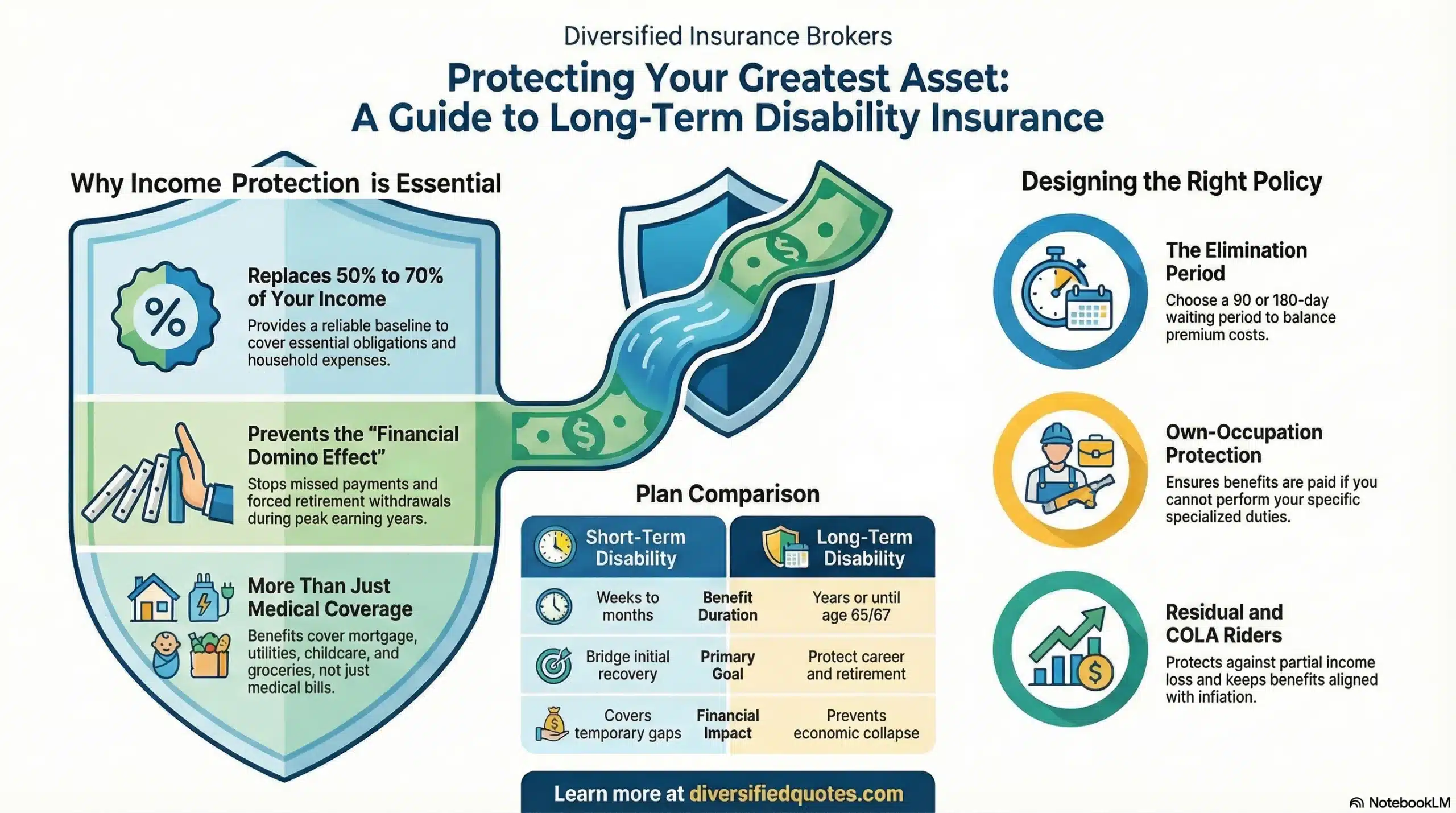
A residual disability rider is particularly important for garbage collectors whose musculoskeletal conditions may reduce collection capacity without eliminating it entirely — a worker who can perform limited light-duty routes or supervisory work but cannot manage full heavy manual collection duties earns reduced income without being totally disabled. Our resource on how residual disability insurance benefits work explains how partial disability coverage supports workers through graduated recovery periods. The elimination period should be calibrated to available savings and the workers’ compensation bridge income — our guide on how disability insurance elimination periods work provides the complete framework. A cost-of-living adjustment rider preserves real benefit value across extended claims — our resource on disability income insurance with a COLA rider explains this protection. For garbage collectors exploring short-term coverage, our guide on how to buy short-term disability insurance covers the complete income protection picture.
Why Garbage Collectors Need an Independent Disability Insurance Broker
Disability insurance for garbage collectors involves occupational classification considerations, workers’ compensation coordination, and income documentation nuances — particularly around overtime pay — that require experienced broker knowledge to navigate effectively. A broker who understands waste collection occupational classifications, who knows how to present total collection income including overtime earnings to underwriters accurately, and who can identify the carriers most favorable for heavy manual labor occupational classifications produces better coverage outcomes than a standard retail application.
At Diversified Insurance Brokers, we work with solid waste collection workers, recycling collectors, landfill and transfer station workers, and waste industry professionals across all employment structures — municipal workers, private sector employees, and self-employed haulers — to structure disability coverage that reflects how garbage collectors earn, what conditions would actually prevent them from working, and what policy features provide the most meaningful financial protection for workers in one of America’s most genuinely dangerous occupations. Our dedicated resource on why independent disability insurance brokers matter explains the full value of this approach. And our resource on whether disability insurance is worth the investment provides the foundational financial case for coverage that applies with particular force to workers in an occupation that BLS consistently ranks as one of the four most dangerous in the country.
Final Thoughts on Disability Insurance for Garbage Collectors
Garbage collectors and solid waste workers provide one of the most essential services in any community — collecting waste that, if left uncollected, would produce public health crises that modern urban life depends on preventing. They do this work daily in some of the most hazardous labor conditions in American industry, accepting vehicle traffic risk, heavy physical loading, and biological and chemical exposure hazards that the broader public rarely thinks about when their bins are empty at the end of collection day.
Disability insurance for garbage collectors is the financial tool that ensures the fourth deadliest occupation in America does not also become a financially catastrophic one when an injury or illness inevitably strikes. A well-structured policy — supplementing workers’ compensation, covering overtime income, providing own-occupation protection against the heavy manual labor disability scenarios most likely to affect a working collector, and maintaining benefits for the full recovery period — provides the income security that every waste collection worker deserves and that no other financial tool provides.
Related Pages
Talk With an Advisor Today
Choose how you’d like to connect—call or message us, then book a time that works for you.
Schedule here:
calendly.com/jason-dibcompanies/diversified-quotes
Licensed in all 50 states • Fiduciary, family-owned since 1980
Disability Insurance for Garbage Collectors FAQs
Yes, garbage collectors and solid waste collection workers can obtain individual disability insurance. The occupational classification reflects the physical demands and injury risk profile of collection work — heavy manual labor, vehicle operation, and outdoor work in variable conditions — and places solid waste workers in a classification tier that accounts for this occupational intensity. The most important planning considerations for waste collection workers are ensuring the benefit amount reflects total compensation including overtime pay that workers’ compensation and employer group plans typically exclude, selecting a policy with an own-occupation definition that will respond to the most likely disability scenarios for heavy physical collection work, and including a residual disability rider for the gradual musculoskeletal and back conditions that commonly reduce collection capacity before fully eliminating it. Working with an independent broker who understands heavy labor occupational classifications and waste industry income structures produces materially better coverage outcomes than a standard retail application. For context on disability insurance for other high-physical-demand labor occupations in the same hazard tier, see our page on disability insurance for boilermakers and other heavy manual labor workers in high-injury occupational categories.
Waste collection is documented by the Bureau of Labor Statistics as one of the most dangerous occupations in the United States. In 2023, BLS ranked refuse and recyclable material collectors as the fourth deadliest occupation in the country, with a fatality rate of 41.4 per 100,000 workers — exceeded only by logging, fishing and hunting, and roofing. Transportation incidents are the leading cause of fatalities, reflecting the constant vehicle traffic exposure of collection work on public roads throughout the working shift. Beyond fatality rates, the non-fatal injury rate for solid waste collection workers — 4.3 total cases per 100 FTE — is nearly double the overall private industry average of 2.4. The illness rate for solid waste collection workers reached 13.8 per 100 FTE in recent BLS data, documenting an elevated occupational illness burden from biological and chemical hazard exposure in waste handling. These statistics place waste and recycling collection consistently among the most hazardous American occupations across multiple consecutive years of BLS reporting, making disability insurance planning a genuine financial priority rather than a remote contingency for anyone working in this industry.
Workers’ compensation provides a meaningful baseline for garbage collectors employed at waste hauling companies and municipal sanitation departments, but its limitations leave real income protection gaps. Workers’ compensation replaces only two-thirds or less of average weekly wages and explicitly excludes overtime pay — which many solid waste collection workers depend on for a significant portion of total annual income. Workers’ compensation covers only work-related injury events: a garbage collector disabled from a serious illness, an off-duty injury, or a gradually developing back condition that cannot be attributed to a single workplace incident may receive nothing. Workers’ compensation also ends at maximum medical improvement, which may occur before the worker has fully regained the physical capacity for sustained heavy collection work, leaving a gap between benefit termination and safe return to full duty. For self-employed private haulers and independent solid waste operators, workers’ compensation for the owner is typically absent entirely. Individual disability insurance addresses all of these gaps by covering any cause of disability, maintaining benefits for the full benefit period, and calibrating the benefit to total compensation including overtime. For context on the workers’ compensation coverage gap for heavy manual labor workers, see our resource on disability insurance for heavy labor operators managing workers’ compensation coverage limitations.
Back injuries from heavy container lifting and repetitive bending motions are the most prevalent and most financially consequential disability category for garbage collectors — lumbar disc herniations, lumbar strain, and degenerative disc disease from sustained career spinal loading that accumulates across thousands of daily collection stops. Shoulder injuries from sustained overhead and reaching motions during container handling, rotator cuff tears and tendinopathy from repetitive arm loading, and lower extremity injuries from vehicle mounting and dismounting and uneven surface navigation all contribute to the musculoskeletal injury profile. Struck-by vehicle incidents — where collection workers are hit by vehicles while servicing routes on public roads — represent the most acute and most severe injury category, capable of producing traumatic brain injuries, spinal trauma, and multiple orthopedic injuries requiring extended recovery. Falls from truck steps and platforms produce fractures and head injuries. Occupational illness from biological exposure — hepatitis B and C from sharps contact, respiratory conditions from bioaerosol and chemical vapor exposure — adds a disease dimension to the physical injury profile. Each of these categories can produce weeks to months of inability to perform collection work with immediate income consequences.
Own-occupation disability insurance pays benefits when a disabling condition prevents a garbage collector from performing the specific physical duties of their collection work — heavy container handling, vehicle operation, route service, outdoor labor in variable conditions — regardless of whether they could theoretically perform other less physically demanding work. Any-occupation coverage only pays if the worker cannot perform virtually any gainful employment. A solid waste collection worker whose back injury prevents the heavy lifting and physical demands of collection work but who could theoretically perform a sedentary desk job would receive no any-occupation benefits, while an own-occupation policy recognizes the genuine inability to perform collection work and pays accordingly. For workers whose entire income depends on their specific physical capacity for heavy manual outdoor labor, the any-occupation definition provides almost no meaningful income protection for the most common disability scenarios in waste collection. For context on how the own-occupation distinction works for physically demanding labor occupations, see our resource on disability insurance for physically demanding trade workers managing the own-occupation definition.
Residual disability coverage pays proportional benefits when a disabling condition reduces a garbage collector’s work capacity and income without completely eliminating the ability to work. A collection worker recovering from back surgery or a serious shoulder injury may be medically cleared for light-duty work — perhaps a driver-only role, a smaller route with lighter containers, or reduced-hours collection — months before they can safely return to full heavy collection duty. During this graduated return, collection income is reduced without being fully eliminated. Without a residual disability rider, a total-disability-only policy pays nothing during this partial capacity period. A residual rider supplements reduced collection income proportionally throughout the graduated return to full collection duty, providing continuous financial support from the onset of disability through complete return to normal route operations. For garbage collectors whose most common disabling conditions — back injuries, shoulder injuries, and musculoskeletal conditions — typically follow extended graduated recovery timelines rather than sudden binary incapacity, the residual rider is essential for the policy to function as genuine income protection. For context on residual coverage for heavy manual labor workers, see our page on disability insurance for hazardous labor workers requiring partial disability protection.
Overtime pay is a meaningful component of total annual compensation for many solid waste collection workers who regularly work extended shifts, weekend routes, and holiday collection schedules. Workers’ compensation wage replacement is calculated on regular weekly wages and typically excludes overtime, creating a meaningful income gap for workers whose total earnings depend substantially on overtime hours. Individual disability insurance carriers base benefit amounts on verified total earned income using W-2 documentation, and total W-2 income including documented overtime earnings can be included in the insurable income calculation — allowing the benefit amount to be calibrated to actual total annual compensation rather than base wage rates alone. For a garbage collector whose overtime earnings represent 15% to 25% or more of annual income, the difference between a benefit amount based on regular wages only versus total W-2 income including overtime can represent thousands of dollars in annual disability benefit — a financially significant difference during an extended recovery period. Working with an independent broker who understands how to document and present waste collection overtime income to underwriters effectively is important for securing benefit amounts that reflect genuine total earning capacity.
Yes — individual disability insurance covers disability from any cause including occupational illness from biological or chemical exposure, when the condition meets the policy’s definition of disability. A garbage collector who develops hepatitis C from a sharps exposure incident and who subsequently experiences disabling liver disease qualifies for disability benefits when the condition prevents performing collection work. A worker who develops occupational asthma from bioaerosol or chemical vapor exposure during waste handling operations qualifies for benefits when the respiratory condition makes continued waste collection work medically inadvisable. Workers’ compensation may cover these occupational illness scenarios if they can be attributed to specific workplace incidents, but many gradually developing occupational illness conditions — respiratory sensitization from cumulative exposure, chronic disease from repeated biological exposure events — are difficult to qualify under workers’ compensation’s incident-based framework. Individual disability insurance covers these conditions without requiring attribution to a single identifiable workplace event, providing income replacement for the full range of occupational illness outcomes that waste collection exposure creates.
The elimination period selection for garbage collectors should account for workers’ compensation coverage for work-related injuries, available personal savings, and employer sick leave provisions. For garbage collectors employed by waste hauling companies or municipal sanitation departments whose work-related injuries activate workers’ compensation income replacement immediately, a 90-day elimination period on an individual supplemental policy may be financially manageable — using workers’ compensation income as a bridge during the waiting period before individual long-term disability benefits activate. However, for disabilities that are not work-related — illness, off-duty injuries, gradually developing back conditions from cumulative career loading — no workers’ compensation income is available during the elimination period, making the sole support factor the worker’s available personal savings. For garbage collectors with limited savings, a 30 or 60-day elimination period may be the more appropriate choice even at higher premium cost, since the financial urgency of a non-work-related disability begins immediately with no institutional bridge income available. For workers with stronger financial reserves, the 90-day elimination period is typically the most cost-effective option.
The best time is as early as possible in a waste collection career — ideally when first entering the profession, before back conditions, shoulder injuries, or other occupational health consequences from collection work have accumulated in the medical record. Disability insurance premiums are based in part on age and health status at the time of application, and younger collection workers in good health secure the most comprehensive coverage at the most favorable rates. Back conditions from sustained heavy collection work, shoulder injuries from repetitive container handling, and respiratory conditions from bioaerosol and chemical vapor exposure all develop predictably over a waste collection career and can result in exclusion riders or restricted terms if documented at application. Applying before these occupational health consequences develop ensures they are covered under an existing policy when they eventually appear. A future increase option rider secured early also allows benefit amounts to grow with collection income as earnings increase over a career — including as overtime opportunities expand — without requiring new medical underwriting when occupational health conditions may have changed from years of physically demanding collection work.
An independent broker accesses multiple disability insurance carriers and compares occupational class assignments, own-occupation definition language, residual disability rider terms, overtime income documentation approaches, and premium structures across the full marketplace. For garbage collectors whose income includes regular overtime earnings requiring specific documentation, whose occupational duties vary between heavy manual collection work and driver-operator roles that may receive different classifications at different carriers, and whose workers’ compensation coordination needs require specific attention in the elimination period selection, the differences between carriers in how they evaluate waste collection employment produce meaningfully different real-world coverage outcomes. At Diversified Insurance Brokers, we evaluate the full competitive landscape for every waste collection worker we work with and structure coverage genuinely calibrated to how garbage collectors earn, what injuries would actually prevent them from working, and what policy features provide the most meaningful financial protection for workers in one of America’s four most dangerous occupations.
About the Author:
Jason Stolz, CLTC, CRPC, DIA, CAA and Chief Underwriter at Diversified Insurance Brokers (NPN 20471358), is a senior insurance and retirement professional with more than 25 years of real-world experience helping individuals, families, and business owners protect their income, assets, and long-term financial stability. As a long-time partner of the nationally licensed independent agency Diversified Insurance Brokers, Jason provides trusted guidance across multiple specialties—including fixed and indexed annuities, long-term care planning, personal and business disability insurance, life insurance solutions, Group Health, Travel Medical and Evacuation Insurance, and short-term health coverage. Diversified Insurance Brokers maintains active contracts with over 100 highly rated insurance carriers, ensuring clients have access to a broad and competitive marketplace.
His practical, education-first approach has earned recognition in publications such as VoyageATL, and contributions from his agency featured in Kiplinger and GoBankingRates— highlighting his commitment to financial clarity and client-focused planning. Drawing on deep product knowledge and years of hands-on field experience, Jason helps clients evaluate carriers, compare strategies, and build retirement and protection plans that are both secure and cost-efficient. Visitors who want to explore current annuity rates and compare options across multiple insurers can also use this annuity quote and comparison tool.
Explore More Disability Insurance Options: Browse our complete guide to Disability Insurance for Transportation, Maritime & Hazardous Occupations — covering truck drivers, flight attendants, merchant marines, divers, chauffeurs & drivers from 100+ carriers.
Last Reviewed: June 8, 2026 |
Reviewed by: Jason Stolz, CLTC, CRPC, DIA, CAA
Chief Underwriter, Diversified Insurance Brokers, Inc. | NPN: 20471358 | Diversified Insurance Brokers, Inc. — Licensed in all 50 states
Fact Checked by: Tonia Pettitt, CMIP©
Medicare Specialist, Diversified Insurance Brokers, Inc. | NPN: 14374308 | Diversified Insurance Brokers, Inc. — Licensed in all 50 states
Did you find this content helpful? Leave us a Google review — it helps others find trustworthy guidance too.
Editorial Standards: Diversified Insurance Brokers maintains rigorous editorial standards to ensure accuracy, clarity, and independence in all content. Learn more about our editorial standards and commitment to transparency.
