
Is Pacific Life a Good Insurance Company?
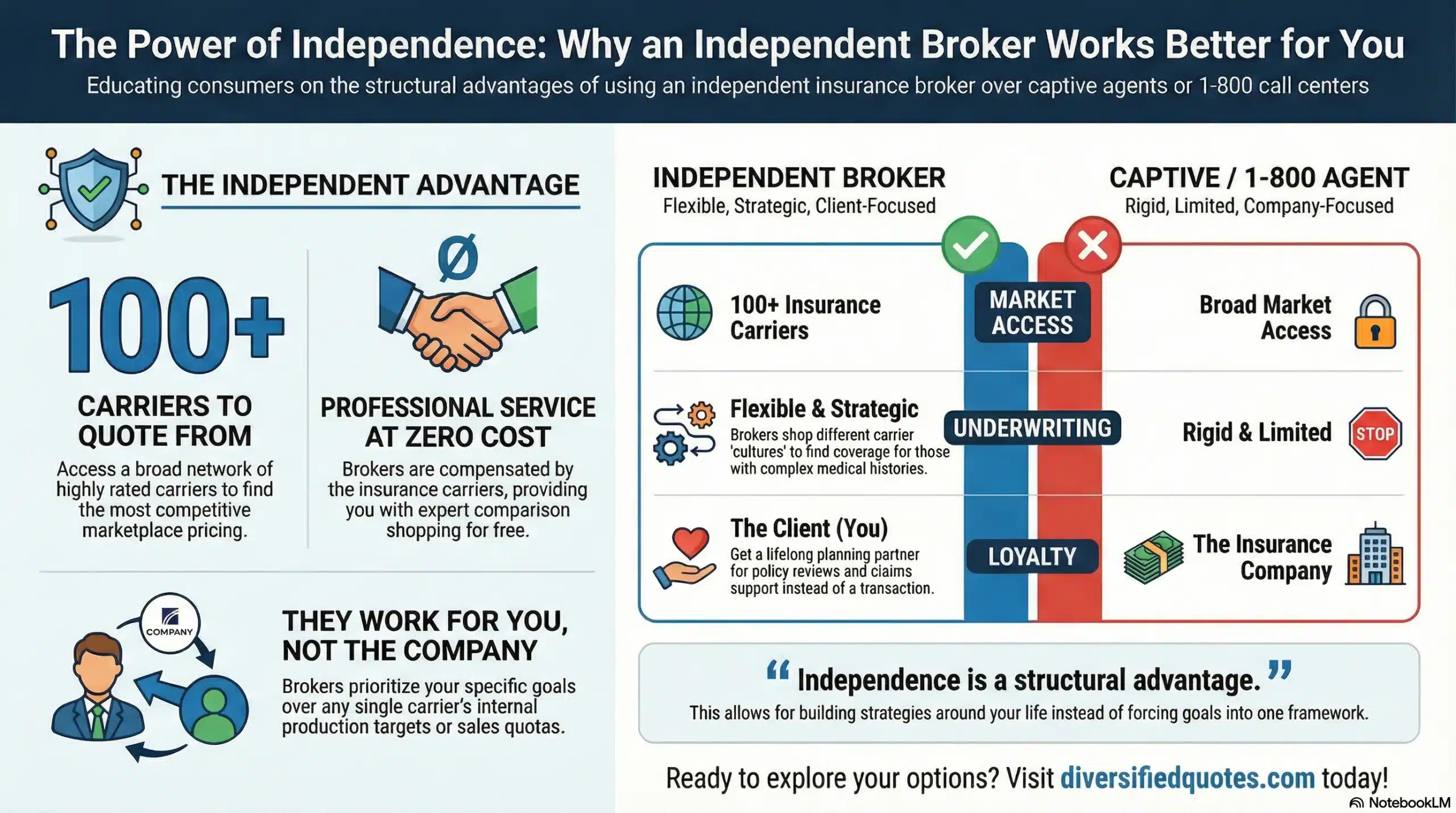
View the table near the end of the page to see why working with an independent insurance broker provides you the best possible rates.
Is Pacific Life a Good Insurance Company?

Jason Stolz CLTC, CRPC, DIA, CAA
Pacific Life is a good insurance company by the most meaningful measures that matter for long-term contracts: financial strength, operational longevity, and claims-paying reliability. It holds an A+ (Superior) rating from AM Best, AA- from both S&P and Fitch, and Aa3 from Moody’s — placing it among the most financially strong carriers in the U.S. market. With over 155 years of history and $1.5 trillion of life insurance in force, Pacific Life is not a carrier whose long-term obligation-keeping ability is a realistic concern. The more relevant question for anyone evaluating Pacific Life is not whether the company is good — it is whether a specific Pacific Life product is the best available option for the specific planning objective, timeline, and financial profile of the person buying it. At Diversified Insurance Brokers, Jason Stolz, CLTC, CRPC, DIA, CAA helps clients move past the company name to the contract mechanics, because that is where the real differences between equally strong carriers actually live.
Pacific Life is particularly recognized for its strength in universal life products. Bankrate named Pacific Life the Best Universal Life Insurer for 2025, and the company was recognized as one of the World’s Most Ethical Companies by the Ethisphere Institute in 2025. The carrier operates as a mutual holding company — a structure that aligns it with policyholder interests rather than shareholder returns — which is a meaningful operational distinction for buyers of long-duration contracts. Pacific Life’s breadth across life insurance and annuities means it is shortlisted in retirement income planning, estate planning, and family protection conversations simultaneously, which is an advantage when a coordinated multi-product strategy is the goal. Our resource on how to protect your funds in retirement covers the broader retirement security framework within which Pacific Life products are typically evaluated, and our resource on insurance company reviews covers the full carrier landscape for comparing Pacific Life against peer insurers across multiple product categories.
Compare Pacific Life Life Insurance Rates Side by Side
Life Insurance Quoter
Get a Pacific Life Comparison — Life Insurance or Annuity
We compare Pacific Life against peer carriers for your specific age, health profile, timeline, and planning objective. No brand-first assumptions — just the best available option for the specific goal.
Request a Quote Call 800-533-5969Pacific Life — Product Category Evaluation at a Glance
Pacific Life competes across life insurance and annuity categories simultaneously — which is both a strength and a potential source of confusion. Evaluating Pacific Life as a company is different from evaluating Pacific Life for a specific product category, because the carrier’s competitive positioning varies by product type. The table below maps Pacific Life’s standing across its major product lines.
Ratings as of December 2025. Product features and pricing vary by state and underwriting profile. Verify current information before purchase.
| Product Category | Pacific Life Positioning | Typical Buyer Profile | Competitive Strength | When to Compare Others |
|---|---|---|---|---|
| Term Life Insurance | Competitive across standard term periods; strong conversion provision to permanent coverage | Families seeking income replacement, mortgage protection, or business coverage for defined periods | Strong conversion window to permanent coverage up to age 70; broad health class availability; competitive pricing in standard health profiles | Applicants with specific health histories that another carrier evaluates more favorably; applicants prioritizing lowest available premium above conversion flexibility |
| Indexed Universal Life (IUL) | Primary competitive strength — Bankrate Best Universal Life Insurer 2025; Pacific Horizon IUL 2 is the flagship consolidated platform | High-income earners, business owners, estate planning clients, and those seeking flexible permanent coverage with cash value accumulation potential | Elite financial strength ratings, mutual holding company structure, flexible premium design, strong index crediting options, robust rider menu | Applicants whose health profile prices better at another carrier; applicants needing lower-complexity permanent products at lower premium |
| Variable Universal Life (VUL) | Active VUL platform; Pacific Protector Plus VUL launched June 2025 through State Farm strategic alliance | Sophisticated investors seeking equity-linked cash value inside a permanent life structure; estate and wealth transfer planning | Broad investment sub-account menu; mutual holding structure aligns with policyholder interests; strong carrier stability for long-duration VUL obligations | Applicants who want traditional whole life with dividends (Pacific Life does not emphasize participating whole life for individuals) |
| Fixed Annuity (MYGA) | Available in select markets; competitive against peer high-quality carriers but rate varies by term and state | Conservative savers seeking guaranteed declared rate for a defined term with principal protection | A+ AM Best backing provides strong policyholder confidence; clean product structure; reliable renewal practices | Rate shopping across the full market frequently surfaces higher-yielding MYGA options at comparable financial strength levels; compare current rates before committing |
| Fixed Indexed Annuity (FIA) | Competitive FIA platform with multiple index options; solid crediting design and rider availability | Retirement savers seeking market-linked growth potential with principal protection and optional income rider | Carrier financial strength is a meaningful advantage for long-duration FIA contracts; multiple index crediting options; income rider available for future income planning | Caps, participation rates, and income factors should be compared across the full FIA market — Pacific Life may or may not be the best rate/feature combination for the specific age and term |
| Income Annuity / GLWB | Income riders available on FIA platform; payout factors should be compared at the specific income start age and premium level | Pre-retirees building a guaranteed income floor for distribution phase; retirees reducing reliance on portfolio withdrawals | Financially strong carrier provides long-duration obligation confidence; integrated FIA-plus-income rider design supports accumulation and income in one contract | Income payout factors at specific ages and start dates should always be compared across the full income annuity market — guaranteed monthly income varies meaningfully by carrier and contract design |
The table’s most actionable message is in the last column: regardless of how strong Pacific Life’s carrier positioning is in any category, the specific payout rate, cap rate, income factor, or premium at your specific age and health profile should always be compared against the full market before a commitment is made. This is not because Pacific Life is weak — it is because the competitive dynamics within each product category mean that the best outcome for a specific person almost never comes from a brand-first selection process. Our resource on how to prescreen a life insurance application covers the informal carrier evaluation process that identifies the best carrier before a formal application creates a permanent record.
Pacific Life Financial Strength — Current Ratings in Context
Pacific Life’s A+ (Superior) AM Best rating was reaffirmed in December 2025, with AA- from S&P, AA- from Fitch, and Aa3 from Moody’s — and a Comdex score of 90, which is a composite ranking of all agency ratings that places Pacific Life among the top tier of carriers by aggregate financial strength. Pacific Life’s NAIC complaint index is 0.19, which means it receives significantly fewer customer complaints relative to its market size than the industry baseline of 1.0. For buyers of long-duration contracts — a 20-year term policy, a 10-year fixed indexed annuity surrender period, or a variable universal life policy expected to remain in force for decades — carrier financial strength is the underwriting of the insurer itself. These ratings matter in ways that are easy to underestimate when shopping on price alone.
Pacific Life operates as a mutual holding company, a structure that prioritizes policyholder interests over shareholder returns — distinguishing it from publicly traded carriers whose dividend obligations to shareholders create different incentive structures. This structural distinction is particularly meaningful for long-duration life insurance policyholders whose contract obligations span economic cycles, interest rate environments, and market conditions that will look very different 15 or 25 years from now than they do today. The mutual holding structure does not guarantee better products or better service, but it does align the carrier’s long-term incentives with the policyholder’s rather than with external equity investors. Pacific Life ranked 10th out of 22 companies in J.D. Power’s 2025 U.S. Life Insurance Study — placing it solidly above average in customer satisfaction while not reaching the top tier. For context, customer satisfaction in the insurance industry is heavily influenced by claims experience, which varies by product type and is less measurable for life and annuity products than for auto or homeowners claims.
Pacific Life for Term Life Insurance — When It Wins and When to Look Elsewhere
Term life insurance is primarily a price and underwriting decision. For any given coverage amount and term length, the premium that a given applicant pays is determined almost entirely by the underwriting health class assigned — and health class assignment varies by carrier based on their specific underwriting guidelines for age, build, blood pressure, cholesterol, family history, prescription history, and lifestyle factors. A carrier that offers Pacific Life the best pricing for a healthy, standard applicant may offer a less competitive outcome than a different carrier for an applicant with a specific blood pressure reading, a specific family history, or a specific body mass index that falls differently within different carriers’ rate banding structures.
Pacific Life’s conversion provision on term products allows policyholders to move to permanent coverage without new medical underwriting up to age 70 — which is a meaningfully stronger conversion window than some competing carriers. This conversion flexibility has real planning value for applicants who are currently in good health but who are uncertain whether health changes in the coming years might make new permanent life underwriting difficult or expensive. An applicant who buys term today and converts to permanent later preserves their original health class — regardless of any health deterioration between the term issue date and the conversion. Our resource on convert term to permanent life insurance covers conversion mechanics, which carriers have the broadest conversion options, and when conversion makes strategic sense for a specific planning situation.
For applicants with health histories that require specialized carrier matching — prior conditions, elevated risk factors, or complex medical histories — the term life comparison should account for how each carrier’s underwriting guidelines treat the specific profile rather than defaulting to the most familiar brand name. Our resource on life insurance with pre-existing conditions covers the impaired-risk underwriting framework that applies when health complexity is the dominant variable in carrier selection, and our resource on how to prescreen a life insurance application covers how to identify the most favorable carrier before any formal application creates a permanent MIB record.
Pacific Life’s IUL Strength — What Makes It a Primary Competitor
Indexed Universal Life insurance is where Pacific Life’s competitive positioning is clearest and most defensible. Pacific Life recently consolidated its IUL product lineup into the Pacific Horizon IUL 2 — a unified platform designed to serve a wide range of planning objectives from death benefit protection to cash value accumulation. IUL products from Pacific Life are frequently evaluated for high-income earners whose estate planning, business succession, or supplemental retirement income needs require a permanent life insurance structure with flexible premium design and the potential for index-linked cash value growth.
The mutual holding company structure is particularly relevant for IUL buyers because indexed universal life policies are long-duration contracts where the carrier’s financial management over multiple decades determines whether the illustrated policy behavior matches the actual policy behavior. A carrier whose incentive structure is aligned with policyholder outcomes — rather than with equity investor returns — is arguably better positioned for the long-term cash value management that IUL policies require. Pacific Life’s IUL products also benefit from the carrier’s elite financial strength ratings, which provide confidence for the contractual guarantees embedded in the policy design over timelines measured in decades rather than years.
Pacific Life for Annuity Buyers — The Multi-Product Consideration
Pacific Life competes in multiple annuity categories simultaneously — fixed annuities, fixed indexed annuities, variable annuities, and income-focused designs with GLWB riders. For annuity buyers, the most important principle remains constant regardless of the carrier: the headline rate or brand name is only one variable. Surrender period, free-withdrawal provisions, the presence of a market value adjustment, income rider cost and payout factor design, and renewal rate history all affect the actual performance of the contract over its full holding period. Our resource on annuity free withdrawal rules covers the withdrawal mechanics that govern liquidity access, and our resource on annuity surrender charges explained covers the surrender cost structure that affects the actual cost of exiting a contract early.
For fixed annuity (MYGA) buyers, Pacific Life’s A+ AM Best rating is a meaningful quality signal — but the declared rate for a given term and state should still be compared across the full MYGA market, because carriers with equivalent or near-equivalent financial strength ratings often offer meaningfully different rates driven by their own portfolio positioning and competitive strategy. Our resource on fixed annuities vs fixed indexed annuities covers the structural comparison between these two approaches to protected accumulation, and our resource on annuities 101 covers the foundational annuity mechanics for buyers approaching the category for the first time. Our resource on best MYGA annuity rates provides the current rate landscape for comparing where Pacific Life’s fixed annuity offering sits relative to the competitive market at any given time.
For buyers evaluating a Pacific Life fixed indexed annuity, the most productive comparison framework is to model the specific Pacific Life FIA’s caps, participation rates, crediting method, and income factor alongside the same inputs from peer carriers at the same age and premium. The carrier’s financial strength is a meaningful input in that comparison — a slightly lower cap or participation rate from a carrier with elite ratings may be the better long-term choice than a higher cap from a carrier with weaker financial strength ratings — but it is an input alongside contract economics, not a replacement for the contract comparison. Our resource on how a fixed indexed annuity works covers the product mechanics that determine how Pacific Life’s FIA would translate index movement into credited interest, and our resource on what is a GLWB covers the income rider structure that governs Pacific Life’s guaranteed lifetime withdrawal benefit design.
Pacific Life for Retirement Income — Where It Fits in the Strategy
Retirement income planning with Pacific Life products typically involves one of three roles: conservative accumulation through a MYGA or FIA structure, income floor construction through a FIA paired with a GLWB rider, or estate liquidity and legacy planning through IUL or VUL. The most important design principle in each case is that the product selected should be matched to the specific role it is meant to play in the overall retirement income architecture — not selected because Pacific Life as a brand is familiar or because a single product feature is compelling in isolation.
Many retirement income strategies use a layered approach: guaranteed income from Social Security and/or annuity income covers essential expenses, while investment assets serve discretionary spending, flexibility, and legacy objectives. Our resource on how Social Security and annuities work together covers how to coordinate these income streams for maximum stability, and our resource on guaranteed income from annuities covers the annuity income planning framework within which Pacific Life products compete. Our resource on the 4% rule covers the systematic withdrawal alternative to annuity income — a useful comparison point for buyers evaluating whether annuity income or portfolio withdrawal better serves the retirement income goal. And our resource on annuity beneficiary death benefits covers the legacy and death benefit treatment of annuity contracts — a relevant planning dimension for buyers who want to understand what happens to the contract value if the annuitant dies before the surrender period ends or before the full premium is returned through income payments.
What Pacific Life Is Not the Right Fit For
A balanced review requires acknowledging where Pacific Life is not the optimal choice. Pacific Life’s only whole life product is designed for business use, making it a poor fit for individuals seeking traditional participating whole life insurance with policy dividends — a common planning objective for buyers who want the guaranteed growth, dividend participation, and conservative design of a mutual company whole life policy as the cornerstone of their permanent insurance strategy. Buyers whose primary objective is participating whole life dividends should evaluate carriers specifically known for that product line rather than fitting Pacific Life into a planning role it is not designed to fill.
For price-sensitive term life buyers whose health profile prices significantly better at a specific competitor, Pacific Life’s brand strength is not a sufficient reason to accept a higher premium — the price difference over a 20-year term policy can be substantial, and the coverage is identical across carriers at the same health class. The carrier selection discipline that produces the best term life outcome is health-class-first shopping rather than brand-first shopping, and the comparison should always include the carriers that are most favorable for the specific health characteristics of the individual applicant rather than defaulting to the most recognized names. Our resource on is Assurity a good company and our resource on is Columbus Life a good company cover the evaluation framework for peer carriers in adjacent product categories — providing comparative context for understanding where Pacific Life’s positioning sits relative to the broader carrier landscape. Our resource on common annuity myths covers the most frequently heard misconceptions that distort annuity product comparisons — relevant for buyers who are evaluating Pacific Life annuities alongside competing products and want to ensure the comparison framework is accurate.
How Independent Comparison Produces Better Outcomes Than Brand-First Selection
The most consistent mistake in insurance and annuity shopping is selecting a carrier based on familiarity or reputation before evaluating whether that carrier’s specific product is the best available option for the specific planning objective. Pacific Life’s strong brand, elite financial strength ratings, and broad product lineup make it a frequent starting point for comparison — which is appropriate. The starting point should not become the ending point without verifying that the specific Pacific Life product beats the competitive alternatives on the metrics that actually determine outcome: premium for a given coverage and health class in life insurance; rate, surrender terms, and liquidity in fixed annuities; caps, participation, and income factors in FIA; and payout, rider cost, and survivor provisions in income annuities.
As an independent broker with access to 100+ carriers, Diversified Insurance Brokers positions Pacific Life in the comparison rather than as the default answer. In many cases — particularly for IUL, for buyers whose health profile fits Pacific Life’s underwriting favorably, and for retirement income buyers who value the carrier’s mutual holding company structure alongside competitive product design — Pacific Life emerges as the best available option for the planning goal. In other cases, a different carrier produces a better outcome for the specific premium, rate, income factor, or health class. The independent comparison is what determines which outcome applies to a specific individual — and that comparison is what we do.
Compare Pacific Life Against Peer Carriers for Your Specific Goal
We compare Pacific Life against 100+ carriers for your age, health profile, timeline, and planning objective — and show you the tradeoffs in plain English before you commit.
Request a QuoteAnnuity Planning Tools — Compare Pacific Life’s Rates
Ensure you are receiving the absolute top rates
Current Fixed Annuity Rates
Compare today’s best fixed annuity rates from top carriers.
Current Bonus Annuity Rates
See which annuities offer the highest upfront bonus today.
Request an Annuity Quote
Submit our annuity request form to get personalized rate options.
Lifetime Income Calculator
Estimate how much guaranteed lifetime income a Pacific Life or alternative annuity may produce at your age and premium.
Related Retirement & Annuity Guides
Annuity structures, withdrawal rules, beneficiary treatment, and how to coordinate income sources in a retirement plan.
Related Life Insurance Planning Pages
Underwriting strategy, conversion planning, coverage comparison, and independent broker resources for life insurance buyers.
Financial Protection Essentials
Carrier review directory, peer carrier comparisons, conversion planning, and prescreening resources.
Talk With an Advisor Today
Choose how you’d like to connect—call or message us, then book a time that works for you.
Schedule here:
calendly.com/jason-dibcompanies/diversified-quotes
Licensed in all 50 states • Fiduciary, family-owned since 1980
FAQs: Is Pacific Life a Good Insurance Company?
Is Pacific Life a financially strong insurance company?
Pacific Life is among the most financially strong carriers in the U.S. insurance market by every major rating agency’s measure. Its AM Best A+ (Superior) rating was reaffirmed in December 2025, and it carries AA- from S&P, AA- from Fitch, and Aa3 from Moody’s — a ratings combination that places it in the top tier of all U.S. carriers. The Comdex score of 90 (a composite of all agency ratings) is another indicator of aggregate financial strength that few carriers can match. For buyers of long-duration life insurance or annuity contracts, where the carrier’s obligation-keeping ability over decades matters as much as any product feature, Pacific Life’s financial strength is a meaningful advantage. The carrier’s mutual holding company structure reinforces this — it aligns long-term incentives with policyholder outcomes rather than with shareholder returns. The practical takeaway is that Pacific Life’s financial strength is not a concern for most buyers, and it can be a genuine differentiator in situations where carrier financial quality is a primary selection criterion alongside product economics.
What types of products is Pacific Life best known for?
Pacific Life is most widely recognized as a premier competitor in indexed universal life insurance and variable universal life insurance — the product categories where it holds the Bankrate Best Universal Life Insurer designation for 2025. Its Pacific Horizon IUL 2, launched as a consolidated IUL platform, serves the full range of IUL planning objectives from pure death benefit protection to cash value accumulation for supplemental retirement income. Pacific Life is also actively competitive in the fixed indexed annuity and fixed annuity categories, and it competes in the variable annuity market, including through its June 2025 State Farm strategic alliance product. In term life insurance, Pacific Life is competitive across standard health profiles and offers a strong conversion provision to permanent coverage without new medical underwriting, which is a planning advantage for buyers who may want permanent coverage later. What Pacific Life is not primarily known for is traditional participating whole life insurance with policy dividends — its individual whole life product is designed for business applications rather than personal wealth accumulation.
Does Pacific Life offer good term life insurance pricing?
Pacific Life can be very competitive for term life insurance, but “best price” is always applicant-specific. The premium any applicant pays depends on the underwriting health class assigned — and health class assignment is determined by age, build, blood pressure, cholesterol, family history, prescription history, and lifestyle factors evaluated against each carrier’s specific underwriting guidelines. Pacific Life may be the most competitive carrier for one health profile and not the most competitive for another. This is why multi-carrier comparison is always more reliable than brand-first selection for term life. The strongest case for choosing Pacific Life term life specifically is its conversion provision, which allows conversion to permanent coverage up to age 70 without new medical evidence — a planning advantage that is worth pricing even if another carrier offers a slightly lower term premium without comparable conversion flexibility. Our resource on convert term to permanent life insurance covers how conversion provisions work and why the conversion window matters for applicants who are even considering future permanent coverage.
How do Pacific Life annuities fit into a retirement plan?
Pacific Life annuities are most commonly used in retirement planning for one of three purposes: protected accumulation through a fixed or fixed indexed annuity structure, income floor construction through a FIA paired with a GLWB income rider, or estate liquidity through an IUL or VUL structure. In each case, the Pacific Life product’s role in the plan should be defined before the product is selected — because the product design, surrender terms, and rider mechanics that serve each role well are different. A conservative accumulation buyer should compare Pacific Life’s fixed annuity rate against the current MYGA market, because rates vary by carrier and current rate offerings shift with market conditions. An income planning buyer should compare Pacific Life’s income rider payout factor at the specific income start age against peer carriers, because payout factors vary meaningfully across the market. Our resource on guaranteed income from annuities covers the income annuity framework, and our resource on annuities 101 covers the product mechanics for buyers approaching annuities for the first time alongside a Pacific Life product evaluation.
Are Pacific Life fixed indexed annuities safe from market loss?
Pacific Life’s fixed indexed annuities are structured to protect principal from direct market losses — meaning the account balance does not decrease due to negative index performance within the strategy terms. When the index measurement period produces a negative result, the credited interest for that period is typically 0% rather than a negative return to the account. The trade-off is that crediting is subject to caps, participation rates, or spreads that limit how much of the index’s positive movement translates into credited interest. The 0% floor on negative index periods is one of the defining structural features that makes fixed indexed annuities different from direct market investment — and it is the mechanism that makes them attractive for retirement income planning where protecting principal from market drawdowns is a planning priority. However, “safe from market loss” applies within the strategy terms — it does not mean the contract is without other risk factors, such as surrender charges for early withdrawal, the cost of income riders that reduce accumulation if income is added, or the impact of market value adjustments in some fixed annuity structures. Our resource on annuity surrender charges explained covers how these costs are structured and how they affect actual contract value during the surrender period.
What should I pay attention to before buying a Pacific Life annuity?
The most important pre-purchase evaluation areas for any Pacific Life annuity — and for any annuity regardless of carrier — are surrender period and early withdrawal cost, free-withdrawal provisions, whether a market value adjustment applies, how renewal terms are set after the initial guarantee period, and the complete cost and payout rules of any income rider. The surrender period defines how long capital is committed to the contract before full penalty-free access is available — Pacific Life’s surrender schedules vary by product and state, and the correct surrender period for a specific buyer is the one that matches the buyer’s actual liquidity needs and timeline rather than the longest available period or the one with the highest marketed rate. Free-withdrawal provisions define how much can be accessed annually without surrender charges — typically 10% of account value per year — and understanding these provisions prevents the most common source of annuity dissatisfaction, which is buying a product with restricted liquidity without fully understanding the restriction. Our resource on annuity free withdrawal rules covers these mechanics in detail and explains how free-withdrawal provisions interact with surrender schedules in real-world situations.
Is Pacific Life a good option for guaranteed lifetime income?
Pacific Life can be a strong candidate for guaranteed lifetime income planning, but the correct answer for any specific buyer depends on comparing the Pacific Life income annuity design against the current market at the buyer’s specific age, premium, and desired income start date. Guaranteed lifetime income from an annuity is driven by the income base growth rate, the payout percentage at the income start age, the income rider fee, and how the rider behaves after income starts — all of which vary across carriers and contracts. Pacific Life’s financial strength and mutual holding company structure provide confidence for the long-term nature of a lifetime income obligation, but the monthly income dollar amount is the outcome that most income-planning buyers care most about, and that amount should be compared across the competitive market before any commitment is made. Our resource on what is a GLWB covers the guaranteed lifetime withdrawal benefit mechanics, and the ARW Lifetime Income Calculator above provides a preliminary comparison tool for seeing how different carriers’ current income rates translate into monthly income at your age and premium.
What are common reasons someone might choose a different carrier over Pacific Life?
For life insurance, the most common reason to choose a different carrier is that a peer carrier offers a more favorable underwriting class for a specific health profile — which translates directly into lower premium for the same coverage amount and term length. Health-class-first carrier selection consistently produces better outcomes than brand-first selection for term life buyers whose medical history, prescription record, or lifestyle factors are evaluated differently across carriers. For annuity buyers, a different carrier may offer a higher fixed rate for the same term, a higher cap or participation rate in an FIA, better liquidity provisions, or a stronger income factor at the specific income start age. None of these advantages require the competing carrier to be financially stronger than Pacific Life — they simply reflect competitive dynamics where different carriers price different aspects of the same product differently based on their own portfolio strategy and current market positioning. The independent comparison process that evaluates Pacific Life alongside its competitors on the specific metrics that determine outcome — not on brand recognition or general reputation — is the most reliable mechanism for identifying when Pacific Life is the right choice and when a different carrier produces a better result for the specific planning goal.
Does Pacific Life offer traditional whole life insurance?
Pacific Life’s individual whole life product is designed primarily for business insurance applications rather than for personal wealth accumulation through policy dividends. This makes Pacific Life a poor fit for buyers whose primary planning objective is a participating whole life policy — one that accumulates guaranteed cash value, earns non-guaranteed dividends from the carrier’s surplus, and is designed to serve as a conservative long-term savings and protection vehicle for individuals and families. Buyers whose priority is participating whole life with strong dividend histories should evaluate carriers that specialize in this product category rather than expecting Pacific Life’s business-focused whole life to serve a personal planning role it was not designed for. This limitation does not affect Pacific Life’s IUL or VUL positioning — both of which serve many of the same planning objectives (permanent coverage, cash value accumulation, estate planning) that whole life serves, but through different product mechanics and with different risk and growth characteristics. The IUL structure in particular is where Pacific Life’s competitive strength is clearest and best documented.
What’s the best way to compare Pacific Life against competitors?
The most reliable comparison framework uses identical inputs for the same product category: same state, same age, same premium or coverage amount, same planning timeline, and same specific product type (term vs. IUL; MYGA vs. FIA; income-focused vs. accumulation-focused). Product category mismatches — comparing a Pacific Life FIA against a competitor’s MYGA, for example — produce misleading results because the product structures are different regardless of the carrier. Within the same product category and the same inputs, the comparison should focus on the metrics that actually determine outcome rather than on marketing claims: health class assignment and premium for term life; declared rate, surrender schedule, free-withdrawal, and renewal terms for fixed annuities; crediting method, caps/participation/spreads, and income factor for FIA; and payout percentage, rollup rate, and rider cost for income-focused designs. Pacific Life’s financial strength ratings are a genuine differentiating factor that should be included in the comparison — particularly for long-duration contracts where the carrier’s 20–30 year obligation-keeping ability matters. But financial strength is an input to the comparison, not a substitute for it. Our resource on insurance company reviews provides the framework for evaluating Pacific Life alongside peer carriers across multiple product categories.
About the Author:
Jason Stolz, CLTC, CRPC, DIA, CAA and Chief Underwriter at Diversified Insurance Brokers (NPN 20471358), is a senior insurance and retirement professional with more than 25 years of real-world experience helping individuals, families, and business owners protect their income, assets, and long-term financial stability. As a long-time partner of the nationally licensed independent agency Diversified Insurance Brokers, Jason provides trusted guidance across multiple specialties—including fixed and indexed annuities, long-term care planning, personal and business disability insurance, life insurance solutions, Group Health, Travel Medical and Evacuation Insurance, and short-term health coverage. Diversified Insurance Brokers maintains active contracts with over 100 highly rated insurance carriers, ensuring clients have access to a broad and competitive marketplace.
His practical, education-first approach has earned recognition in publications such as VoyageATL, and contributions from his agency featured in Kiplinger and GoBankingRates— highlighting his commitment to financial clarity and client-focused planning. Drawing on deep product knowledge and years of hands-on field experience, Jason helps clients evaluate carriers, compare strategies, and build retirement and protection plans that are both secure and cost-efficient. Visitors who want to explore current annuity rates and compare options across multiple insurers can also use this annuity quote and comparison tool.
Review More Carrier Reviews: Browse our complete Annuity Company Reviews — covering Allianz, Athene, Jackson National, North American, and more annuity carriers.
Review More Carrier Reviews: Browse our complete Life Insurance Company Reviews — covering Banner Life, Lincoln Financial, Protective, Transamerica, and more life insurance carriers.
Last Reviewed: June 21, 2026 |
Reviewed by: Jason Stolz, CLTC, CRPC, DIA, CAA
Chief Underwriter, Diversified Insurance Brokers, Inc. | NPN: 20471358 | Diversified Insurance Brokers, Inc. — Licensed in all 50 states
Fact Checked by: Tonia Pettitt, CMIP©
Medicare Specialist, Diversified Insurance Brokers, Inc. | NPN: 14374308 | Diversified Insurance Brokers, Inc. — Licensed in all 50 states
Did you find this content helpful? Leave us a Google review — it helps others find trustworthy guidance too.
Editorial Standards: Diversified Insurance Brokers maintains rigorous editorial standards to ensure accuracy, clarity, and independence in all content. Learn more about our editorial standards and commitment to transparency.
