
Disability Insurance for Merchant Marines
As an Independent Disability Insurance Broker, we have access to exclusive discounts and negotiated pricing most captive agents can’t offer — see the full breakdown near the end of this page.
Disability Insurance for Merchant Marines

Jason Stolz CLTC, CRPC, DIA, CAA
Disability insurance for merchant marines is one of the most essential and most frequently overlooked financial protections available to a profession that the National Institute for Occupational Safety and Health identifies as facing fatality and injury rates significantly higher than the national average for all U.S. workers. The water transportation industry has a fatality rate 4.7 times higher than the rate for all U.S. workers, and NIOSH estimates that approximately 61,600 nonfatal injuries and illnesses occur annually among maritime workers — nearly twice the rate for all U.S. workers. Merchant marines operate in an environment that combines the physical demands of vessel operations with the specific hazards of working on water: heavy equipment and machinery, unpredictable weather and sea conditions, falls on wet and moving deck surfaces, chemical and cargo exposure, noise-induced hearing loss, whole-body vibration from vessel propulsion systems, and the critical challenge of being geographically isolated from shore-based medical care when an injury or illness occurs. These hazards are not theoretical — they are the documented daily reality of a profession that keeps global commerce moving, and they create genuine, statistically significant disability risk across every position in the merchant marine hierarchy. At Diversified Insurance Brokers, we help merchant mariners in every role — from officers and engineers to ratings and specialized crew — design disability insurance that reflects the real risks of their work, the income structure of a profession with unique compensation arrangements, and the financial planning considerations that maritime careers create. For a foundational overview of how disability insurance works before examining merchant marine-specific considerations, our disability insurance services overview provides the essential framework, and our resource on why people buy disability insurance explains the core protection logic that applies with particular force in high-risk occupations.
Protect Your Income as a Merchant Marine
Compare disability insurance options designed for maritime professionals across all vessel types, positions, and employment arrangements.
Request Disability Insurance OptionsQuestions? Call 800-533-5969
What Merchant Marines Do — and Why the Work Creates Exceptional Disability Risk
Merchant marines are the professional mariners who crew the commercial vessels that carry approximately 90% of world trade — container ships, bulk carriers, tankers, liquefied natural gas carriers, roll-on/roll-off vessels, passenger cruise ships, ferries, tugboats, towboats, and the full range of commercial marine transportation. In the United States, merchant mariners hold credentials issued by the U.S. Coast Guard — the Merchant Mariner Credential — and fill positions ranging from ship captains and deck officers who navigate and command vessels, through chief engineers and engineering officers who manage propulsion and auxiliary systems, to ratings including able seamen, ordinary seamen, bosuns, marine oilers, engine wipers, and specialized crew members who perform the physical deck and engine room work that vessel operations require.
The work of merchant mariners is physically demanding at every level of the hierarchy. Officers navigate vessels through challenging sea and weather conditions, manage cargo loading and discharging operations that involve heavy equipment and significant injury risk, maintain watch schedules that generate chronic sleep disruption and fatigue, and perform emergency response duties that may require physical action in dangerous conditions. Engineers maintain complex machinery in confined, hot, and noisy engine room environments, perform hands-on maintenance and repair tasks that generate musculoskeletal loading, and manage the propulsion and systems that vessel safety depends on. Deck ratings perform some of the most physically demanding work in the maritime industry — line handling during docking and undocking operations, cargo securing and lashing, deck maintenance involving painting and chipping on exposed surfaces in variable weather, mooring operations, and the sustained physical labor of vessel upkeep. Throughout all of these roles, the marine environment adds a constant background of additional hazard: wet and moving deck surfaces, confined spaces, heavy weather that generates unexpected forces on personnel and equipment, and the ever-present risk of man-overboard situations in waters where survival time is severely limited.
Long-haul maritime assignments also create extended periods of geographic isolation from shore-based medical care. A merchant mariner who develops a serious medical condition while a vessel is at sea — days or weeks from the nearest port — faces delays in diagnosis and treatment that can worsen outcomes and extend the disability period compared to the same condition occurring ashore. This isolation dimension is a distinctive feature of maritime disability risk that has no parallel in shore-based occupations, and it amplifies the financial consequences of health events that occur during deep-sea assignments.
The Documented Injury and Fatality Statistics: Some of the Highest in American Industry
The statistics on maritime worker injury and fatality are among the most striking in American occupational health data. NIOSH’s Center for Maritime Safety and Health Studies reports that maritime industries have a higher fatality rate and risk of injury and illness than the national average for all U.S. workplaces. The water transportation industry specifically has a fatality rate 4.7 times higher than the rate for all U.S. workers — a figure that places maritime employment in the same extreme-risk tier as commercial fishing, which is widely regarded as one of the most dangerous jobs in the United States. Nonfatal injury rates in maritime industries are estimated at nearly twice the rate for all U.S. workers, with approximately 61,600 nonfatal injuries and illnesses occurring annually.
These statistics reflect multiple converging hazard categories. Falls represent one of the primary injury mechanisms — falls on wet decks, falls between vessel and dock, falls from elevated working surfaces, and falls overboard. Heavy equipment and machinery hazards from cargo handling, mooring operations, and mechanical maintenance generate crush, entanglement, and laceration injuries. Fires and explosions on vessels — particularly those carrying flammable cargo — represent potentially catastrophic events. Noise-induced hearing loss from sustained exposure to engine and machinery noise is a documented occupational disease in maritime workers. Whole-body vibration from vessel propulsion systems contributes to musculoskeletal conditions, particularly lumbar spine disorders. Chemical exposure from cargo, cleaning compounds, and fuel products adds a toxic hazard dimension that shore-based occupations rarely face. For mariners considering disability insurance, our resource on disability insurance for high-risk occupations explains how underwriting approaches occupations with elevated injury rates and how coverage can be designed despite the classification challenges high-risk work presents.
Specific Hazard Categories and Their Disability Implications
Musculoskeletal injuries are the most prevalent disability pathway for merchant mariners across all positions and vessel types. The physical demands of maritime work — line handling, mooring operations, cargo operations, mechanical maintenance in confined spaces, sustained standing on moving surfaces, and the postural demands of watch-standing — generate cumulative loading on the spine, shoulders, knees, and hands that produces the disc conditions, joint injuries, and repetitive strain conditions that constitute the most common sources of long-term disability in physical occupations. A mariner whose lumbar disc condition prevents the sustained physical demands of deck work, or whose shoulder injury prevents the overhead reach and force application that mooring and cargo operations require, faces genuine occupational disability — income loss that disability insurance must address because the Jones Act and maritime compensation laws alone do not provide the comprehensive long-term income replacement that an extended disability requires.
Hearing loss is a documented and prevalent occupational disease in merchant mariners from sustained exposure to engine and machinery noise in the vessel environment. Noise-induced hearing loss is irreversible — once cochlear damage has occurred from sustained high-decibel exposure, it cannot be restored. A mariner whose hearing loss reaches the threshold that prevents the auditory communication required for safe vessel operations — hearing bridge communications, engine room alarms, and deck coordination — faces genuine functional impairment of their maritime professional role. Disability insurance that covers occupational disease including noise-induced hearing loss addresses this chronic exposure pathway. Our resource on whether disability insurance is worth it provides the cost-benefit framework that makes coverage essential for occupations with high occupational disease exposure.
Cardiovascular conditions from the combined effects of shift work, sleep disruption, physical exertion, and the psychological stress of maritime operations represent a significant disability risk for career mariners. Research has documented elevated cardiovascular disease rates in maritime workers relative to shore-based comparison populations, reflecting the cumulative cardiovascular burden of a career characterized by irregular schedules, dietary disruption during extended voyages, physical exertion demands, and the isolation and psychological stress of extended time away from family and social support. A cardiac event that permanently limits a mariner’s ability to pass the medical fitness standards required for their Coast Guard credential represents career-ending disability — income loss that extends across the remaining years of what would have been a productive career.
Falls overboard and near-drowning events, while survivable in many cases, can produce neurological, psychological, and physical sequelae that prevent return to maritime work. A mariner who survives a serious man-overboard event may develop PTSD, physical injuries from the water entry or recovery process, or neurological consequences from hypothermia and near-drowning that constitute genuine ongoing disability even when the immediate medical emergency has been resolved. Disability insurance that covers both physical injuries and their psychological consequences provides income replacement during the recovery period and any extended disability that follows.
Toxic and chemical exposures from cargo, bunker fuel, cleaning products, and vessel maintenance compounds create long-term health risk for mariners working in the engine room, in cargo holds, and in maintenance roles. Chronic respiratory conditions from chemical exposure, skin conditions from fuel and lubricant contact, and the cumulative toxic burden of a career in the maritime chemical environment represent genuine disability pathways that develop over years of exposure. Our resource on disability insurance with preexisting conditions covers how exposure-related health history is handled in underwriting.
The Jones Act, Maritime Compensation Laws, and the Critical Gap Disability Insurance Fills
Merchant mariners injured in the course of their employment have legal protections under maritime law — primarily the Jones Act for seamen, and the Longshore and Harbor Workers’ Compensation Act (LHWCA) for certain shore-side maritime workers — that provide some compensation for work-related injury. Understanding what these legal frameworks do and do not provide is essential for any merchant mariner evaluating their income protection needs, because the gap between what maritime law provides and what comprehensive income replacement requires is exactly where private disability insurance becomes indispensable.
Under the Jones Act, an injured seaman is entitled to maintenance and cure — daily living expenses during recovery (maintenance) and necessary medical treatment (cure) — plus the ability to sue the employer for negligence causing the injury. Maintenance payments under the Jones Act are typically in the range of $35 to $45 per day — amounts that bear no relationship to the mariner’s actual wages and that cover a fraction of actual living expenses during a disability period. The negligence claim component requires proving employer fault, navigating maritime litigation timelines that can extend years, and accepting settlement outcomes that are uncertain and variable. This legal framework is designed around maritime injury law principles, not income replacement — and it leaves the mariner’s household expenses, mortgage or rent, family obligations, and ongoing financial responsibilities entirely unaddressed during the weeks, months, or years of a disability period.
Private disability insurance fills this gap by replacing a meaningful percentage of the mariner’s actual pre-disability income — regardless of employer fault, regardless of the maritime legal process timeline, and during the full duration of the disability rather than through a one-time legal settlement. For merchant mariners whose income supports households with the same mortgage payments, school tuitions, and financial obligations as any other household, this income replacement function is not supplemental — it is the primary financial protection that keeps the household financially viable during a disability that maritime law alone cannot adequately address. Our resource on short-term vs. long-term disability insurance explains how both protection layers work together, and our resource on how much disability insurance you need helps translate specific income into appropriate benefit amounts.
Income Structure for Merchant Mariners: Range, Complexity, and What Needs Protecting
Merchant mariner income varies dramatically by position, vessel type, employer, and sea time versus shore time patterns. The Bureau of Labor Statistics reports a median annual wage for water transportation workers of $66,490 in May 2024, but this median encompasses the broad range from entry-level ratings through experienced senior officers. Ship captains and mates at the top of the officer hierarchy can earn $100,000 to $200,000 or more annually depending on vessel type and employer, with some specialized or hazardous cargo officers earning significantly above these figures. Marine chief engineers on large vessels report comparable compensation to senior deck officers. Industry pay data from maritime forums shows captains averaging $1,040 per day or more on major commercial vessels, reflecting annualized compensation well above the BLS median for the profession as a whole.
The compensation structure for merchant mariners is also distinctive in its time-on/time-off rotation pattern. Many mariners work contracts of 30 to 90 days or more aboard vessels, followed by extended shore leave periods of comparable length. This rotation means that a mariner’s annual income is generated entirely during their sea-time periods, and a disability that prevents return to sea after shore leave ends creates immediate and complete income cessation — there is no partial work capacity that generates partial income during a recovery period, only the binary of fit-for-duty versus unable to ship out. This income structure makes disability insurance planning particularly critical because the all-or-nothing income pattern of maritime employment creates a sharper financial cliff when disability prevents return to sea than in shore-based occupations where partial work arrangements may be possible.
For merchant mariners who work as self-employed contractors or through crewing agencies rather than direct employer relationships, the absence of employer-sponsored benefits makes personal disability insurance the only available income protection mechanism. Our resource on disability insurance for independent contractors covers the income documentation and coverage design considerations that apply to contract-based maritime employment, and our resource on getting disability insurance when self-employed addresses the specific considerations for mariners without employer coverage.
High-Risk Occupation Classification and What It Means for Merchant Marine Applicants
Disability insurance carriers classify occupations into risk tiers that affect both the premium charged and the policy provisions available. Merchant marines are typically classified in lower occupation classes — often Class 2 or Class 3 — reflecting the documented high injury and fatality rates of maritime work. This classification has practical implications: higher premiums than professional office occupations, potential limitations on benefit period, and in some cases restrictions on the own-occupation definition available. However, lower occupation class does not mean uninsurable — it means that carrier selection becomes especially important, because different carriers classify maritime occupations with varying specificity and offer meaningfully different coverage terms for the same mariner applicant.
An independent broker with experience placing maritime occupation applications knows which carriers offer the strongest own-occupation definitions for mariner applicants, which carriers provide to-age-65 benefit periods for maritime occupations rather than limiting to 5-year benefit periods, and which carriers underwrite maritime risk most competitively. This carrier-specific knowledge is the most valuable input a merchant mariner can access when building their disability coverage strategy. Our resource on why working with an independent disability insurance broker matters explains how carrier comparison drives better outcomes for high-risk occupation applicants, and our resource on disability insurance by occupation provides broader context on how classification shapes coverage across different work categories. If you have existing coverage and want an independent evaluation of whether it is adequate for your specific maritime role, our disability insurance second opinion service provides an unbiased review against the full market of available options.
Own-Occupation Definition and Its Importance for Maritime Professionals
For merchant mariners, the disability definition in their policy determines whether benefits pay in the specific scenarios their occupational risk profile generates — and the own-occupation standard is especially important because maritime professional qualifications are highly specialized and non-transferable to other employment categories in the way that many professional credentials are.
Under a true own-occupation disability definition, a merchant mariner is considered disabled when they cannot perform the material and substantial duties of their specific occupation as a licensed mariner, even if they could theoretically perform some other type of work. A ship captain whose cardiac condition prevents them from meeting the medical fitness standards required to maintain their Coast Guard credential and hold a command position would receive benefits under own-occupation coverage even if they could theoretically work in a shore-based transportation management role. An engineer officer whose back injury prevents the physical demands of engine room work and sea duty would receive benefits even if they could perform desk-based mechanical consulting. The policy protects the maritime income specifically — the income that reflects years of sea time, credential accumulation, and specialized vessel expertise.
Under an any-occupation standard — common in lower-tier occupation class policies — the same mariner might be denied benefits because they retain capacity for some shore-based professional work even when their maritime career is permanently ended. For senior officers whose income reflects their credential hierarchy and sea time investment, this definition failure produces exactly the coverage gap that disability insurance was supposed to close. Our resource on own-occupation disability insurance explains how this critical distinction operates in real claim scenarios.
Designing a Disability Policy for Merchant Mariners
Effective disability insurance for merchant mariners requires designing coverage that addresses the specific hazard profile of the individual mariner’s position, vessel type, and employment arrangement while navigating the occupation classification challenges that maritime work presents.
The benefit amount should reflect actual documented income as accurately as carrier underwriting allows. For mariners on rotation contracts, income documentation typically uses the prior year’s total W-2 or Schedule C earnings rather than a monthly salary figure, and the benefit amount is established based on that documented annual income. Maximizing the available benefit amount ensures the policy actually addresses the financial exposure of disability — particularly for senior officers whose income significantly exceeds the profession’s median.
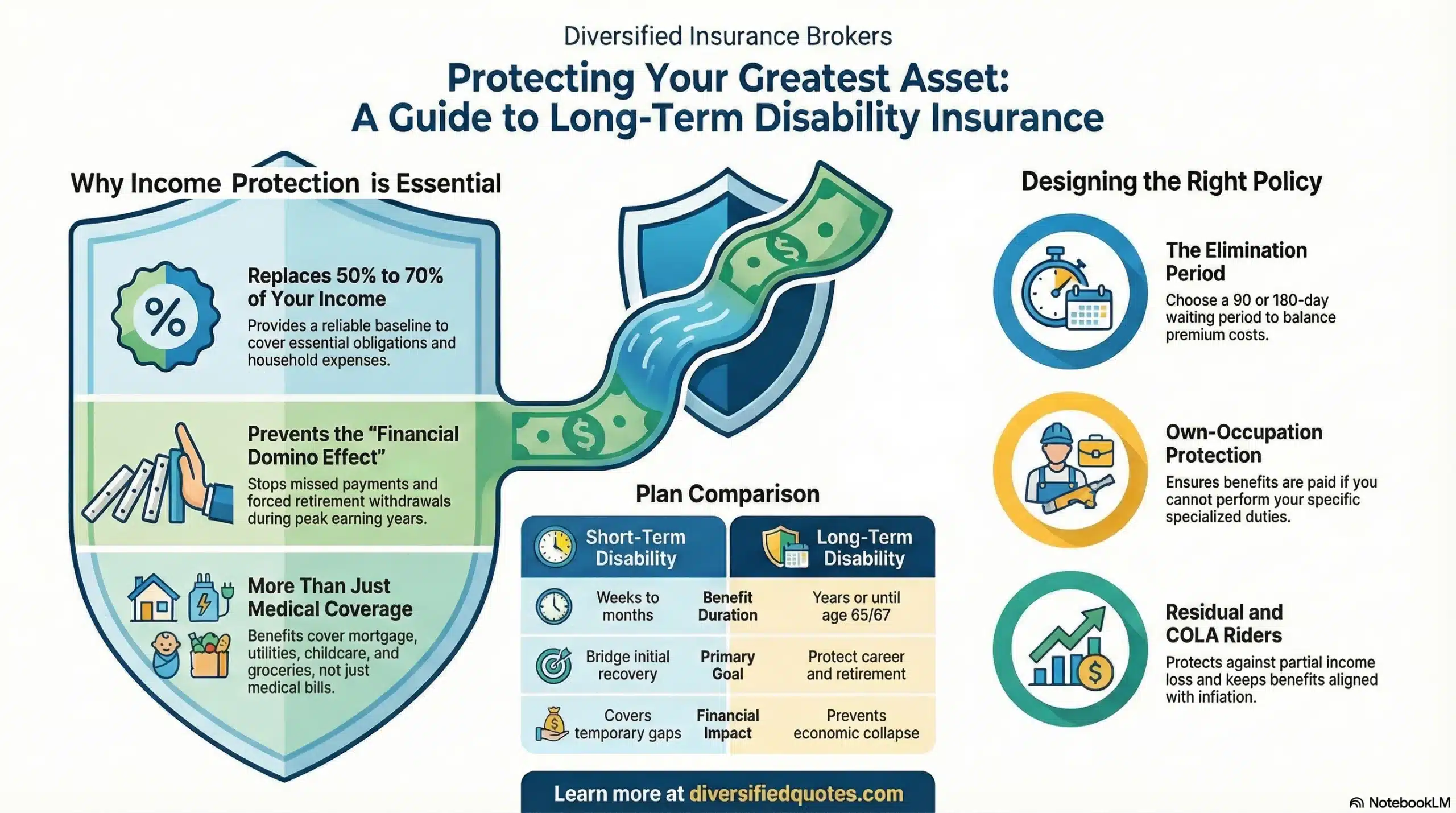
The elimination period should reflect the mariner’s financial reserves and the pattern of their employment. A mariner currently on shore leave with savings that can cover 60 to 90 days of living expenses may be well-served by a standard 90-day elimination period. A mariner whose rotation schedule means they return to sea quickly and whose savings are thinner may benefit from a shorter 30 to 60-day elimination period that initiates benefits before financial pressure becomes acute. Our resource on disability insurance elimination periods explained provides the calibration framework.
The benefit period should extend as long as the carrier allows for the maritime occupation class — ideally to age 65. A mariner disabled in their early 40s by a back injury or cardiac event that prevents return to sea duty faces 20 to 25 years of foregone career income — a financial gap that a 5-year benefit period addresses only partially and inadequately. To-age-65 benefit periods, where available for maritime occupation classes, provide the comprehensive protection that a career-ending disability requires.
The residual disability rider addresses scenarios where a mariner can perform some maritime duties but not at full sea duty status. A mariner cleared for harbor-only or limited coastal work but not deep-sea voyages has experienced real income reduction that residual coverage supports proportionately. Our resource on residual disability insurance benefits explained covers how this proportionate benefit works. For mariners interested in supplementing long-term protection with short-term coverage for the initial disability period, our resource on how to buy short-term disability insurance covers the available options.
When to Apply and Why Earlier Is Always Better
For merchant mariners, the timing argument for early disability insurance application has an additional dimension beyond the standard premium and health history considerations: the maritime occupation’s inherent risk means that each year of active sea duty increases the statistical probability that an occupational health event will complicate future underwriting. A mariner who develops a documented back condition, hearing loss, or cardiovascular finding during active sea duty and then attempts to obtain disability insurance faces the underwriting consequences of those documented conditions — exclusion riders, rated premiums, or in some cases application denial.
A mariner who applies at age 25, early in their career before the cumulative occupational health burden of maritime employment has generated documented conditions, obtains a comprehensive policy at the lowest available premium — locked in for the duration of the policy. The future increase option purchased alongside the base policy allows coverage to expand as income grows through the credential hierarchy without new medical underwriting, preserving insurability regardless of what occupational health events develop in subsequent sea-duty years. Our resource on disability insurance future insurability riders explains how this protection works for mariners building career income over time, and our resource on why young professionals need disability coverage addresses the timing argument directly. Our resource on how to get the best disability insurance rates explains all the factors that drive coverage quality and cost for maritime occupational applicants.
Get Disability Insurance Quotes for Merchant Marines
We compare options across carriers for maritime professionals to find the right combination of coverage, definition strength, and value for your position and vessel type.
Request Disability Insurance OptionsQuestions? Call 800-533-5969
Financial Protection Essentials
Income protection resources and disability insurance planning tools for maritime and high-risk occupation professionals.
Talk With an Advisor Today
Choose how you’d like to connect—call or message us, then book a time that works for you.
Schedule here:
calendly.com/jason-dibcompanies/diversified-quotes
Licensed in all 50 states • Fiduciary, family-owned since 1980
Frequently Asked Questions: Disability Insurance for Merchant Marines
The Jones Act provides important legal protections for injured seamen — including maintenance and cure payments and the right to sue for negligence — but it is fundamentally a maritime injury law framework, not an income replacement program. Maintenance payments under the Jones Act typically provide $35 to $45 per day for living expenses during recovery, which bears no relationship to a mariner’s actual wages and covers only a fraction of real household expenses. The negligence claim process requires proving employer fault, navigating maritime litigation that can take years to resolve, and accepting uncertain settlement outcomes. Throughout all of this, the mariner’s mortgage, rent, family expenses, and financial obligations continue without pause.
Private disability insurance fills the gap the Jones Act leaves open by replacing a meaningful percentage of actual pre-disability income — regardless of employer fault, regardless of legal timelines, and for as long as the disability continues rather than in a one-time settlement. For a merchant mariner supporting a household with the same financial obligations as any other professional, this ongoing income replacement function is indispensable. Our resource on whether disability insurance is worth it provides the framework for evaluating this protection relative to the financial exposure it addresses.
Merchant marines do face a more complex disability insurance application process than lower-risk occupations, and not every carrier will write coverage for maritime occupations. However, disability insurance is available for merchant mariners — the coverage landscape for maritime professionals includes carriers who specialize in or are experienced with high-risk occupation underwriting, and an independent broker with maritime occupation experience can identify which carriers offer the strongest terms for specific mariner positions. The key variables are the specific position (officer vs. rating), the vessel type, the trade route, and the applicant’s health history at the time of application.
Maritime occupation classification typically results in Class 2 or Class 3 ratings rather than the Class 4 or 5A ratings available to professional office occupations — meaning higher premiums and in some cases limitations on benefit period or definition options. But these limitations are navigable, and for a profession with 4.7x the fatality rate of all U.S. workers, the coverage that is available is worth every dollar of premium paid. Our resource on disability insurance for high-risk occupations explains how underwriting approaches elevated-risk work, and our resource on high-risk disability insurance coverage options covers what is available when both occupation and health history present underwriting complexity.
The most common disability scenarios for merchant mariners align with the documented hazard profile of maritime work. Musculoskeletal injuries — lumbar disc conditions from physical work and whole-body vibration, shoulder injuries from mooring and cargo operations, knee injuries from working on moving vessel surfaces — represent the most prevalent disability pathway and occur at rates nearly twice the national average for all U.S. workers. A back condition that prevents a mariner from meeting the physical fitness standards required for sea duty, or a shoulder injury that prevents the overhead force application that deck operations require, produces immediate income cessation when the mariner cannot ship out.
Cardiovascular conditions, including heart attacks and cardiac rhythm disorders that prevent a mariner from maintaining their Coast Guard medical certificate, represent the second major disability pathway — particularly for senior officers in their 40s and 50s. Hearing loss from sustained machinery and engine noise exposure is a documented occupational disease that can eventually prevent the communication standards required for safe vessel operations. Chemical and toxic exposure conditions from cargo, fuel, and maintenance compounds create respiratory and systemic health conditions that develop over years of cumulative exposure. Each of these pathways produces the same financial consequence: inability to ship out, loss of the rotation-based income that maritime employment generates, and immediate household financial pressure that only disability insurance income replacement can address.
The time-on/time-off rotation structure of merchant marine employment creates a distinctive income pattern that makes disability insurance both critically important and somewhat complex to structure correctly. Many mariners work contracts of 30 to 90 days or more aboard vessels, followed by comparable shore leave periods. This means annual income is generated entirely during sea-time periods, and a disability that prevents return to sea after shore leave ends creates immediate and complete income cessation — there is no partial work option that generates reduced income during recovery, only the binary of fit-for-duty versus unable to ship out.
For insurance purposes, income documentation for rotation-based mariners typically uses the prior year’s total earnings from tax returns to establish the benefit amount — capturing the full annual income from sea-time rotations rather than attempting to establish a monthly salary figure. Mariners should ensure their benefit amount reflects total annual earnings including all sea-time rotations rather than an artificially low figure that understates actual income. For mariners working through crewing agencies or on independent contractor arrangements, our resource on disability insurance for independent contractors covers the specific income documentation considerations that apply.
Loss of the Coast Guard Merchant Mariner Credential or the medical certificate required to hold it is career-ending for the maritime professional role — and it represents exactly the disability scenario that own-occupation disability insurance must address. A merchant mariner cannot ship out in a licensed or credentialed capacity without a valid MMC and the associated medical fitness standards. When a health condition — cardiac disease, severe musculoskeletal disability, significant hearing loss, or other conditions that fail USCG medical standards — prevents a mariner from maintaining their credential, their maritime career ends regardless of whether they retain some capacity for shore-based work.
Under a true own-occupation disability definition, a mariner who cannot perform the material and substantial duties of their specific occupation as a licensed merchant mariner — including the sea duty, watch-standing, and physical demands that the credentialed position requires — receives disability benefits even if they could theoretically perform a shore-based job. This definition protects the maritime income specifically rather than just the generic ability to earn something. Under an any-occupation standard, the same mariner might be denied benefits because they could work in a shore-based transportation or logistics role at a fraction of their maritime income. Our resource on own-occupation disability insurance explains this critical distinction and why it is the most important provision to confirm in any maritime disability policy.
The optimal time for a merchant mariner to apply for disability insurance is as early in their maritime career as possible — ideally when first obtaining their Merchant Mariner Credential, before years of sea duty have produced the occupational health conditions that complicate underwriting. Maritime careers accumulate health history quickly: back conditions from physical work and whole-body vibration, hearing loss from engine and machinery noise, cardiovascular findings from the lifestyle demands of extended voyages. Each of these documented conditions at the time of application can produce exclusion riders that limit coverage for the most likely disability scenarios or elevate premiums beyond what early application would have produced.
A mariner who applies at age 24 after obtaining their first credential obtains the lowest locked-in premium for the policy’s life, at the cleanest point of their health history, with the broadest available coverage terms. A mariner who applies at age 44 after 20 years of sea duty faces not only significantly higher premiums but potentially a documented health history that limits coverage options substantially. The future increase option purchased with an early policy allows coverage to expand as maritime income grows through the officer hierarchy without new medical underwriting. Our resource on how to get the best disability insurance rates explains all the factors that determine coverage quality and cost for maritime occupation applicants.
About the Author:
Jason Stolz, CLTC, CRPC, DIA, CAA and Chief Underwriter at Diversified Insurance Brokers (NPN 20471358), is a senior insurance and retirement professional with more than 25 years of real-world experience helping individuals, families, and business owners protect their income, assets, and long-term financial stability. As a long-time partner of the nationally licensed independent agency Diversified Insurance Brokers, Jason provides trusted guidance across multiple specialties—including fixed and indexed annuities, long-term care planning, personal and business disability insurance, life insurance solutions, Group Health, Travel Medical and Evacuation Insurance, and short-term health coverage. Diversified Insurance Brokers maintains active contracts with over 100 highly rated insurance carriers, ensuring clients have access to a broad and competitive marketplace.
His practical, education-first approach has earned recognition in publications such as VoyageATL, and contributions from his agency featured in Kiplinger and GoBankingRates— highlighting his commitment to financial clarity and client-focused planning. Drawing on deep product knowledge and years of hands-on field experience, Jason helps clients evaluate carriers, compare strategies, and build retirement and protection plans that are both secure and cost-efficient. Visitors who want to explore current annuity rates and compare options across multiple insurers can also use this annuity quote and comparison tool.
Explore More Disability Insurance Options: Browse our complete guide to Disability Insurance for Transportation, Maritime & Hazardous Occupations — covering truck drivers, flight attendants, merchant marines, divers, chauffeurs & drivers from 100+ carriers.
Last Reviewed: September 13, 2026 |
Reviewed by: Jason Stolz, CLTC, CRPC, DIA, CAA
Chief Underwriter, Diversified Insurance Brokers, Inc. | NPN: 20471358 | Diversified Insurance Brokers, Inc. — Licensed in all 50 states
Fact Checked by: Tonia Pettitt, CMIP©
Medicare Specialist, Diversified Insurance Brokers, Inc. | NPN: 14374308 | Diversified Insurance Brokers, Inc. — Licensed in all 50 states
Did you find this content helpful? Leave us a Google review — it helps others find trustworthy guidance too.
Editorial Standards: Diversified Insurance Brokers maintains rigorous editorial standards to ensure accuracy, clarity, and independence in all content. Learn more about our editorial standards and commitment to transparency.
