
Disability Insurance for Taxi and Rideshare Drivers
As an Independent Disability Insurance Broker, we have access to exclusive discounts and negotiated pricing most captive agents can’t offer — see the full breakdown near the end of this page.
Disability Insurance for Taxi and Rideshare Drivers

Jason Stolz CLTC, CRPC, DIA, CAA
Taxi and rideshare drivers face a disability risk profile that combines the most dangerous physical work environment in the American economy — road transportation, which accounts for 38.2% of all occupational fatalities in 2024 according to the Bureau of Labor Statistics, with workers in transportation and material moving occupations representing the occupational group with the most fatalities with 1,391 fatal work injuries in 2024 at a fatality rate of 12.5 per 100,000 FTE workers — with the complete absence of employer-provided disability benefits that most other professions can at least partially rely on. Taxi drivers and rideshare drivers are classified as independent contractors, not employees. There is no employer sick pay. There is no employer-sponsored long-term disability plan. There is no workers’ compensation in most states for on-demand driving injuries. When income stops because a driver cannot work, it stops entirely — with no safety net beyond whatever the driver has built personally.
The financial fragility that results is acute. Most rideshare and taxi drivers are fully dependent on their ability to drive. Unlike a salaried professional who might weather a disability with savings, accrued sick leave, and a group LTD plan, a driver who cannot work for three months faces immediate household financial crisis. The Uber Optional Injury Protection plan — available in most states at $0.024 per mile — provides some coverage while the app is active, but only for accidents during active driving, only for on-trip or en-route periods depending on the state and policy, and with maximum earnings replacement that typically falls short of full income replacement. The deep structural coverage gap that rideshare and taxi drivers face requires a proactive, individually structured disability insurance solution that does not depend on whether the app is running, whether the trip was in progress, or whether the state has extended protections.
At Diversified Insurance Brokers, we help taxi drivers, rideshare drivers, and gig transportation workers build individual disability income protection that reflects the real-world economics of their work — variable income, self-employment documentation challenges, independent contractor status, and the specific physical and health risks that professional driving creates over a career. Our resources on disability insurance for the self-employed and disability insurance for 1099 workers address the income documentation and underwriting mechanics that apply directly to this workforce.
Disability Insurance for Taxi and Rideshare Drivers
Individual income protection for independent contractor drivers who cannot afford to stop earning — and have no employer safety net when they do.
Request a Disability Insurance QuoteCall 800-533-5969
The Physical Disability Risk Profile for Professional Drivers
The health risks that taxi and rideshare drivers accumulate over a career are documented across multiple peer-reviewed research streams that paint a consistent picture: professional driving is among the most physically damaging sedentary occupations in the workforce. The combination of sustained seated vibration exposure, prolonged static posture, the biomechanical demands of repetitive vehicle control inputs, and the cumulative cardiovascular effects of long sedentary work hours creates a chronic disease and disability risk profile that is elevated well above the general population.
Musculoskeletal disorders are the most prevalent occupational health consequence for professional drivers. Professional drivers, such as truck, taxi, and bus drivers, often encounter adverse conditions like traffic congestion, continuous time pressure, and excessive physical demands, which can impact their health and make them vulnerable to work-related musculoskeletal disorders. WMSDs in professional drivers are linked to various ergonomic risk factors. Long-term sitting, whole-body vibration, and the mismatch of anthropometric measurements of drivers with the physical environment of the driver cabin are among the key physical risk factors identified. A systematic review of MSD research among taxi drivers found that the prevalence of MSDs in this population ranged from 43.1% to 93%, with the lower back being the most commonly affected region — lower back pain identified in 53% of studies reviewed — followed by neck, upper back, and shoulder conditions.
Sedentary time among taxi drivers averages over 715 minutes per day by objective accelerometry measurement — nearly 12 hours of sedentary exposure in a single working day. This extreme sedentary exposure compounds over years and decades to produce the cardiovascular disease risk that peer-reviewed research has consistently documented in taxi driver populations. A taxi driver study in Los Angeles found that work-related stress and sedentary work were associated with an elevated risk of developing hypertension, obesity, vision problems, and musculoskeletal pain in the back, legs, and shoulders. Studies across multiple U.S. cities — New York, Los Angeles, San Francisco, Chicago — have documented elevated rates of hypertension, cardiovascular disease risk factors, and metabolic conditions in taxi driver populations compared to non-driver controls.
Traffic accident risk is the acute overlay on top of these cumulative chronic health risks. Research has shown that taxi drivers are at risk for numerous health concerns, such as low back and leg pain, linked to their highly sedentary occupation, long work hours and stressors related to the job including safety threats. For rideshare drivers specifically, research indicates that rideshare driver fatigue is a contributing factor in 15% of crashes, that nighttime rideshare trips see a 25% increase in crash involvement compared to daytime trips, and that drivers have a 3.2 times higher risk of being involved in an accident after working more than 8 hours in a day. Violence risk — from passengers or from the general traffic environment — adds a specific acute injury pathway that is not present for most other occupations.
The Platform Coverage Gap: What Uber and Lyft Actually Provide
The most important thing taxi and rideshare drivers need to understand about platform-provided coverage is what it does not cover, because the marketing language around these programs can create a false sense of income protection adequacy. Understanding the exact scope and limitations of platform coverage is the starting point for identifying where personal disability insurance must fill the gap.
| Coverage Source | What It Covers | Critical Limitations |
|---|---|---|
| Uber Optional Injury Protection (most states) | Medical expenses, disability payments, survivor benefits for covered accidents while online | Accident-only; no illness coverage; only while the app is active; driver pays the per-mile premium; maximum earnings replacement often below full income |
| Occupational Accident Insurance (CA, MA, MN) | Medical expenses up to $1M, disability at 66% of average weekly earnings, death benefits for work-related injuries while online | Work-related injuries only; does not cover illness, chronic disease, or non-work disabilities; no permanent disability benefits in most designs; no dispute resolution equivalent to workers’ comp |
| Workers’ Compensation (Washington, limited other states) | Broader workplace injury coverage; medical, wage replacement for qualifying on-duty injuries | State-specific; not available in most states for IC drivers; does not cover non-occupational disability |
| Individual Disability Insurance (personal policy) | Any disabling condition from any cause — accident, illness, chronic disease, mental health — regardless of whether the app is active or the driver is on-trip | Must be applied for individually; income documentation required; health underwriting applies; premium is paid personally |
The gap that this table illustrates is consequential: platform coverage and occupational accident insurance address only the accident-while-driving scenario. The back pain that develops over eight years of daily driving and eventually prevents a driver from spending ten hours in a vehicle — the most statistically common disabling condition for taxi drivers — is entirely outside platform coverage. The cardiovascular event that results from years of sedentary high-stress work is not covered. The mental health condition that produces disabling anxiety about driving following a serious accident is not covered beyond the immediate accident injury. Individual disability insurance covers all of these scenarios because it covers any disabling condition from any cause, with no requirement that the condition arise from an on-trip accident.
Occupational Classification for Taxi and Rideshare Drivers
Taxi and rideshare drivers typically receive Class 2 or Class 3 occupational ratings from disability insurance carriers, reflecting the elevated traffic risk, physical demands, and health risk profile of professional driving work. This is a meaningful constraint compared to office-based professionals who receive Class 4 or Class 5 ratings — Class 2 and Class 3 produce higher premiums per dollar of monthly benefit and may limit access to some of the most comprehensive policy provisions available at higher classes. However, this does not mean meaningful disability protection is unavailable. It means thoughtful carrier selection, elimination period strategy, and benefit amount calibration matter more for drivers than for lower-risk occupational classes.
Some carriers distinguish between taxi driving and rideshare driving for occupational classification purposes. Full-time taxi drivers who drive exclusively under a taxi medallion or commercial vehicle license may receive different treatment than part-time rideshare drivers who drive as a secondary income source. Drivers who disclose rideshare work as secondary to a primary occupation receive the classification for whichever occupation presents the higher risk — which generally means the rideshare driving governs the occupational class regardless of how many hours the driver actually spends doing each activity. Our resource on disability insurance for chauffeurs addresses the closely related professional driving occupational classification for commercial and for-hire vehicle drivers.
Income Documentation: The Self-Employment Challenge
The variable income structure of rideshare and taxi driving creates a specific disability underwriting challenge that requires preparation before any application is submitted. For full-time drivers, insurable income is typically documented through Schedule C on personal tax returns showing net self-employment income, 1099 forms from Uber and Lyft reflecting gross platform earnings, and potentially bank statements showing consistent income deposits over time. Carriers calculate insurable income from documented net taxable income — after business deductions for vehicle expenses, phone, insurance, and other legitimate business costs — rather than from the gross earnings that appear on driver dashboard summaries.
This creates a familiar self-employment tension: legitimate business expense deductions that reduce taxable income also reduce the documented insurable income available for benefit calculation. A rideshare driver who earns $65,000 in gross platform income but reports $38,000 in net taxable income after vehicle depreciation, mileage, and other deductions may find their maximum available monthly benefit calculated on the lower net figure. Understanding which income components each carrier includes in their insurable income calculation, and applying during or shortly after periods when net taxable income is at its highest sustainable level, produces better coverage outcomes than applying without this understanding.
Part-time rideshare drivers who use driving as a secondary income source face an additional complexity: carriers typically base insurable income calculations on total documented earned income from all sources, with the benefit amount limited to a percentage of total income rather than specifically rideshare income. A teacher who drives rideshare on evenings and weekends has their total combined income as the basis for benefit calculation. The insurable benefit is capped at a percentage of that total income, meaning the rideshare portion may not be separately insurable above the total income cap. Our resource on disability insurance for 1099 workers covers the income documentation requirements for gig economy workers with multiple income sources.
The Non-Occupational Disability Gap Is the Biggest Risk
The most important reframing for any taxi or rideshare driver evaluating disability insurance is this: the disabling events most likely to end a driving career are not traffic accidents — they are the chronic health conditions that develop from years of professional driving. Back pain severe enough to prevent sustained vehicle operation, a cardiovascular event resulting from the combination of sedentary work, stress, and irregular sleep schedules, diabetes complications affecting vision or sensation that prevent safe driving, or a mental health condition producing disabling anxiety about road situations — these are the disability scenarios with the highest statistical probability for professional drivers, and none of them are covered by platform occupational accident insurance.
The Social Security Administration estimates that more than one in four of today’s 20-year-olds will become disabled before reaching retirement age, and most of those disabilities result from illness rather than accident. For professional drivers whose cumulative health risk profile is elevated by the specific demands of their work, the probability is not reduced relative to the general population — if anything, the documented elevated rates of musculoskeletal disorders, cardiovascular risk, and mental health conditions in professional driver populations suggest the disability probability is higher than average, not lower. Individual disability insurance covering any disabling condition from any cause is the only mechanism that addresses this full spectrum of risk.
Elimination Period Strategy for Drivers Without Sick Pay
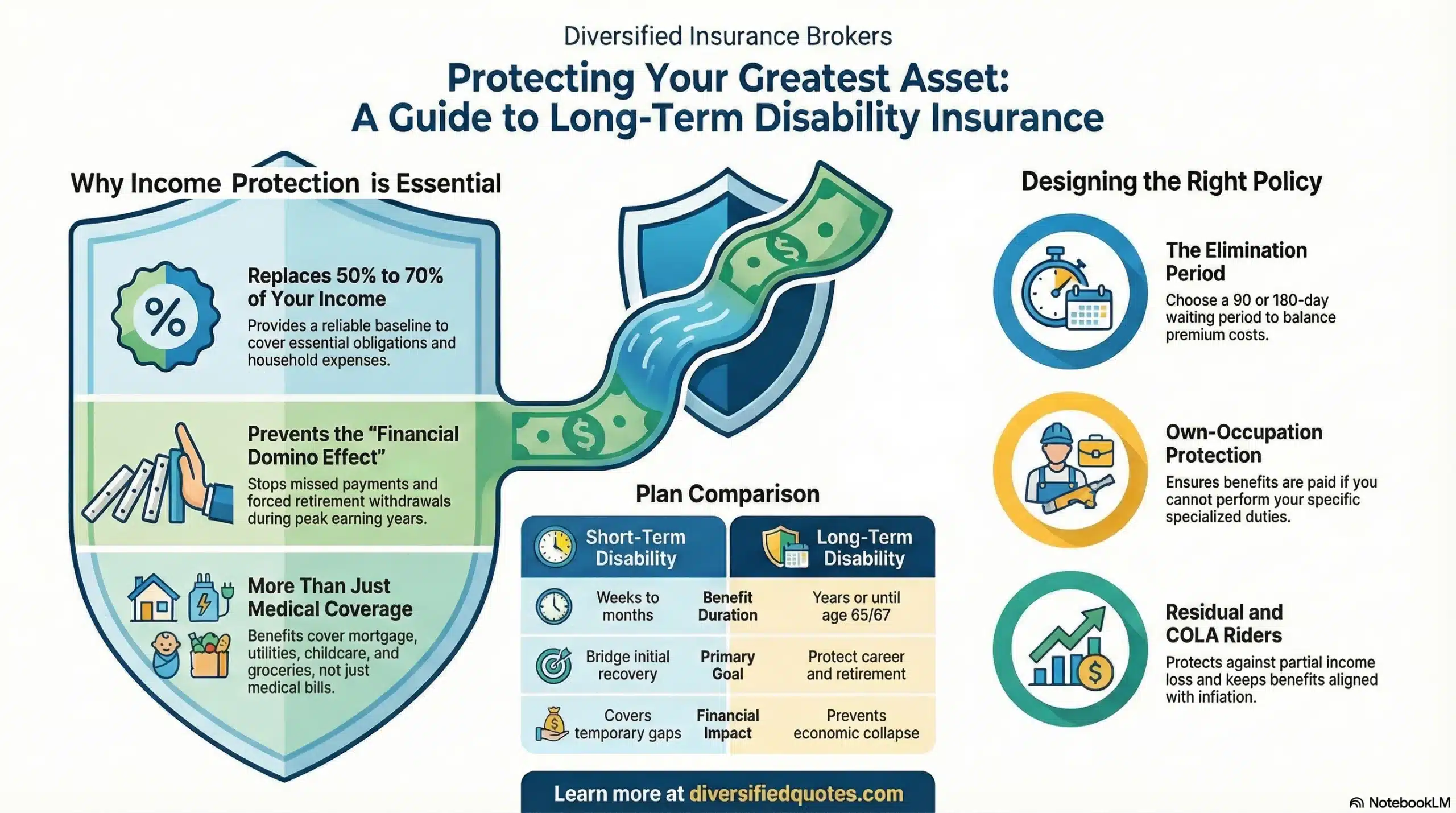
The elimination period — the waiting period between disability onset and first benefit payment — should be selected based on actual financial reserves, not on a default assumption. The standard 90-day elimination period assumes a driver can fund approximately three months of living expenses before disability benefits begin. For many full-time drivers without significant savings, this assumption may not hold. A driver who cannot work for three months faces three months of missed income with no platform earnings, no employer sick pay, and no workers’ compensation to bridge the gap — a financial crisis that may force premature return to driving before medical recovery is complete.
A 60-day or 30-day elimination period provides earlier income protection at higher monthly premium cost. For drivers with limited savings, the higher monthly premium for a shorter elimination period may be justified by the financial reality that the alternative — a 90-day uncompensated gap — could produce lasting financial damage. Short-term disability coverage is also worth exploring as a bridge layer; some individual carriers offer short-term disability products that provide earlier income while a longer-term policy’s elimination period runs. Our resource on disability insurance elimination periods explained provides the full framework for selecting the right waiting period based on realistic reserves.
The Residual Rider for Partial Capacity Returns
Drivers who experience a disability and return to work at reduced capacity — driving fewer hours because of a back condition, limiting shift lengths because of a cardiovascular recovery restriction, or reducing nighttime driving because of vision or anxiety-related limitations — experience real income loss that the residual disability rider addresses proportionally. A driver who can work five hours per day instead of ten earns roughly half their previous income. Without a residual rider, this produces no disability benefit despite substantial financial harm. With the residual rider, the partial income reduction triggers proportional benefit payments based on the actual income loss, making the transition from disability back to full working capacity financially manageable rather than financially impossible.
For rideshare drivers specifically, the variable nature of platform earnings means that partial disability — driving fewer hours, avoiding high-intensity surge periods, limiting geographic areas due to anxiety — produces proportional income reduction that is precisely the scenario the residual rider addresses best. The rider’s income comparison method — comparing current earnings to pre-disability earnings and paying the proportional benefit — maps naturally onto the variable, surge-based income structure of rideshare driving.
Combining Platform Coverage and Personal Disability Insurance
The optimal total income protection strategy for a rideshare or taxi driver combines multiple coverage layers that address different risk scenarios. Uber’s Optional Injury Protection or occupational accident insurance in states where it is provided automatically addresses acute accident injury while driving — this is low-cost accident coverage that drivers in eligible states should utilize. Personal individual disability insurance from the private market addresses everything else: illness, chronic disease, non-driving injuries, and any accident disability that extends beyond the platform program’s benefit period or benefit amount cap.
For drivers who use driving as a primary full-time income, the individual disability policy should target 60% to 70% of documented average monthly net income as the monthly benefit amount, with a benefit period extending to age 65 or 67 — because a back condition that prevents driving at age 45 represents potentially 20 years of income replacement need, and a short benefit period policy that expires at year five leaves the vast majority of that risk unprotected. For drivers who use rideshare as supplemental income alongside a primary occupation, the individual disability policy benefit structure should reflect the total income picture and the relative importance of the driving income to total household financial stability.
Our resources on disability insurance for bus drivers, disability insurance for truck drivers, and disability insurance for chauffeurs cover related professional driving occupational classifications and income protection considerations for drivers across different vehicle and service categories. For the broader self-employed income protection context, our resource on whether self-employed professionals can get disability insurance addresses the complete framework for independent contractor income protection.
Protect Your Income as a Professional Driver
Individual disability insurance that covers accident, illness, and chronic disease — not just on-trip accidents while the app is running.
Get Your Disability Insurance QuoteCall 800-533-5969
Related Disability Insurance Pages
Income protection resources for professional drivers, gig economy workers, and self-employed transportation workers.
Financial Protection Essentials
Income protection, life insurance, and retirement planning tools for gig economy and independent contractor workers.
Talk With an Advisor Today
Choose how you’d like to connect—call or message us, then book a time that works for you.
Schedule here:
calendly.com/jason-dibcompanies/diversified-quotes
Licensed in all 50 states • Fiduciary, family-owned since 1980
FAQs: Disability Insurance for Taxi and Rideshare Drivers
Doesn’t Uber’s Optional Injury Protection cover me for disability?
Partially — but with significant limitations that make it insufficient as standalone income protection. Uber’s Optional Injury Protection (available in most states at $0.024 per mile) provides disability payments, medical coverage, and survivor benefits for covered accidents, but only while the app is active. The program covers accidents that occur while you’re online with Uber — waiting for a trip, en route to pickup, or on a trip — and provides earnings replacement at a rate that may not fully replace income depending on your typical hourly earnings.
What it does not cover is critical: illness, chronic disease, back pain from years of professional driving, cardiovascular disease, diabetes complications, mental health conditions, or any non-accident disabling event. The back pain that develops over eight years of daily driving and eventually prevents sustained vehicle operation — statistically the most common disabling condition for professional drivers — is entirely outside platform coverage. Individual disability insurance covers any disabling condition from any cause, regardless of whether the app is running, making it the essential complement to platform coverage rather than a substitute for it.
What occupational class do taxi and rideshare drivers receive?
Taxi and rideshare drivers typically receive Class 2 or Class 3 occupational ratings, reflecting the elevated traffic risk, physical demands of professional driving, and health risk profile of this occupation. This produces higher premiums per dollar of monthly benefit compared to office-based professionals who receive Class 4 or Class 5 ratings, and may limit access to some of the most comprehensive policy provisions. However, meaningful disability protection is available at these occupational classes — carrier selection matters significantly since some carriers are more favorable than others for professional driving occupations, and an independent broker who can compare the full market identifies the most favorable available option. Some carriers distinguish between full-time taxi drivers and part-time rideshare drivers, with the more demanding classification governing when both apply.
How do I document my income for disability underwriting as a rideshare driver?
Insurable income for disability underwriting is calculated from documented net taxable income — typically two years of Schedule C tax returns and 1099 forms from Uber and Lyft showing gross platform earnings. The critical distinction is that carriers use net taxable income after business deductions (vehicle expenses, mileage, phone, platform fees, insurance) rather than gross platform earnings. A driver who earns $65,000 in gross earnings but reports $38,000 in net taxable income after deductions may find their available monthly benefit calculated on the lower net figure. Applying during periods when net taxable income is at its highest sustainable documented level produces the best available benefit amount. Our resource on disability insurance for 1099 workers covers the documentation mechanics in detail.
What are the most common disabling conditions for professional drivers?
Musculoskeletal disorders — particularly lower back pain, neck and shoulder conditions, and knee problems — are the most prevalent occupational health consequence for taxi and rideshare drivers, driven by sustained seated vibration exposure, prolonged static posture, and whole-body vibration. Research documents MSD prevalence in taxi driver populations ranging from 43.1% to 93%, with lower back pain affecting 53% of drivers across studies. Cardiovascular disease risk is elevated by the combination of sedentary work, irregular sleep, work-related stress, and poor nutrition opportunities during long shifts. Mental health conditions — anxiety from traffic stress, depression from isolation, and PTSD following accidents — are significant disability pathways as well. The important planning implication is that these conditions are not covered by platform occupational accident insurance, which addresses only accident injuries during active driving. Individual disability insurance covering any cause is the only protection that addresses the full spectrum of professional driver disability risk.
Can part-time rideshare drivers get individual disability insurance?
Yes — part-time rideshare drivers can access individual disability insurance, though the available benefit amount is calculated based on documented total earned income from all sources rather than just rideshare earnings specifically. For a part-time driver who also has primary employment, the insurable income calculation reflects total combined earnings, and the rideshare income contributes to the total income base for benefit calculation purposes. For part-time drivers whose rideshare income is the primary or sole income source, the self-employment income documentation mechanics described for full-time drivers apply. The occupational classification for disability underwriting purposes typically reflects the rideshare driving occupation regardless of part-time status, since disability carriers use the highest-risk occupation when multiple occupations apply.
What elimination period should a rideshare or taxi driver choose?
The right elimination period depends on actual financial reserves, not a default assumption. The standard 90-day elimination period assumes a driver can fund three months of living expenses before benefits begin — with no platform earnings, no employer sick pay, and no workers’ compensation in most states. For full-time drivers with limited savings, a 90-day gap before benefits begin can create severe financial hardship and pressure for premature return to driving before medical recovery is complete. A 60-day or 30-day elimination period provides earlier protection at higher monthly premium cost, which may be justified when the alternative is a financial crisis during the waiting period. Some drivers use platform-provided accident coverage for the immediate post-accident period, then rely on individual disability insurance for the longer-duration income replacement need beyond the platform program’s duration. Our resource on disability insurance elimination periods provides the full decision framework.
About the Author:
Jason Stolz, CLTC, CRPC, DIA, CAA and Chief Underwriter at Diversified Insurance Brokers (NPN 20471358), is a senior insurance and retirement professional with more than 25 years of real-world experience helping individuals, families, and business owners protect their income, assets, and long-term financial stability. As a long-time partner of the nationally licensed independent agency Diversified Insurance Brokers, Jason provides trusted guidance across multiple specialties—including fixed and indexed annuities, long-term care planning, personal and business disability insurance, life insurance solutions, Group Health, Travel Medical and Evacuation Insurance, and short-term health coverage. Diversified Insurance Brokers maintains active contracts with over 100 highly rated insurance carriers, ensuring clients have access to a broad and competitive marketplace.
His practical, education-first approach has earned recognition in publications such as VoyageATL, and contributions from his agency featured in Kiplinger and GoBankingRates— highlighting his commitment to financial clarity and client-focused planning. Drawing on deep product knowledge and years of hands-on field experience, Jason helps clients evaluate carriers, compare strategies, and build retirement and protection plans that are both secure and cost-efficient. Visitors who want to explore current annuity rates and compare options across multiple insurers can also use this annuity quote and comparison tool.
Explore More Disability Insurance Options: Browse our complete guide to Disability Insurance for Transportation, Maritime & Hazardous Occupations — covering truck drivers, flight attendants, merchant marines, divers, chauffeurs & drivers from 100+ carriers.
Last Reviewed: May 18, 2026 |
Reviewed by: Jason Stolz, CLTC, CRPC, DIA, CAA
Chief Underwriter, Diversified Insurance Brokers, Inc. | NPN: 20471358 | Diversified Insurance Brokers, Inc. — Licensed in all 50 states
Fact Checked by: Tonia Pettitt, CMIP©
Medicare Specialist, Diversified Insurance Brokers, Inc. | NPN: 14374308 | Diversified Insurance Brokers, Inc. — Licensed in all 50 states
Did you find this content helpful? Leave us a Google review — it helps others find trustworthy guidance too.
Editorial Standards: Diversified Insurance Brokers maintains rigorous editorial standards to ensure accuracy, clarity, and independence in all content. Learn more about our editorial standards and commitment to transparency.
