
Annuity Quotes
Annuity Quotes

Jason Stolz CLTC, CRPC, DIA, CAA
An annuity quote is far more than a single percentage or payment projection. It’s a detailed illustration that shows how your premium interacts with contract mechanics, carrier crediting strategies, payout options, and guarantee structures over time. Most people searching for annuity quotes are looking for one of two things: either a guaranteed interest rate for principal protection (if considering a fixed annuity) or a projected income amount for retirement planning (if considering income-producing structures). The challenge is that many online annuity quote tools and insurance company websites present rates in isolation—without the context needed to understand trade-offs, liquidity constraints, or long-term costs. A professional annuity quote from an independent annuity broker provides this context and ensures you’re comparing apples to apples across multiple carriers.
At Diversified Insurance Brokers, we’ve spent decades helping retirees, business owners, and wealth planners request, evaluate, and act on annuity quotes from over 100 carriers. Our approach is straightforward: an annuity quote is only useful if it answers the right questions for your specific situation. Are you protecting a lump sum of capital? Planning guaranteed retirement income? Looking for tax-deferred growth with downside protection? Seeking to coordinate lifetime income with Social Security and pensions? Each scenario produces a different type of annuity quote, compares against different benchmarks, and leads to different purchasing decisions. Understanding what an annuity quote shows—and what it doesn’t show—is the first step toward using it effectively. This guide walks you through the anatomy of a professional annuity quote, how to request one, what to compare, and how to avoid common mistakes that lead to poor decisions.
Request Your Personalized Annuity Quote Today
Current Fixed Annuity Rates
Compare today’s best fixed annuity rates from top carriers.
View Current RatesCurrent Bonus Annuity Rates
See which annuities offer the highest upfront bonus today.
View Bonus RatesRequest an Annuity Quote
Submit our annuity request form to get personalized rate options.
Quote Request FormModel Your Guaranteed Income
Use our calculator to see income scenarios based on your situation.
What an Annuity Quote Actually Contains: Understanding the Core Components
An annuity quote has several essential sections, each providing different information. The first and most obvious section is the contract summary. This shows the annuity type (fixed, fixed indexed, immediate, deferred, qualified, non-qualified), the issuing carrier name, the premium amount you’re investing, and the contract effective date or start date of the annuity quote. This section seems basic, but it’s critical because small differences here affect guarantees and tax treatment. A $100,000 fixed annuity quote with an effective date of today is different from the same annuity quote with an effective date 30 days from now—rates may have shifted. Understanding how annuities are taxed depends partly on whether your annuity quote is for qualified or non-qualified funds.
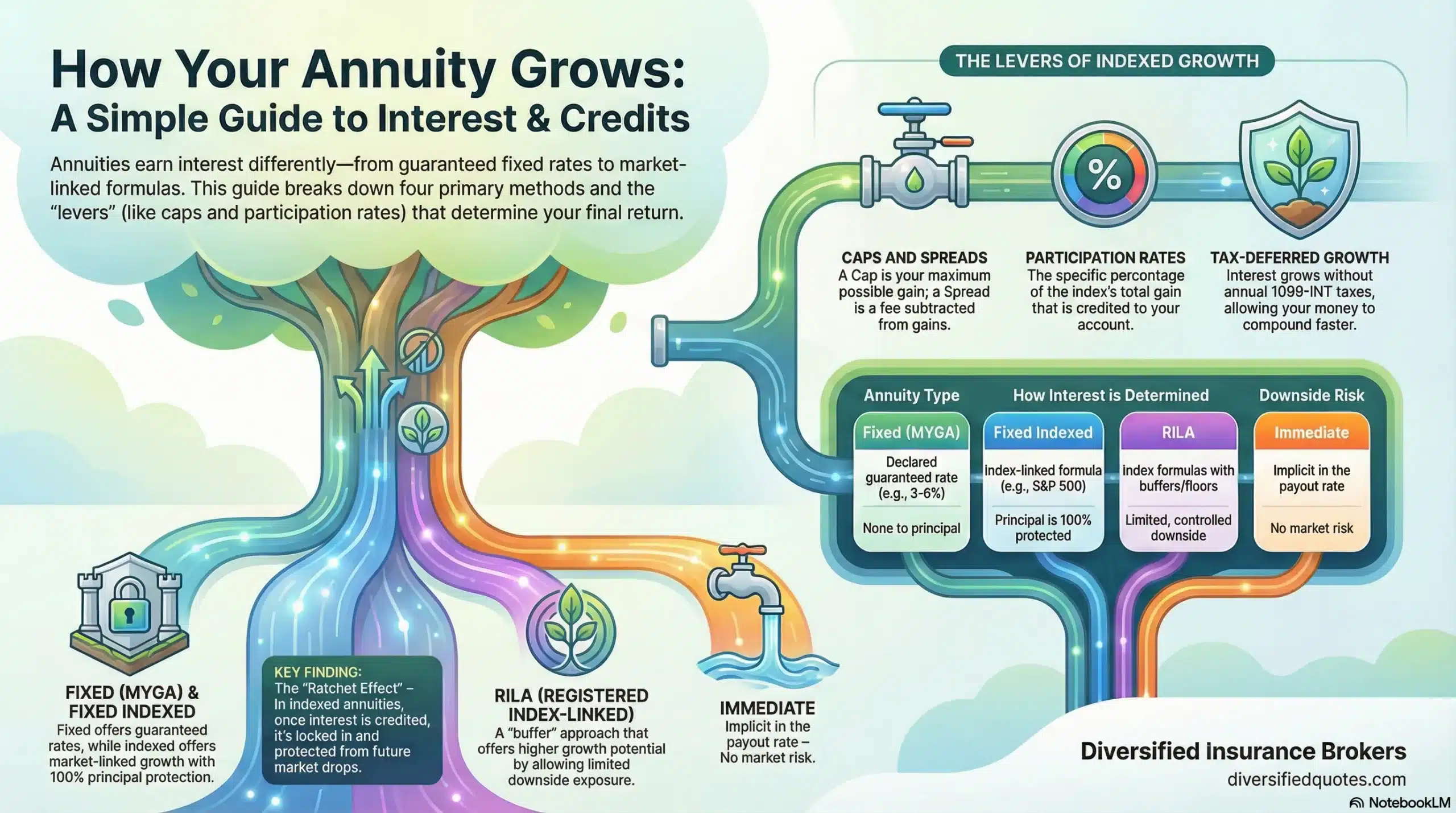
The second key section of an annuity quote is the rate or crediting methodology. For a fixed annuity quote, this shows a guaranteed interest rate for a specific term—perhaps 5.35% for five years. This rate is contractual and does not change for the stated period. After the initial period, the annuity quote shows what the “renewal rate” might be (an estimate only, since it depends on future interest rates and carrier decisions). For a fixed indexed annuity quote, the rate section is more complex. It shows which index options are available (typically the S&P 500 or other market indices), what the annual participation rate is (the percentage of index gains you receive), what the annual cap is (the maximum return you can earn), and whether there are spreads, fees, or other crediting adjustments. Understanding fixed indexed annuity pros and cons requires carefully reviewing this crediting methodology section of your annuity quote.
The third component of an annuity quote is the illustrated values section. This shows what your premium is projected to grow to at various points in the future—typically at 1-year, 5-year, 10-year, and 15-year intervals (or at your targeted withdrawal date if you have one). For a fixed annuity quote, these projections are guaranteed (based on the stated rate). For an indexed annuity quote, these values are illustrated based on historical average returns, not guaranteed. The fine print on every annuity quote explicitly states which values are guaranteed and which are illustrated assumptions. This distinction matters profoundly. An annuity quote showing an indexed product’s account growing from $100,000 to $180,000 over ten years is an illustration, not a promise. You might receive $120,000 or $200,000 depending on actual market performance. Reading the fine print on an annuity quote about guarantee levels prevents costly misunderstandings.
The fourth essential section of an annuity quote is the payout or income section. If you’re evaluating a SPIA (Single Premium Immediate Annuity) or an DIA (Deferred Income Annuity), your annuity quote shows estimated monthly or annual payments. It typically shows payments for different payout options: single life (highest payment but stops at death), joint life (lower payment but continues for surviving spouse), and period certain options (payments guaranteed for 10, 15, or 20 years even if you die early). Each payout choice on your annuity quote shows a different income amount because each carries different duration risk for the insurance company. If you’re considering an income rider on a fixed indexed annuity with a GLWB, your annuity quote shows the withdrawal guarantees and any fees associated with maintaining the rider.
The fifth section of an annuity quote outlines fees, charges, and surrender provisions. This section is often where people miss critical details. A fixed annuity quote typically shows no annual management fees (your rate is adjusted to cover costs), but shows surrender charges—penalties if you withdraw more than a free withdrawal amount in early years. A typical annuity quote for a fixed product might show: Year 1-2, 7% surrender charge; Year 3-4, 6%; Year 5-6, 5%; and 0% after year 7. An indexed annuity quote often shows annual M&E (mortality and expense) fees, administrative fees, and potentially rider fees if income guarantees are added. Understanding these charges on your annuity quote is critical because they compound over time and can materially affect returns. A well-prepared annuity quote from a professional advisor explains these costs clearly; a poorly-prepared annuity quote may bury them in fine print.
How to Request an Annuity Quote: The Information You’ll Need
Requesting an accurate annuity quote requires providing specific information to the carrier or broker. The most fundamental piece of information is your current age. For income annuity quotes, your age is the primary driver of your income amount—a 65-year-old and a 75-year-old requesting an annuity quote for the same $100,000 premium will receive dramatically different monthly payments. This is because insurance companies base payments on actuarial life expectancy tables. If you’re getting an annuity quote for yourself and a spouse (for joint income), you need both ages.
Your state of residence is also critical for an annuity quote because product availability, crediting rates, and maximum guarantees vary by state. Some carriers may not be licensed to issue annuities in your state, so your annuity quote options depend on where you live. Premium amount (the dollar investment you’re making) is the next essential input for your annuity quote. Even though annuity quote rates don’t typically vary with deposit size (a carrier’s rate is the same whether you’re depositing $50,000 or $500,000), carriers do have minimum deposit requirements that vary by product. Your annuity quote can only reflect products that meet your deposit size.
For income-focused annuity quotes, you’ll need to specify when you want income to begin: immediately (for a SPIA annuity quote), or at a future date (for a deferred annuity quote). The income start date materially affects your annuity quote payment. Deferring five years can increase monthly income 20-40% compared to immediate income, so an accurate annuity quote depends on getting this timing right. You’ll also need to specify your desired payout option for your annuity quote: single life, joint life, or period certain. Each generates a different annuity quote amount. If you have a spouse, their age is necessary for an accurate joint-life annuity quote.
For growth-focused annuity quotes (fixed or indexed products not yet producing income), you should specify your intended holding period—when you plan to withdraw or take income. This helps the annuity quote illustrator show you surrender charges and the contract stage most relevant to your needs. If you’re considering adding riders (like an income rider or long-term care rider), mention this when requesting your annuity quote because riders affect the crediting rate and fees shown in your illustration.
Finally, clarifying whether your annuity quote is for qualified funds (IRA, 401(k) rollover) or non-qualified funds (after-tax savings) is important because it affects tax treatment and, in some cases, product availability. Many carriers limit the size of qualified annuity quotes they’ll issue, while others have restrictions on joint-life payout options for qualified contracts. A complete annuity quote request includes all these details.
Annuity Quote Comparison Table: Sample Carrier Rates and Guaranteed Values
| Carrier (AM Best Rating) | Product Type | Term / Rate* | Guaranteed Value ($100K) | Key Features |
|---|---|---|---|---|
| Athene (A+) | 5-Yr Fixed (MYGA) | 6.30% | $134,650 | No surrender charges after year 5; 10% annual free withdrawal |
| Fidelity/MassMutual (A+) | 5-Yr Fixed (MYGA) | 5.45% | $129,175 | Highest carrier ratings; retail platform access; $25K minimum |
| New York Life (A+) | 7-Yr Fixed (MYGA) | 5.85% | $145,315 | Mutual company; no shareholder pressure; competitive on longer terms |
| American Equity (A) | Fixed Indexed (FIA) | S&P 500 | 70% Cap | Principal Protected | Downside protection; annual reset; income rider available (1% fee) |
| Midland National (A+) | 3-Yr Fixed (MYGA) | 5.50% | $117,560 | Competitive on shorter terms; accessible through independent brokers |
| American National (A) | SPIA (Age 65) | Single Life Income | $625 / month | Immediate income; income begins within 30 days; no market risk |
*Rates shown are illustrative samples. Actual rates in your annuity quote depend on carrier availability, state, qualification status, and specific product features. Guaranteed values assume no additional deposits or withdrawals. Use an annuity quote request for current, personalized illustrations.
Why Annuity Quote Rates Change and How to Time Your Purchase
An annuity quote rate is not static. Carriers reprice their products frequently—sometimes weekly or even daily for highly commoditized products like MYGAs (Multi-Year Guaranteed Annuities). The primary driver of annuity quote rate changes is Treasury yield movement. When 10-year Treasury yields rise, annuity quote rates typically follow within 2-4 weeks (carriers need time to adjust their systems). When Treasury yields fall, annuity quote rates typically decline as well. This is why an annuity quote you received three weeks ago may show a 5.45% rate, while today’s annuity quote for the identical product shows 5.35%—Treasury yields moved. Understanding this relationship helps you decide whether to move on an annuity quote or wait for rates to stabilize. If you believe Treasury yields are about to rise, waiting for an improved annuity quote may pay off. If you believe yields are about to fall, locking in today’s annuity quote rate protects you against deteriorating rates.
An annuity quote typically includes a “rate lock” period. This means once you submit your formal application, the rates shown in your annuity quote are locked for a specified period—typically 7 to 60 days depending on the carrier and product. During this rate-lock window, you can complete underwriting, medical review (if applicable), and final approval without worrying that your annuity quote rate will change. After the rate-lock period expires, a new annuity quote is required. Rate-locking is valuable for planning because it gives you certainty while you complete the application process. Understanding the rate-lock period in your annuity quote helps you pace your decision-making appropriately.
Timing your annuity purchase based on rate expectations is speculative. Many retirees try to time annuity quote purchases the same way they try to time stock market entry points—waiting for “the best rate.” However, annuities are not timing investments. The opportunity cost of waiting for better rates often exceeds the benefit of obtaining slightly higher rates later. If an annuity quote today meets your income or growth needs, and the rate is competitive relative to CD rates and Treasury yields, that’s often the better decision than continuing to shop for a theoretical “better” annuity quote that may never materialize. Professional advisors use the term “good enough” to describe this principle: a rate that meets your minimum acceptable threshold, from a carrier you trust, available in an annuity quote today is better than chasing marginal improvements.
How Annuity Quote Rates Compare to CDs, Treasuries, and Market Alternatives
One of the most important questions an annuity quote prompts is: how does this rate compare to other safe alternatives? A typical annuity quote for a 5-year MYGA shows rates around 6.30% from top carriers, while 5-year CDs average 4.65% and 5-year Treasury yields hover around 4.25%. The annuity quote advantage over a CD or Treasury is meaningful—approximately 1.65% higher annual return on the Treasury comparison. However, this comparison has important nuances. An annuity quote’s tax-deferred growth adds additional value compared to a taxable CD or Treasury (which generates annual tax liability). For a high-income retiree, tax deferral on an annuity quote might provide 0.50% to 1.00% additional after-tax value compared to a taxable alternative. Understanding how annuities are taxed helps you properly evaluate your annuity quote against taxable benchmarks.
A critical limitation of comparing your annuity quote directly to CD or Treasury rates is that they serve different purposes. A CD or Treasury is highly liquid—you can sell or redeem it with minimal friction. An annuity quote typically comes with surrender charges that restrict early withdrawal for 5-10 years. If you may need the money, the illiquidity burden of an annuity quote might outweigh its rate advantage. If you’re confident you won’t need the money for the guarantee period shown in your annuity quote, the rate advantage is meaningful and the illiquidity penalty is irrelevant. Thinking about your actual liquidity needs before committing to an annuity quote prevents regretted purchases.
An indexed annuity quote presents a different comparison. Instead of a fixed rate, an indexed annuity quote shows crediting methodology (participation rate, cap, spread) rather than a stated percentage. Comparing an indexed annuity quote to a fixed-rate benchmark (CD or Treasury) is less direct. However, the comparison still matters. If historical data suggests indexed products typically deliver 4.5-5.5% annually (below the annuity quote fixed rate), the fixed option may be more attractive. If you believe stock market returns will be strong and want fixed indexed annuity participation in upside while protecting downside, an indexed annuity quote might deserve comparison to a balanced portfolio or managed accounts, not just fixed benchmarks.
Comparing Multiple Annuity Quotes: What to Focus On Beyond the Rate
Many people focus exclusively on the rate when comparing annuity quotes. This is a mistake. Two carriers might show similar rates in their annuity quotes, but differ significantly in surrender charges, liquidity provisions, renewal history, and state guaranty association coverage. When comparing annuity quotes side by side, ask these questions: What are the surrender charges in years 1-10, and are they the same in this annuity quote across different term lengths? Does this annuity quote allow a 10% annual free withdrawal without penalty? What is the carrier’s history of renewal rates after the initial guaranteed period (does this annuity quote provider raise rates aggressively after guarantees expire)? Is the carrier rated A- or higher by AM Best or similar rating services? Will this annuity quote issuer accept contributions over time, or must your premium be a single lump sum?
For income-focused annuity quotes (like DIA quotes), focus on whether the income base in your annuity quote grows between now and income start date. Some annuity quotes show your income base growing at a guaranteed rate (e.g., 3% annually), while others freeze the base at purchase. A growing income base in your annuity quote can dramatically improve eventual payments. Similarly, if your annuity quote includes income riders, understand how the rider fee is calculated. Some annuity quotes show riders priced as an annual percentage of the account value; others charge a flat fee. The methodology affects long-term cost in your annuity quote illustration.
Carrier financial strength matters more in an annuity quote than in most other financial transactions because you’re depending on this company for potentially 30+ years of payments or guarantees. Carriers rated A- or better by AM Best are standard in professional annuity quotes. Carriers rated B++ or lower may offer higher rates in their annuity quotes, but the additional default risk may not justify the incremental return. A professional annuity quote from an independent broker will show you carrier ratings alongside the rates.
Fixed vs. Indexed vs. Income Annuity Quotes: Understanding the Product Differences
The type of annuity your quote represents fundamentally changes what the illustration shows. A fixed annuity quote shows a guaranteed rate for a defined term. This is the simplest annuity quote to understand—5.35% for five years means your money earns exactly 5.35% per year (compounded), guaranteed. Your annuity quote guaranteed value is contractual and does not depend on market conditions or carrier decisions.
An indexed annuity quote is more complex. Rather than a guaranteed rate, your annuity quote shows index options (S&P 500, Nasdaq-100, diversified indices), crediting strategies (annual reset, point-to-point), and participation/cap parameters. An indexed annuity quote might show “S&P 500 with 70% participation rate, annual reset, 8% annual cap.” This means your annuity quote earns 70% of the S&P 500’s annual gains, up to an 8% maximum, with downside protection (0% minimum, so you don’t lose money). An indexed annuity quote’s illustrated values depend on assumptions about historical average returns; they are not guaranteed.
An income annuity quote (SPIA or DIA) focuses on payout, not accumulation. Your annuity quote shows monthly or annual income based on your age, premium, and payout choice. Income annuity quotes are straightforward to compare—higher payment per dollar invested is better, all else equal. However, “all else” includes beneficiary protections, carrier financial strength, and flexibility. Understanding what immediate annuities are versus deferred income annuities helps you request the right annuity quote for your timeline.
Working With an Independent Broker to Get the Best Annuity Quotes
Requesting annuity quotes directly from carriers or through major financial institutions (banks, retail brokerage firms) limits your access to the full market. An independent annuity broker like Diversified Insurance Brokers can access annuity quotes from 100+ carriers, including many that don’t distribute through retail channels. Independent brokers can often show you annuity quotes that are 0.50% to 0.75% higher than what you’d receive through a retail platform for equivalent products. This difference compounds significantly over time.
Additionally, an independent broker can explain your annuity quote in context. Rather than handing you a rate sheet, a professional annuity broker walks you through the annuity quote’s implications: What do the surrender charges mean for your liquidity? How do the fees affect your net returns? What happens if rates change after this annuity quote period ends? Should you annuitize all at once or use a ladder strategy to spread risk? An independent advisor helps you evaluate your annuity quote not as an isolated product, but as one component of your broader annuity playbook and retirement strategy.
A qualified annuity quote advisor also ensures you’re using the right structure for your situation. If you’re rolling over a 401(k), understanding how to transfer a 401(k) to an annuity is critical—the wrong move can trigger unwanted tax consequences. If you’re considering whether annuity death benefits are taxable or need to coordinate your annuity quote with estate planning, professional guidance matters.
Common Mistakes When Evaluating Annuity Quotes
Focusing only on rate is the most common annuity quote mistake. Two products with similar rates but different surrender schedules, free withdrawal allowances, or fee structures can perform very differently over time. An annuity quote showing a high rate but long surrender periods and low free withdrawal percentages might be less attractive than a slightly lower-rate annuity quote with better liquidity terms.
Comparing annuity quotes from different product types is another frequent error. Comparing a fixed annuity quote directly to an indexed annuity quote based on rates is misleading—they serve different purposes. Similarly, comparing a SPIA annuity quote to a growth-focused indexed annuity quote doesn’t make sense; one produces income now, the other builds value for future income. When evaluating your annuity quote options, ensure you’re comparing apples to apples.
Ignoring carrier financial strength in your annuity quote selection is risky. A 0.50% rate advantage from a weaker carrier might not be worth the default risk. Your annuity quote’s payment is only as reliable as the carrier issuing it.
Failing to understand the illustrated vs. guaranteed distinction in your annuity quote leads to disappointment. If your indexed annuity quote shows impressive illustrated returns but those returns are not guaranteed, your actual experience may differ substantially. Reading the fine print on every annuity quote is essential.
Key Takeaways: Making the Most of Your Annuity Quote
An annuity quote is your first window into how specific carriers can serve your financial goals. A professional annuity quote shows not just a rate, but a complete illustration including guaranteed values, fees, surrender terms, liquidity provisions, and context for decision-making. Request multiple annuity quotes so you can compare across carriers and product types. Focus on guaranteed elements and renewal history alongside headline rates. Compare your annuity quote against CD and Treasury alternatives, accounting for tax-deferral advantages. Confirm carrier financial strength in your annuity quote—An A- or better rating from AM Best is standard. Clarify whether values in your annuity quote are guaranteed or illustrated, and understand what assumptions drive the illustrations. When ready to act on your annuity quote, work with an independent advisor to ensure you’re accessing the full market and that your annuity quote serves your complete financial strategy. An accurate, professional annuity quote is the foundation for making confident decisions about guaranteed income, principal protection, and tax-deferred growth. Ready to get started? Request your personalized annuity quotes today to compare options across multiple carriers and find the right fit for your retirement goals.
Related Annuity Quote Resources
Compare rates, understand products, and explore quoting tools.
Financial Protection Essentials
Coordinate your annuity strategy with comprehensive insurance protection.
Talk With an Advisor Today
Choose how you’d like to connect—call or message us, then book a time that works for you.
Schedule here:
calendly.com/jason-dibcompanies/diversified-quotes
Licensed in all 50 states • Fiduciary, family-owned since 1980
Frequently Asked Questions About Annuity Quotes
What information do I need to provide to get an accurate annuity quote?
An accurate annuity quote requires your current age (or both spouses’ ages for joint income options), your state of residence, the premium amount you’re investing, whether funds are qualified (IRA/401k) or non-qualified, your desired income start date (if applicable), and your preferred payout structure. If you’re considering specific riders or product types, mentioning these helps the quote provider illustrate the most relevant scenario. The more detailed your information, the more accurate your annuity quote will be. For assistance gathering this information, you can use our annuity quote request form.
How long is an annuity quote guaranteed once I receive it?
Most carriers offer a “rate lock” once you submit your formal application for the annuity quote, typically lasting 7 to 60 days depending on the carrier and product type. During this period, the rates and terms shown in your annuity quote cannot change, even if market rates shift. After the rate-lock period expires, if you haven’t completed your application, you’ll need a new annuity quote with potentially different rates. This lock period allows you time to complete underwriting and medical review without worrying that your annuity quote rates will deteriorate.
How does an annuity quote for a fixed annuity differ from a fixed indexed annuity quote?
A fixed annuity quote shows a single guaranteed interest rate for a defined period (e.g., 5.35% for 5 years). Your growth is predictable and contractual. A fixed indexed annuity quote shows crediting methodology based on market index performance (e.g., S&P 500 with 70% participation and 8% cap). Growth is linked to index movement but capped, with downside protection. Fixed annuity quotes are simpler to understand; indexed annuity quotes offer growth potential but with illustrated (not guaranteed) returns. Both offer principal protection from market declines.
Do bonus annuities shown in an annuity quote really give you “free money”?
Bonus credits in an annuity quote are real additions to your account or income base—but they come with trade-offs. A bonus shown in your annuity quote might be a 5% or 10% upfront credit, but typically applies to longer surrender schedules (7-10 years vs. 5 years for non-bonus products), different crediting terms, or higher annual fees. The annuity quote should clearly show how the bonus is applied and what you surrender in exchange. Whether a bonus is valuable depends on your timeline and goals. A bonus annuity quote can be excellent if the surrender period matches your holding timeline, but it’s not universally “free money”—it’s a structural trade-off.
Why do annuity quote rates change so frequently?
Annuity quote rates track Treasury yields closely. When 10-year Treasury yields rise, annuity quotes typically improve within 2-4 weeks. When Treasury yields fall, annuity quote rates decline as well. Carriers reprice frequently—sometimes weekly for heavily commoditized products like MYGAs—to stay competitive and manage interest-rate risk. This means an annuity quote you received three weeks ago at 5.45% might show 5.35% today if rates shifted. Understanding this relationship helps you decide whether to lock in an annuity quote immediately or wait for potential rate improvement.
Should I compare annuity quotes against CD and Treasury rates?
Yes, but with important caveats. As of May 2026, a competitive annuity quote for a 5-year MYGA runs around 6.30%, while 5-year CDs average 4.65% and Treasury yields hover near 4.25%. The annuity quote advantage is real—roughly 1.65% over Treasuries. However, annuity quotes come with surrender charges restricting early access, while CDs and Treasuries are liquid. Additionally, tax-deferred growth in an annuity quote provides after-tax advantages over taxable alternatives. Compare your annuity quote to these alternatives only if you’re confident you won’t need the money during the surrender period. If you may need access, the liquidity penalty might outweigh the rate advantage shown in your annuity quote.
Can I update or refresh my annuity quote if circumstances change?
Absolutely. If your timeline changes, rates shift significantly, you want to compare different term lengths, or you’re adding a spouse for joint income, you can request a refreshed annuity quote at any time. There’s no penalty for requesting new annuity quotes. Carriers also publish updated rates regularly, so shopping multiple times can reveal better options than your initial annuity quote. If you’re not under a rate-lock (i.e., you received a quote but haven’t submitted an application yet), requesting fresh annuity quotes as often as monthly can help you catch rate improvements without obligation.
What does it mean if an annuity quote shows “guaranteed” vs. “illustrated” values?
Guaranteed values in your annuity quote are contractual—they will occur regardless of market conditions or carrier decisions. Illustrated values are projections based on assumptions (like average historical market returns or a carrier’s assumptions). A fixed annuity quote shows guaranteed values throughout. An indexed annuity quote typically shows guaranteed principal protection but illustrated growth based on crediting methodology and historical average returns. Your annuity quote must clearly label which values are guaranteed and which are illustrated. Never assume an illustrated value in an annuity quote will materialize—base your decision primarily on guaranteed elements.
Why should I work with an independent broker to get annuity quotes rather than going directly to a carrier?
An independent broker can access annuity quotes from 100+ carriers, while a direct approach to a single carrier shows only that carrier’s options. Independent brokers frequently quote rates 0.50% to 0.75% higher than retail platforms for equivalent products because they access the full wholesale market. Additionally, an independent advisor explains your annuity quote in context—walking through surrender charges, fees, liquidity provisions, and how the quote fits your broader retirement strategy. Working with an independent annuity broker ensures you’re comparing apples to apples across carriers and making informed decisions based on complete information, not just single-carrier quotes.
About the Author:
Jason Stolz, CLTC, CRPC, DIA, CAA and Chief Underwriter at Diversified Insurance Brokers (NPN 20471358), is a senior insurance and retirement professional with more than 25 years of real-world experience helping individuals, families, and business owners protect their income, assets, and long-term financial stability. As a long-time partner of the nationally licensed independent agency Diversified Insurance Brokers, Jason provides trusted guidance across multiple specialties—including fixed and indexed annuities, long-term care planning, personal and business disability insurance, life insurance solutions, Group Health, Travel Medical and Evacuation Insurance, and short-term health coverage. Diversified Insurance Brokers maintains active contracts with over 100 highly rated insurance carriers, ensuring clients have access to a broad and competitive marketplace.
His practical, education-first approach has earned recognition in publications such as VoyageATL, and contributions from his agency featured in Kiplinger and GoBankingRates— highlighting his commitment to financial clarity and client-focused planning. Drawing on deep product knowledge and years of hands-on field experience, Jason helps clients evaluate carriers, compare strategies, and build retirement and protection plans that are both secure and cost-efficient. Visitors who want to explore current annuity rates and compare options across multiple insurers can also use this annuity quote and comparison tool.
Explore More Annuity Options: Browse our complete guide to Annuities 101 — covering annuity education, planning guides, pros & cons, how to choose & buy from 100+ carriers.
Last Reviewed: August 15, 2026 |
Reviewed by: Jason Stolz, CLTC, CRPC, DIA, CAA
Chief Underwriter, Diversified Insurance Brokers, Inc. | NPN: 20471358 | Diversified Insurance Brokers, Inc. — Licensed in all 50 states
Fact Checked by: Tonia Pettitt, CMIP©
Medicare Specialist, Diversified Insurance Brokers, Inc. | NPN: 14374308 | Diversified Insurance Brokers, Inc. — Licensed in all 50 states
Did you find this content helpful? Leave us a Google review — it helps others find trustworthy guidance too.
Editorial Standards: Diversified Insurance Brokers maintains rigorous editorial standards to ensure accuracy, clarity, and independence in all content. Learn more about our editorial standards and commitment to transparency.
