
Highest Guaranteed Annuity Rates

Jason Stolz CLTC, CRPC
Discover the highest guaranteed annuity rates available today from 75+ top-rated insurance carriers. Fixed annuities—often called Multi-Year Guaranteed Annuities (MYGAs)—are built for people who want predictable growth, principal protection, and tax-deferred accumulation without stock-market volatility. If your priority is “know what I’m getting” instead of guessing what markets might do next, a guaranteed annuity can be a clean, conservative fit—especially when it’s matched to your time horizon, liquidity needs, and tax situation.
At Diversified Insurance Brokers, we compare rates across carriers and terms to help you find the best combination of yield, company strength, and policy features. Rates are only part of the decision, though. Two products can post similar headline yields while behaving very differently when you need liquidity, when you want to move money later, or when you’re coordinating this annuity with other retirement income sources. That’s why we pair rate shopping with structure guidance—like whether you should ladder terms, whether your funds are qualified or non-qualified, and whether you might want a future income rider (learn the basics in what is a GLWB).
🖊️ Request a Personalized Annuity Quote
Get customized guaranteed annuity options based on your deposit amount, term, and state—including top MYGA rate matches.
How Guaranteed Annuity Rates Work
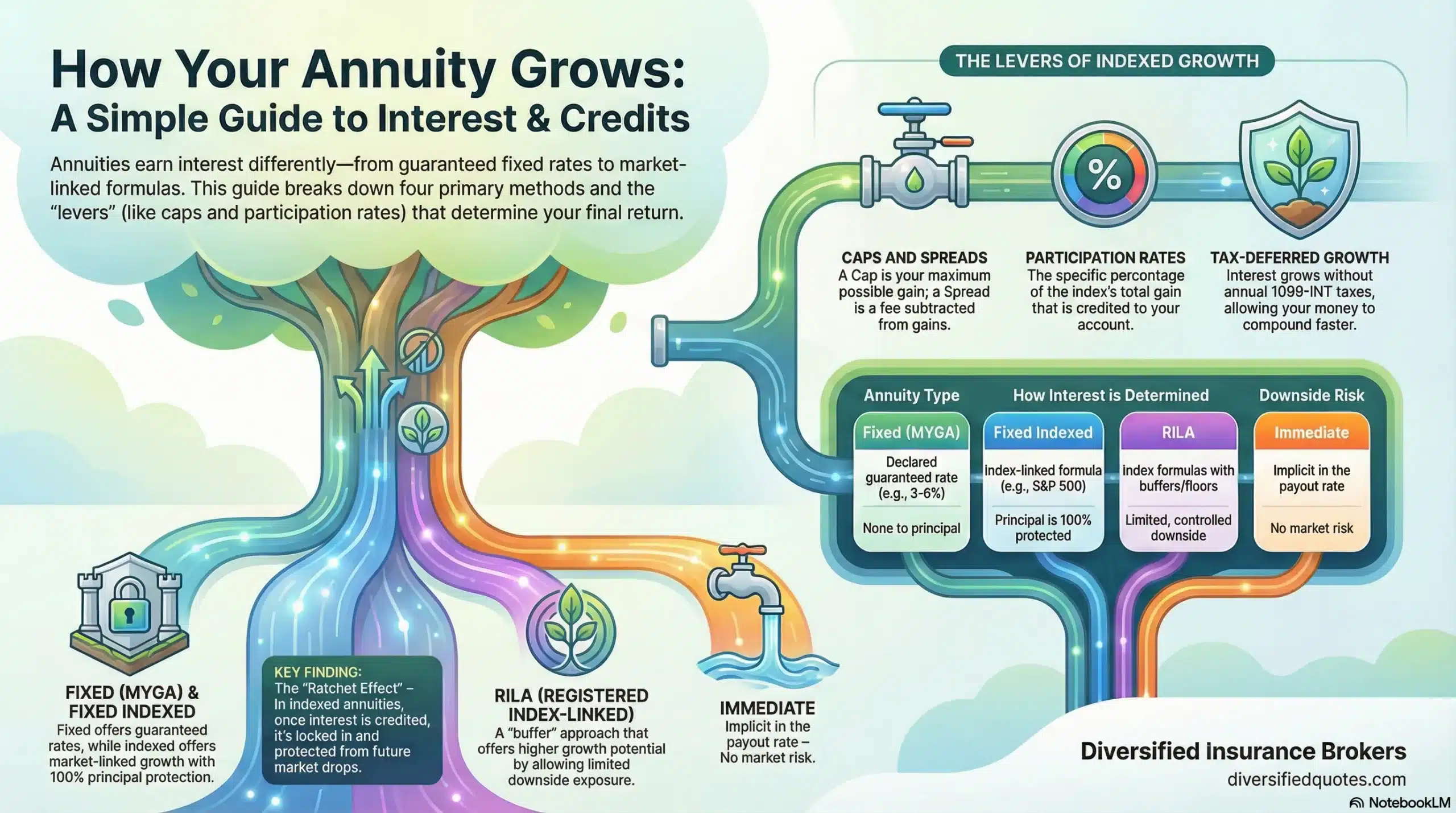
A MYGA locks a declared interest rate for a set term (often 1–10 years). Your premium is not exposed to market losses, and the insurer credits interest according to the guarantee schedule. The growth inside the annuity generally compounds on a tax-deferred basis until you withdraw, which is one reason conservative savers often compare MYGAs to CDs once their deposit sizes and tax situations get larger. If you want a deeper primer, start with how annuities earn interest, then review what a deferred annuity is and the common question of whether annuities have fees. Those three pages usually clear up 90% of the confusion people have when comparing products.
It also helps to understand why rates differ by term. Shorter terms may price closer to current interest-rate expectations and carrier strategy, while longer terms tend to reflect a broader view of the insurer’s portfolio management and its appetite for long-dated liabilities. Even within the same carrier, a 3-year and a 7-year MYGA can look different because the insurer is managing reinvestment risk, liquidity, and reserve requirements differently across durations. This is why many clients prefer “term matching”—aligning the surrender period to the exact window when they do not need the money.
How to Use Guaranteed Rates in a Real Retirement Plan
A guaranteed annuity can play different roles depending on where you are in the retirement timeline. If you’re still accumulating, a MYGA may simply be a “safe growth sleeve” that protects principal while earning a competitive rate. If you’re close to retirement, a ladder (multiple smaller MYGAs with different maturities) can create scheduled liquidity windows so you’re not forced to choose between surrender charges and market risk at the wrong time. If you’re already retired, many people use fixed growth as a stabilization tool—funding predictable expenses while coordinating with Social Security and other income streams (see how Social Security and annuities work together).
Another planning layer is how MYGAs compare to fixed indexed annuities (FIAs). A MYGA is simple: rate locked, predictable accumulation. An FIA is designed for people who want upside linked to an index with downside protection (but crediting terms and caps can change). If you’re deciding between the two, it often helps to read how a fixed indexed annuity works, then compare it to a MYGA based on your goals: “maximum certainty” versus “potentially higher interest with index-linked rules.”
Example of Guaranteed Growth
Here’s how guaranteed compounding can look in practice. If you deposit $250,000 into a 5-year MYGA crediting 6.00% guaranteed, your account could grow to roughly $334,000 at maturity (assuming interest remains in the contract and withdrawals are not taken). That’s the value of simplicity: no market risk, no “performance chasing,” and no surprise losses due to volatility. If you’re comparing interest calculations, it can also help to review simple vs. compound interest on annuities, because different accumulation structures can change the effective outcome over time even when the headline rate looks similar.
Many people also evaluate whether they might want to convert a portion of assets into guaranteed income later. That decision typically happens closer to retirement, but planning ahead matters because the best time to evaluate income options is when you’re not in a rush. If income is part of your longer-term plan, this pairs naturally with learning about GLWB riders and using the income calculator embedded below to estimate what future income could look like.
📊 Highest Guaranteed Annuity Rates (as of April 2026)
The table below is a snapshot-style view of example top rates by term. In real shopping, we refine this further by state availability, premium band (some carriers offer higher rates at certain deposit levels), and whether your funds are qualified (IRA/401k) or non-qualified. When you request quotes, we also compare policy provisions—penalty-free withdrawal terms, any market value adjustment language, and renewal policies—so you’re not selecting a product based on rate alone.
Some of the highest annuity rates are sometimes offered by carriers with B or B+ ratings. However, we also work with many insurance companies rated A-, A, A+, and A++ by AM Best. In many cases the difference in rates between carriers is small, and the most important factor is choosing a company you feel comfortable with. We have access to dozens of carriers and can help you shop the market to find the option that best fits your goals.
| Term | Rate | Provider | Product | AM Best Rating |
|---|---|---|---|---|
| 1 Year | 4.15% | GCU Life | 1+4 Choice | A- |
| 2 Years | 5.25% | Mountain Life | Secure Summit | B |
| 3 Years | 6.00% | Mountain Life | Secure Summit | B |
| 4 Years | 6.05% | Mountain Life | Secure Summit | B |
| 5 Years | 6.30% | American Gulf | Anchor MYGA | B++ |
| 6 Years | 6.30% | American Gulf | Anchor MYGA | B++ |
| 7 Years | 6.30% | American Gulf | Anchor MYGA | B++ |
| 8 Years | 6.00% | Mountain Life | Secure Summit | B |
| 9 Years | 5.50% | Liberty Bankers | Heritage Elite | A- |
| 10 Years | 6.25% | Sentinel Security | Personal Choice | B |
Rates are subject to change and may vary by state, age, and deposit size. Higher premiums may qualify for enhanced rates. Guarantees rely on the insurer’s claims-paying ability.
Annuity Interest Rate Examples by Deposit Size
See how annuity interest and income potential can vary depending on the size of your investment.
How to Read the Rates Table the “Right” Way
Rates are the headline, but the contract features determine whether the rate works for your real-life plan. When comparing two MYGAs in the same term, we look for differences in the penalty-free withdrawal schedule (many allow 10% annually after year one), surrender charge lengths, and whether a market value adjustment (MVA) can apply if you withdraw early. We also look at renewal posture—what happens when the term ends, how renewal rates are declared, and what flexibility you have at maturity to roll into a new term or move to another carrier.
It’s also important to remember that MYGA “best rate” shopping is state-specific. Some carriers are more competitive in certain states due to distribution strategy and regulatory filing differences. That’s why a table is useful for education, but the quote request process is where you get the accurate “in-your-state” ranking for your deposit band. If you’re building a ladder, we can also map different maturity dates so you’re not re-shopping everything in the same year, which can improve flexibility when rates change.
Estimate Lifetime Income Options (Calculator)
Some clients use MYGAs strictly for accumulation and liquidity planning, while others want a path to guaranteed lifetime income later. The calculator below helps you estimate what income options can look like with different ages and deposit sizes. This does not mean you must buy an income rider—many people simply want to understand what “income math” looks like before deciding whether they prefer a pure MYGA or a fixed/indexed annuity with income features.
💡 Note: The calculator accepts premiums up to $2,000,000. If you’re investing more, results increase in direct proportion — for example, doubling your premium roughly doubles the guaranteed income at the same age and options.
Liquidity, Penalties, and “What If I Need the Money?”
Most MYGAs are designed to be held through the surrender period, which is why term selection matters. That said, many contracts include annual penalty-free withdrawals—often around 10% per year—after an initial waiting period. This feature is especially useful for retirees who want predictable interest but still want some emergency access. If you expect you might need substantial liquidity (for example, potential large medical costs, a home purchase, or a major family event), we typically build that into the ladder design rather than forcing the annuity to be something it wasn’t designed to do.
If withdrawals exceed penalty-free provisions, surrender charges can apply, and some contracts may also apply an MVA depending on interest-rate movement. That’s why we talk through time horizon first. If you know the money is earmarked for a near-term purchase, a shorter term may be safer even if the rate is slightly lower. If the money is truly longer-term, locking a strong rate for a longer term can be attractive—especially if you’re comparing the tradeoff between certainty and potential reinvestment risk.
Moving Qualified Funds: Rollovers and IRA Transfers
If your annuity deposit is coming from a qualified account (IRA, 401(k), 403(b), etc.), the “how” matters. In many cases, the cleanest approach is a trustee-to-trustee movement so you’re not creating a taxable event or a withholding headache. For qualified plans, that often looks like a direct rollover. For IRA-to-annuity moves, the process is typically an IRA transfer rather than a distribution, and you can review the mechanics in how to transfer an IRA to an annuity. Structuring the move correctly helps you keep the tax-deferral intact while aligning the annuity’s term to your planning timeline.
If you’re considering a fixed annuity for accumulation but you also want to understand income features for later, it can be helpful to learn the “building blocks” of policy design—especially around income riders and benefit bases—starting with GLWB riders. The goal is not complexity for complexity’s sake. The goal is understanding which tool matches your objective: maximum guaranteed yield, or yield plus a future income pathway.
Beneficiaries, Spousal Continuation, and Legacy Planning
For legacy planning, fixed annuities often provide a straightforward beneficiary structure. If the owner passes away, the remaining account value typically passes to named beneficiaries according to contract terms and applicable rules. If you’re planning for a spouse, some contracts allow continuation provisions that can simplify the transition. To explore how this works, review annuity death benefits and spousal continuation. These considerations matter more than most people think—especially when you’re using annuities as a conservative anchor inside a larger retirement income plan.
MYGA vs Bonus Annuity: When the “Bonus” Is (and Isn’t) Worth It
You’ll also see products advertising premium bonuses. In the right scenario, a bonus annuity can improve early accumulation, but it usually comes with tradeoffs—like longer surrender periods, different renewal crediting, or different liquidity terms. That’s why we treat bonuses as a math problem, not a marketing feature. If you want to understand the tradeoffs, read bonus annuity pros and cons. In many cases, a strong MYGA rate can outperform a bonus product over the intended holding period, but there are situations where a bonus structure can be competitive. The correct answer depends on your timeline and withdrawal expectations.
Get the Highest Guaranteed Annuity Rates
Compare guaranteed contracts side-by-side and match the best rate to your term, liquidity needs, and state availability.
Financial Protection Essentials
Compare annuity term strategies, interest mechanics, income riders, fees, and bonus structures.
Retirement Account & Income Transition Planning
Compare post-retirement rollover, distribution, and income strategy decisions across major retirement account types.
Advanced Planning, Insurance, and Income Strategy Topics
Explore deeper strategy topics including diversification, Medicare timing, income design, and insurance planning fundamentals.
Talk With an Advisor Today
Choose how you’d like to connect—call or message us, then book a time that works for you.
Schedule here:
calendly.com/jason-dibcompanies/diversified-quotes
Licensed in all 50 states • Fiduciary, family-owned since 1980
FAQs: Highest Guaranteed Annuity Rates
What does “guaranteed annuity rate” mean?
It’s the fixed interest rate locked in for a set period—usually 1 to 10 years—on a Multi-Year Guaranteed Annuity (MYGA). Your earnings and principal are guaranteed by the issuing insurer.
How are guaranteed annuity rates determined?
Rates reflect current bond yields, carrier portfolio performance, and term length. Longer terms generally pay higher guaranteed rates.
Are these rates locked for the entire term?
Yes. Once your contract starts, the rate is guaranteed for the full term—your return won’t change regardless of market conditions.
Can I access my money before maturity?
Most contracts allow 10% free withdrawals each year after the first contract year. Larger withdrawals may trigger surrender charges or market value adjustments.
Do guaranteed annuities charge fees?
No ongoing management fees apply. The rate you see is the rate you earn—guaranteed by contract.
Can I hold a guaranteed annuity in an IRA?
Yes. Guaranteed annuities can fund Traditional or Roth IRAs through a tax-free transfer or rollover, maintaining all IRA benefits.
What happens when the term ends?
At maturity, you can renew, roll over into another annuity, or withdraw funds without penalty. Many clients ladder annuities to keep funds accessible over time.
Are annuities safer than market investments?
Fixed annuities are not subject to market losses. They’re backed by the insurer’s claims-paying ability and regulated by state insurance departments.
What’s the minimum investment amount?
Most carriers start around $10,000–$25,000, while premium tiers of $100,000 or more may qualify for slightly higher rates.
Can I use a 1035 exchange to move funds?
Yes, you can perform a tax-free 1035 exchange from an existing annuity to a new one offering a higher guaranteed rate.
About the Author:
Jason Stolz, CLTC, CRPC and Chief Underwriter at Diversified Insurance Brokers (NPN 20471358), is a senior insurance and retirement professional with more than two decades of real-world experience helping individuals, families, and business owners protect their income, assets, and long-term financial stability. As a long-time partner of the nationally licensed independent agency Diversified Insurance Brokers, Jason provides trusted guidance across multiple specialties—including fixed and indexed annuities, long-term care planning, personal and business disability insurance, life insurance solutions, Group Health, and short-term health coverage. Diversified Insurance Brokers maintains active contracts with over 100 highly rated insurance carriers, ensuring clients have access to a broad and competitive marketplace.
His practical, education-first approach has earned recognition in publications such as VoyageATL, highlighting his commitment to financial clarity and client-focused planning. Drawing on deep product knowledge and years of hands-on field experience, Jason helps clients evaluate carriers, compare strategies, and build retirement and protection plans that are both secure and cost-efficient. Visitors who want to explore current annuity rates and compare options across multiple insurers can also use this annuity quote and comparison tool.
