
F&G Flex Accumulator – Market Growth with Principal Protection and Flexible Access
F&G Flex Accumulator – Market Growth with Principal Protection and Flexible Access
At Diversified Insurance Brokers, we specialize in helping individuals secure customized annuity solutions designed for long-term financial stability. The F&G Flex Accumulator Fixed Indexed Annuity, issued by Fidelity & Guaranty Life Insurance Company (AM Best: A Excellent, affirmed March 2025 with stable outlook — upgraded from A- to A in January 2024; Moody’s A3; top-5 FIA market position in the independent agent channel), is designed for individuals who want meaningful market-linked growth opportunities while protecting retirement assets from direct market losses. In today’s volatile environment — where interest rates shift, equity markets fluctuate, and retirement timelines feel increasingly uncertain — many pre-retirees and retirees are looking for a disciplined strategy that allows participation in upside potential without exposing principal to downside risk. That is precisely where a properly structured fixed indexed annuity can play a powerful role within a retirement income plan.

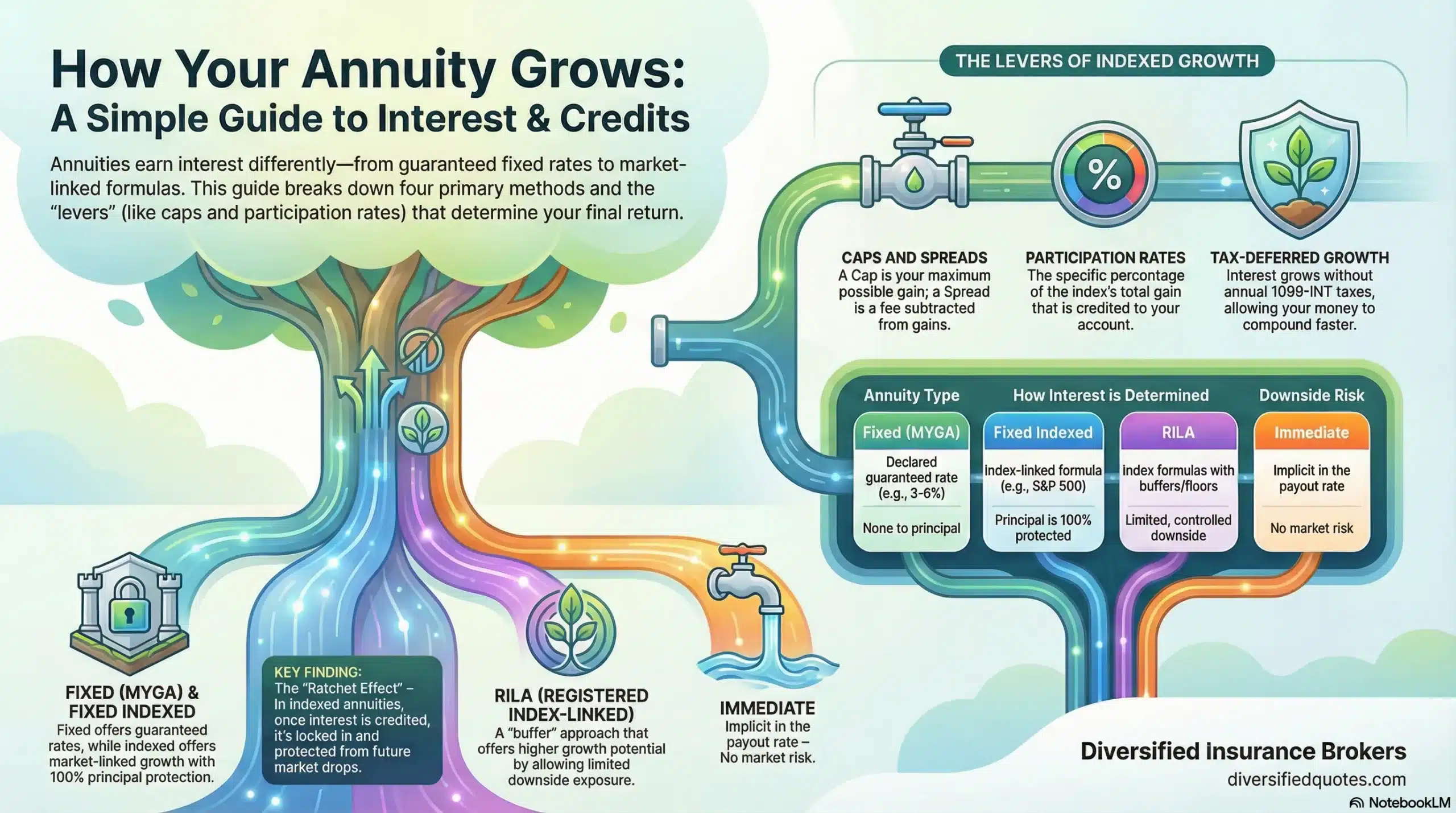
The Flex Accumulator is built for long-term accumulation with flexibility. Unlike traditional fixed annuities that credit a declared rate, or variable annuities that directly invest in subaccounts tied to market performance, this product credits interest based on the performance of external market indexes. However, your money is not directly invested in the market. That distinction is critical. When markets rise, you participate in growth subject to caps, spreads, or participation rates. When markets decline, your credited interest is never negative due to market performance. That zero-floor protection can provide substantial psychological and financial relief for individuals who are within five to ten years of retirement and no longer want to experience large drawdowns. Many clients comparing options will also review current annuity rates to determine whether a fixed indexed strategy or a traditional fixed annuity offers better alignment with their objectives. If your primary goal is guaranteed declared interest with no market linkage, reviewing current fixed annuity rates may make sense. However, if you are willing to accept indexed crediting formulas in exchange for potentially higher long-term accumulation, the Flex Accumulator becomes particularly attractive. For those evaluating products that offer upfront enhancements, comparing current bonus annuity rates alongside this strategy clarifies structural differences between bonus-driven and multiplier-driven designs.
Ensure you are receiving the absolute top rates
Current Fixed Annuity Rates
Compare today’s best fixed annuity rates from top carriers.
Current Bonus Annuity Rates
See which annuities offer the highest upfront bonus today.
Request an Annuity Quote
Submit our annuity request form to get personalized rate options.
Lifetime Income Calculator
Use our calculator to see how much guaranteed income your annuity can provide.
F&G Flex Accumulator vs. the Conservative Growth Landscape
| Dimension | F&G Flex Accumulator FIA | MYGA (Declared Rate Annuity) | Variable Annuity / Market Portfolio |
|---|---|---|---|
| Principal Protection | Full — 0% floor on all indexed accounts. Account value cannot decline due to negative index performance in any crediting period. Annual reset locks in prior gains permanently; future index declines restart from the current level, not the prior peak. | Full — principal and declared interest guaranteed contractually for the full term. No index exposure of any kind. Rate known on day one; the most straightforward protection structure with zero crediting formula complexity. | None — subaccounts are directly market-invested. A 30%–40% drawdown is fully realized. No floor protects account value. A severe loss near retirement may permanently impair withdrawal sustainability even if markets eventually recover. |
| Growth Mechanism | Multiple — S&P 500 strategies with cap rates, proprietary volatility-controlled multi-asset indexes with participation rates, fixed interest strategy. Volatility-managed indexes smooth participation rate stability, reducing cap compression in volatile markets. | Single declared rate — locked for the full guarantee period with no strategy selection. Maximum simplicity; no upside beyond the stated rate regardless of market conditions. Zero variance from the declared rate in any market environment. | Full market participation — no cap on gains, no floor on losses. In bull markets: full upside. In bear markets: full downside. M&E fees, fund expense ratios, and any rider charges reduce net return in all market conditions. |
| Death Benefit | Enhanced — interest multiplier feature may increase the effective interest credited for legacy purposes beyond the standard account value accumulation. Provides a compelling balance between growth during life and enhanced transfer value at death. | Standard — at death, accumulated contract value (principal plus credited interest) passes to beneficiaries. No enhanced multiplier or legacy enhancement feature beyond the accumulated account value at the time of death. | Standard — account value at date of death passes to beneficiaries after M&E charges. Some variable annuities offer enhanced death benefit riders (typically at additional cost) that may floor the death benefit at a minimum amount. |
| Tax Treatment | Full tax deferral — no annual 1099 on credited interest. Full credited rate compounds without annual tax reduction. Gains taxable as ordinary income at distribution on LIFO basis for non-qualified contracts; basis returned tax-free. | Full tax deferral — same compounding advantage as the FIA. Both structures provide identical deferral treatment; the growth mechanism (indexed vs. declared) is the only material difference from a tax standpoint. | Full tax deferral — but M&E charges, fund expense ratios, and rider fees assessed annually reduce effective compound return, partially offsetting the deferral advantage. Taxable in brokerage accounts — annual dividends and realized gains generate 1099s. |
| Carrier Strength | F&G: AM Best A (Excellent), affirmed March 2025, upgraded from A- in January 2024; Moody’s A3. Top-5 FIA market position in the independent agent channel. FNF parent support via capital contributions. Strong risk-adjusted capitalization. | Varies — MYGA marketplace spans B++ through A++ rated carriers. A-rated and A+ rated MYGA alternatives allow buyers to access declared-rate certainty alongside equivalent or stronger carrier financial strength if that combination is preferred. | Typically A or A+ rated major issuers for variable annuities. Carrier strength is less central to the buyer’s protection in variable products because the market risk is borne by the policyholder rather than the carrier’s balance sheet. |
Index Options, Volatility Controls, and the Multiplier Feature
The Flex Accumulator distinguishes itself through diversified index options. Policyholders can allocate among strategies tied to well-known benchmarks and proprietary volatility-controlled indexes. Options typically include the S&P 500 as well as multi-asset and sector-based blends designed to smooth volatility. These volatility-managed indexes attempt to adjust exposure based on market conditions, which can stabilize participation rates and improve long-term crediting consistency. The benefit is structural — not speculative. Rather than attempting to time the market, the product design uses contractual formulas to systematically capture portions of growth. Understanding how FIA crediting methods work across cap strategies, participation rates, and volatility-controlled designs provides the analytical foundation for evaluating which Flex Accumulator strategy allocation produces the most realistic accumulation outcome across bull, flat, and bear market scenarios over the holding period.
The enhanced death benefit structure further strengthens the product’s appeal. Through an interest multiplier feature, beneficiaries may receive a benefit that increases the effective interest credited for legacy purposes beyond the standard account value at death. For clients who are comparing accumulation-focused indexed annuities against pure income riders, this feature offers a compelling balance: growth potential during life and enhanced transfer value at death. If legacy optimization is a meaningful objective, confirming the specific interest multiplier terms and how the enhanced death benefit is calculated in the current product version is an important step in the illustration review process.
Liquidity, Health Waivers, and the 10% Annual Provision
Liquidity is another meaningful advantage of the Flex Accumulator. After the first contract year, you may access up to 10% of your account value annually without surrender charges. Understanding how annuity free withdrawal rules work — and how the 10% is calculated (typically as 10% of the prior-year account value or accumulated value), whether it resets annually, and whether unused withdrawal amounts carry forward to subsequent years — ensures the liquidity expectation is accurately sized before commitment. Nursing home and terminal illness waivers allow qualifying individuals to access funds beyond the standard 10% provision without surrender penalties under specific qualifying conditions. These health waivers are particularly important for retirees proactively planning for healthcare uncertainties — the waiver eliminates the surrender charge that would otherwise apply to amounts exceeding the annual free provision, providing meaningful contingency protection for the most financially disruptive health scenarios. Understanding how annuity surrender charges work across the full surrender schedule — the declining charge percentages by year, what events waive charges, and how partial versus full surrenders are treated — is part of the due diligence conversation before any long-term commitment is made.
Tax Deferral, Sequence-of-Returns Risk, and Portfolio Coordination
Tax deferral further enhances the long-term compounding effect. Earnings inside the Flex Accumulator accumulate without annual taxation, allowing growth to build uninterrupted until withdrawals begin. Over extended periods, eliminating large losses through the 0% floor also eliminates the compounding damage those losses create — avoiding a 30% drawdown means you do not need a 43% recovery gain just to break even. This asymmetric protection can materially influence retirement readiness, especially for conservative investors who prioritize preservation. The combination of tax deferral and downside elimination — two structural advantages that taxable direct market investments cannot replicate simultaneously — makes the Flex Accumulator particularly efficient for mitigating sequence-of-returns risk in the five years before and after retirement, when a severe drawdown combined with ongoing withdrawals can permanently impair portfolio sustainability even if markets subsequently recover.
Although primarily accumulation-focused, the Flex Accumulator also retains the option to annuitize into a guaranteed lifetime income stream in the future. Some clients ultimately transition their growth annuity into income once retirement officially begins. Others prefer to ladder strategies — allocating some assets to accumulation products like this one while placing separate funds into immediate or deferred income structures. If guaranteed lifetime income is the primary objective today, reviewing the best income annuities for retirement may help clarify whether a rider-based approach or immediate annuity would better match the specific retirement timeline and income need. For individuals rolling over qualified assets — such as traditional IRAs or former 401(k) plans — the Flex Accumulator can provide a tax-deferred repositioning strategy that reduces exposure to market volatility while maintaining growth opportunity. Our educational resource on 401(k) to IRA annuity rollovers provides structural insight on the mechanics, tax treatment, and planning considerations before making allocation decisions from a qualified plan.
Before selecting the Flex Accumulator — or any annuity — it is wise to compare contract terms, surrender schedules, cap structures, and participation rates. Rates change periodically based on market conditions and carrier hedging costs. That is why we encourage prospective clients to verify live illustrations before committing funds. At Diversified Insurance Brokers, we provide transparent comparisons, personalized illustrations, and contract-level clarity. Our objective is long-term alignment — ensuring the product you choose remains suitable not just today, but throughout retirement. We evaluate rate competitiveness, index allocation flexibility, surrender structure, and optional features to ensure full transparency.
Looking for indexed growth with downside protection?
Request Your Custom Annuity Quote
Related Pages
Explore additional retirement and annuity planning resources.
Financial Protection Essentials
Explore disability income protection, life insurance policy rules, annuity structures, and the benefits of working with independent insurance brokers.
Talk to an Advisor or Request Your Annuity Quote
Ready to explore this annuity in more detail—or compare it with other carriers to see if even higher rates are available? With guaranteed income, principal protection, and long-term growth potential on the line, making the right choice is essential. The experienced advisors at Diversified Insurance Brokers will guide you through the options and design a strategy tailored to your retirement goals.
Schedule here:
calendly.com/jason-dibcompanies/diversified-quotes
Licensed in all 50 states • Fiduciary, family-owned since 1980
How do the volatility-controlled indexes in the Flex Accumulator differ from the S&P 500 strategy?
The Flex Accumulator’s volatility-controlled proprietary index strategies differ from the S&P 500 strategy in their underlying construction and the crediting parameter they use. The S&P 500 strategy is straightforward: it links credited interest to S&P 500 performance over the crediting period, subject to a cap rate that limits the maximum credit in any given year. In strong bull markets, the S&P 500 cap strategy may credit more than what a volatility-controlled index produces; in volatile or sideways markets, the reverse may be true. Volatility-controlled proprietary indexes are built to limit the internal measured volatility of the index itself through dynamic rebalancing — typically by shifting allocations between equity components, fixed income components, and cash-like instruments based on real-time measured volatility. When market volatility spikes, the index reduces equity exposure to maintain its target volatility level; when volatility is low, equity exposure may increase. The result is an index that produces smoother return trajectories than a pure equity benchmark — avoiding the sharp drawdowns and recoveries of direct equity exposure. The key crediting difference: volatility-controlled indexes typically use participation rates rather than caps. A participation rate credits a defined percentage of the index gain without an upper ceiling, which means there is no hard cap on the credited amount — only a percentage reduction of the total gain. In high-volatility bull market years where the S&P 500 posts large gains, the cap-based S&P 500 strategy may outperform the participation-rate volatility-controlled strategy. In years with moderate, smooth gains, the participation-rate strategy may produce competitive credits without the ceiling limitation. Understanding how each FIA crediting mechanism performs across different market environments — specifically how cap-based strategies compare to participation-rate strategies across bull, sideways, and volatile upward markets — is the essential analytical framework for allocating between these two strategy types within the Flex Accumulator. Our advisory process illustrates both strategies across multiple market scenarios before any allocation decision is recommended.
How does the Flex Accumulator’s interest multiplier death benefit work — and is it valuable?
The interest multiplier feature in the Flex Accumulator’s enhanced death benefit is a contractual provision that increases the effective credited interest rate used to calculate the death benefit paid to beneficiaries beyond what was credited to the accumulation account value during the contract period. The practical mechanism: the multiplier takes the actual credited interest over the contract period and applies an enhancement percentage — for example, if $100,000 was credited as indexed interest over the life of the contract, the multiplier might calculate the death benefit as if $115,000 or $120,000 had been credited (the exact multiplier percentage is defined in the contract and should be confirmed in a current product illustration). The result is a death benefit to beneficiaries that may be meaningfully higher than the account value alone, without requiring the policyholder to purchase a separate life insurance policy or pay explicit life insurance premium costs. The value of this feature is most apparent for buyers with legacy objectives who want the accumulation protection and growth potential of the FIA during their lifetime while providing an enhanced transfer at death. The interest multiplier feature creates a structural advantage in a side-by-side comparison against a standard FIA (which pays only the accumulated account value at death) or a MYGA (which similarly pays only the accumulated declared-rate value). For buyers whose primary objective is legacy transfer rather than lifetime income generation, understanding how the annuity’s credited interest interacts with the multiplier over the accumulation period — specifically whether the multiplier applies to all credited interest across all contract years or only to certain crediting periods — is essential before making the multiplier feature a deciding factor in the product selection.
How does the Flex Accumulator compare to simply putting the same funds in a short-term MYGA and then rolling over?
The MYGA rolling strategy — purchasing a series of shorter-term declared-rate annuities and reinvesting at each maturity — is a common alternative framework for conservative accumulation buyers who want simplicity and rate flexibility. The comparison between this rolling MYGA approach and the Flex Accumulator over an equivalent holding period requires evaluating four dimensions. First, rate competitiveness: in the current interest rate environment, a 5-year MYGA from an A-rated carrier may declare a rate that competes with the Flex Accumulator’s realistic credited interest expectations across moderate market scenarios. If the MYGA declared rate is meaningfully higher, the rolling MYGA may produce better accumulation in a flat or declining market environment where the Flex Accumulator credits near zero. Second, upside potential: in a sustained bull market where the S&P 500 delivers above-cap returns in multiple consecutive years, the Flex Accumulator’s indexed strategies can produce significantly higher accumulated value than the MYGA’s fixed declared rate. Third, surrender flexibility: a rolling MYGA strategy (5 + 5 = 10 years) provides a 5-year reassessment window at the first maturity, allowing repositioning into stronger products if the market or rate environment has improved — while the Flex Accumulator commits to its full surrender period without a mid-term repositioning option. Fourth, death benefit: the Flex Accumulator’s interest multiplier provides an enhanced legacy benefit that the MYGA does not. Exploring 8-year fixed annuity rates and 10-year fixed annuity rates in the current marketplace provides the declared-rate benchmarks needed to ground this comparison with actual numbers rather than theoretical scenarios — which is how we structure the side-by-side evaluation before any recommendation is made.
How should I think about the Flex Accumulator within a layered retirement income strategy?
The Flex Accumulator is most effectively positioned as the growth and protection layer within a layered retirement income architecture — not as the sole retirement vehicle. The “layering” framework assigns different retirement asset pools specific roles: Social Security and any pension income form the guaranteed income foundation; the Flex Accumulator and similar accumulation FIAs serve as the protected growth layer during the pre-retirement accumulation window; and income-specific vehicles (immediate annuities, income riders, or deferred income annuities) handle the guaranteed income conversion at the retirement boundary. Within this framework, the Flex Accumulator’s 0% floor and indexed growth potential allow it to serve as the accumulation vehicle that builds the value which is later converted to income — either through annuitization at maturity or by rolling the accumulated value into an income-focused product. The best retirement income annuities at that future conversion point may come from the same carrier or from a competitor depending on who offers the best income terms when the buyer is ready to activate income — which is why accumulation-first positioning in the Flex Accumulator preserves the option to select the most competitive income structure at the actual conversion date rather than committing to a specific income structure years in advance. A laddering approach — allocating the Flex Accumulator as one segment of a broader conservative allocation with staggered maturity dates — creates rolling access points to evaluate the full marketplace at each maturity interval while maintaining protected growth across the full allocation during the accumulation phase.
What is F&G’s AM Best A rating history and how did the 2024 upgrade happen?
Fidelity & Guaranty Life Insurance Company’s AM Best upgrade from A- (Excellent) to A (Excellent) in January 2024 — affirmed March 2025 with stable outlook — is the result of a multi-year improvement trajectory that AM Best characterized as reflecting FGL’s expanded business profile, stronger operating performance, and continued capital contributions from its ultimate parent Fidelity National Financial (FNF). The January 2024 upgrade language from AM Best specifically cited FGL’s proven track record, balance sheet strength, financial transparency, and commitment to achieving higher ratings over time. F&G went public as an independent company (FG Annuities & Life, Inc.) with continued FNF majority ownership, and the institutional capital support from FNF has been a material factor in AM Best’s assessment of the group’s financial strength. The March 2025 affirmation maintained the A (Excellent) rating with stable outlook, confirming that the factors supporting the 2024 upgrade have remained intact. For the Flex Accumulator buyer, the upgrade from A- to A means the contractual guarantees in the product — the 0% floor, the indexed crediting mechanism, the interest multiplier death benefit, and the health waivers — are backed by a carrier that has recently demonstrated an improving financial trajectory recognized by AM Best. Understanding how the annuity’s guaranteed components are taxed at distribution — and how the carrier’s financial strength affects the long-term reliability of those guarantees — provides the full evaluation context for the Flex Accumulator as a multi-decade commitment of retirement capital. F&G also holds Moody’s A3 rating, which places it in the third-highest Moody’s rating category and is consistent with the AM Best A position. The combination of AM Best A and Moody’s A3 provides multi-agency validation of the carrier’s financial stability that buyers can use in carrier comparisons.
About the Author:
Jason Stolz, CLTC, CRPC, DIA, CAA and Chief Underwriter at Diversified Insurance Brokers (NPN 20471358), is a senior insurance and retirement professional with more than 25 years of real-world experience helping individuals, families, and business owners protect their income, assets, and long-term financial stability. As a long-time partner of the nationally licensed independent agency Diversified Insurance Brokers, Jason provides trusted guidance across multiple specialties—including fixed and indexed annuities, long-term care planning, personal and business disability insurance, life insurance solutions, Group Health, Travel Medical and Evacuation Insurance, and short-term health coverage. Diversified Insurance Brokers maintains active contracts with over 100 highly rated insurance carriers, ensuring clients have access to a broad and competitive marketplace.
His practical, education-first approach has earned recognition in publications such as VoyageATL, and contributions from his agency featured in Kiplinger and GoBankingRates— highlighting his commitment to financial clarity and client-focused planning. Drawing on deep product knowledge and years of hands-on field experience, Jason helps clients evaluate carriers, compare strategies, and build retirement and protection plans that are both secure and cost-efficient. Visitors who want to explore current annuity rates and compare options across multiple insurers can also use this annuity quote and comparison tool.
Browse More Resources: Return to our complete Fixed Indexed Annuity Products & Education guide — covering FIA products and education from top carriers.
Last Reviewed: June 26, 2026 |
Reviewed by: Jason Stolz, CLTC, CRPC, DIA, CAA
Chief Underwriter, Diversified Insurance Brokers, Inc. | NPN: 20471358 | Diversified Insurance Brokers, Inc. — Licensed in all 50 states
Fact Checked by: Tonia Pettitt, CMIP©
Medicare Specialist, Diversified Insurance Brokers, Inc. | NPN: 14374308 | Diversified Insurance Brokers, Inc. — Licensed in all 50 states
Did you find this content helpful? Leave us a Google review — it helps others find trustworthy guidance too.
Editorial Standards: Diversified Insurance Brokers maintains rigorous editorial standards to ensure accuracy, clarity, and independence in all content. Learn more about our editorial standards and commitment to transparency.
