
How Multi-Year Guaranteed Annuities (MYGAs) Compare to CDs
As an Independent Annuity Broker, we compare rates across 100+ carriers and 1,000 different annuities— not just one company’s product offerings — to find the best fit for your goals.
How Multi-Year Guaranteed Annuities (MYGAs) Compare to CDs
Multi-year guaranteed annuities and bank certificates of deposit occupy the same corner of the financial landscape — both offer principal protection, both pay a fixed rate for a defined term, and both appeal to savers who want stability over market participation. When a conservative saver is evaluating where to place a meaningful sum for three, five, or seven years, a MYGA and a CD will often appear side by side as candidates. On the surface, the comparison looks almost trivial. Both are guaranteed. Both produce a rate that is known at the time of commitment. Both protect the deposited principal from market losses. The meaningful differences between the two products are not visible in the headline rate — they are embedded in how interest is taxed during the holding period, what options are available at the end of the term, how early access is structured, and what protection framework backs each product. Our dedicated resource on fixed annuities vs. CDs covers the broader category comparison, and our resource on can I transfer my CD into an annuity covers the mechanical steps for anyone evaluating a move at CD maturity.

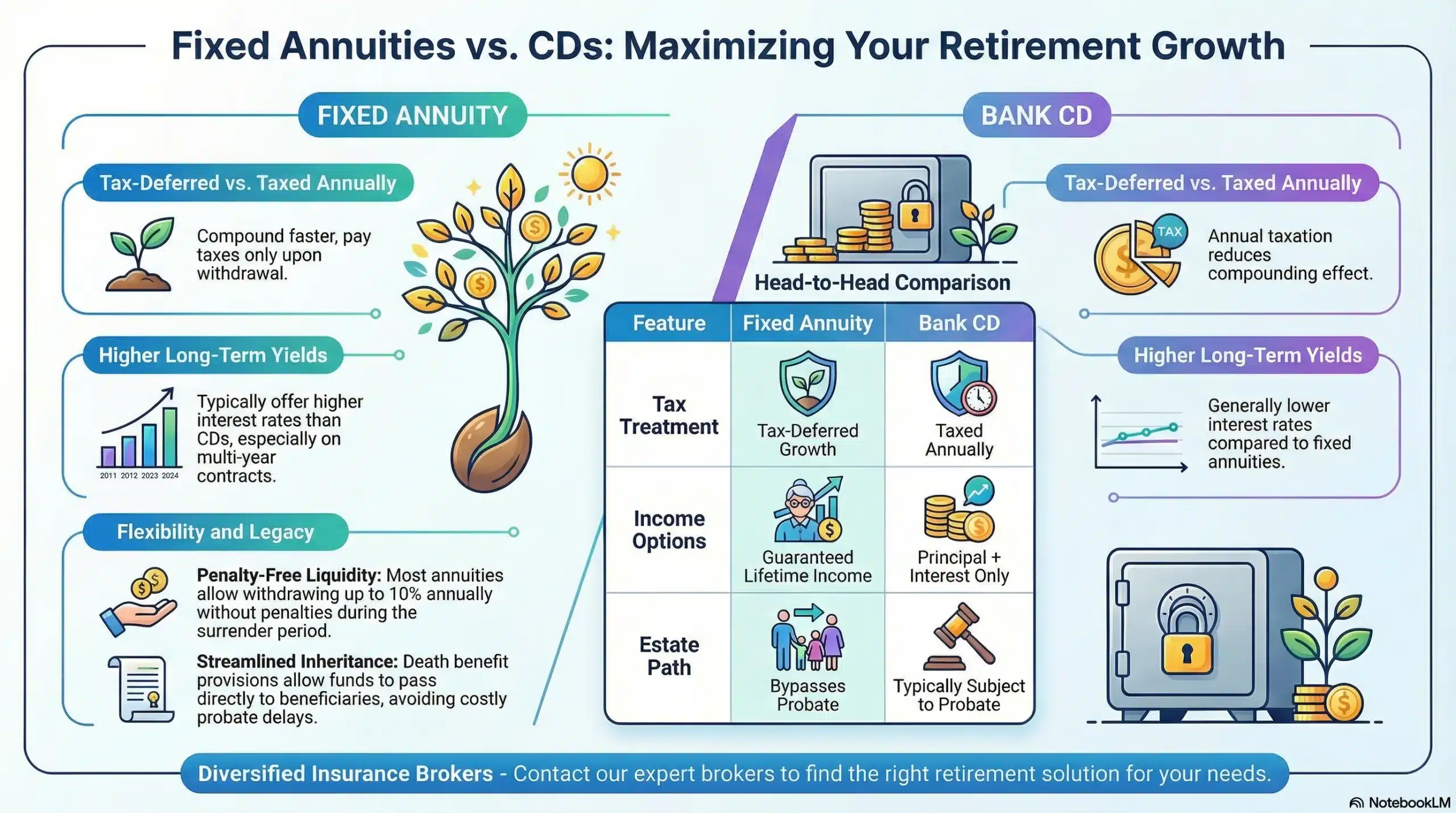
The structural differences between a MYGA and a CD compound in significance over the holding period. In a non-qualified bank CD, interest is taxable in the year it accrues — the bank reports it on a 1099-INT and the saver pays ordinary income tax on it annually, whether or not they ever touch the CD. In a non-qualified MYGA, interest accrues inside the contract on a tax-deferred basis — no tax is owed in the year of accrual, only in the year of withdrawal. That difference, maintained across a multi-year holding period, allows a MYGA to compound on a larger base than the same-rate CD because the portion of interest that would have been paid in taxes each year remains in the account continuing to grow. This is not a marginal effect for savers in middle-to-higher income brackets over multi-year periods — it is a meaningful return enhancement that makes a direct rate-to-rate comparison between a MYGA and a CD incomplete. Our resource on non-qualified annuity taxation covers the full tax treatment of non-qualified annuity withdrawals, and our resource on how annuities are taxed covers the framework.
Beyond taxation, MYGAs historically offer higher yields than comparable bank CDs for similar terms — a structural pattern driven by the different business models of banks and insurance carriers. Banks must manage shorter-duration liquidity requirements tied to lending operations; insurance carriers managing long-duration liabilities can commit to longer guaranteed periods more aggressively. The rate premium, combined with the tax deferral advantage, creates a compounding benefit gap over multi-year holding periods that is consistently favorable to the MYGA for non-qualified money held in a non-spending mode. Our resource on best MYGA annuity rates tracks current competitive rates for comparison against bank CD offers. Our resource on understanding multi-year guaranteed annuities covers the full MYGA product structure for savers who are encountering the product for the first time.
Ensure you are receiving the absolute top rates
Current Fixed Annuity Rates
Compare today’s best fixed annuity rates from top carriers.
Current Bonus Annuity Rates
See which annuities offer the highest upfront bonus today.
Request an Annuity Quote
Submit our annuity request form to get personalized rate options.
Lifetime Income Calculator
Use our calculator to see how much guaranteed income your MYGA proceeds can generate.
MYGA vs. CD — Complete Structural Comparison
The table below examines the full comparison across the dimensions that actually determine long-term outcomes. A direct rate comparison captures only one of the eleven factors that distinguish these products.
| Feature | Bank CD | Multi-Year Guaranteed Annuity (MYGA) |
|---|---|---|
| Principal protection | Yes — full principal guaranteed by issuing bank | Yes — full principal guaranteed by issuing insurance carrier for the term |
| Interest rate structure | Fixed for the term; set by the bank based on the Fed Funds Rate and competitive market conditions; historically lower than comparable MYGA rates for equivalent terms | Fixed for the full term — locked at contract issue regardless of subsequent rate changes; historically runs 1-2+ percentage points above comparable bank CD rates for equivalent terms |
| Tax treatment (non-qualified) | Interest reported on Form 1099-INT and taxed as ordinary income annually — even if left in the CD to compound; reduces the effective compounding base each year | Interest accrues tax-deferred — no annual taxation; taxes owed only in the year of distribution; the entire balance including interest that would have been taxed continues to compound |
| FDIC / insurance protection | FDIC insured up to $250,000 per depositor per ownership category per FDIC institution — federal government-backed | Not FDIC insured — protected by state guaranty associations (typically $100,000–$500,000 per annuitant per insolvent carrier, varying by state) and carrier financial strength (AM Best rating) |
| Early withdrawal terms | Penalty typically equals 90–180 days of interest; modest relative to MYGA; principal is always accessible | Surrender charges typically 7–9% in year one, declining annually to zero; 10% annual free withdrawal provision avoids surrender charges on partial access; more significant than CD penalties for full surrender |
| Typical term range | 3 months to 5 years most common; some banks offer up to 10 years | 2 to 10 years; 3- and 5-year terms most common; some carriers offer 1-year or 12+ year contracts |
| At-maturity options | Withdraw as cash (bank auto-renews within 7–14 day grace period if no action taken); renew at prevailing rate | Withdraw as cash; renew in the same product; perform a tax-free Section 1035 exchange to a different annuity; annuitize for guaranteed lifetime income; 30–60 day renewal notice from carrier |
| Annual fees | None — bank earns through spread between deposit rate and lending rate | None on basic MYGA accumulation — no management fee, no M&E charge; carrier earns through spread management; fees apply only if optional riders are added |
| IRA / qualified account compatibility | Yes — IRA CDs are common; tax deferral provided by the IRA wrapper (not the CD itself); withdrawals subject to standard IRA rules | Yes — IRA MYGAs are direct replacements for IRA CDs; rate lock and principal protection still apply; tax deferral provided by the IRA wrapper (the MYGA’s own deferral is redundant inside a qualified account) |
| Income conversion option | None — a CD cannot be annuitized; income must be drawn through periodic withdrawals managed by the depositor | Yes — MYGA can be annuitized at maturity to generate a guaranteed lifetime income stream; income rider can be added to some products for withdrawal-based guaranteed income |
| Estate / beneficiary treatment | Passes as a cash asset through the estate unless set up with a Payable On Death (POD) designation; no probate bypass by default | Passes directly to named beneficiaries without probate; beneficiary options may include continued tax deferral in certain inheritance structures; see our resource on annuity beneficiary death benefits |
Rate differentials between MYGAs and CDs reflect general structural patterns and vary by carrier, market conditions, term, and deposit amount. FDIC and guaranty association limits are subject to change; verify current limits before making large deposit decisions. Tax treatment above assumes non-qualified (non-IRA) accounts. MYGA rates and CD rates fluctuate continuously — use our rates pages for current comparisons.
The Tax Deferral Advantage — How Compounding Without Annual Tax Drag Compounds Over Time
The most consistently underestimated advantage of a non-qualified MYGA over a non-qualified bank CD is the tax deferral effect on compounding. The mechanism is straightforward but powerful: a CD saver who earns interest and pays annual income tax on it is compounding only the after-tax remainder each year. A MYGA saver who earns the same interest and pays no tax until withdrawal is compounding the full pre-tax balance each year. Over multi-year holding periods, this difference produces materially different ending balances even at identical stated interest rates — and MYGAs typically offer higher stated rates than CDs to begin with. The effect intensifies at higher tax brackets and over longer terms. A saver in a 24% federal bracket holding a five-year CD pays roughly 24 cents of every dollar of interest to taxes annually, reducing the compounding base by that amount each year. The MYGA holder retains the full dollar of interest in the contract accumulating on the larger base throughout. Our resource on non-qualified annuity taxation covers how the deferred tax is eventually collected at withdrawal, and our resource on annuity exclusion ratio covers how cost basis is recovered in non-qualified distributions. The after-tax compounding advantage is one of the primary reasons insurance carriers can offer competitive rates — the tax efficiency embedded in the MYGA structure adds return to the saver without adding risk to the carrier.
Rate Structure — Why MYGAs Historically Offer Higher Yields Than Comparable CDs
The rate advantage MYGAs carry over comparable bank CDs is not coincidental — it is structural. Banks are deposit-taking institutions that must maintain high liquidity to fund lending operations and satisfy regulatory capital requirements. That liquidity constraint limits how aggressively they can commit to long-term rates on deposit products. Insurance carriers issuing MYGAs operate on a different liability model: they are managing long-duration insurance obligations and can invest more aggressively in longer-dated fixed income instruments that carry higher yields. The spread between MYGA rates and CD rates on equivalent terms is a direct reflection of this structural difference in how each institution manages its balance sheet. For savers, the practical result is that historically, equivalent-term MYGAs have offered meaningfully higher guaranteed yields than bank CDs without the saver taking on additional market risk. Our resource on best MYGA annuity rates provides current competitive rates, and our resource on best short-term MYGA annuities covers shorter-term options for savers seeking the MYGA rate advantage without committing to a long surrender period. Our resource on when fixed annuities outperform market-based investments covers the broader rate-environment context.
Reinvestment Risk — The Hidden Cost of Rolling Short-Term CDs
Reinvestment risk is the risk that when a fixed-rate instrument matures, the proceeds must be reinvested at whatever interest rate prevails at that moment — which may be lower than the rate originally earned. For short-term CD holders who roll 12-month or 24-month CDs repeatedly, reinvestment risk is a structural feature of the strategy: each renewal is an exposure to the prevailing rate environment regardless of what the holder earned before. In a declining-rate environment, repeated short-term CD rollovers gradually ratchet down the average yield earned across the portfolio over time. A MYGA eliminates reinvestment risk for the duration of the guarantee period — the rate is locked at the time of issuance and cannot be reduced by subsequent rate changes during the term. For a saver who believes that rates may decline from current elevated levels before their holding period ends, locking a multi-year MYGA rate provides protection against that scenario. For a saver uncertain about rate direction, a laddered approach — multiple MYGAs of different terms — provides a blend of rate lock and periodic reinvestment opportunity. Our resources on laddering annuities and the power of laddering fixed annuities cover the laddering strategy specifically, and our resource on are annuities a smart move when interest rates are high covers the rate-environment timing considerations in detail.
FDIC vs. State Guaranty — Understanding How Each Product Is Protected
The safety framework comparison between CDs and MYGAs is nuanced. CDs at FDIC-insured institutions carry a federal government-backed guarantee up to $250,000 per depositor per ownership category per institution. This is a government guarantee with no qualifying conditions on the carrier’s financial health — it is a full backstop. MYGAs are backed by the financial strength of the issuing insurance carrier and, in the event of insolvency, by the state guaranty association system. Every state maintains a life and health insurance guaranty association that covers annuity values up to applicable limits — commonly ranging from $100,000 to $500,000 per annuitant per insolvent carrier, varying by state. The FDIC protection framework is technically stronger for amounts at or below the $250,000 limit because it is a direct federal guarantee. For balances above $250,000, both strategies require distribution across multiple institutions or carriers to stay within applicable coverage limits. Our resources on are annuities FDIC insured, are annuities guaranteed, and state guaranty association cover the MYGA protection framework in detail. Carrier financial strength ratings — AM Best A- or better is the standard benchmark — are the primary due diligence filter for MYGA buyers, and our resource on safe fixed annuity options and what is the safest type of annuity cover the carrier selection framework.
Liquidity — Where Each Product’s Access Rules Apply
CD liquidity during the term is simple: any withdrawal from a CD before maturity triggers the bank’s early withdrawal penalty, which typically amounts to 90-180 days of interest forfeited. The penalty is applied to whatever amount is withdrawn, and the principal itself is not at risk — only a portion of the earned interest is forfeited. MYGA liquidity is more structured: most contracts include a free withdrawal provision that allows access to approximately 10% of the account value annually without triggering surrender charges. Beyond that allowance, surrender charges apply — starting typically at 7-9% in year one and declining each year until they reach zero at the end of the surrender period. The net effect is that a CD holder who needs full access to the entire balance at any point before maturity faces a modest penalty. A MYGA holder who needs full access beyond the free withdrawal allowance during the surrender period faces a more significant charge. The practical planning guidance is consistent for both products: only commit funds that you genuinely do not need for the duration of the term. The free withdrawal provision of a MYGA provides meaningful partial access throughout — but full surrender during the surrender period carries a real cost. Our resource on annuity free withdrawal rules covers the provision mechanics, and our resource on annuity surrender charges explained covers the surrender schedule structure.
At-Maturity Options — Where MYGAs Provide Strategic Advantages
The at-maturity comparison is where a MYGA creates planning value that a CD cannot replicate. When a bank CD matures, the holder has two real options: withdraw the cash or renew into another CD at the bank’s current offered rate. The bank typically sends a notice 30 days or so before maturity and auto-renews within a short grace window if no action is taken. When a MYGA matures, the holder receives a 30-60 day notice and can choose among multiple options. The first is simple withdrawal — take the accumulated value as cash and pay taxes on the gain in the year of receipt. The second is renewal — the carrier typically offers a new term at prevailing rates. The third is a tax-free Section 1035 exchange — the MYGA proceeds are transferred directly to a new annuity contract at whatever carrier is offering the most competitive rates at that time, without triggering a taxable event. The fourth is annuitization — converting the accumulated value into a guaranteed stream of lifetime income payments, which a CD simply cannot do. The 1035 exchange option is particularly powerful for long-term savers: it means the tax deferral established at first purchase can continue indefinitely across multiple MYGA terms without ever triggering a taxable event, as long as the proceeds are exchanged rather than withdrawn. Our resource on how to transfer a CD into an annuity covers the practical mechanics of the move, and our resource on guaranteed income from annuities covers the annuitization pathway available at MYGA maturity.
MYGAs Inside IRAs — The Rate Lock Advantage When Tax Deferral Is Already Provided
When a CD or MYGA is held inside an IRA, the tax deferral comparison largely disappears — the IRA wrapper provides tax deferral regardless of whether the underlying holding is a CD or a MYGA. An IRA CD and an IRA MYGA both grow without annual taxation because the IRA already provides that benefit. The MYGA advantages that remain inside a qualified account are the rate lock, the principal protection, and the at-maturity options. An IRA MYGA locks the rate for the full contract term at the rate available on the issuance date — providing certainty about accumulation that an IRA CD ladder cannot guarantee beyond each individual CD’s term. For IRA holders approaching required minimum distribution age, the predictable maturity value of a MYGA simplifies RMD planning — the account value at any future date is precisely known. And at maturity, the IRA MYGA can be 1035-exchanged to a new IRA annuity at whatever carrier offers the best rate at that time, extending the rate management advantage. Our resource on how to transfer an IRA to an annuity covers the IRA-to-MYGA transfer mechanics, and our resource on best annuities for 401k rollover covers qualified account rollovers into MYGA-type products. Our resource on how to transfer a retirement account to an annuity covers the general qualified account transfer framework.
When a CD Is the Better Choice
A MYGA is not the right choice for every saver or every dollar. There are specific situations where a bank CD is genuinely the more appropriate option. When the FDIC’s $250,000 guarantee is the highest priority and the amount is within that limit, the federal backing of the CD is technically stronger than the state guaranty association backing of the MYGA. When access to the full balance within 1-2 years is a realistic possibility, a CD’s modest early withdrawal penalty is far less punitive than a MYGA’s surrender charge structure. When the amount is very small and the tax deferral effect on compounding would be negligible, the simplicity of a CD renewal may outweigh the MYGA’s structural advantages. When the holding period needed is shorter than 2 years — most MYGAs have minimum terms of 2-3 years — a CD’s shorter-term offerings may better fit the timeline. The decision between a MYGA and a CD is not a binary “one is always better” judgment — it is a function of the specific saver’s liquidity needs, tax situation, balance size, and time horizon. Our resource on annuities for conservative investors and our resource on best fixed annuities for conservative investors cover the full product selection framework for the conservative saver segment, and our resource on get a 2nd opinion on your annuity quote covers the review process for validating any specific product recommendation against the full market.
Talk With an Advisor Today
Choose how you’d like to connect—call or message us, then book a time that works for you.
Schedule here:
calendly.com/jason-dibcompanies/diversified-quotes
Licensed in all 50 states • Fiduciary, family-owned since 1980
FAQs: How MYGAs Compare to CDs
Are MYGAs safer than CDs?
Both protect principal, but through different mechanisms. CDs are FDIC insured up to $250,000 per depositor per ownership category per FDIC institution — a direct federal government guarantee. MYGAs are backed by the financial strength of the issuing insurance carrier and by state guaranty associations (typically $100,000–$500,000 per annuitant per insolvent carrier, varying by state). The FDIC guarantee is technically stronger for amounts within the $250,000 limit because it is a government backstop rather than a carrier-specific financial strength commitment. For balances above $250,000, both strategies require distribution across multiple institutions or carriers to stay within applicable coverage limits. An AM Best A-rated MYGA carrier with a decades-long track record provides strong practical safety, but the FDIC protection framework and the insurance company protection framework are structurally different.
Why do MYGAs generally pay higher rates than CDs?
Banks issuing CDs must maintain high liquidity to fund lending operations and satisfy regulatory capital requirements, which constrains how aggressively they can commit to long-term deposit rates. Insurance carriers issuing MYGAs manage long-duration liabilities and can invest in longer-dated fixed income instruments carrying higher yields. This structural difference in balance sheet management produces higher guaranteed rates at the MYGA carrier level compared to what banks can offer on CDs for equivalent terms. The rate premium, combined with the tax deferral advantage of non-qualified MYGA accumulation, creates a compounding return advantage that is consistently favorable to the MYGA for non-qualified money held in a non-spending mode.
How does tax deferral make a MYGA grow faster than a CD at the same rate?
In a non-qualified bank CD, interest is taxed as ordinary income in the year it accrues — even if you never touch the money. Each year’s tax payment reduces the base that earns interest the following year. In a non-qualified MYGA, interest accrues without any tax until you withdraw — the entire balance including interest that would have been paid in taxes continues to compound at the full rate. Over a five-year holding period for a saver in the 22-24% tax bracket, this deferral effect produces a meaningfully larger ending balance than the same-rate CD — without any additional risk. The effect is proportional to the tax bracket and the holding period: higher tax bracket and longer holding period both increase the compounding advantage.
Can I access my money in a MYGA before the term ends?
Yes, with limits. Most MYGA contracts include a free withdrawal provision that allows access to approximately 10% of the account value annually without triggering surrender charges. Beyond that allowance, surrender charges apply — typically 7–9% in year one, declining each year until they reach zero at the end of the surrender period. CD early withdrawal penalties (typically 90–180 days of interest) are less punitive than MYGA surrender charges for full early surrender. If there is any meaningful probability that you will need more than 10% of the balance in a given year during the surrender period, the funds should remain in a CD or other liquid vehicle rather than a MYGA.
What are my options when a MYGA matures compared to when a CD matures?
When a CD matures, your practical options are: withdraw the cash or renew at the bank’s current offered rate (the bank auto-renews within a short grace period if no action is taken). When a MYGA matures, you receive a 30–60 day notice and can: withdraw as cash (paying tax on gains in the year received); renew at the carrier’s current rate; perform a Section 1035 exchange to a new annuity contract at any carrier — tax-free, allowing continued deferral; or annuitize the accumulated value into a guaranteed lifetime income stream. The 1035 exchange option is particularly powerful — it allows the tax deferral to continue indefinitely across multiple MYGA terms, and lets you shop for the best rate at each maturity without triggering a taxable event. A CD has no equivalent mechanism.
Does it make sense to hold a MYGA inside an IRA?
Yes — though the tax deferral advantage the MYGA provides over a CD largely disappears inside a qualified IRA account, because the IRA wrapper already provides tax deferral regardless of what’s held inside it. An IRA MYGA and an IRA CD both grow without annual taxation. The remaining advantages of an IRA MYGA are: historically higher guaranteed rate locked for the full term; principal protection with predictable maturity value that simplifies RMD planning; a 1035 exchange option at maturity that allows tax-free rollover to a new annuity at the best available rate; and the eventual option to annuitize for guaranteed lifetime income. Rates for IRA MYGAs are identical to non-qualified MYGA rates — there is no premium or discount for qualified money.
About the Author:
Jason Stolz, CLTC, CRPC, DIA, CAA and Chief Underwriter at Diversified Insurance Brokers (NPN 20471358), is a senior insurance and retirement professional with more than 25 years of real-world experience helping individuals, families, and business owners protect their income, assets, and long-term financial stability. As a long-time partner of the nationally licensed independent agency Diversified Insurance Brokers, Jason provides trusted guidance across multiple specialties—including fixed and indexed annuities, long-term care planning, personal and business disability insurance, life insurance solutions, Group Health, Travel Medical and Evacuation Insurance, and short-term health coverage. Diversified Insurance Brokers maintains active contracts with over 100 highly rated insurance carriers, ensuring clients have access to a broad and competitive marketplace.
His practical, education-first approach has earned recognition in publications such as VoyageATL, and contributions from his agency featured in Kiplinger and GoBankingRates— highlighting his commitment to financial clarity and client-focused planning. Drawing on deep product knowledge and years of hands-on field experience, Jason helps clients evaluate carriers, compare strategies, and build retirement and protection plans that are both secure and cost-efficient. Visitors who want to explore current annuity rates and compare options across multiple insurers can also use this annuity quote and comparison tool.
Last Reviewed: June 23, 2026 |
Reviewed by: Jason Stolz, CLTC, CRPC, DIA, CAA
Chief Underwriter, Diversified Insurance Brokers, Inc. | NPN: 20471358 | Diversified Insurance Brokers, Inc. — Licensed in all 50 states
Fact Checked by: Tonia Pettitt, CMIP©
Medicare Specialist, Diversified Insurance Brokers, Inc. | NPN: 14374308 | Diversified Insurance Brokers, Inc. — Licensed in all 50 states
Did you find this content helpful? Leave us a Google review — it helps others find trustworthy guidance too.
Editorial Standards: Diversified Insurance Brokers maintains rigorous editorial standards to ensure accuracy, clarity, and independence in all content. Learn more about our editorial standards and commitment to transparency.
